

by Bettina Stauffer
Narrative Policy Framework (NPF) research has mostly focused on micro- and meso-level narratives — in other words, narratives that operate at the individual and group levels. Macrolevel NPF research is scarce, and the existing literature suffers from inconsistent definitions and research methods. My paper sets out to address this disparity in NPF literature by providing a definition of macrolevel narratives, proposing a model for replicable empirical research, and connecting the macro level to lower-level narratives.
In an effort to create a versatile, standard definition of macrolevel narratives, I draw on the policy paradigm concept. A policy paradigm, as Peter Hall saw it, is a system of standards and ideas shared among policy actors that outline a policy problem, policy goals, and instruments that can be used to attain these goals. I argue that macrolevel narratives are constrained within a policy paradigm and tell stories about the paradigm. These narratives can also tell stories about the institutional and cultural contexts as these are related to the paradigm. Thus, it is useful to divide macrolevel narratives into three categories: paradigm macrolevel narratives, institutional macrolevel narratives, and cultural macrolevel narratives.
Conceptualizing macrolevel narratives like this gives researchers a clearer definition that can be adapted to various policy contexts and will help standardize future macrolevel research. I also use this definition to develop a standard model for macrolevel NPF analysis. This model (illustrated in Figure 1) empirically captures how macrolevel narratives affect public policy debate at the macro and meso level.
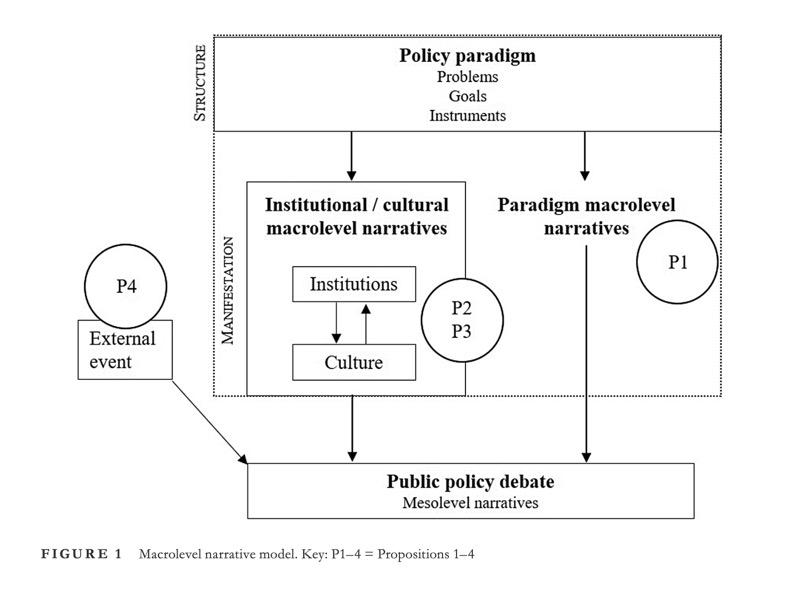
I derive several propositions from this model:
P1: If a policy paradigm is supported (e.g., by political actors, the civil society, the public), positive macrolevel and subsequent mesolevel narratives dominate. If a paradigm is opposed, negative macrolevel and mesolevel narratives dominate.
P2: If a policy paradigm and existing institutions coincide, positive macrolevel and subsequent mesolevel narratives dominate. If a paradigm and institutions do not coincide, that is, if institutional changes have to be made to adjust to a paradigm, negative macrolevel and mesolevel narratives dominate.
P3: If a policy paradigm and existing cultural norms are compatible, positive macrolevel and subsequent mesolevel narratives dominate. If a paradigm and culture are incompatible, that is, if a paradigm leads to incongruence with cultural values or between institutions and culture, negative macrolevel and mesolevel narratives dominate.
P4: Several external factors, including focusing events, can change a public policy debate, that is, mesolevel narratives after an external event may start opposing the macrolevel narratives about a policy paradigm and/or its corresponding institutions and culture.
I applied these developments to child and adult protection policy in Switzerland. I found quantitative and qualitative evidence that macrolevel narratives do, in fact, tell the story of how a policy paradigm affects institutional and cultural settings. I demonstrated that macrolevel narratives affect mesolevel narratives. This will prove useful in future analysis that hopes to determine where mesolevel narratives come from. My analysis also demonstrated how this model can be used as a tool for future standardized empirical research on macrolevel narratives.
I thank Eli Polley for supporting me in the drafting of this blog post.
You can read the original article in Policy Studies Journal at
Stauffer, Bettina. 2023. “ What’s the grand story? A macro-narrative analytical model and the case of Swiss child and adult protection policy.” Policy Studies Journal 51: 33–52. https://doi.org/10.1111/psj.12465.
About the Author

Bettina Stauffer is a research associate for public policy at the Center for Public Management of the University of Bern. Her research focuses on policy making and public policy implementation, particularly in the areas of social and health policy as well as child and adult protection.
 Policy Studies Journal Blog