A Novel Research Method to Detect Punctuation and its Application to Bureaucratic Decision-Making

How can researchers effectively capture shifts in policy over time? Traditionally, political scientists have relied upon conventional index measures to test the Punctuated Equilibrium Theory (PET)—the idea that policy is stable for a long period before erupting into brief moments of radical change (i.e., punctuation). However, traditional approaches to evaluating policy change have received a lot of criticism for being unable to sufficiently measure the magnitude of policy changes and subjectively categorizing stability and punctuation cutoffs. For these reasons, this article proposes a new approach to measuring punctuated policy changes that involves using a statistical model to separate policy stability from punctuation to provide an objective visualization of changes in policy over time. To test this novel approach, the authors apply the framework toward budgetary decisions in both highly bureaucratized and non-bureaucratized local education systems in New York and Texas. By pursuing this methodological innovation, the authors aim to answer this central research question: Do bureaucratized or non-bureaucratized organizations exhibit a more punctuated pattern of budgetary changes?

Methodology

The authors collected instructional spending per pupil in both New York and Texas school districts during 1997-2019. Annual percentage changes in both states’ school districts instructional funding were calculated to measure year-over-year changes. Subsequently, the authors applied a Generalized Method of Moments (GMM) used to differentiate between incremental or routine budget changes and extreme spikes.

Key Findings

New York Bureaucratic School Districts Follow PET Patterns

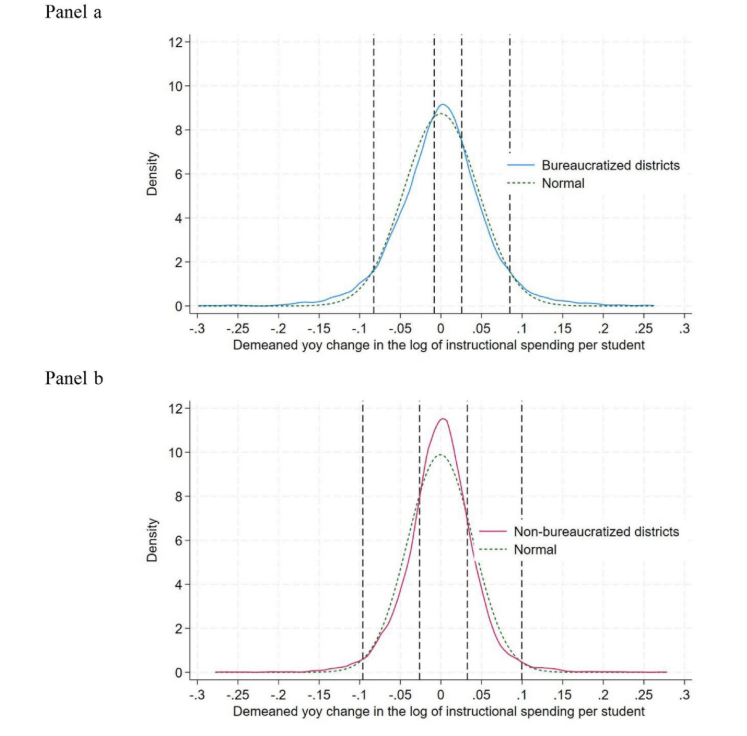
School districts in New York that are considered highly bureaucratic or structurally rigid exhibited occurrences of punctuated changes in spending patterns after periods of stability. As shown in Figure 2, bureaucratic schools correlated with a higher frequency of punctuated budgetary trends compared to non-bureaucratized schools. These dynamics illustrate that spending on instructional expenses in New York school districts align with the theoretical assumptions of PET—overseeing periods of routine stability before institutional frictions create a breaking point of drastic spikes in spending. Ultimately, the patterns indicate that regional institutional frameworks in New York act as facilitators of volatile, punctuated policy shifts.

Figure 2. The distribution of changes in instructional spending per student in New York overlaid with normal distribution. (Panel a) Bureaucratized school districts. (Panel b) Non-bureaucratized school districts.

Spending Patterns in Texas Bureaucratic School Districts are Unstable

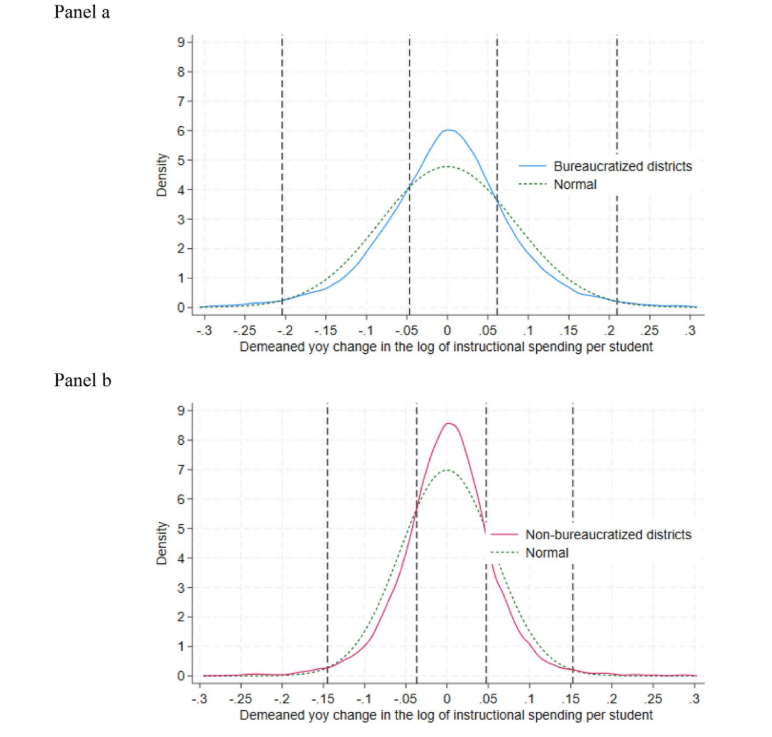
In stark contrast to New York, heavily bureaucratized school districts in Texas display unique budgetary patterns that actively deviate from traditional theoretical assumptions. As shown in Figure 5, bureaucratized school districts in Texas were associated with ongoing instability instead of a long period of stability in budgetary behavior punctuated by rare spikes. This indicates that highly bureaucratic and rigid administrative frameworks do not always maintain routine policies. Instead, the revelations in Texas bureaucratic school districts suggest that intense bureaucratization prompts hyper-reactive administrative environments defined by frequent corrections or revisions to budgetary policies..

Figure 5. The distribution of changes in instructional spending per student in Texas overlayed with normal distribution. (Panel a) Bureaucratized school districts. (Panel b) Non-bureaucratized school districts.

Why It Matters

The investigations in this article illustrate a thoughtful breakthrough to methodologically testing the assumptions of PET. By tailoring methodological standards to specific institutions and objective cutoffs, the authors provide an appropriate template for analyzing and understanding policy changes over a longitudinal period. The findings illuminated in the article emphasize the potency of administrative environments in shaping organizational policy choices affecting important public services such as education. For future research opportunities, the authors recommend exploring the conditions that propel policy fluctuations, with a specific emphasis on the flow of information in bureaucratic settings. Building upon these empirical foundations and research directions will allow policymakers and researchers alike to create strategies that improve decision-making in bureaucratic organizations.

Read the original article in Policy Studies Journal:

Butler, J. S. and Iuliia Shybalkina. 2025. “A Novel Research Method to Detect Punctuation and Its Application to Bureaucratic Decision-Making.” Policy Studies Journal, 53(4): 876–898. https://doi.org/10.1111/psj.70013.

About the Article’s Author(s)

J.S. Butler is an accomplished econometrician, earned his Ph.D. in Economics from Cornell University. Before joining the University of Kentucky Martin School, he taught at Vanderbilt University and Cornell University. His teaching focuses on econometrics and statistics. 

Iuliia Shybalkina is an assistant professor at the Martin School at the University of Kentucky. She holds a Ph.D. in Public Administration from the Maxwell School of Syracuse University. Her research and teaching are centered on local financial administration.

The Impact of Political Attention on Collaborative Environmental Governance Among Municipal Street-Level Bureaucrats

Does the level of attention that politicians direct toward complex environmental problems impact how frontline bureaucrats in municipal settings form relationships? The collaborative interactions among civil servants are a defining feature of environmental governance, drastically shaping how issues are addressed. In this article, the authors incorporate political attention, or the priority status that an issue receives on the political agenda, to analyze how fluctuating attention levels affect the ties created between street-level bureaucrats and the policy outcomes produced. These dynamics are explored within the issue context of flood risk mitigation across municipal civil servant networks in Southern Sweden. Three actor types within municipal administration heavily involved in flood risk mitigation are examined: water & sewage, planning, and politicians and senior managers. By investigating the effects of political attention on collaborative environmental governance, the authors aim to illustrate how policy consequences and relationships at the municipal level are shaped by top-down influences.

Hypotheses

To evaluate the relationships between political attention and collaborative networks, the authors established the following hypotheses:

  1. When political attention is low, water and sewage actors tend to have more ties than each of the other types of actors.
  2. When political attention is high, planners, politicians, and senior-level managers tend to have more ties than each of the other types of actors.
  3. Actors appointed as coordinators tend to have more ties, the stronger the political attention is.

Methodology

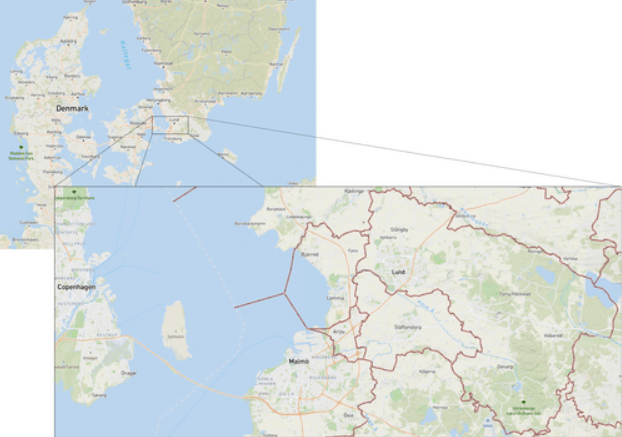
The authors examined three municipalities in Southern Sweden, including Lomma, Lund, and Staffanstorp (as shown in Figure 2), that all exhibited varying degrees of political attention to flood risk mitigation. Three sources of data were utilized in the study, consisting of scientific literature, 143 qualitative interviews with local actors, and a national performance metric of climate adaptation performances by Swedish municipalities. In addition, social network analytical modeling in R was conducted to analyze the relationships between different municipal actors.

Figure 2. The location of Lomma, Lund, and Staffanstorp municipalities in Southern Sweden (developed from Vatten.Atlas.se).

Key Findings

Collaborative Network Dominance Varies by Actor Type and Attention

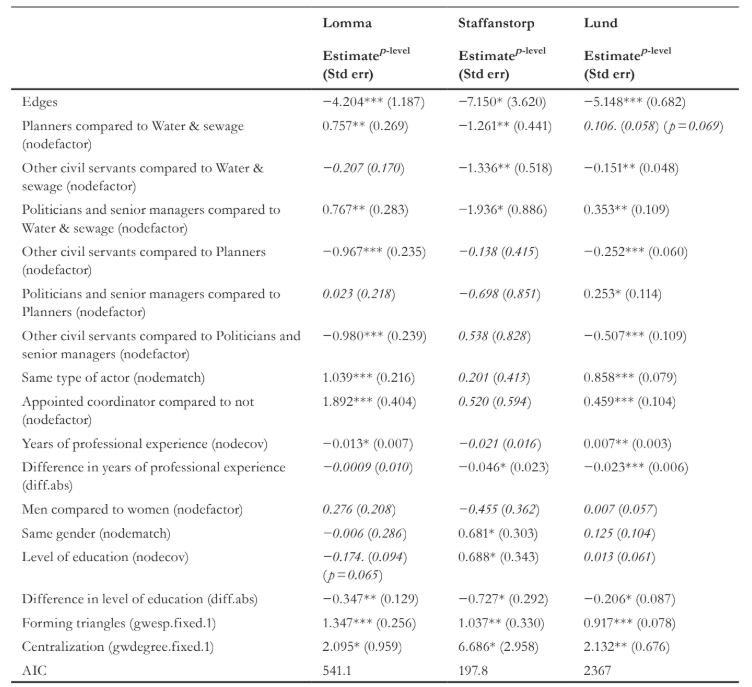
As shown in Table 3 below, the propensity of ties or relationships differ drastically across the examined municipalities. In Staffanstorp, an area of low political attention to flood risk mitigation, water & sewage actors exhibit more ties than any other category. However, in municipalities with high political attention such as Lomma and Lund, planners, as well as politicians and senior managers have more ties compared to water & sewage actors. These dynamics reveal that network collaborations differ by the level of political attention or prioritization that is given to flood risk mitigation issues. Subsequently, this confirms the authors’ two initial hypotheses (H1 & H2), demonstrasting political attention serves as a catalyst for dictating the types of collaborative relationships that develop.

Table 3. Results of hypothesis testing model (including the type of actor, appointed coordinator, gender, level of education, and triangle formation).

Coordinators Act as a Bridge for Developing Network Ties

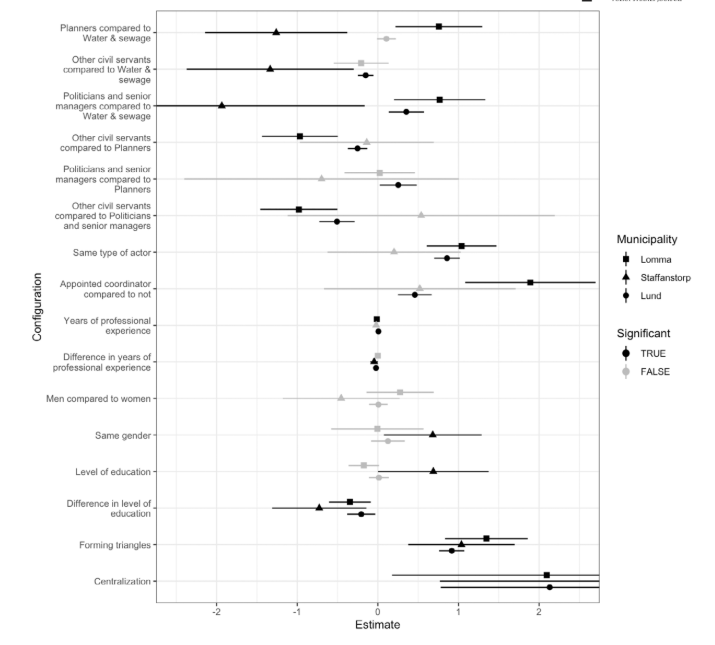
Being an appointed coordinator in a Swedish municipality with high political attention is shown to matter in fostering network ties between street-level bureaucrats. Figure 3 illustrates that in municipalities such as Lomma and Lund with high political attention to flood risk mitigation, coordinators who are appointed are critical to mobilizing different actors. In contrast, in Staffanstorp, the low political attention dynamics correspond to coordinators having no significant impact on their ability to form collaborative relationships. These results indicate that high political attention boosts the success of coordination between actors when an issue is being prioritized. Furthermore, the results imply that politicians’ attention to environmental challenges establishes the issue salience needed for collaborative networks to form and to incentivize cooperation.

Figure 3. Ranges of estimates (+/-2 standard errors) for each configuration in the model per municipality. Ranges crossing zero correspond to the estimate not providing a significant result for the particular municipality, while overlapping ranges in the estimates for a particular configuration connote no significance difference between municipalities.

Why It Matters

The tendencies of street-level bureaucrats or public servants to work together is heavily defined by different environmental and institutional contexts. This article demonstrates that the level of political attention expressed toward complex environmental challenges facilitates varying degrees of network coordination among street-level actors. The described phenomenon signifies that networks are formed on the basis of a shared issue prioritization and preference for collaboration. More importantly, the authors acknowledge that the study could potentially explore additional factors that may influence the development of ties between street-level actors. Nonetheless, the study makes an important contribution to the field of collaborative governance by illuminating the patterns that drive network development in municipal settings.

Read the original article in Policy Studies Journal:

Becker, Per and Örjan Bodin. 2025. “The Impact of Political Attention on Collaborative Environmental Governance Among Municipal Street-level Bureaucrats.” Policy Studies Journal 53(4): 852–875. https://doi.org/10.1111/psj.70020.

About the Article’s Author(s)

Per Becker is Professor of Risk and Sustainability at Lund University, Professor of Leadership and Command & Control at the Swedish Defence University, Extraordinary Professor at North-West University. His research focuses on the systemic interactions between the physical environment, social organization and social behavior in relation to societal safety, security, and sustainability. 

Örjan Bodin is Professor of Environmental and Sustainability Science at Stockholm Resilience Center, Stockholm University, and Visiting Professor at the Swedish Defence University. His research focuses on collaborative environmental governance using a combination of natural and social science methods and perspectives.

The Triangle of Bureaucratic Policy Analysis and the Professional Types of High-Level Civil Servants: Empirical Evidence from Southern Europe

Public policy and public administration research has focused on conceptualizing bureaucrats as pivotal actors in the policymaking process. This has allowed scholars to investigate the capacities and skills of bureaucrats as policymakers and how advice and knowledge inform their behavior. Nevertheless, the literature has proceeded in a fragmented way and without a sophisticated analytical framework that would allow for comparative research. Our recent study aims to address this by proposing a new framework for understanding how high-level civil servants—those at the top of national public administrations—engage in policymaking through the lens of policy analysis.

This study asks a central question: How can we better conceptualize the professional role of senior civil servants in the policy process? To answer this, we developed the “triangle of bureaucratic policy analysis,” which connects three core dimensions of bureaucratic work:

  • Policy Work: What bureaucrats do on a daily basis (e.g., advising, managing, steering).
  • Policy Analytical Capacity: What analytical skills and techniques they use (e.g., economic, legal, statistical).
  • Sources of Information: Where they get their information (e.g., laws, government reports, statistical data).

Figure 1. Triangle of bureaucratic policy analysis.

We applied this framework to a unique dataset: a large survey of 1,014 senior civil servants in the central governments of Greece, Italy, Portugal, and Spain. These countries share a “Napoleonic” administrative tradition and do not typically employ specialized policy analysts, making them ideal cases for examining how policy analysis functions without formal structures.

We used factor analysis to identify patterns in how civil servants combine work, skills, and information. Then, we used principal component analysis (PCA) to cluster these patterns into three main professional “types” of high-level bureaucrats:

  1. Political Generalist: A flexible coordinator and boundary-spanner. These bureaucrats steer ministry activities, interact with politicians and stakeholders, and rely on a broad mix of information sources. They possess “eclectic” analytical capacities—skills gained through both training and professional experience—and play a central role in aligning government priorities across sectors.
  2. Legal Advisor: True to Southern Europe’s legalistic traditions, these civil servants focus on advising political leaders using legal and regulatory tools. Their policy work revolves around assessing legal feasibility, and they rely heavily on juridical sources of information. Their analytical expertise is narrowly focused on legal techniques.
  3. Manager: A newer type, these officials emphasize implementation and results. They are more empirically oriented, favoring evidence-based data and economic analysis. Their policy work includes program management and performance monitoring, reflecting the influence of New Public Management reforms.

Each of these types reflects a different way that bureaucrats contribute to policymaking—one political and strategic, one legalistic, and one managerial.

Image Description

Figure 2. (a) Empirical types of high-level civil servants in Southern Europe: Type 1 (political generalist). (b) Empirical types of high-level civil servants in Southern Europe: Type 2 (legal advisor). (c) Empirical types of high-level civil servants in Southern Europe: Type 3 (manager).

This study contributes to a growing recognition that senior civil servants are more than passive implementers—they are policy actors with distinct analytical profiles. Our “triangle” approach offers a new way to classify and understand how bureaucracies influence policymaking, moving beyond simplistic divides like “generalist vs. specialist” or “bureaucrat vs. politician.” Moreover, these insights are relevant for reform efforts, helping policymakers assess whether administrative roles and skills are well-matched—and whether bureaucrats are being utilized effectively across different policy challenges.

You can read the original article in Policy Studies Journal at

Capano, Giliberto, Alice Cavalieri and Andrea Pritoni. 2025. “The Triangle of Bureaucratic Policy Analysis and the Professional Types of High-level Civil Servants: Empirical Evidence From Southern Europe.” Policy Studies Journal 53(1): 69–90. https://doi.org/10.1111/psj.12577.

About the Article’s Authors

Giliberto Capano is a professor of Public Policy at the University of Bologna, Italy. He specializes in public administration, public policy analysis, and comparative higher education. His research focuses on governance dynamics and performance in higher education and education, policy design and policy change, policy instruments’ impact, the social role of political science, the policy impact of COVID-19, and leadership as an embedded function of policy making. His recent books are A modern Guide to Public Policy (coedited with M. Howlett, Edward Elgar, 2020); Convergence and Diversity in the Governance of Higher Education (coedited with D. Jarvis, Cambridge University Press, 2020); Trajectories of Governance How States Shaped Policy Sectors in the Neoliberal Age (coauthored with A. Zito, J. Rayner, and F. Toth, Palgrave, 2022); The Fate of Political Scientists in Europe (with Luca Verzichellli, Palgrave, 2023). 

Alice Cavalieri is a post-doctoral researcher at the University of Trieste (Italy), where she works on a project about the response of parliaments and governments to different crises. Her main research interests are public budgeting and women’s representation. Her first book, Italian Budgeting Policy (Palgrave Macmillan; 2023), has been awarded the “Pietro Grilli di Cortona” Biannual Prize for the best book published by a member of the Italian Political Science Association. She is a member of the Italian team of the Comparative Agendas Project and former country lead for Italy of the OxCGRT led by the Blavatnik School of Government (University of Oxford).

Andrea Pritoni is an associate professor of Political Science in the Department of Arts at the University of Bologna, where he teaches Electoral Campaigns in Italy and Institutional Relations and Advocacy. His main research interests relate to Italian politics, lobbying and interest group politics, as well as comparative public policy. He has recently published articles on South European Society & Politics (2024), International Review of Administrative Sciences (2024) and European Political Science (2024).

Are bureaucrats’ interactions with politicians linked to the bureaucrats’ policy entrepreneurship tendencies?

by Mariana Costa Silveira, Nissim Cohen, & Gabriela Lotta

Policy entrepreneurs – individuals who seek to shape policy outcomes that they could not otherwise achieve on their own – play a crucial role in the policymaking process. Typical examples of policy entrepreneurs include lobbyists, consultants, and even politicians. Bureaucrats, too, can also be policy entrepreneurs.

Our paper looks at the relationship between bureaucrats’ interactions with other policy actors – specifically politicians, peers, and non-state actors – and how confident the bureaucrats feel about engaging in policy entrepreneurship activities. At a broad level, we know that these interactions impact whether bureaucrats act as policy entrepreneurs, but we don’t have studies that have looked at how these interactions might be related to bureaucrats’ perceptions of their own policy entrepreneurship skills. We also assess how the reputation of a bureaucrat’s organization impacts their self-efficacy. The below research model outlines our hypotheses.

Image Description

Figure 1. Research model.

To test our hypotheses, we used a survey of 2,000 bureaucrats in Brazil taken between October and December 2017 by the country’s National School of Public Administration, of whom approximately 30% completed the survey. The survey asked respondents about their levels of confidence performing different sorts of tasks, their frequency of interactions with actors from different groups (e.g., politicians, private companies, unions, etc.), and their motivations for doing their jobs.

In the course of analyzing the data, we found that the bureaucrats surveyed sorted into three profiles, based on their levels of interactions as well as with whom they interacted: brokers, who have high levels of interactions inside and outside of their organization with both state and non-state actors; insiders, who have high levels of interactions mainly inside their organization, with other state actors; and loners, who have low levels of interactions across all actor types. 

We found that bureaucrats who interacted more regularly with peers and politicians displayed more confidence about their ability to engage in policy entrepreneurship. As far as non-state actors were concerned, we found positive – and statistically significant – relationships as regards interactions with the press and unions, but not statistically significant relationships with other non-state actors, such as private companies. Lastly, bureaucrats’ self-efficacy was also positively correlated with the reputation of their organization. We observed some variation across the three bureaucrat profiles: interactions with politicians were most strongly associated with feelings of self-efficacy among brokers than either insiders or loners. Regarding bureaucrats’ motivations to engage in policy entrepreneurship, we found that both the desire to advance the public good and their own careers were associated with greater policy entrepreneurship self-efficacy. This suggests that public- and self-interest motivations aren’t mutually exclusive, and that both can drive policy entrepreneurship. 

We want to caution that, when it comes to bureaucratic self-efficacy about policy entrepreneurship, we have identified correlations rather than causations. The dataset used for this study does not allow us to conclude whether, for example, frequent interactions with politicians makes bureaucrats more confident about engaging in policy entrepreneurship, or whether those bureaucrats already confident in their abilities as policy entrepreneurs are more likely to seek out interactions with politicians. 

Nevertheless, in identifying these correlations, we draw attention to those factors that likely impact whether – and to what extent – bureaucrats engage in policy entrepreneurship. Our findings suggest that expanding opportunities for bureaucrats to grow their networks and interact with different types of actors – such as politicians and those outside of the government – is important for cultivating policy entrepreneurship among bureaucrats. Ultimately, more research will need to be done to identify the precise causal mechanisms at play. Moreover, our study looked only at bureaucrats in Brazil, so additional case studies will confirm the extent to which our findings are generalizable. 

You can read the original article in Policy Studies Journal at

Silveira, Mariana Costa, Nissim Cohen and Gabriela Lotta. 2024. “ Are Bureaucrats’ Interactions With Politicians Linked to the Bureaucrats’ Policy Entrepreneurship Tendencies?.” Policy Studies Journal 52 (3): 533–559. https://doi.org/10.1111/psj.12536.

About the Authors

Mariana Costa Silveira is a postdoctoral research fellow at the Swiss Graduate School of Public Administration (IDHEAP) at Lausanne University. Her research interests include behavioral public administration, organizational behavior, policy entrepreneurship, and collaborative governance.

Nissim (Nessi) Cohen is a professor of Public Administration and Policy at the University of Haifa. His research interests include interactions between politicians and bureaucrats, public administration reform, street level bureaucracy and policy entrepreneurship.

Gabriela Lotta is an Associate Professor of Public Administration at Fundação Getulio Vargas’s Sao Paulo School of Business Administration. Her current research interests include policy implementation, street-level bureaucracy and bureaucratic politics.


Manifesting Symbolic Representation through Collaborative Policymaking

by Jack Mewhirter, Danielle McLaughlin, & Brian Calfano

Representation is crucial to any collaborative governance arrangement. The makeup of those who participate in collaborative forums impacts not just who “wins” and “loses” in the policymaking process, but also how the public perceives participating organizations. Generally speaking, if citizens feel that their interests and incentives are being represented by those participating in a collaboration, they will hold more positive beliefs toward those organizations involved, a phenomenon referred to as “symbolic representation.” Conversely, a perceived lack of representation can potentially engender distrust and negative perceptions toward participating organizations.

The inclusion of civil society organizations in collaborative policymaking is crucial to making citizens feel represented in collaborative forums. Compared to, for example, business and government stakeholders, civil society organizations tend to be more embedded in local communities and thus more responsive to their wants and needs. Thus, we argue that collaborative policymaking forums that feature high participation from civil society organizations should produce a symbolic effect toward participating organizations for citizens aware of this representation.

We test this hypothesis in the context of the Collaborative Settlement Agreement (or CA) governing policing in Cincinnati, Ohio. Established following the controversial killing of a Black teenager in 2001, the CA created a collaborative forum that brought together the Cincinnati Police Department and civil society organizations to address concerns around policing. The CA is a good case study for our hypothesis because civil society organizations have been well-represented and very active within the forum, using it to bring about numerous reforms to department practices.

To capture respondents most representative of Cincinnati’s urban core, we conducted surveys at several community events in the city of Cincinnati between June and September 2017. We asked respondents about their familiarity with the CA and their subsequent feelings toward the Cincinnati Police Department, anticipating that the two will be positively related (i.e., those who are more knowledgeable about the CA will feel more warmly towards the police). We also asked a number of demographic and personal history questions (e.g., regarding race, age, income, any interactions with police, etc.) to see how such variables might correlate with respondents’ knowledge and attitudes. 

And indeed, we found a strong positive relationship between knowledge about the CA and attitudes towards the police. In our survey we also asked respondents to indicate whether they thought that Cincinnati police officers “looked like” them – otherwise referred to as “passive representation” – and found that those who agreed also felt more positively about the police. Other variables that showed positive correlations included age, employment, and income. 

Our study demonstrates the important role that representation in collaborative policymaking forums can play in how people feel about those who participate in it. The case of the Collaborative Agreement in Cincinnati particularly illustrates how the inclusion of civil society organizations can contribute to feelings of symbolic representation, an important finding in the context of police-community relationships. Our findings point to the need to involve groups with close community ties in collaborative policymaking endeavors, as this will go a long way to securing buy-in and coproduction from the broader population. Our findings also reinforce that passive representation – having participants in forums who “look like you” – can bolster symbolic representation. While the CA is a powerful example of inclusion and representation done well, further studies need to be done to see whether collaborative forums that don’t feature robust involvement from civil society organizations are indeed looked upon less favorably. Furthermore, our study took for granted that citizens feel represented by civil society organizations, but this assumption requires empirical testing as well. 

You can read the original article in Policy Studies Journal at

Mewhirter, Jack, Danielle McLaughlin, and Brian Calfano. 2024. “Manifesting Symbolic Representation Through Collaborative Policymaking.” Policy Studies Journal, 52(2): 283–318. https://doi.org/10.1111/psj.12525.

About the Authors

Jack Mewhirter is an Associate Professor in the Baker School of Public Policy and Public Affairs at the University of Tennessee. His research assesses the origins, implementation, and impacts of public policies meant to address complex social problems. This work is done in various contexts, including environmental, health and policing policy. 

Danielle M. McLaughlin is an Assistant Professor in the Department of Political Science at Kent State University. Her research focuses on the impact of institutions in solving collective action problems, mainly in the context of environmental policy issues.

Brian Calfano is a Professor at the University of Cincinnati. His research focuses on media and politics, religion and politics, and community engagement with local government. 

Race, Representation, and Policy Attitudes in U.S. Public Schools

by Lael A. Keiser & Donald P. Haider-Markel

Tragic events around the country highlight the disproportionate ill-treatment of African Americans within the criminal justice system, the high levels of distrust African Americans have for the police and political institutions in general, and the lack of racial and ethnic diversity in public institutions. In response, some have sought to increase the passive or descriptive representation of minorities within law enforcement, higher education, and public schools, with the hope that doing so will improve the treatment of under-represented groups and enhance positive attitudes toward institutions and the policies they implement. 

However, different schools of thought exist about whether increasing representation of minorities is a zero-sum game (where increasing representation of one group reduces it for others) and whether it worsens attitudes of historical majorities. Further, while scholars have discussed two major perspectives – the mirror image and the institutional democracy hypotheses – few have measured passive representation in ways that fit these two perspectives or examined their implications for both minority and majority groups. 

According to the theory of symbolic representation, greater passive representation can evoke feelings of inclusiveness and of being represented which, in turn, impacts public attitudes toward policy and public institutions. Two distinct and competing mechanisms connect this passive representation with citizen attitudes. One argument, described as the “mirror image” hypothesis, is that a person’s support for government institutions depends, in part, on whether people within those institutions “look like” that person. The institutional symbol of democracy perspective, on the other hand, posits that support for public institutions depends on whether the institution reflects the population as a whole. 

In our paper, we test both of these hypotheses by examining passive representation in public schools and attitudes about school discipline using different measures of passive representation that better map onto existing theory. Using individual-level survey data from the Education Longitudinal Study of 2002 (ELS), we analyze a sample of 5,750 white, Black, and Hispanic 10th-grade students across 453 high schools who were asked their perspectives on the fairness of school rules and whether they felt the rules were implemented in a uniform manner across all students. We utilize three distinct measures of passive representation, as illustrated below.

Our results were more consistent with the institutional symbol hypothesis, where more diverse school personnel corresponded with more positive attitudes about how institutions implement policy among white students. White students in schools with a higher proportion of minority teachers (and therefore fewer white teachers) were more likely to think punishment is fair than were white students in schools with less passive representation for minorities. This finding provides evidence that increasing the number of minority teachers may not always be considered a zero-sum context.  However, we do find evidence in support of the mirror image hypothesis for Black students who were more likely to think punishment was fairer when their percentage representation was greater but we find no evidence that attitudes were affected by representation measured by diversity or proportional representation.  We find inconsistent results for Hispanic students. 

However, our results suggest some important caveats. Though our analysis indicated that white students’ attitudes toward fairness were greater in schools with higher percentage representation of minorities, this was largely only the case in schools with smaller minority student populations. We found no evidence that white students’ attitudes varied with differences in proportional representation. This suggests that the positive link between minority representation and whites’ attitudes was strongest when in schools with relatively small minority student shares.

And perhaps more importantly, our results highlight how the use of different measures of representation, as well as of distinct statistical models, can lead to dissimilar results. This calls attention to the assumptions researchers implicitly make about theory when they choose measures of representation and calls us to both specify the theoretical mechanisms at play and to match them to theory so that we can improve our understanding of how passive representation truly affects policy attitudes. 

You can read the original article in Policy Studies Journal at

Keiser, Lael R., Donald P. Haider-Markel, and Rajeev Darolia. 2022. “Race, Representation, and Policy Attitudes in U.S. Public Schools.” Policy Studies Journal, 50(4): 823–848. https://doi.org/10.1111/psj.12443

About the Authors

Lael R. Keiser is professor and director of the Harry S. Truman School of Government and Public Affairs. Her research and teaching focuses on the policy implementation and the administration of public programs. She serves on the editorial boards of Public Administration Review and the Journal of Public Administration Research and Theory.

Donald P. Haider-Markel is Professor of political science at the University of Kansas. His research and teaching are focused on the representation of group interests in politics and policy, and the dynamics between public opinion, political behavior, and public policy.

More than Agents: Federal Bureaucrats as Information Suppliers in Policymaking

by JoBeth S. Shafran

Despite the widespread notion of federal bureaucrats as implementers of congressional will, their role in the policymaking process extends far beyond. Traditionally understood through the lens of principal-agent theory, bureaucrats act as agents to their principal, Congress, executing and implementing legislative directives without much influence on policy shaping. However,  bureaucrats are also key information suppliers to Congress. In this paper, I explore the conditions that enable bureaucrats to become influential contributors who define problems and propose solutions during legislative discussions.

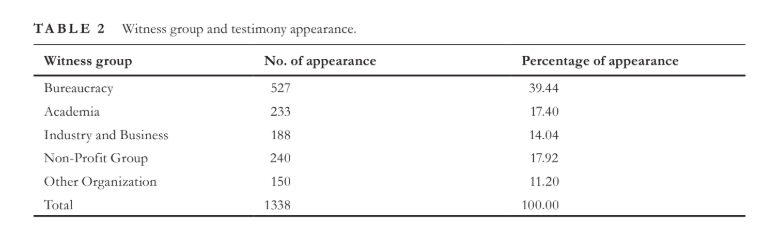
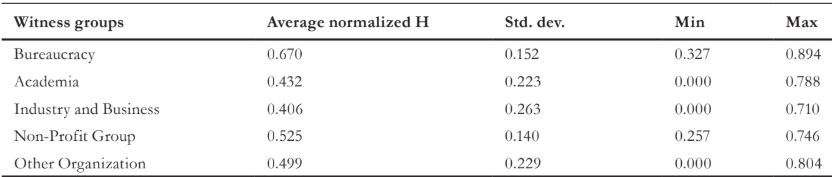
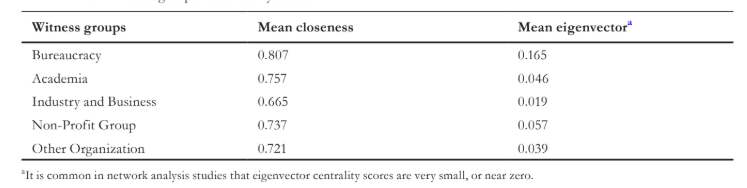
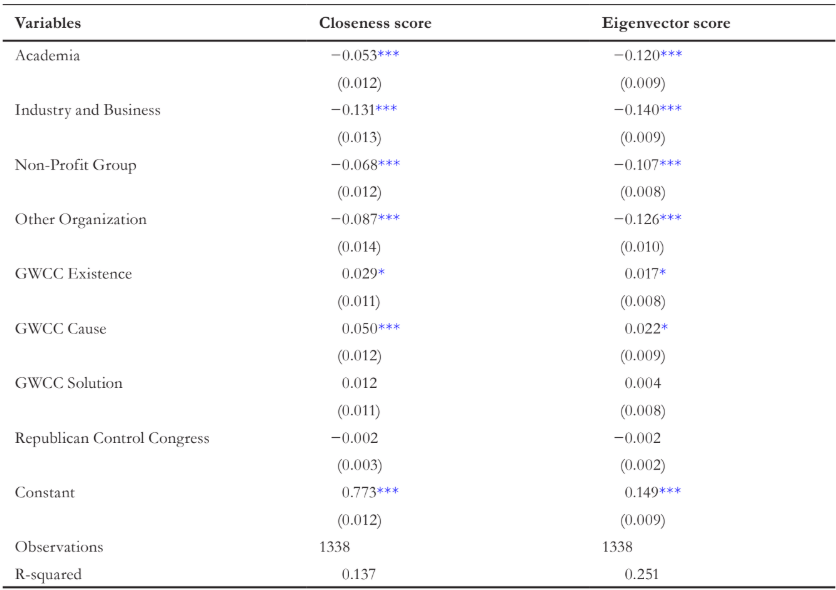
Policymakers, constrained by limited resources, time, and attention, selectively rely on key information sources. Certain political elites, such as bureaucrats and interest groups, are actively invited to participate in policy making, while others remain on the periphery. Congress delegates the tasks of information processing and knowledge accumulation to the bureaucracy in return for neutral expertise. As such, I argue that the information asymmetry, wherein bureaucrats hold specialized knowledge not readily available to legislators, can be strategically leveraged by Congress. Bureaucrats are more likely to testify at congressional hearings under three conditions: when alternative information sources are scarce; when their expertise is essential for committee tasks, such as agency oversight; and when their input can help manage diverse committee workloads. 

Focusing on congressional hearings across three policy domains—domestic commerce, energy, and health—from 1995 to 2010, I examine approximately 4,700 hearings and more than 33,000 testimonies. Given the count nature of the dependent variable (a count of bureaucrats testifying at a given hearing), I employ negative binomial regressions to examine the factors influencing the prevalence of bureaucrats among witnesses, such as the type of committee and the agenda of the committee.  

The findings reveal that bureaucrats are more likely to be called as witnesses when committees face limited access to alternative expert sources and when the information bureaucrats provide is directly relevant to the committee’s legislative goals. As indicated in the figure below, I find a higher reliance on bureaucratic testimony when committees address a broader scope of issues, which implies that bureaucrats’ ability to process information is valued in diverse legislative environments. 

Figure 5. Predicted number of careerist bureaucrats testifying at constituency, policy, and power committees as agenda diversity increases, 1995-2010

Additionally, the findings show that bureaucratic testimony is more prevalent in policy areas characterized by lower public engagement and high technical complexity, such as energy policy. Conversely, in domestic commerce, where multiple stakeholders are involved and information is abundant, bureaucrats are less likely to dominate the testimony. This study enhances our understanding of bureaucratic expertise and knowledge in the legislative process. Bureaucrats do more than implement policy–they actively shape it through information provision in policy debates. 

You can read the original article in Policy Studies Journal at

Shafran, JoBeth S. 2022. “More than Agents: Federal Bureaucrats as Information Suppliers in Policymaking.” Policy Studies Journal, 50(4): 921–943. https://doi.org/10.1111/psj.12455

About the Author

JoBeth S. Shafran is an assistant professor at Western Carolina University, where she teaches public policy courses for both the Political Science and Master of Public Affairs programs. Her research focuses on information processing in Congress and the federal bureaucracy. Her work has been published in Policy Studies Journal and Cognitive Systems Research, among others.