
How can researchers effectively capture shifts in policy over time? Traditionally, political scientists have relied upon conventional index measures to test the Punctuated Equilibrium Theory (PET)—the idea that policy is stable for a long period before erupting into brief moments of radical change (i.e., punctuation). However, traditional approaches to evaluating policy change have received a lot of criticism for being unable to sufficiently measure the magnitude of policy changes and subjectively categorizing stability and punctuation cutoffs. For these reasons, this article proposes a new approach to measuring punctuated policy changes that involves using a statistical model to separate policy stability from punctuation to provide an objective visualization of changes in policy over time. To test this novel approach, the authors apply the framework toward budgetary decisions in both highly bureaucratized and non-bureaucratized local education systems in New York and Texas. By pursuing this methodological innovation, the authors aim to answer this central research question: Do bureaucratized or non-bureaucratized organizations exhibit a more punctuated pattern of budgetary changes?
Methodology
The authors collected instructional spending per pupil in both New York and Texas school districts during 1997-2019. Annual percentage changes in both states’ school districts instructional funding were calculated to measure year-over-year changes. Subsequently, the authors applied a Generalized Method of Moments (GMM) used to differentiate between incremental or routine budget changes and extreme spikes.
Key Findings
New York Bureaucratic School Districts Follow PET Patterns
School districts in New York that are considered highly bureaucratic or structurally rigid exhibited occurrences of punctuated changes in spending patterns after periods of stability. As shown in Figure 2, bureaucratic schools correlated with a higher frequency of punctuated budgetary trends compared to non-bureaucratized schools. These dynamics illustrate that spending on instructional expenses in New York school districts align with the theoretical assumptions of PET—overseeing periods of routine stability before institutional frictions create a breaking point of drastic spikes in spending. Ultimately, the patterns indicate that regional institutional frameworks in New York act as facilitators of volatile, punctuated policy shifts.
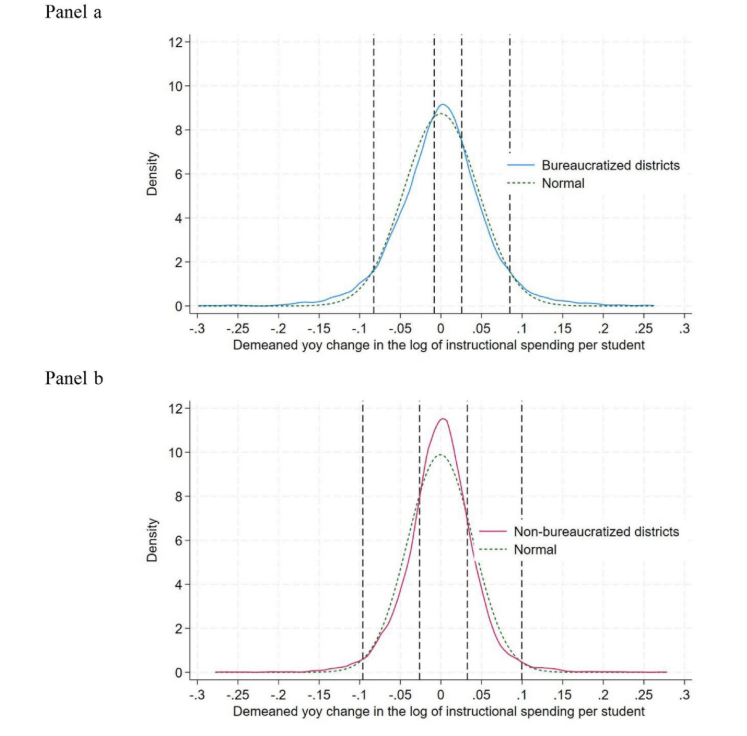
Figure 2. The distribution of changes in instructional spending per student in New York overlaid with normal distribution. (Panel a) Bureaucratized school districts. (Panel b) Non-bureaucratized school districts.
Spending Patterns in Texas Bureaucratic School Districts are Unstable
In stark contrast to New York, heavily bureaucratized school districts in Texas display unique budgetary patterns that actively deviate from traditional theoretical assumptions. As shown in Figure 5, bureaucratized school districts in Texas were associated with ongoing instability instead of a long period of stability in budgetary behavior punctuated by rare spikes. This indicates that highly bureaucratic and rigid administrative frameworks do not always maintain routine policies. Instead, the revelations in Texas bureaucratic school districts suggest that intense bureaucratization prompts hyper-reactive administrative environments defined by frequent corrections or revisions to budgetary policies..
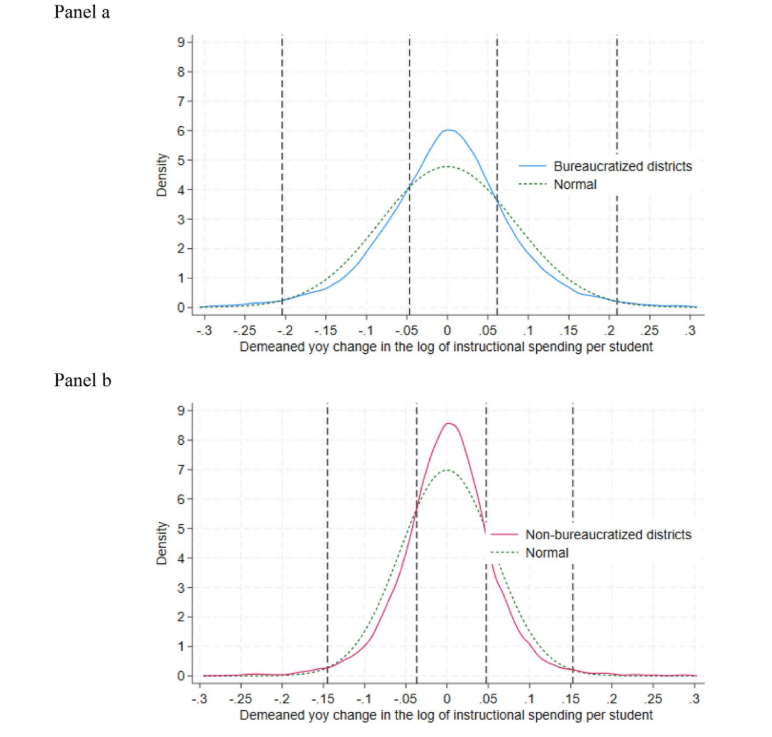
Figure 5. The distribution of changes in instructional spending per student in Texas overlayed with normal distribution. (Panel a) Bureaucratized school districts. (Panel b) Non-bureaucratized school districts.
Why It Matters
The investigations in this article illustrate a thoughtful breakthrough to methodologically testing the assumptions of PET. By tailoring methodological standards to specific institutions and objective cutoffs, the authors provide an appropriate template for analyzing and understanding policy changes over a longitudinal period. The findings illuminated in the article emphasize the potency of administrative environments in shaping organizational policy choices affecting important public services such as education. For future research opportunities, the authors recommend exploring the conditions that propel policy fluctuations, with a specific emphasis on the flow of information in bureaucratic settings. Building upon these empirical foundations and research directions will allow policymakers and researchers alike to create strategies that improve decision-making in bureaucratic organizations.
Read the original article in Policy Studies Journal:
Butler, J. S. and Iuliia Shybalkina. 2025. “A Novel Research Method to Detect Punctuation and Its Application to Bureaucratic Decision-Making.” Policy Studies Journal, 53(4): 876–898. https://doi.org/10.1111/psj.70013.
About the Article’s Author(s)

J.S. Butler is an accomplished econometrician, earned his Ph.D. in Economics from Cornell University. Before joining the University of Kentucky Martin School, he taught at Vanderbilt University and Cornell University. His teaching focuses on econometrics and statistics.

Iuliia Shybalkina is an assistant professor at the Martin School at the University of Kentucky. She holds a Ph.D. in Public Administration from the Maxwell School of Syracuse University. Her research and teaching are centered on local financial administration.

