Building Street-Level Capacity: Evidence From a Policy for Problem Gambling Prevention

How are problem-gambling prevention policies actually implemented at the street-level? Although policies may appear clear on paper, frontline workers must constantly consider how to apply them in unpredictable, real-world settings. This article further explores these dynamics, specifically examining how policies related to problem gambling prevention were implemented in Turin, Italy, under the 2021 “Time is Money” project. In addition, this article also analyzes how frontline workers develop “policy capacity”, or competencies and skills needed to implement these policies on the ground. To guide this investigation, the authors ask the following questions: How do operators use their margin of discretion to redesign policy during implementation? Does this process imply the development of individual analytical policy capacities at the street level?

Theoretical Expectations

The authors outline the following expectations in their study:

  1. Street-level bureaucrats (SLBs) prioritize understanding policy problems through direct experience and real-time problem-solving.
  2. Policy capacities matter in environments wherein frontline workers have high discretion levels and must constantly redesign rules/policies.

Methodology

To gather relevant data, the authors use a three-phase qualitative, longitudinal case-study design in Turin, Italy. First, scientific publications, literature and related documents were reviewed to improve understanding of gambling policies at the local, national, and international levels. Second, the authors conducted semi-structured interviews with key informants involved in the “Time is Money” project to learn more about the creation and implementation of the project. Third, an ethnographic approach was pursued, involving participant observation in at least three gambling venues over the course of four months, to observe the interactions between the operators (SLBs) and gamblers.

Key Findings

An Intensive Process of Policy Divergence and Re-Design

During their time spent observing policy implementation, the authors noticed a series of transformations in the policy. What was written on paper was not exactly how things were going in practice. This phenomenon known as “policy divergence” was highlighting something more: a process of so-called “re-design”. In other words, frontline workers were adapting the “original” policy to concrete, unexpected problems. To do so, they were using their experience and expertise. With small adjustments, trial and error, and reflective effort, the implementers applied small (but important) changes to the policy, trying to achieve a better fit to the goals. The article discusses in detail some of these adaptive strategies (i.e.: hooking, bargaining, termination, conversation) that helped implementers establish relations of shared trust with gamblers, aimed at risk-prevention and damage-control.

The Development of a Distinct Kind of Analytical Capacity at the Street-Level

Observing the process of re-design, the authors noticed that the adaptive strategies didn’t come to be during the early stages of implementation, but later on. At first, frontline workers tried going by the book, but over time they introduced small changes as they gained more experience. The authors interpreted this as evidence of distinct kinds of capacity being developed. Previous studies have shown that designing “on paper” an effective policy requires analytical capacities (the skills to understand a problem and picking the best solution). This article suggests that similar processes occur during frontline implementation. Like policy design, policy “re-design” requires a specific set of skills. Although they take different forms, these frontline skills serve the same purpose: identifying effective solutions to real-world problems. The article illustrates how these capacities develop in practice: workers identify problems and reflect on possible responses, test creative solutions, and evaluate feedback on what works.

Why It Matters

These findings have a series of practical implications for policymaking. First, the article shows that policy divergences do not necessarily indicate inappropriate design, nor excessive discretion among frontline workers. On the contrary, for policies addressing complex social problems (like problem-gambling), divergence is a space for creative problem-solving and an opportunity for learning. Second, leveraging these opportunities requires specific capacities. While the article shows how such skills can be developed autonomously, this process requires an amount of time and effort that is not always granted in every public program. More research is needed on how these capacities can be taught, shared, and transferred. Third, the findings broaden our understanding of the skills and competencies required by policymakers (policy capacities). Some of these capacities (like the analytical ones) can manifest in different, unexpected forms and places. Regardless of where, when, and how they emerge, such capacities appear to complement each other in supporting policy success.

Read the original article in Policy Studies Journal:

Aimo, Niccolò and Federico Cuomo. 2025. “Building Street-level Capacity. Evidence From a Policy For Problem Gambling Prevention.” Policy Studies Journal 53(4): 1045–1064. https://doi.org/10.1111/psj.70005.

About the Article’s Author(s)

Niccolò Aimo acquired a Ph.D. in Urban and Regional Development at the Polytechnic University of Turin following his master’s degree in Political Science at the University of Turin. He is a senior researcher in policy analysis and evaluation for IRES Piemonte and has conducted research abroad at the University of Lisbon (ULisboa). His research focuses on various aspects of sub-national policymaking, with a particular emphasis on the local implementation of European-funded programs, social policies, gambling regulation, sustainability, and workfare. 

Federico Cuomo obtained a Ph.D. in Innovation for the circular economy at the University of Turin after graduating in Political Science. At the same time, he worked within the European Funds and Innovation Office of the City of Turin. He carried out research stays at the University of Amsterdam (UvA), the Centre for Social Sciences in Budapest, the Universidad Autonoma de Madrid (UaM) and the University of Antwerp (UAntwerp). His research interests range from the analysis of urban experimentations and collaborative governance arrangements to the evaluation of environmental and healthcare policies. Currently, he is a postdoctoral researcher in policy analysis at the University of Turin and IRES Piemonte.
How to Talk about Crises? Leaders’ Narrative Strategies During the COVID-19 Vaccination Campaign in Italy and France

During a crisis, narratives matter as they allows us to make sense of an unpredictable situation and navigate urgency. The COVID-19 pandemic showed that the type of narratives and communication strategies used fundamentally shaped public opinion toward governmental efforts aimed at mitigating the virus. This article examines the role of narrative strategies utilized by France and Italy during the pandemic; focusing on the vaccination campaigns in both countries, to see how political leaders processed and framed both pandemic-related issues and recommended solutions. Furthermore, to track how narrative strategies and patterns in both countries developed over time, the authors applied the Narrative Policy Framework (NPF) and an analytical typology that examines evidence versus emotion, as well as gain versus loss framing.

Hypotheses

The authors established several theoretical expectations to study changes in narrative strategies during crisis.

  1. Evidence-based strategies will only be preferred over emotion-based arguments when sound information is available; evidence-based strategies are less likely to appear in earlier stages of a crisis.
  2. Evidence-based strategies are more likely to be implemented when leaders have a scientific or technical background.
  3. Decision-makers will try to extensively utilize gain-framed messaging in their narrative strategies given the social acceptability of positive communication.
  4. The propensity of loss-framed messaging may increase when gain-framed strategies are ineffective or the desired outcomes need to be accelerated.

Methodology

The authors examined a total of 22 documents (13 Italian and 9 French) that included speeches and press releases from government leaders and Health Ministers in both Italy, as well as France. These documents were selected from 2021, encompassing the first phases of vaccination campaigns pursued by the French and Italian governments. Moreover, the authors utilized Discourse Network Analyzer (DNA) software to code for narratives present in the collected documents.

Key Findings

Who are the Heroes and Villains of the Pandemic?

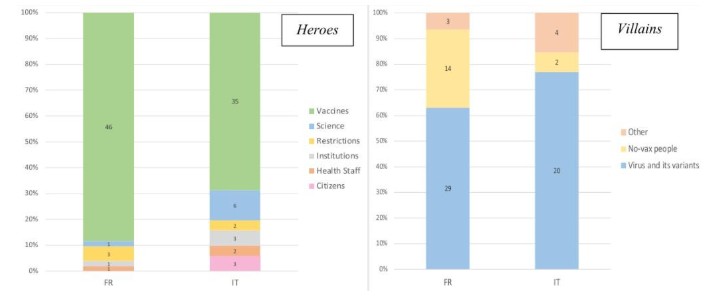
Figure 2 shows that in the majority of cases and in both countries, vaccines were narrated as the “heroes” of the story, alongside restrictive measures and health staff—with science also featuring as a “hero”, though only in the Italian case. The distribution of “heroes” is notably similar across the two countries. The more meaningful differences emerge on the “villains” side: while COVID-19 and its variants feature as the primary “villain” in both countries, no-vax people appear far more frequently as “villains” in the French case than in the Italian one. These patterns indicate that while France and Italy broadly share the same “heroic” narratives around vaccines, French leaders were considerably more inclined to cast unvaccinated individuals in an antagonistic role—a finding consistent with the greater use of loss-framed and scaring tactics observed in the French narrative strategies more broadly.

Figure 2. Heroes and Villains in the French and Italian Narratives.

France and Italy Used Different Narratives Strategies Over Time

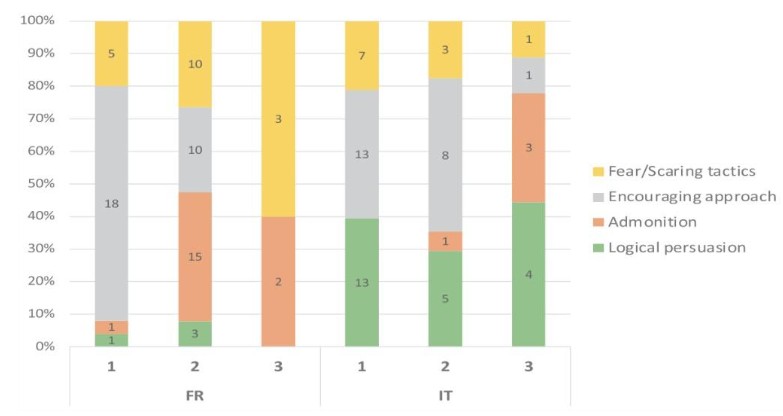
As illustrated in Figure 6, during Phase 1 of the vaccination campaign, both France and Italy utilized encouraging narrative approaches to build trust; this was more pronounced in France whereas Italy employed a mixture of an encouraging approach and logical persuasion. However, across Phases 2-3, the narrative strategies began to diverge in both countries as France resorted toward admonition and scaring practices, whereas Italy balanced admonition with gain-framed types of narratives (i.e., logical persuasion and an encouraging approach). These findings indicate that France was more likely to depend on alarmist and emotional narrative tactics to increase vaccination rates, whereas Italy pursued a more technical, deliberative approach.

Figure 6. Narrative Strategies by Country and Phase.

Why It Matters

This article reveals that narratives are not simply “talk”, but represent strategic tools applied to shape public acceptance toward restrictive policies. By focusing on France and Italy as empirical cases of COVID-era narratives, the study illuminates how political leaders in different national settings communicated with the public during a time of crisis. The authors encourage future research to apply their typological framework to other crises, such as climate change mitigation, to determine whether evidence-based or emotion-based strategies are employed in different policy contexts. Understanding these narrative patterns can help future political leaders select communication strategies that mediate compliance and institutional trust.

Read the original article in Policy Studies Journal:

Mastroianni, Laura and Stefania Profeti. 2025. “How to Talk About Crises? Leaders’ Narrative Strategies During the COVID-19 Vaccination Campaign in Italy and France.” Policy Studies Journal 53(4): 994–1013. https://doi.org/10.1111/psj.12585.

About the Article’s Author(s)

Laura Mastroianni is a Postdoctoral Research Fellow in Public Policy at the University of Bologna, Department of Political and Social Sciences. 

Stefania Profeti is Associate Professor in Political Science at the University of Bologna, Department of Political and Social Sciences.

Indirect Restrictions Demobilize Supporters of Abortion Rights

Abortion rights remain a high-stakes issue in American politics, provoking a lot of moral debate and public reactions. Since the landmark ruling in Dobbs v. Jackson (2022), several states have added more restrictions on abortion access. Researchers have found that public opinion shapes state policies on abortion, but it is not clear how citizens judge indirect restrictions on abortion rights. To investigate this phenomenon, this study examines how people’s judgments and political mobilization depends on whether the restrictions are indirect, such as defunding services, compared to direct, such as complete bans on abortion.

Hypotheses

The authors test two hypotheses to determine how the type and framing of abortion restrictions influence people’s judgments:

  1. Demobilization Hypothesis: Indirect restrictions demobilize abortion supporters by inciting less opposition compared to direct bans or restrictons.
  2. Exclusion Framing Hypothesis: Pro-choice (abortion) supporters will express greater opposition toward exclusion restrictions (indirect restrictions framed as direct) compared to direct restrictions.

Methodology

Two experiments were conducted in 2015 and 2016 with participants from the United States. In the first experiment, participants read one of three policy conditions: banning, defunding, or excluding. Then participants answered how much they support or oppose the policy, and their willingness to participate in politics to express their views. The second experiment replicated the prior design, except provided participants with a statement indicating the substantial number of women who would be deprived of abortion services because of the restriction, holding constant the number of women who would be affected across the three types of policy.

Key Findings

Pro-Choice Supporters Oppose Banning more than Defunding

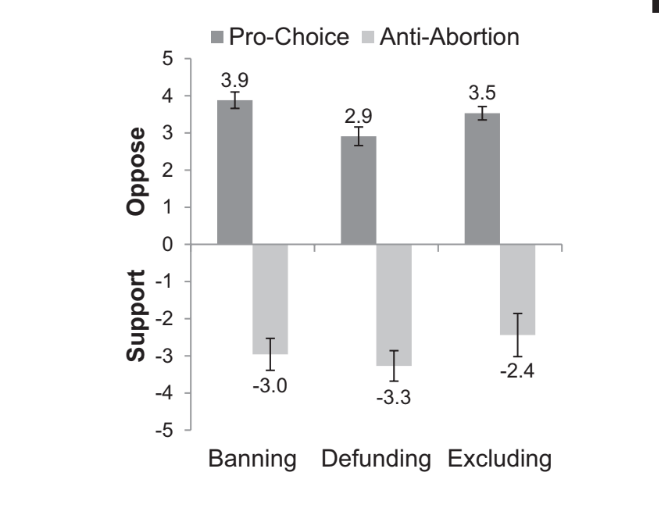
Figure 1 from Experiment 1 reveals that pro-choice supporters expressed less opposition to policies defunding abortion services than to outright bans. Pro-choice supporters also opposed exclusion policies more than defunding policies. These patterns support the demobilization hypothesis, indicating that indirect restrictions reduce public and political opposition compared to direct restrictions. This finding suggests that subtle differences in policy design and framining could bypass mobilized opposition.

Figure 1. Participants’ judgments of abortion restrictions by abortion stance and policy type, Experiment 1. Error bars are standard errors. The sample sizes for the pro-choice groups were: banning n=104, defunding n=117, and excluding n=111. For the anti-abortion group, they were: banning n=43, defunding n=45, and excluding n=33.

Consequences Do Not Overcome Demobilization

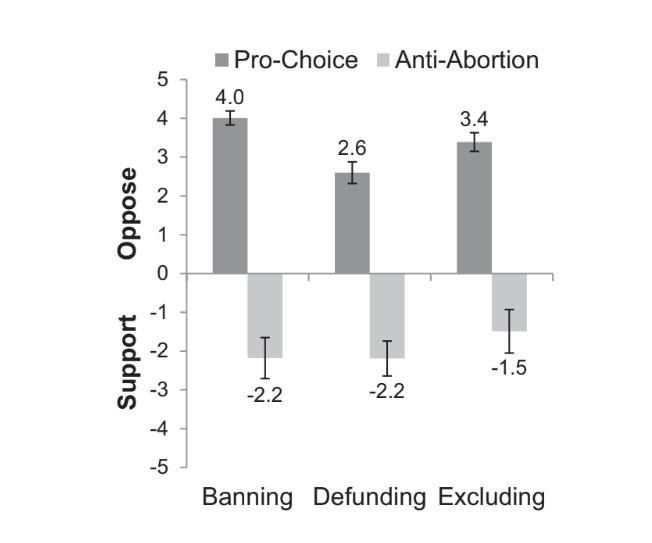
Experiment 2 replicated the findings while holding constant the number of women who would be affected. Figure 2 shows that pro-choice participants opposed defunding abortion less than a complete ban, despite the fact that both policies prevented the same number of women from receiving abortion access. Even when participants knew the consequences, pro-choice supporters were still less opposed to the indirect restriction. The findings also demonstrated that pro-choice supporters opposed exclusionary policies less than direct bans. People’s judgements of restrictions depended on the framing of the policy, particularly how direct the restriction appeared.

Figure 2. Participants’ judgements of abortion restrictions by abortion stance and policy type, Experiment 2. Error bars are standard errors. The sample sizes for the pro-choice groups were: banning n=103, defunding n=94, and excluding n=1-3. For the anti-abortion group, they were: banning n=40, defunding n=49, and excluding n=39.

Why It Matters

This study shows that people’s judgments of abortion restrictions depend on how directly they prevent abortion, determining their willingness to politically mobilize in response. For policymakers and political activists, the takeaway is clear: the directness of the policy, in design and framing, will determine how much people support and oppose those restrictions. As for future research, the authors call for more attention to the psychology of indirect restrictions to better understand public opinion on abortion rights and how state legislatures may seek to minimize opposition.

Read the original article in Policy Studies Journal:

Connors, Elizabeth C., Alessandro Del Ponte, and Peter DeScioli. 2025. “Indirect Restrictions Demobilize Supporters of Abortion Rights.” Policy Studies Journal 53(4): 1123–1137. https://doi.org/10.1111/psj.12575.

About the Article’s Author(s)

Elizabeth C. Connors is an associate professor in the Department of Political Science at the University of South Carolina. 

Alessandro Del Ponte is an assistant professor in the Department of Political Science at the University of Alabama, a Visiting Research Professor at the Global Asia Institute at the National University of Singapore, and a Visiting Assistant Professor at the Smith Institute for Political Economy and Philosophy at Chapman University.

Peter DeScioli is an associate professor in the Department of Political Science at Stony Brook University.