In public policy, we are often interested in attention and participation, and even more specifically in the concentration of attention and participation: are policymakers paying attention to many different issues, or are they focused on one main problem? Is one set of interests dominating a particular conversation or institution or are multiple interests able to have input in making decisions? These questions are important because they speak directly to many of the big ideas at the heart of studying public policy: power, representation, and governing capacity.
Policy process scholars have used a few different measures of concentration to answer these questions over the past several decades. The Herfindahl-Hirschman Index or HHI, was used by economists to measure market concentration; policy scholars used it to measure the clarity of legislative committee jurisdictions (Frank Baumgartner, Bryan Jones, and Michael MacLeod), policy coherence (Peter May, et al.), and the spread of attention in local government agendas (Brooke Shannon), among many other applications.
In 2014, Amber Boydstun, Shaun Bevan, and Herschel Thomas published an article in PSJ comparing the HHI to Shannon’s H, which traditionally measures information entropy or the relative degree of uncertainty about different possible states of being. Boydstun, Bevan, and Thomas found that Shannon’s H outperformed HHI, and Shannon’s H was quickly adopted as the new measure of choice for the relative concentration or spread of attention and participation, including the relative spread of policy target populations (Catherine Chen, Tanya Heikkila, and numerous co-authors), the breadth of issues on which interest groups devote attention (E.J. Fagan, Zac McGee, and Herschel Thomas), the variety of organizations engaged in coalitional lobbying (Maraam Dwidar), and the concentration (or lack thereof) of policymaker attention on Twitter (Annelise Russell).
In my new PSJ research note, I introduce a new set of measures: richness and evenness. From my own experience, I often found that Shannon’s H was highly correlated with a simple count of the number of different issues or groups represented. In my research note, I show that across a number of different datasets, the correlation between Shannon’s H and simple counts of observations can range between 0.74 and 0.97. So perhaps we can use simple counts as measures. But doing so would lose the key piece of information that speaks to questions of power and representation: the concentration or breadth of observations.
Population ecologists often are interested in the same question (albeit for species and not issues or organized interests), and have developed methods to show both the richness (count of observations) on the x-axis and evenness across observations on the y-axis of a plot. A few different evenness measures are available, and they are all fairly simple to implement and calculate either in a spreadsheet or using software like R and Stata.
As I write in my research note, the advantage of having two measures plotted against each other is that we can more precisely note differences across categories in our data. Depending on what the richness-evenness plots look like, we could even identify some trends or dynamics that Shannon’s H might otherwise hide. The plot below, for example, shows a comparison of the spread of issue attention in U.S. presidents’ State of the Union addresses (from Policy Agendas Project data) using Shannon’s H on the left and a richness-evenness plot on the right, the two plots tell different stories.
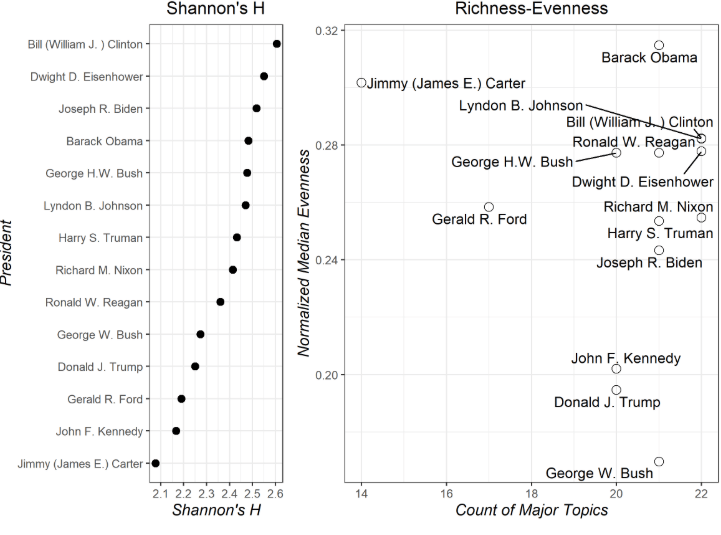
And depending on our data, we can separately trace trends in richness and evenness over time. We can therefore better understand whether changes we see in a particular issue area or institution reflect expansion or contraction of the issue agenda, shifts in attention within an unchanging issue space, or both. My hope is that richness-evenness measures and plots open up new questions for us to consider and help us re-examine what we think we know about dynamic policy processes.
Read the original article in Policy Studies Journal:
Lewallen, Jonathan. (2026). “Big & Rich: A New Way to Measure Attention and Participation Diversity.” Policy Studies Journal 54(1): e12593. https://doi.org/10.1111/psj.12593.
About the Article’s Author(s)

Jonathan Lewallen is an associate professor of political science at the University of Tampa. His research focuses on agenda setting and the policy process, and how issues and institutions evolve together over time.