
How does the itinerary of topics that the government chooses to focus on change over time at the local level? The everyday life of citizens has been directly impacted by decisions made at the local level, with the issues being spotlighted on the agenda reflecting local priorities. Scholarship has understudied the development of policy agendas at the local-level, displacing focus on the interactions between federal and state-level activities. This article looks to examine long-term changes in local policy agendas by focusing on policy developments within the city of Austin, Texas, and how local agenda dynamics are influenced by national-level agendas, population shifts, and institutional changes.
Hypotheses
The authors test the theoretical argument that local policy agendas will expand in response to changes in national-level agenda(s), local population growth, and institutional reforms.
Methodology
City council meeting minutes in Austin, Texas were analyzed using a 120-year sample of agenda items from 1900 to 2020. These meeting minutes were content-coded using the Austin Agendas Project codebook that tracked changes in agenda size and issue content. The authors also calculated an entropy score to measure the number of agenda subtopics by year. Additionally, the study included measures of all U.S. House and Senate hearings that occurred during the 1900-2020 period, to compare local agenda shifts with national-level activities.
Key Findings
Post-War Conditions Triggered Agenda Expansion in Austin
Figure 2 demonstrates that the local agenda of Austin expanded greatly following World War II and has continued to increase into the contemporary period. The number of items and subtopics discussed each year on the local agenda increased significantly, expanding the scope of policy items in focus. These findings suggest that the growth of local agenda items was highly receptive to wartime conditions which sparked a reevaluation of local needs such as infrastructure and property taxes. Furthermore, this finding confirms that the occurrence of major or dramatic national events can transcend into an activation of local-level policy agendas.
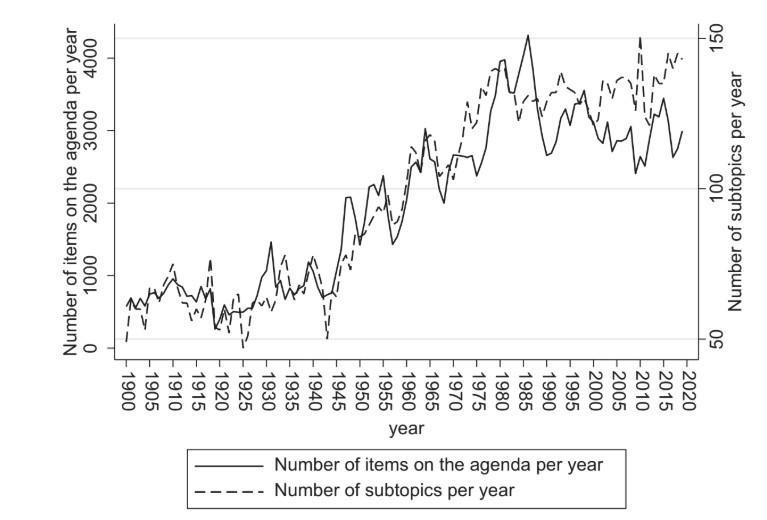
Figure 2. Number of Items and Topics on the Austin City Agenda, 1900-2020.
Population Growth Drives the Local Agenda
As shown in Figure 5, the increase in the number of citizens in Austin correlated with an expansion of the local agenda. However, these dynamics are not necessarily stable, as the local agenda expanded more than the increase of citizens following World War II, and around 1990, the local agenda stagnated despite a growing population. These fluctuations indicate that while the local agenda does not firmly follow steady population growth patterns, local policy agendas are generally receptive to the need to accommodate interests of newer residents.
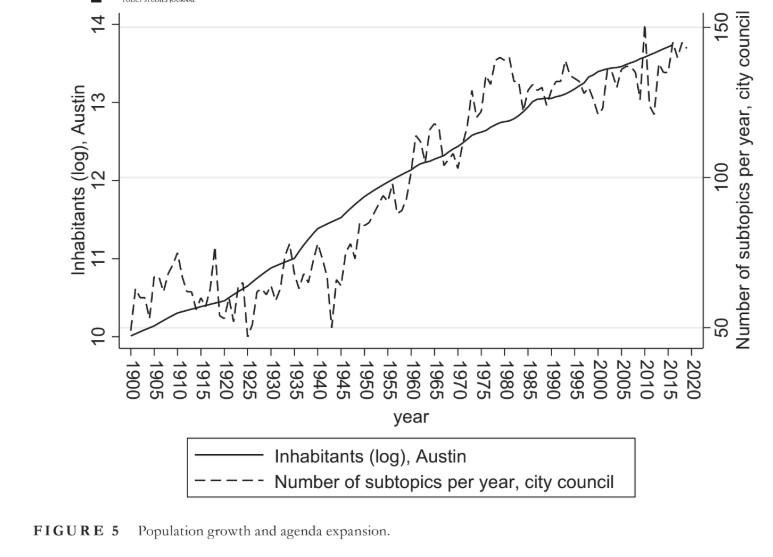
Figure 5. Population Growth and Agenda Expansion.
Why It Matters
This article provides an analysis of how local policy agendas respond to changing forces, such as population growth, national agendas, and institutional reforms. It contributes to the field by providing an empirical analysis of local policy developments and thereby offering an opportunity for scholarship to further explore trends in local-level policy dynamics. The authors argue that expanding the scope of this research could help uncover the interplay between local and national agendas, as well as patterns in policy experimentation in other cities.
Listen to their Podcast Interview
The authors participated in the Art of Science Podcast (AoS) to discuss their study on local policy agendas in Austin, Texas. You can listen to their interview via either link below:
Read the original article in Policy Studies Journal:
Mortensen, Peter B. and Brooke Nicole Shannon. 2025. “ Agendas and Instability in American Local Politics: A Study of the Austin City Council Agenda 1900–2020.” Policy Studies Journal 53(4): 815–832. https://doi.org/10.1111/psj.12587.
About the Article’s Author(s)
Peter B. Mortensen is a full professor at the Department of Political Science, Aarhus University. His research interests include public policy and local and national agenda setting.
Brooke Nicole Shannon is an assistant professor in the Department of Political Science at the University of Memphis. Her research explores the policy agenda of city councils, American political development at the local level, policy process theory, and local institutions such as city councils, mayors, and law enforcement departments.

