Structure, Valence, and Causality: A Scoping Review of Plot Concepts and Measurements in the Narrative Policy Framework

Narratives are central to how people communicate and understand public policy. Policy actors use stories to explain what went wrong, when, who is responsible, and what we should do about it. Within the Narrative Policy Framework (NPF), scholars study those policy stories by identifying common narrative elements, including the characters (Heroes, Villains, Victims), settings, morals of the story, and the story’s plot.

Plot has been one of the most difficult concepts to define and measure consistently because it can refer to several related ideas; it might describe the sequence of events or identify where things went wrong (e.g., the policy problem), or perhaps describe the reason there is a problem to begin with. This article takes a step toward bounding those ideas into a single useful descriptor: plot is the action of a narrative.

Methodology

This article uses a scoping review to examine how NPF scholars have defined and measured plot across existing research. The review identified NPF studies that explicitly engaged plot as a narrative element and examined how each study described, conceptualized, and operationalized plot. The review also looked for recurring patterns in how scholars used plot in practice.

Key Findings

This article finds that NPF research has used plot in diverse but often complementary ways. Rather than treating those differences as competing definitions, the article organizes plot around three conceptual dimensions: structure, valence, and causality.

Structure refers to how action unfolds in a policy narrative, including sequence, timing, beginnings, and endings. Valence captures the direction or tone of action, such as whether a narrative describes improvements, declines, crisis, or progress on a policy issue. Causality refers to how responsibility for action is assigned, explaining why events happen, who or what is responsible, and how policy problems are connected to policy solutions.

Figure 4 summarizes this argument by showing how these three dimensions connect to common operational approaches in the NPF literature. This helps clarify that NPF scholars may all be studying plot, but they are often measuring different parts of plot.
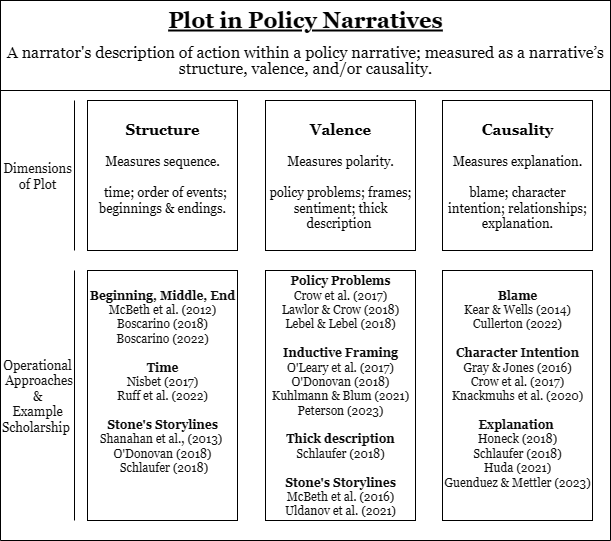
Figure 4. A Reference for Plot in NPF Scholarship.

Why It Matters

This article argues that plot should not be treated as a single, fixed measurement. Instead, scholars can use structure, valence, and causality as a shared language for describing what they mean when they study plot. That shared language can help NPF scholars communicate their research designs more clearly, compare findings across studies, and build cumulative knowledge about how policy stories shape public life.

As the NPF continues to grow across policy areas, methods, and levels of analysis, clear concepts matter. Boundaries for plot can help researchers explain how policy stories organize action, assign meaning, and connect policy problems to policy solutions. The article concludes with opportunities for future research on plot, especially in better measuring how structure and causality work together to create momentum for policy narratives.

Read the original article in Policy Studies Journal:

Ruff, Jonathan WA. 2026. “Structure, Valence, and Causality: A Scoping Review of Plot Concepts and Measurements in the Narrative Policy Framework”. Policy Studies Journal 54(1). https://doi.org/10.1111/psj.70066.

About the Article’s Author(s)

Jonathan Ruff is an Assistant Professor of Political Science in the School of American and Global Studies at South Dakota State University. His research examines how governments use storytelling to define policy problems, justify bureaucratic authority, and organize institutional responsibilities. 
How to Talk about Crises? Leaders’ Narrative Strategies During the COVID-19 Vaccination Campaign in Italy and France

During a crisis, narratives matter as they allows us to make sense of an unpredictable situation and navigate urgency. The COVID-19 pandemic showed that the type of narratives and communication strategies used fundamentally shaped public opinion toward governmental efforts aimed at mitigating the virus. This article examines the role of narrative strategies utilized by France and Italy during the pandemic; focusing on the vaccination campaigns in both countries, to see how political leaders processed and framed both pandemic-related issues and recommended solutions. Furthermore, to track how narrative strategies and patterns in both countries developed over time, the authors applied the Narrative Policy Framework (NPF) and an analytical typology that examines evidence versus emotion, as well as gain versus loss framing.

Hypotheses

The authors established several theoretical expectations to study changes in narrative strategies during crisis.

  1. Evidence-based strategies will only be preferred over emotion-based arguments when sound information is available; evidence-based strategies are less likely to appear in earlier stages of a crisis.
  2. Evidence-based strategies are more likely to be implemented when leaders have a scientific or technical background.
  3. Decision-makers will try to extensively utilize gain-framed messaging in their narrative strategies given the social acceptability of positive communication.
  4. The propensity of loss-framed messaging may increase when gain-framed strategies are ineffective or the desired outcomes need to be accelerated.

Methodology

The authors examined a total of 22 documents (13 Italian and 9 French) that included speeches and press releases from government leaders and Health Ministers in both Italy, as well as France. These documents were selected from 2021, encompassing the first phases of vaccination campaigns pursued by the French and Italian governments. Moreover, the authors utilized Discourse Network Analyzer (DNA) software to code for narratives present in the collected documents.

Key Findings

Who are the Heroes and Villains of the Pandemic?

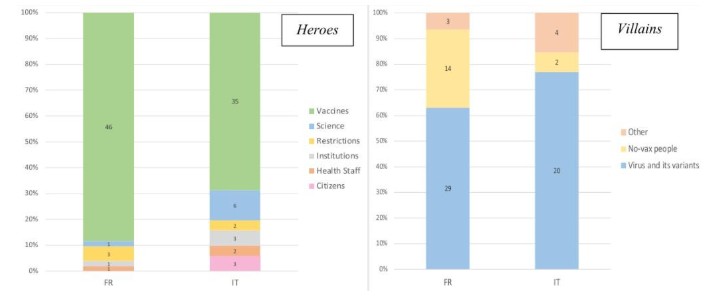
Figure 2 shows that in the majority of cases and in both countries, vaccines were narrated as the “heroes” of the story, alongside restrictive measures and health staff—with science also featuring as a “hero”, though only in the Italian case. The distribution of “heroes” is notably similar across the two countries. The more meaningful differences emerge on the “villains” side: while COVID-19 and its variants feature as the primary “villain” in both countries, no-vax people appear far more frequently as “villains” in the French case than in the Italian one. These patterns indicate that while France and Italy broadly share the same “heroic” narratives around vaccines, French leaders were considerably more inclined to cast unvaccinated individuals in an antagonistic role—a finding consistent with the greater use of loss-framed and scaring tactics observed in the French narrative strategies more broadly.

Figure 2. Heroes and Villains in the French and Italian Narratives.

France and Italy Used Different Narratives Strategies Over Time

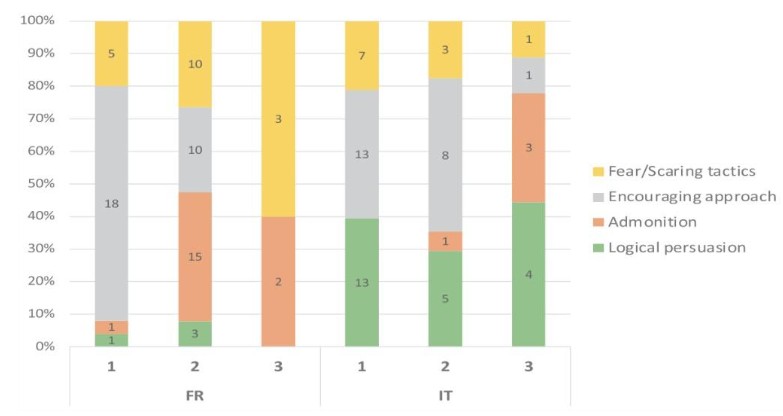
As illustrated in Figure 6, during Phase 1 of the vaccination campaign, both France and Italy utilized encouraging narrative approaches to build trust; this was more pronounced in France whereas Italy employed a mixture of an encouraging approach and logical persuasion. However, across Phases 2-3, the narrative strategies began to diverge in both countries as France resorted toward admonition and scaring practices, whereas Italy balanced admonition with gain-framed types of narratives (i.e., logical persuasion and an encouraging approach). These findings indicate that France was more likely to depend on alarmist and emotional narrative tactics to increase vaccination rates, whereas Italy pursued a more technical, deliberative approach.

Figure 6. Narrative Strategies by Country and Phase.

Why It Matters

This article reveals that narratives are not simply “talk”, but represent strategic tools applied to shape public acceptance toward restrictive policies. By focusing on France and Italy as empirical cases of COVID-era narratives, the study illuminates how political leaders in different national settings communicated with the public during a time of crisis. The authors encourage future research to apply their typological framework to other crises, such as climate change mitigation, to determine whether evidence-based or emotion-based strategies are employed in different policy contexts. Understanding these narrative patterns can help future political leaders select communication strategies that mediate compliance and institutional trust.

Read the original article in Policy Studies Journal:

Mastroianni, Laura and Stefania Profeti. 2025. “How to Talk About Crises? Leaders’ Narrative Strategies During the COVID-19 Vaccination Campaign in Italy and France.” Policy Studies Journal 53(4): 994–1013. https://doi.org/10.1111/psj.12585.

About the Article’s Author(s)

Laura Mastroianni is a Postdoctoral Research Fellow in Public Policy at the University of Bologna, Department of Political and Social Sciences. 

Stefania Profeti is Associate Professor in Political Science at the University of Bologna, Department of Political and Social Sciences.