Latent Target Groups – A Methodological Contribution of Social Identities to Policy Design Research

Researchers have traditionally studied target groups as homogenously constructed groups. Thereby, the groups of interest were assigned single social identities, such as, e.g., people in unemployment. However, it can be questioned whether a singular identity approach is appropriate for studying populations of interest, and in turn, designing effective policies. The authors in this article argue that the internal characteristics of at first sight, and from a traditional policy design perspective, homogenous groups are internally highly heterogenous and respond differently to policies based on their overlapping identities. These concerns have prompted the authors to explore the concept of “latent” target groups, or the idea that individuals have multiple competing identities to analyze the extent of subgroup diversity within these target populations.

Theoretical Arguments

The authors establish two primary arguments to guide their investigation of latent target groups in their study:

  1. Target groups are not homogenous and as a result, their heterogeneity must be considered in policy design.
  2. Social identities serves as a useful conceptual backdrop for target group diversity by structuring how they are composed of different subgroups and identities.

Methodology

This study applies Latent Class Analysis (LCA) as the primary methodological tool to uncover individual attributes through a person-centered design. An original dataset of 2,042 German adult respondents was used, specifically examining two groups: non-vegetarians and car users. The authors focused on these groups due to the consequences of their behaviors on the environment and contributions to increased carbon emissions. To identify hidden social identities, the demographic, local, and organizational identities of the respondents were measured through LCA. Furthermore, the authors utilized regression modeling to predict policy preferences toward specific types of nutrition and mobility policies within the subgroups.

Key Findings

Non-Vegetarians and Car Users are not Monolithic Identity Groups

The results of the LCA, as shown in Figure 1 demonstrated that four hidden subgroups existed within the broader population of non-vegetarians and car users examined. These latent groups consisted of four classes: Wealthy and status-seeking people of the rural and provincial upper class (Class 1); politically engaged men in metropolitan areas influenced by monetary incentives (Class 2); a disengaged subset of women expressing minimal social or political engagement (Class 3); and socially/politically active citizens (Class 4). These discoveries confirm the authors’ expectations that seemingly cohesive groups are distinctly characterized by various identity groups making up their composition. Unique to non-vegetarians and car users, these groups are clearly not monolithic and instead shaped by various socioeconomic and political experiences.
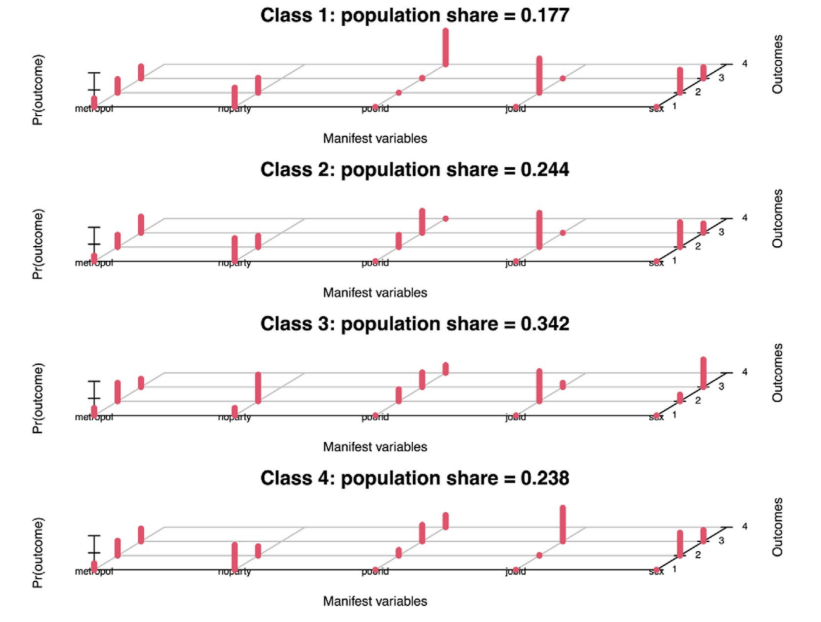
Figure 1. Probability of membership in classes.

Hidden Groups Only Predict Policy Preferences for Car Use

Table 3 shows that the observed latent classes exhibit a higher probability of predicting preferences toward mobility policy. In particular, citizens who are socially and politically active (Class 4) are the most likely subgroup to promote car usage policies. This indicates that underneath the broad socially constructed identity groups, specific subgroup identity cohorts drive support or opposition toward policy preferences. Effectively, this revelation confirms that receptiveness to policy designs is a complex phenomenon heavily influenced by conflicting and salient identity factions.
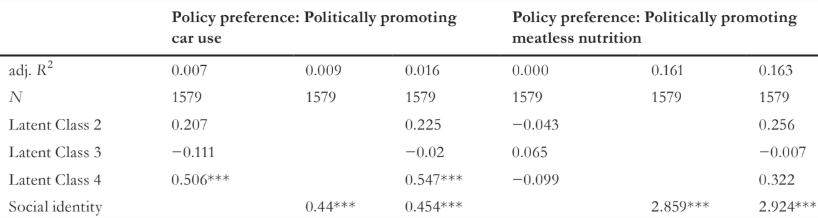
Table 3. Results of logistic regression analyses.

Why It Matters

This article thoughtfully reevaluates how policymakers should approach the design of policy measures and/or programs intended to serve specific target populations. The understanding of identity transcends the traditionally broad social construction of groups into a defined category, as shown in the article. Complex policy issues such as environmental restrictions can spark multiple conflicting identities that create unique policy preferences that differ from others in the demographic segment. Future research directions suggested by the authors include examining how the internal cohesiveness of subgroup identities are affected by policy instruments such as regulations or incentives. By continuing to study latent target groups, policymakers can begin to transition away from “one-size-fits-all” policy approaches and instead pursue tailored design frameworks that align with the behaviors, identities, and values of diverse subgroups.

Read the original article in Policy Studies Journal:

Hornung, Johanna, Nils C. Bandelow, and Madita Olvermann. 2025. “Latent Target Groups—A Methodological Contribution of Social Identities to Policy Design Research.” Policy Studies Journal 53(3): 774–794. https://doi.org/10.1111/psj.70028.

About the Article’s Author(s)

Dr. Johanna Hornung is an assistant professor in Public Policy at the University of Lausanne. She is co-editor-in-chief of the Review of Policy Research (RPR) and the European Policy Analysis (EPA) journal. Her research interests lie in public policy research, particularly health policy, and the integration of psychological perspectives in actor-centered explanations of policy processes. 

Dr. Nils C. Bandelow is professor Political Science and Head of the Institute of Comparative Politics and Public Policy (CoPPP) at the TU Braunschweig. He is co-editor-in-chief of the journals Review of Policy Research (RPR) and European Policy Analysis (EPA). He is interested in policy process research, particularly health policy and infrastructure policy, and integrating psychological perspectives in actor-centered explanations of policy processes.

Dr. Madita Olvermann is an Innovation Manager at the Project House of the TU Braunschweig. She earned her PhD at the Chair of Industrial/Organizational and Social Psychology at the TU Braunschweig. She is passionate about interdisciplinary research and focuses on applying individual-level insights from the psychological field to emerging transition pathways. 
A Novel Research Method to Detect Punctuation and its Application to Bureaucratic Decision-Making

How can researchers effectively capture shifts in policy over time? Traditionally, political scientists have relied upon conventional index measures to test the Punctuated Equilibrium Theory (PET)—the idea that policy is stable for a long period before erupting into brief moments of radical change (i.e., punctuation). However, traditional approaches to evaluating policy change have received a lot of criticism for being unable to sufficiently measure the magnitude of policy changes and subjectively categorizing stability and punctuation cutoffs. For these reasons, this article proposes a new approach to measuring punctuated policy changes that involves using a statistical model to separate policy stability from punctuation to provide an objective visualization of changes in policy over time. To test this novel approach, the authors apply the framework toward budgetary decisions in both highly bureaucratized and non-bureaucratized local education systems in New York and Texas. By pursuing this methodological innovation, the authors aim to answer this central research question: Do bureaucratized or non-bureaucratized organizations exhibit a more punctuated pattern of budgetary changes?

Methodology

The authors collected instructional spending per pupil in both New York and Texas school districts during 1997-2019. Annual percentage changes in both states’ school districts instructional funding were calculated to measure year-over-year changes. Subsequently, the authors applied a Generalized Method of Moments (GMM) used to differentiate between incremental or routine budget changes and extreme spikes.

Key Findings

New York Bureaucratic School Districts Follow PET Patterns

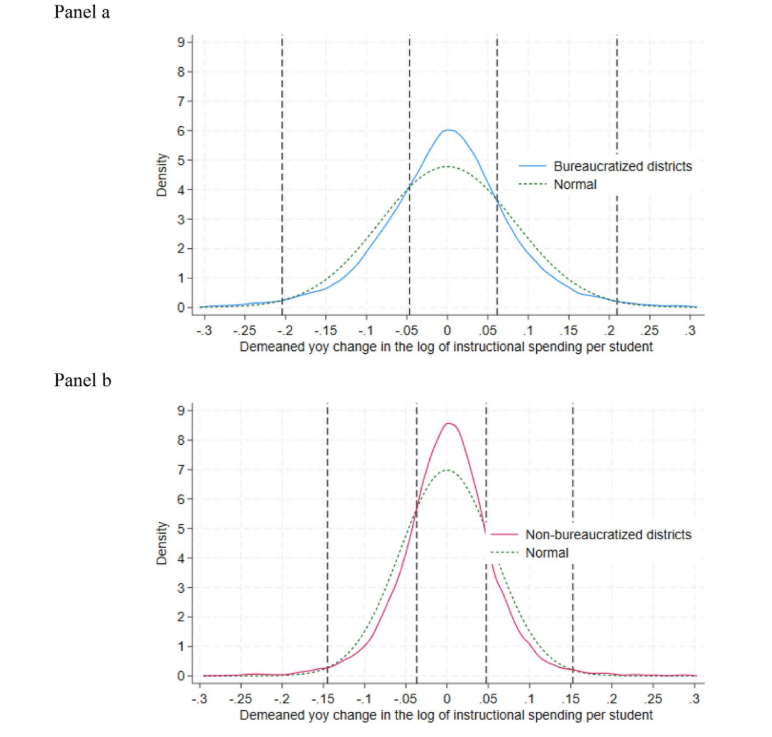
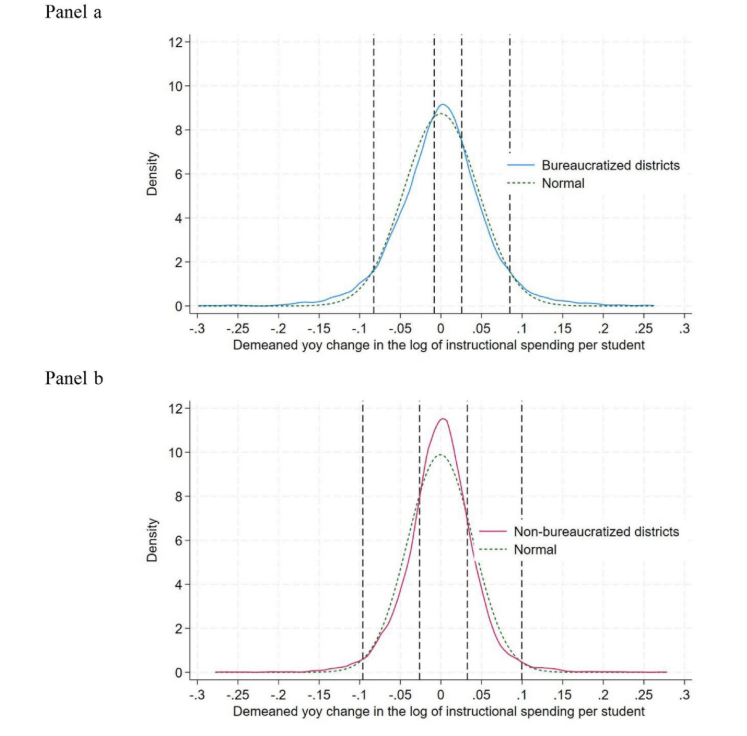
School districts in New York that are considered highly bureaucratic or structurally rigid exhibited occurrences of punctuated changes in spending patterns after periods of stability. As shown in Figure 2, bureaucratic schools correlated with a higher frequency of punctuated budgetary trends compared to non-bureaucratized schools. These dynamics illustrate that spending on instructional expenses in New York school districts align with the theoretical assumptions of PET—overseeing periods of routine stability before institutional frictions create a breaking point of drastic spikes in spending. Ultimately, the patterns indicate that regional institutional frameworks in New York act as facilitators of volatile, punctuated policy shifts.

Figure 2. The distribution of changes in instructional spending per student in New York overlaid with normal distribution. (Panel a) Bureaucratized school districts. (Panel b) Non-bureaucratized school districts.

Spending Patterns in Texas Bureaucratic School Districts are Unstable

In stark contrast to New York, heavily bureaucratized school districts in Texas display unique budgetary patterns that actively deviate from traditional theoretical assumptions. As shown in Figure 5, bureaucratized school districts in Texas were associated with ongoing instability instead of a long period of stability in budgetary behavior punctuated by rare spikes. This indicates that highly bureaucratic and rigid administrative frameworks do not always maintain routine policies. Instead, the revelations in Texas bureaucratic school districts suggest that intense bureaucratization prompts hyper-reactive administrative environments defined by frequent corrections or revisions to budgetary policies..

Figure 5. The distribution of changes in instructional spending per student in Texas overlayed with normal distribution. (Panel a) Bureaucratized school districts. (Panel b) Non-bureaucratized school districts.

Why It Matters

The investigations in this article illustrate a thoughtful breakthrough to methodologically testing the assumptions of PET. By tailoring methodological standards to specific institutions and objective cutoffs, the authors provide an appropriate template for analyzing and understanding policy changes over a longitudinal period. The findings illuminated in the article emphasize the potency of administrative environments in shaping organizational policy choices affecting important public services such as education. For future research opportunities, the authors recommend exploring the conditions that propel policy fluctuations, with a specific emphasis on the flow of information in bureaucratic settings. Building upon these empirical foundations and research directions will allow policymakers and researchers alike to create strategies that improve decision-making in bureaucratic organizations.

Read the original article in Policy Studies Journal:

Butler, J. S. and Iuliia Shybalkina. 2025. “A Novel Research Method to Detect Punctuation and Its Application to Bureaucratic Decision-Making.” Policy Studies Journal, 53(4): 876–898. https://doi.org/10.1111/psj.70013.

About the Article’s Author(s)

J.S. Butler is an accomplished econometrician, earned his Ph.D. in Economics from Cornell University. Before joining the University of Kentucky Martin School, he taught at Vanderbilt University and Cornell University. His teaching focuses on econometrics and statistics. 

Iuliia Shybalkina is an assistant professor at the Martin School at the University of Kentucky. She holds a Ph.D. in Public Administration from the Maxwell School of Syracuse University. Her research and teaching are centered on local financial administration.

Collaborative Diffusion: The Dynamics of Policy Output in COVID-19 Interstate Compacts

State policy development often involves replicating and adapting ideas from across state lines. Interstate compacts have served as a popular vehicle of policy innovation and diffusion as states join together to pool resources and collaborate on a common goal or issue. These dynamics have intrigued previous scholars to study the decision processes of states joining a compact. However, these same research efforts leave unanswered questions about how policies are adopted within a compact after a state has joined. In this article, the authors aim to bridge this gap in literature by exploring and analyzing what happens after a compact is formed. Leveraging the atypicaly policy adoption rates of the COVID-19 crisis, the authors explore these phenomena by looking at how states coordinated within interstate compacts on pandemic-era policies.

Hypotheses

The authors hypothesize the following about policy diffusion processes in interstate compacts:

Hypothesis 1: Members of interstate compacts are more likely than non-members to adopt policy pertaining the compact formation.

Hypothesis 2: The likelihood of adoption for member states increases as the number of their peer members having adopted the policy increases.

Hypothesis 3: The likelihood of policy adoption in non-compact states rises with the number of adoptions in compact member states.

    Methodology

    The authors examined three compacts that were created to regionally coordinate responses to COVID-19: the Eastern, Midwestern, and Western compacts. Using a Network Event History Analysis (NEHA) modeling approach, the adoption of pandemic policies after compact formation were measured to analyze the rate of diffusion among member and non-member states. Additionally, the authors controlled for variables such as state ideology and professionalism to isolate their effects on policy diffusion dynamics.

    Key Findings

    Being a Compact Member Does Not Boost Policy Adoption

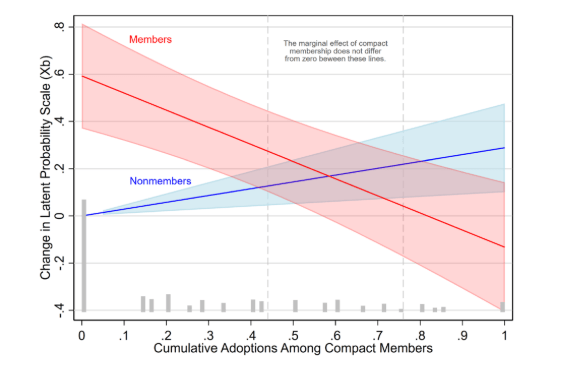
    Surprisingly, as shown in Figure 5 below, being part of an interstate compact does not automatically make member states more assertive in adopting newer policies within the compact. In fact, member states only adopted at a greater rate when there was not adoption by other compact members. However, as member states began adopting internal policies, this decreases the chances of further adoption within the compact. These results show that internal policy activities do not necessarily provoke reactionary behavior from member states. Instead, these results imply potential administrative conundrums wherein coordinating among already ideologically aligned and proactive members does not realistically accelerate further policy diffusion.

    Figure 5. Compact membership and cumulative adoption effects.

    Ideology Drives the Spread and Adoption of COVID-19 Policies

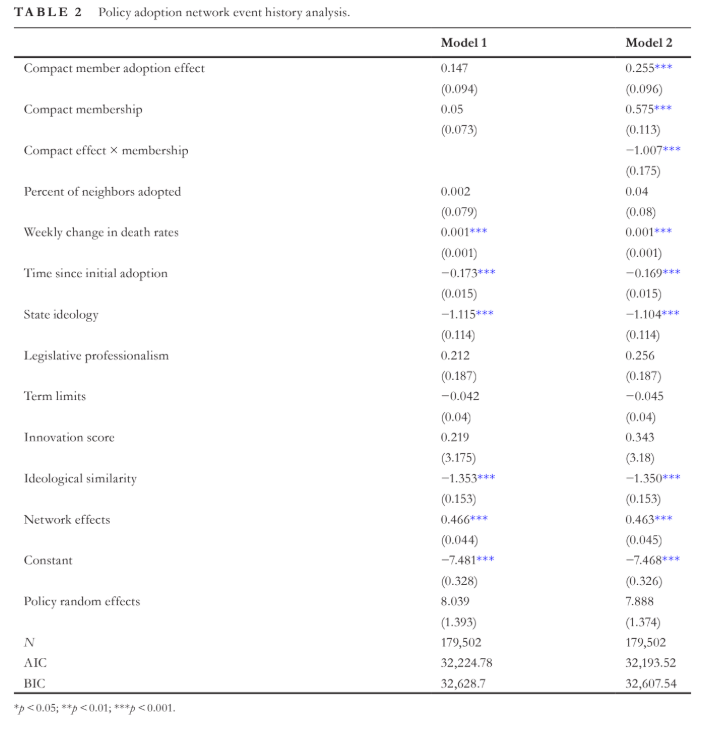
    The authors discovered that the ideology of member states had a significant impact on adopting pandemic-related policies during COVID-19. As shown in Table 2, this indicates that liberal-oriented states were more likely to adopt or emulate pandemic policies within their respective compacts. This outcome clarifies the leadership dynamics of the pandemic, demonstrating that Democratic-led states anchored early policy activity and that ideology serves as a primary determinant of when and how policies spread.

    Non-Member States Free-Ride Off of their More Innovative Peers

    While the more left-leaning and innovative states adopted new policies at a faster rate, that is not to say that their right-leaning and more reactive contemporaries did nothing. The authors observed a free-riding dynamic amongst non-compact members. As the leader states adopted more policies, the follower states observed. Eventually, they adopted many of the novel solutions of their peers, but at a slower pace. Leader states acted quickly, prompting follower states to mimic their innovations as a shortcut for their own institutional decisions. Furthermore, this delayed wave of pandemic policies allowed for right-leaning states to “copy” one another, as opposed to the Democrat-run states that led the charge. Many of these efforts coalesced around Maryland Governor Larry Hogan, who, along with a few other states/actors, provided a parallel path for innovation to right-leaning free-riders that still had to manage the realities of the pandemic despite partisan pressures from the federal government. These findings reflect classic American policy diffusion, showing how cautious states copy their peers after a delay to handle practical problems and partisan pressures.

    Table 2. Policy Adoption Network Event History Analysis.

    Why It Matters

    The activities that occur once an interstate compact is created offer a glimpse into policy cohesiveness and effectiveness of states attempting to tackle shared problems. This article provides an important contribution to the policy diffusion literature by exploring how policy activities navigate the structural frameworks of formal compacts. These investigations also offer valuable insights into how collaborative initiatives affect the decision processes of member and non-member states amid crises. For future research, the authors recommend examining multi-compact initiatives over a longitudinal period, extended to municipal and/or international settings. By pursuing these directions, scholars can begn to fundamentally understand how ideas and practices are shared as well as developed in the midst of ongoing policy experimentation.

    Read the original article in Policy Studies Journal:

    Pollert, Isaac, Johabed Olvera, Bruce A. Desmarais, Frederick J. Boehmke and Jeffrey J. Harden. 2025. “Collaborative Diffusion: The Dynamics of Policy Output in COVID-19 Interstate Compacts.” Policy Studies Journal 53(4): 944–970. https://doi.org/10.1111/psj.70008.

    About the Article’s Author(s)

    Isaac Pollert is a a Teaching Professor at the Pennsylvania State University. His research focuses on American politics, with a focus on the states and policy diffusion. 

    Johabed Olvera is an Assistant Professor at the Pennsylvania State University School of Public Policy and an associate faculty member at the Population Research Institute. Her research examines how the design and implementation of governemnt interventions impact maternal and child health as well as the economic well-being of minorities and low-income families in the U.S. and Latin America.

    Bruce A. Desmarais is the DeGrandis-McCourtney Early Career Professor in the Department of Political Science and faculty affiliate of the Institute for Computational and Data Sciences at Pennsylvania State University. His research focuses on the development and application of research methods to analyze the complex interdependence underlying political interactions.

    Frederick J. Boehmke is Professor and Marvin and Rose Lee Pomerantz Chair in Political Science at the University of Iowa. His research focuses on American state politics and quantitative political methods.

    Jeffrey J. Harden is the Andrew J. McKenna Family College Professor of Political Science at the University of Notre Dame. His research interests include political representation, public policy diffusion, and political methodology. 

    The Impact of Political Attention on Collaborative Environmental Governance Among Municipal Street-Level Bureaucrats

    Does the level of attention that politicians direct toward complex environmental problems impact how frontline bureaucrats in municipal settings form relationships? The collaborative interactions among civil servants are a defining feature of environmental governance, drastically shaping how issues are addressed. In this article, the authors incorporate political attention, or the priority status that an issue receives on the political agenda, to analyze how fluctuating attention levels affect the ties created between street-level bureaucrats and the policy outcomes produced. These dynamics are explored within the issue context of flood risk mitigation across municipal civil servant networks in Southern Sweden. Three actor types within municipal administration heavily involved in flood risk mitigation are examined: water & sewage, planning, and politicians and senior managers. By investigating the effects of political attention on collaborative environmental governance, the authors aim to illustrate how policy consequences and relationships at the municipal level are shaped by top-down influences.

    Hypotheses

    To evaluate the relationships between political attention and collaborative networks, the authors established the following hypotheses:

    1. When political attention is low, water and sewage actors tend to have more ties than each of the other types of actors.
    2. When political attention is high, planners, politicians, and senior-level managers tend to have more ties than each of the other types of actors.
    3. Actors appointed as coordinators tend to have more ties, the stronger the political attention is.

    Methodology

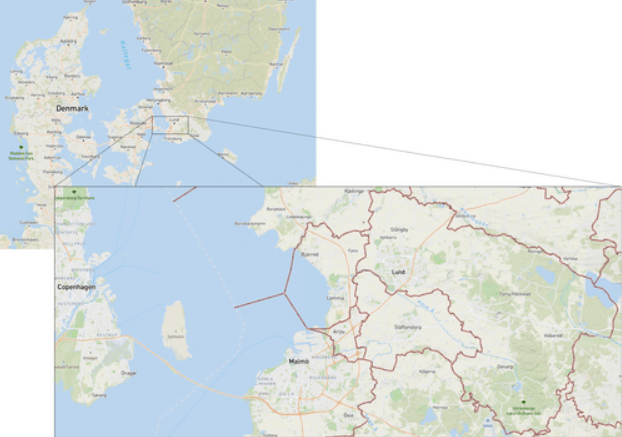
    The authors examined three municipalities in Southern Sweden, including Lomma, Lund, and Staffanstorp (as shown in Figure 2), that all exhibited varying degrees of political attention to flood risk mitigation. Three sources of data were utilized in the study, consisting of scientific literature, 143 qualitative interviews with local actors, and a national performance metric of climate adaptation performances by Swedish municipalities. In addition, social network analytical modeling in R was conducted to analyze the relationships between different municipal actors.

    Figure 2. The location of Lomma, Lund, and Staffanstorp municipalities in Southern Sweden (developed from Vatten.Atlas.se).

    Key Findings

    Collaborative Network Dominance Varies by Actor Type and Attention

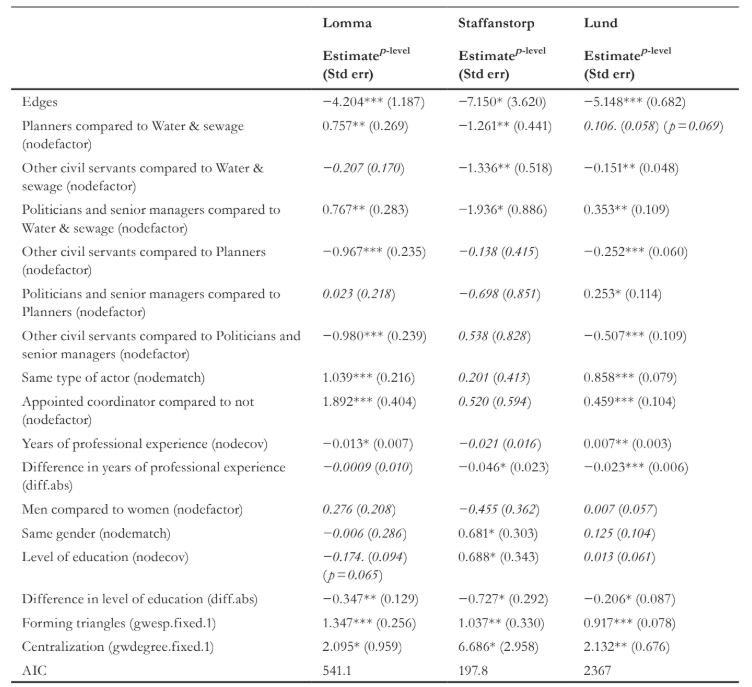
    As shown in Table 3 below, the propensity of ties or relationships differ drastically across the examined municipalities. In Staffanstorp, an area of low political attention to flood risk mitigation, water & sewage actors exhibit more ties than any other category. However, in municipalities with high political attention such as Lomma and Lund, planners, as well as politicians and senior managers have more ties compared to water & sewage actors. These dynamics reveal that network collaborations differ by the level of political attention or prioritization that is given to flood risk mitigation issues. Subsequently, this confirms the authors’ two initial hypotheses (H1 & H2), demonstrasting political attention serves as a catalyst for dictating the types of collaborative relationships that develop.

    Table 3. Results of hypothesis testing model (including the type of actor, appointed coordinator, gender, level of education, and triangle formation).

    Coordinators Act as a Bridge for Developing Network Ties

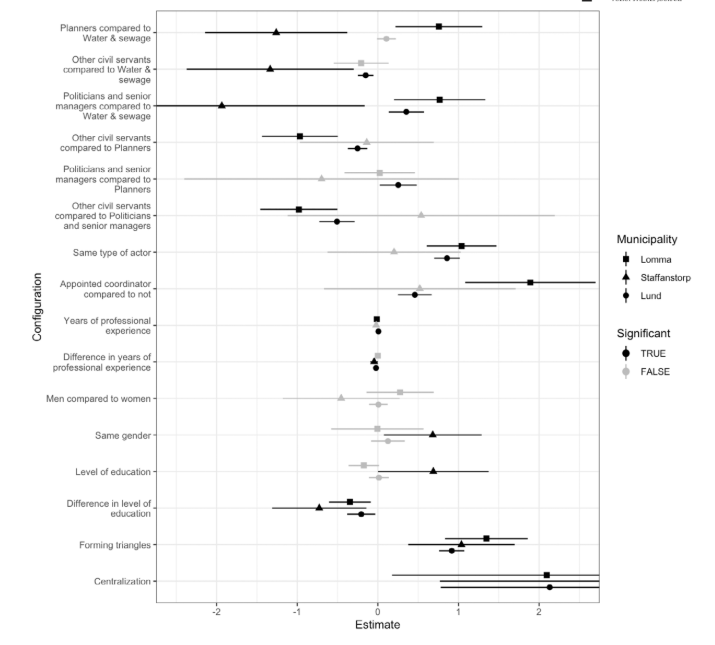
    Being an appointed coordinator in a Swedish municipality with high political attention is shown to matter in fostering network ties between street-level bureaucrats. Figure 3 illustrates that in municipalities such as Lomma and Lund with high political attention to flood risk mitigation, coordinators who are appointed are critical to mobilizing different actors. In contrast, in Staffanstorp, the low political attention dynamics correspond to coordinators having no significant impact on their ability to form collaborative relationships. These results indicate that high political attention boosts the success of coordination between actors when an issue is being prioritized. Furthermore, the results imply that politicians’ attention to environmental challenges establishes the issue salience needed for collaborative networks to form and to incentivize cooperation.

    Figure 3. Ranges of estimates (+/-2 standard errors) for each configuration in the model per municipality. Ranges crossing zero correspond to the estimate not providing a significant result for the particular municipality, while overlapping ranges in the estimates for a particular configuration connote no significance difference between municipalities.

    Why It Matters

    The tendencies of street-level bureaucrats or public servants to work together is heavily defined by different environmental and institutional contexts. This article demonstrates that the level of political attention expressed toward complex environmental challenges facilitates varying degrees of network coordination among street-level actors. The described phenomenon signifies that networks are formed on the basis of a shared issue prioritization and preference for collaboration. More importantly, the authors acknowledge that the study could potentially explore additional factors that may influence the development of ties between street-level actors. Nonetheless, the study makes an important contribution to the field of collaborative governance by illuminating the patterns that drive network development in municipal settings.

    Read the original article in Policy Studies Journal:

    Becker, Per and Örjan Bodin. 2025. “The Impact of Political Attention on Collaborative Environmental Governance Among Municipal Street-level Bureaucrats.” Policy Studies Journal 53(4): 852–875. https://doi.org/10.1111/psj.70020.

    About the Article’s Author(s)

    Per Becker is Professor of Risk and Sustainability at Lund University, Professor of Leadership and Command & Control at the Swedish Defence University, Extraordinary Professor at North-West University. His research focuses on the systemic interactions between the physical environment, social organization and social behavior in relation to societal safety, security, and sustainability. 

    Örjan Bodin is Professor of Environmental and Sustainability Science at Stockholm Resilience Center, Stockholm University, and Visiting Professor at the Swedish Defence University. His research focuses on collaborative environmental governance using a combination of natural and social science methods and perspectives.