

State policy development often involves replicating and adapting ideas from across state lines. Interstate compacts have served as a popular vehicle of policy innovation and diffusion as states join together to pool resources and collaborate on a common goal or issue. These dynamics have intrigued previous scholars to study the decision processes of states joining a compact. However, these same research efforts leave unanswered questions about how policies are adopted within a compact after a state has joined. In this article, the authors aim to bridge this gap in literature by exploring and analyzing what happens after a compact is formed. Leveraging the atypicaly policy adoption rates of the COVID-19 crisis, the authors explore these phenomena by looking at how states coordinated within interstate compacts on pandemic-era policies.
Hypotheses
The authors hypothesize the following about policy diffusion processes in interstate compacts:
Hypothesis 1: Members of interstate compacts are more likely than non-members to adopt policy pertaining the compact formation.
Hypothesis 2: The likelihood of adoption for member states increases as the number of their peer members having adopted the policy increases.
Hypothesis 3: The likelihood of policy adoption in non-compact states rises with the number of adoptions in compact member states.
Methodology
The authors examined three compacts that were created to regionally coordinate responses to COVID-19: the Eastern, Midwestern, and Western compacts. Using a Network Event History Analysis (NEHA) modeling approach, the adoption of pandemic policies after compact formation were measured to analyze the rate of diffusion among member and non-member states. Additionally, the authors controlled for variables such as state ideology and professionalism to isolate their effects on policy diffusion dynamics.
Key Findings
Being a Compact Member Does Not Boost Policy Adoption
Surprisingly, as shown in Figure 5 below, being part of an interstate compact does not automatically make member states more assertive in adopting newer policies within the compact. In fact, member states only adopted at a greater rate when there was not adoption by other compact members. However, as member states began adopting internal policies, this decreases the chances of further adoption within the compact. These results show that internal policy activities do not necessarily provoke reactionary behavior from member states. Instead, these results imply potential administrative conundrums wherein coordinating among already ideologically aligned and proactive members does not realistically accelerate further policy diffusion.
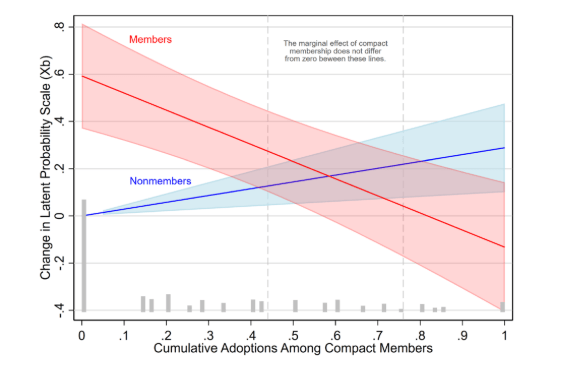
Figure 5. Compact membership and cumulative adoption effects.
Ideology Drives the Spread and Adoption of COVID-19 Policies
The authors discovered that the ideology of member states had a significant impact on adopting pandemic-related policies during COVID-19. As shown in Table 2, this indicates that liberal-oriented states were more likely to adopt or emulate pandemic policies within their respective compacts. This outcome clarifies the leadership dynamics of the pandemic, demonstrating that Democratic-led states anchored early policy activity and that ideology serves as a primary determinant of when and how policies spread.
Non-Member States Free-Ride Off of their More Innovative Peers
While the more left-leaning and innovative states adopted new policies at a faster rate, that is not to say that their right-leaning and more reactive contemporaries did nothing. The authors observed a free-riding dynamic amongst non-compact members. As the leader states adopted more policies, the follower states observed. Eventually, they adopted many of the novel solutions of their peers, but at a slower pace. Leader states acted quickly, prompting follower states to mimic their innovations as a shortcut for their own institutional decisions. Furthermore, this delayed wave of pandemic policies allowed for right-leaning states to “copy” one another, as opposed to the Democrat-run states that led the charge. Many of these efforts coalesced around Maryland Governor Larry Hogan, who, along with a few other states/actors, provided a parallel path for innovation to right-leaning free-riders that still had to manage the realities of the pandemic despite partisan pressures from the federal government. These findings reflect classic American policy diffusion, showing how cautious states copy their peers after a delay to handle practical problems and partisan pressures.
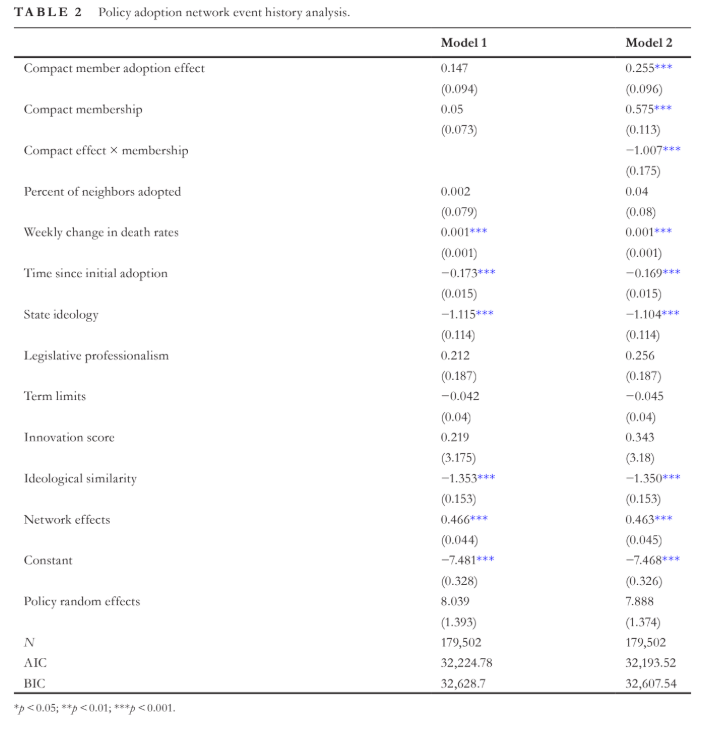
Table 2. Policy Adoption Network Event History Analysis.
Why It Matters
The activities that occur once an interstate compact is created offer a glimpse into policy cohesiveness and effectiveness of states attempting to tackle shared problems. This article provides an important contribution to the policy diffusion literature by exploring how policy activities navigate the structural frameworks of formal compacts. These investigations also offer valuable insights into how collaborative initiatives affect the decision processes of member and non-member states amid crises. For future research, the authors recommend examining multi-compact initiatives over a longitudinal period, extended to municipal and/or international settings. By pursuing these directions, scholars can begn to fundamentally understand how ideas and practices are shared as well as developed in the midst of ongoing policy experimentation.
Read the original article in Policy Studies Journal:
Pollert, Isaac, Johabed Olvera, Bruce A. Desmarais, Frederick J. Boehmke and Jeffrey J. Harden. 2025. “Collaborative Diffusion: The Dynamics of Policy Output in COVID-19 Interstate Compacts.” Policy Studies Journal 53(4): 944–970. https://doi.org/10.1111/psj.70008.
About the Article’s Author(s)
Isaac Pollert is a a Teaching Professor at the Pennsylvania State University. His research focuses on American politics, with a focus on the states and policy diffusion.
Johabed Olvera is an Assistant Professor at the Pennsylvania State University School of Public Policy and an associate faculty member at the Population Research Institute. Her research examines how the design and implementation of governemnt interventions impact maternal and child health as well as the economic well-being of minorities and low-income families in the U.S. and Latin America.
Bruce A. Desmarais is the DeGrandis-McCourtney Early Career Professor in the Department of Political Science and faculty affiliate of the Institute for Computational and Data Sciences at Pennsylvania State University. His research focuses on the development and application of research methods to analyze the complex interdependence underlying political interactions.
Frederick J. Boehmke is Professor and Marvin and Rose Lee Pomerantz Chair in Political Science at the University of Iowa. His research focuses on American state politics and quantitative political methods.
Jeffrey J. Harden is the Andrew J. McKenna Family College Professor of Political Science at the University of Notre Dame. His research interests include political representation, public policy diffusion, and political methodology.

