When “Symbolic” Policy is Anything But: Policy Design and Feedbacks from California’s Human Right to Water Law

How can a policy be impactful if, by design, the policy text is highly symbolic? Symbolic policies communicate salient values such as equity or rights with minimal implementation guidelines. Despite their ubiquity, these policies have been overlooked by scholarship that largely views symbolic policies as performative and meaningless. The authors challenge this prevailing notion by showcasing how symbolic policies can serve as powerful vehicles of transformative sociopolitical change. To demonstrate this, the authors analyzed California’s highly symbolic human right to water law (AB 685, 2012). Results highlight the growth of collective political power and the law’s impact on state responsiveness to drinking water challenges.

Methodology

The authors employed a case study design, using a combination of semi-structured interviews, archival data, and document analysis, to assess the policy design of, and feedbacks from, AB 685. This law, deemed highly symbolic as it lacked enforcement measures, was also widely considered very impactful by a diverse array of policy actors, making it an excellent policy candidate for analyzing how symbolic policies can impact social change. Key informants involved in AB 685 passage or implementation were interviewed. The authors also analyzed state archives associated with AB 685 and a prior human right to water bill, as well as more than 40 state documents, such as legal cases and agency budgets.

Key Findings

Highly Symbolic Policies Can Drive Material and Transformational Change

Through dedicated community organizing and advocacy by grassroots and water justice coalitions in California, the symbolism within the text of AB 685 triggered interpretive consequences that eventually led to substantial material outcomes. For example, coalition members highlighted the negative health effects felt by communities with contaminated drinking water and affordability concerns for low-income users. This, along with high-visibility staging events as shown in Figure 2, not only united previously disconnected grassroots organizations, but also forced state agencies to acknowledge their concerns. By capitalizing on AB 685’s rhetoric, grassroots and water justice groups were able to influence and change existing regulations, as well as shape legislative decisions that ultimately provided $1.4 billion in funding for drinking water access. These developments underscore the ability of symbolic language in policies to incentivize material (resource effects) and transformational changes in policy over time through interpretive effects including narrative change, movement building and increased state responsiveness.
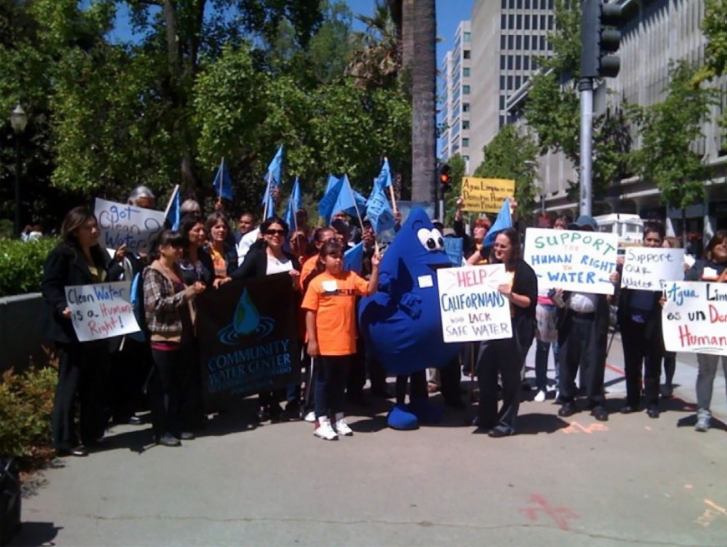
Figure 2. “La Gotita” (“the little water droplet” in Spanish) joined members of the Safe Water Alliance to advocate for the human right to water. Photo credit: Community Water Center.

Ambiguity Can be Key for Movement-Building and Agenda-Setting

The brief text and undefined terms such as “safe”, “clean”, “affordable”, and “accessible” in AB 685 proved helpful in activating a significant coalition-building effort in California. Supporters of AB 685 leveraged the vague legislation to humanize the issue of drinking water access through first-hand community testimonies, as shown in Figure 3. This allowed a highly diverse coalition of stakeolders—rural farmworkers, urban environmental advocacy groups, faith-based organizations, and Indigenous groups to coalesce around a shared frame of ensuring public health and dignity. Moreover, the ambiguous design of AB 685 facilitated relevance across policy venues, scales and time, thereby amplifying its impact across various water justice domains. Finally, the ambiguity of the policy design was key to the law’s passage. Not only were the bill’s proponents’ relative newcomers to state policy debates but the opposition was highly organized and influential. Combined, these results demonstrate that contrary to traditional literature that deems ambiguous symbolic legislation a failure such policy designs may actually be uniquely strategic for social movements.
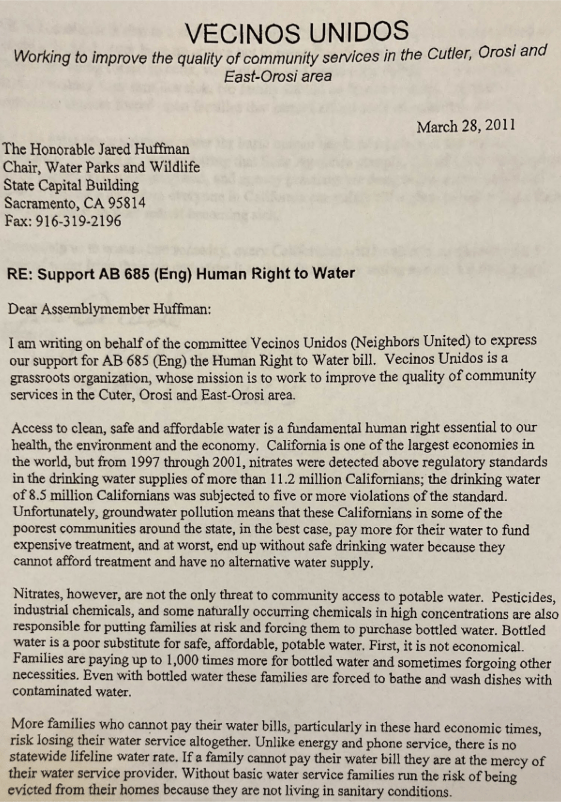
Figure 3. Page one of a 2011 support letter for AB 685 from Vecinos Unidos, which is a community-based organization and member of the grassroots AGUA (Asociación de Gente Unida por el Agua, or Association of People United for Water) coalition.

Why It Matters

Highly symbolic policies such as California’s AB 685 law can effectively act as foundational drivers for reshaping institutional communication and responsiveness to ensure long-term material changes. By elucidating how the feedbacks from symbolic policies can facilitate concrete, long-term changes to policy and regulatory frameworks, the authors address an important gap in policy feedback literature. Specifically, this work illustrates that grassroots movements can utilize symbolic policies as a tool for building long-term collective power and influencing the design of major policy programs. For future research endeavors, the authors recommend further investigating the role of symbolic policy in policy design and feedback beyond drinking water access, such as climate change or social justice, to determine its strategic currency in transforming institutional dynamics.

Read the original article in Policy Studies Journal:

Rempel, Jenny Linder and Kristin Babson Dobbin. 2025. “When “Symbolic” Policy is Anything But: Policy Design and Feedbacks from California’s Human Right to Water Law.” Policy Studies Journal 53(3): 701-722. https://doi.org/10.1111/psj.12564.

About the Article’s Author(s)

Jenny Linder Rempel is a postdoctoral scholar in the Department of Environmental Science, Policy, and Management at UC Berkeley. 

Kristin Babson Dobbin is an Assistant Cooperative Extension Specialist in water justice policy and planning at UC Berkeley in the Department of Environmental Science Policy, and Management. Prior to coming to Berkeley, she was a NSF postdoctoral fellow at the Luskin Center for Innovation at UCLA and previously worked for the Community Water Center in Visalia, California. She received her PhD in the Graduate Group in Ecology at the University of California Davis in 2021.
Structure, Valence, and Causality: A Scoping Review of Plot Concepts and Measurements in the Narrative Policy Framework

Narratives are central to how people communicate and understand public policy. Policy actors use stories to explain what went wrong, when, who is responsible, and what we should do about it. Within the Narrative Policy Framework (NPF), scholars study those policy stories by identifying common narrative elements, including the characters (Heroes, Villains, Victims), settings, morals of the story, and the story’s plot.

Plot has been one of the most difficult concepts to define and measure consistently because it can refer to several related ideas; it might describe the sequence of events or identify where things went wrong (e.g., the policy problem), or perhaps describe the reason there is a problem to begin with. This article takes a step toward bounding those ideas into a single useful descriptor: plot is the action of a narrative.

Methodology

This article uses a scoping review to examine how NPF scholars have defined and measured plot across existing research. The review identified NPF studies that explicitly engaged plot as a narrative element and examined how each study described, conceptualized, and operationalized plot. The review also looked for recurring patterns in how scholars used plot in practice.

Key Findings

This article finds that NPF research has used plot in diverse but often complementary ways. Rather than treating those differences as competing definitions, the article organizes plot around three conceptual dimensions: structure, valence, and causality.

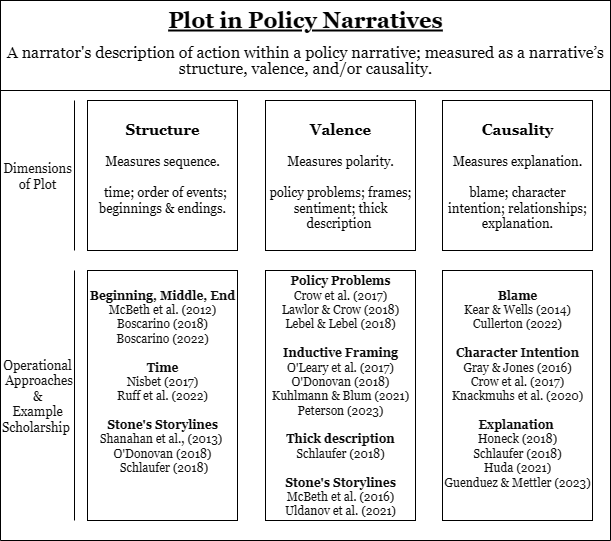
Structure refers to how action unfolds in a policy narrative, including sequence, timing, beginnings, and endings. Valence captures the direction or tone of action, such as whether a narrative describes improvements, declines, crisis, or progress on a policy issue. Causality refers to how responsibility for action is assigned, explaining why events happen, who or what is responsible, and how policy problems are connected to policy solutions.

Figure 4 summarizes this argument by showing how these three dimensions connect to common operational approaches in the NPF literature. This helps clarify that NPF scholars may all be studying plot, but they are often measuring different parts of plot.

Figure 4. A Reference for Plot in NPF Scholarship.

Why It Matters

This article argues that plot should not be treated as a single, fixed measurement. Instead, scholars can use structure, valence, and causality as a shared language for describing what they mean when they study plot. That shared language can help NPF scholars communicate their research designs more clearly, compare findings across studies, and build cumulative knowledge about how policy stories shape public life.

As the NPF continues to grow across policy areas, methods, and levels of analysis, clear concepts matter. Boundaries for plot can help researchers explain how policy stories organize action, assign meaning, and connect policy problems to policy solutions. The article concludes with opportunities for future research on plot, especially in better measuring how structure and causality work together to create momentum for policy narratives.

Read the original article in Policy Studies Journal:

Ruff, Jonathan WA. 2026. “Structure, Valence, and Causality: A Scoping Review of Plot Concepts and Measurements in the Narrative Policy Framework”. Policy Studies Journal 54(1). https://doi.org/10.1111/psj.70066.

About the Article’s Author(s)

Jonathan Ruff is an Assistant Professor of Political Science in the School of American and Global Studies at South Dakota State University. His research examines how governments use storytelling to define policy problems, justify bureaucratic authority, and organize institutional responsibilities. 

Devil and Angel Shifts in Collective Action: A Call for Integration and Improvements

Collective action can serve as a vehicle for advancing policy change. Studies show that, to this end, coalitions may form around shared beliefs to influence policies in line with their preferences. In interaction with competing coalitions, however, intergroup dynamics can lead to a demonization of opponents and a glorification of allies; phenomena that have been termed Devil-Shift (DS) and Angel-Shift (AS), respectively. The growing interest in these observations from different strands of research has encouraged the authors in this article to investigate how DS-AS is studied across different policy frameworks. With regard to the Advocacy Coalition Framework (ACF) and the Narrative Policy Framework (NPF), the authors conducted a systematic literature review in order to promote theoretical integration and methodologically improve how policy researchers study collective action and intergroup dynamics. The authors explicitly ask: How do the ACF and NPF conceptualize, as well as measure DS-AS tactics? To what extent do similarities and/or differences exist between these frameworks that may affect mutual research progress on collective action?

Methodology

The authors conducted a systematic literature review, screening articles that engaged with the DS-AS concepts in relevant databases such as Web of Science. Subsequently, after ensuring that the collected articles aligned with the authors’ criteria/guidelines, the final sample for the literature review consisted of 38 articles. The authors then reviewed the application trends of DS and AS over time regarding publication outlets, policy domains, co-citations, conceptualization, measurement, and findings. This was done with the aim of proposing an integration of the research in a joint research program.

Key Findings

Conceptualization and Measurement Differ Substantially by Framework

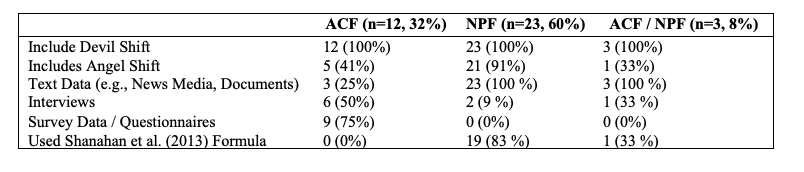
The ACF and the NPF differ substantially in their conceptualization of DS-AS. While the ACF mainly uses the original definition of the perception of opponents as exaggeratingly more evil and powerful, the NPF conceptualizes the two as narrative strategies used in communication in policy processes. Table 1 also reveals that ACF studies predominantly employ survey data/questionnaires, as well as interviews, to capture the perceptions of policy actors. Meanwhile, NPF studies draw on textual data, such as news articles and documents, to analyze how actors’ biases/perceptions are translated into viable narrative strategies. These discrepancies highlight a severe disconnect between ACF and NPF-centric studies, showcasing that while both studies attempt to further explore collective action dynamics, the applied methods lead to varied understandings of actor behaviors.

Table 1. Summary of Methods for DS/AS in ACF/NPF Studies.

A Unified Sub-Theory with Different Methods

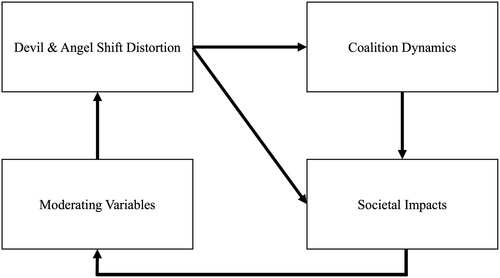
Despite using different conceptualizations and methodological approaches to study the two phenomena, there is a converging interest in examining similar facets of cognitive processes that shape preferences and behavior in the policy process, as well as strategies used to mobilize and/or combat other coalitions. Therefore, the authors propose a unified research program to structure and jointly advance research on the DS-AS. Figure 7 visualizes this theory, in which DS-AS can be analyzed as both an independent and a dependent variable, and to the study of which both ACF and NPF can make a meaningful and complementary contribution. While ACF provides insights into DS-AS alongside the NPF’s identified narrative strategies, the NPF adds a manifestation of DS-AS in the public discourse of what the ACF captures as cognitive misperceptions.

Figure 7. Flow Diagram of General Devil Shift-Angel Shift Theory.

Why It Matters

This article provides a critical foundation for exploring how cognitive biases influence the identification of allies and adversaries by political actors amidst policy conflicts. By focusing on DS-AS tactics across two different theoretical frameworks, an opportunity exists for cross-theoretical integration. The prospective blend of coalitional and discourse-focused research in ACF and NPF, respectively, has the potential to shed light on inter-group dynamics affecting collective action on complex policy issues. While both theoretical frameworks diverge on conceptualizations and measurements of DS-AS, they are actively molding a robust and unified sub-theory of actor perceptions in policy research. The authors recommend that both research communities contribute to this unified sub-theory with different theoretical and methodological extensions and advancements, and by engaging in an interdisciplinary dialogue to better understand the drivers of policy actor biases and activities during policy conflict.

Read the original article in Policy Studies Journal:

Hornung, Johanna, Allegra H. Fullerton, and Christopher M. Weible. 2025. “Devil and Angel Shifts in Collective Action: A Call For Integration and Improvements”. Policy Studies Journal 53(4): 1014-1044. https://doi.org/10.1111/psj.70018.

About the Article’s Author(s)

Dr. Johanna Hornung is an assistant professor in Public Policy at the University of Lausanne. She is Co-Editor of the Review of Policy Research (RPR) and the European Policy Analysis (EPA) journal. Her research interests lie in public policy research, particularly health policy, and the integration of psychological perspectives in actor-centered explanations of policy processes. 

Dr. Allegra H. Fullerton is a researcher and lecturer at the School of Public Affairs at the University of Colorado Denver. Her work focuses on policy theories, emotions in politics, and improving fairness for marginalized communities. She serves on the Conference on Policy Process Research organizing committee and as Digital Associate Editor at Policy and Politics.

Dr. Christopher M. Weible is a University of Colorado Distinguished Professor at the School of Public Affairs. He is the Co-Founder and Co-Director of the Center for Policy and Democracy (CPD) and Co-Editor of Policy & Politics. His work includes Theories of the Policy Process, Methods of the Policy Process, and Policy Debates in Hydraulic Fracturing. He has an Honorary Doctor of Philosophy and is a Guest Professor at the Luleå University of Technology, Luleå, Sweden. 

Bureaucratic Access in Congressional Agenda Setting on Global Warming and Climate Change

Most research on bureaucracy and Congress examines oversight of policy implementation. This article shifts focus to bureaucratic access to congressional agenda setting on global warming and climate change (GWCC) during the early-stage, pre-legislative period (1976-2007), when the issue was emerging and no major legislation had yet been drafted.

Concepts and Hypotheses

The authors conceptualize bureaucratic access to congressional hearings as a multidimensional construct with three key components:

Participation — Frequency of testimony appearances (measured by simple count).

Dispersion — Spread across congressional committees (measured by normalized Shannon’s entropy).

Centrality — Positional importance in the congressional hearing network (measured by closeness and eigenvector centrality).

Bureaucrats are expected to dominate early-stage GWCC hearings due to their specialized expertise, broad monitoring capacity, perceived neutrality, and institutional memory—advantages often lacking in other witness groups. The study tests three hypotheses:

H1: Bureaucrats provide more testimonies than other groups.

H2: Bureaucrats appear across a wider range of committees.

H3: Bureaucrats occupy more central positions in hearing networks.

Methodology

Using mixed methods, the authors analyzed original data from Lexis-Nexis Congressional Publications, including 153 GWCC hearings and 1,338 testimonies from 1976-2007. Witnesses were coded into five groups (bureaucracy, academia, industry/business, nonprofits, and other). Quantitative measures of participation, dispersion, and centrality, along with statistical tests, were used to evaluate the hypotheses.

Key Findings

Participation: Bureaucrats Dominated GWCC Testimonies

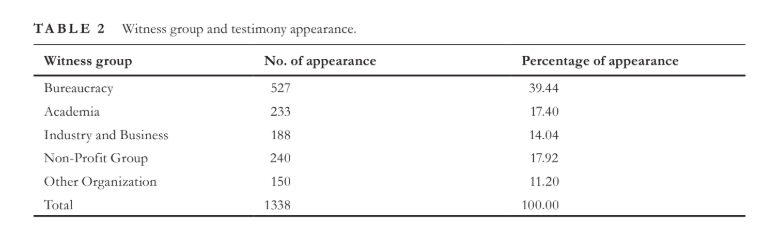
Table 2 below shows that out of 1,338 testimonies, bureaucrats provided 527 (39.4%), far more than academia (17.4%), non-profits (17.9%), industry and business (14.0%), or other organizations (11.2%). Statistical tests confirm that bureaucrats appeared significantly more often than any other witness group.

Table 2. Witness Group and Testimony Appearance.

Dispersion: Bureaucrats Were the Most Dispersed

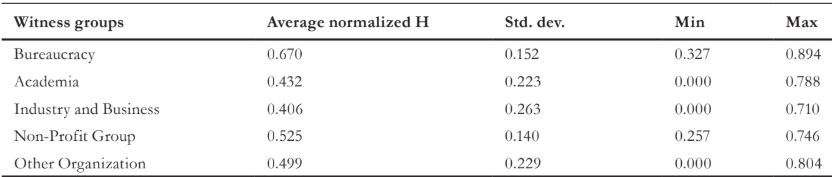
Table 3 below shows the bureaucrats’ average normalized entropy score (0.67) was the highest among the five witness groups. Further statistical tests confirm they testified across a significantly wider range of congressional committees than any other group.

Table 3. Witness Group and Dispersion Score.

Centrality: Bureaucrats Occupied the Most Central Network Positions

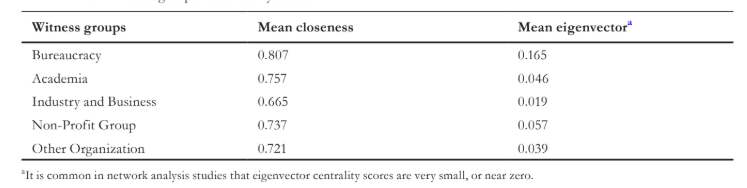
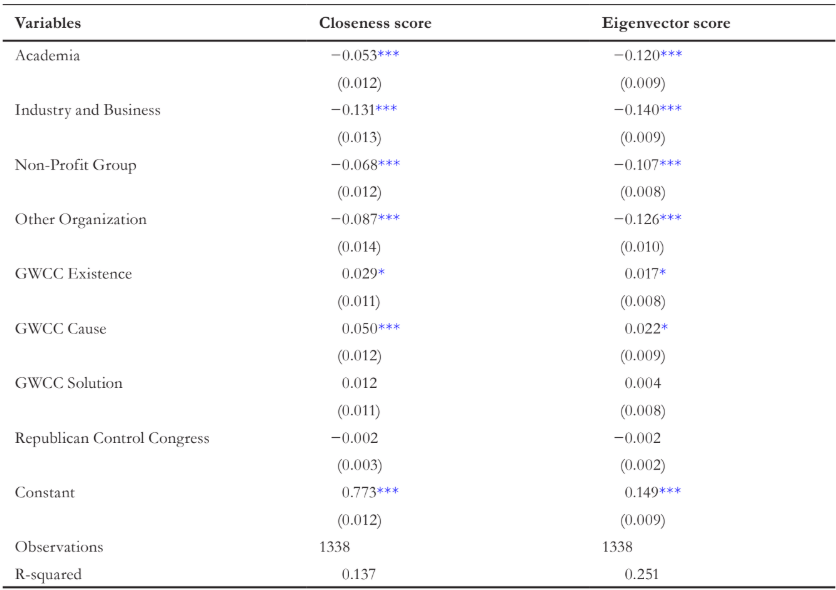
As shown in Table 4, Bureaucrats scored the highest on both measures of network centrality: closeness centrality (more direct and efficient connections to other actors) and eigenvector centrality (connections to other well-connected actors). They acted as key hubs linking different committees and stakeholders. Further regression analysis (see Table 5) indicates these patterns of bureaucratic centrality held strongly during the early years of congressional GWCC agenda setting when Congress was seeking information from various witness groups on whether the problem was real and human caused.

Table 4. Witness Group and Centrality Scores.

Table 5. Determinants of Closeness and Eigenvector Centrality (Bureaucracy as the Reference Group) for the Entire Study Period (1976-2007).

Why It Matters

This study demonstrates the bureaucracy’s prominent role in congressional GWCC agenda setting in terms of their testimony participation, committee dispersion, and network centrality. For policy scholars, it provides theoretical insights and empirical tools (e.g., entropy score and network metrics) for studying multidimensional agenda access. For practitioners, it highlights that bureaucrats shape policy agendas, not just implementation.

Read the original article in Policy Studies Journal:

Liu, Xinsheng, Bryce Hannibal, and Arnold Vedlitz. 2025. “Bureaucratic Access in National Policy Agenda Setting Process: Participation, Dispersion, and Centrality. ” Policy Studies Journal, 53(4): 833-851. https://doi.org/10.1111/psj.70023

About the Article’s Author(s)

Xinsheng Liu, Ph.D., Senior Research Scholar and Research Scientist, Institute for Science, Technology, and Public Policy, Bush School of Government and Public Service, Texas A&M University, College Station, Texas, USA.

Bryce Hannibal, Ph.D., Federal Statistical Research Data Center Administrator and Survey Statistician. U.S. Census Bureau. Suitland, Maryland, USA.

Arnold Vedlitz, Ph.D., Bob Bullock Chair in Government and Public Policy, Director & Distinguished Research Scholar, Institute for Science, Technology and Public Policy, Bush School of Government and Public Service, Texas A&M University, College Station, Texas, USA.