Bureaucratic Access in Congressional Agenda Setting on Global Warming and Climate Change

Most research on bureaucracy and Congress examines oversight of policy implementation. This article shifts focus to bureaucratic access to congressional agenda setting on global warming and climate change (GWCC) during the early-stage, pre-legislative period (1976-2007), when the issue was emerging and no major legislation had yet been drafted.

Concepts and Hypotheses

The authors conceptualize bureaucratic access to congressional hearings as a multidimensional construct with three key components:

Participation — Frequency of testimony appearances (measured by simple count).

Dispersion — Spread across congressional committees (measured by normalized Shannon’s entropy).

Centrality — Positional importance in the congressional hearing network (measured by closeness and eigenvector centrality).

Bureaucrats are expected to dominate early-stage GWCC hearings due to their specialized expertise, broad monitoring capacity, perceived neutrality, and institutional memory—advantages often lacking in other witness groups. The study tests three hypotheses:

H1: Bureaucrats provide more testimonies than other groups.

H2: Bureaucrats appear across a wider range of committees.

H3: Bureaucrats occupy more central positions in hearing networks.

Methodology

Using mixed methods, the authors analyzed original data from Lexis-Nexis Congressional Publications, including 153 GWCC hearings and 1,338 testimonies from 1976-2007. Witnesses were coded into five groups (bureaucracy, academia, industry/business, nonprofits, and other). Quantitative measures of participation, dispersion, and centrality, along with statistical tests, were used to evaluate the hypotheses.

Key Findings

Participation: Bureaucrats Dominated GWCC Testimonies

Table 2 below shows that out of 1,338 testimonies, bureaucrats provided 527 (39.4%), far more than academia (17.4%), non-profits (17.9%), industry and business (14.0%), or other organizations (11.2%). Statistical tests confirm that bureaucrats appeared significantly more often than any other witness group.
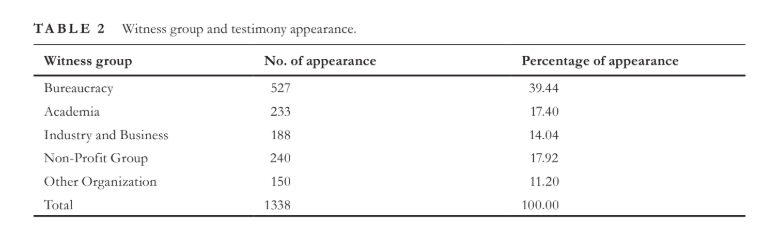
Table 2. Witness Group and Testimony Appearance.

Dispersion: Bureaucrats Were the Most Dispersed

Table 3 below shows the bureaucrats’ average normalized entropy score (0.67) was the highest among the five witness groups. Further statistical tests confirm they testified across a significantly wider range of congressional committees than any other group.
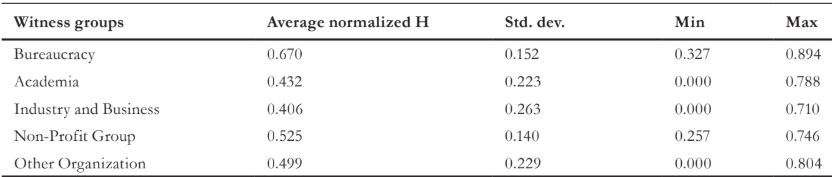
Table 3. Witness Group and Dispersion Score.

Centrality: Bureaucrats Occupied the Most Central Network Positions

As shown in Table 4, Bureaucrats scored the highest on both measures of network centrality: closeness centrality (more direct and efficient connections to other actors) and eigenvector centrality (connections to other well-connected actors). They acted as key hubs linking different committees and stakeholders. Further regression analysis (see Table 5) indicates these patterns of bureaucratic centrality held strongly during the early years of congressional GWCC agenda setting when Congress was seeking information from various witness groups on whether the problem was real and human caused.
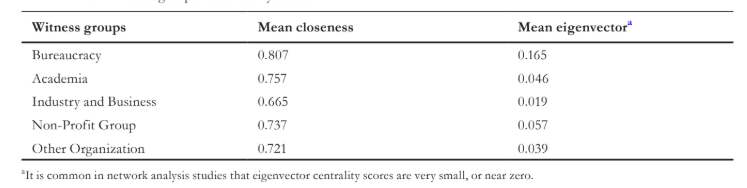
Table 4. Witness Group and Centrality Scores.
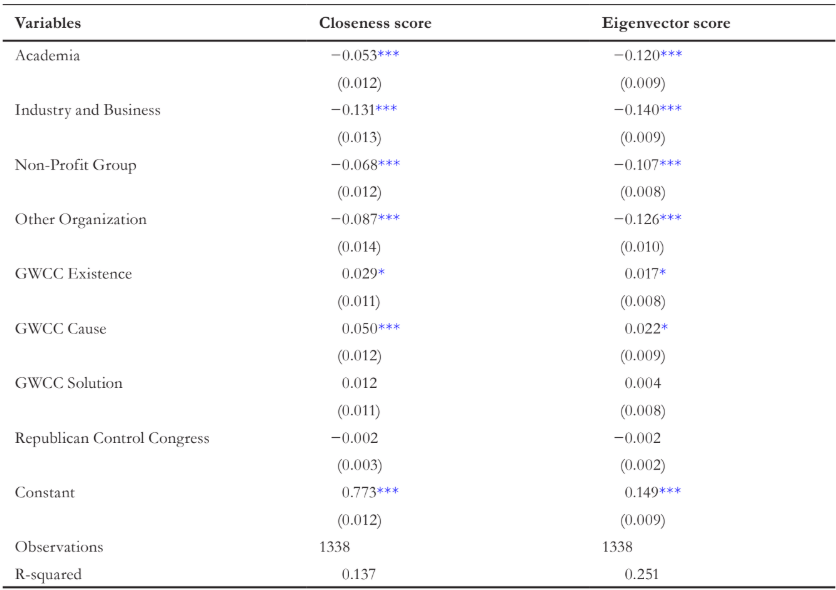
Table 5. Determinants of Closeness and Eigenvector Centrality (Bureaucracy as the Reference Group) for the Entire Study Period (1976-2007).

Why It Matters

This study demonstrates the bureaucracy’s prominent role in congressional GWCC agenda setting in terms of their testimony participation, committee dispersion, and network centrality. For policy scholars, it provides theoretical insights and empirical tools (e.g., entropy score and network metrics) for studying multidimensional agenda access. For practitioners, it highlights that bureaucrats shape policy agendas, not just implementation.

Read the original article in Policy Studies Journal:

Liu, Xinsheng, Bryce Hannibal, and Arnold Vedlitz. 2025. “Bureaucratic Access in National Policy Agenda Setting Process: Participation, Dispersion, and Centrality. ” Policy Studies Journal, 53(4): 833-851. https://doi.org/10.1111/psj.70023

About the Article’s Author(s)

Xinsheng Liu, Ph.D., Senior Research Scholar and Research Scientist, Institute for Science, Technology, and Public Policy, Bush School of Government and Public Service, Texas A&M University, College Station, Texas, USA.

Bryce Hannibal, Ph.D., Federal Statistical Research Data Center Administrator and Survey Statistician. U.S. Census Bureau. Suitland, Maryland, USA.

Arnold Vedlitz, Ph.D., Bob Bullock Chair in Government and Public Policy, Director & Distinguished Research Scholar, Institute for Science, Technology and Public Policy, Bush School of Government and Public Service, Texas A&M University, College Station, Texas, USA. 

The Triangle of Bureaucratic Policy Analysis and the Professional Types of High-Level Civil Servants: Empirical Evidence from Southern Europe

Public policy and public administration research has focused on conceptualizing bureaucrats as pivotal actors in the policymaking process. This has allowed scholars to investigate the capacities and skills of bureaucrats as policymakers and how advice and knowledge inform their behavior. Nevertheless, the literature has proceeded in a fragmented way and without a sophisticated analytical framework that would allow for comparative research. Our recent study aims to address this by proposing a new framework for understanding how high-level civil servants—those at the top of national public administrations—engage in policymaking through the lens of policy analysis.

This study asks a central question: How can we better conceptualize the professional role of senior civil servants in the policy process? To answer this, we developed the “triangle of bureaucratic policy analysis,” which connects three core dimensions of bureaucratic work:

  • Policy Work: What bureaucrats do on a daily basis (e.g., advising, managing, steering).
  • Policy Analytical Capacity: What analytical skills and techniques they use (e.g., economic, legal, statistical).
  • Sources of Information: Where they get their information (e.g., laws, government reports, statistical data).

Figure 1. Triangle of bureaucratic policy analysis.

We applied this framework to a unique dataset: a large survey of 1,014 senior civil servants in the central governments of Greece, Italy, Portugal, and Spain. These countries share a “Napoleonic” administrative tradition and do not typically employ specialized policy analysts, making them ideal cases for examining how policy analysis functions without formal structures.

We used factor analysis to identify patterns in how civil servants combine work, skills, and information. Then, we used principal component analysis (PCA) to cluster these patterns into three main professional “types” of high-level bureaucrats:

  1. Political Generalist: A flexible coordinator and boundary-spanner. These bureaucrats steer ministry activities, interact with politicians and stakeholders, and rely on a broad mix of information sources. They possess “eclectic” analytical capacities—skills gained through both training and professional experience—and play a central role in aligning government priorities across sectors.
  2. Legal Advisor: True to Southern Europe’s legalistic traditions, these civil servants focus on advising political leaders using legal and regulatory tools. Their policy work revolves around assessing legal feasibility, and they rely heavily on juridical sources of information. Their analytical expertise is narrowly focused on legal techniques.
  3. Manager: A newer type, these officials emphasize implementation and results. They are more empirically oriented, favoring evidence-based data and economic analysis. Their policy work includes program management and performance monitoring, reflecting the influence of New Public Management reforms.

Each of these types reflects a different way that bureaucrats contribute to policymaking—one political and strategic, one legalistic, and one managerial.

Image Description

Figure 2. (a) Empirical types of high-level civil servants in Southern Europe: Type 1 (political generalist). (b) Empirical types of high-level civil servants in Southern Europe: Type 2 (legal advisor). (c) Empirical types of high-level civil servants in Southern Europe: Type 3 (manager).

This study contributes to a growing recognition that senior civil servants are more than passive implementers—they are policy actors with distinct analytical profiles. Our “triangle” approach offers a new way to classify and understand how bureaucracies influence policymaking, moving beyond simplistic divides like “generalist vs. specialist” or “bureaucrat vs. politician.” Moreover, these insights are relevant for reform efforts, helping policymakers assess whether administrative roles and skills are well-matched—and whether bureaucrats are being utilized effectively across different policy challenges.

You can read the original article in Policy Studies Journal at

Capano, Giliberto, Alice Cavalieri and Andrea Pritoni. 2025. “The Triangle of Bureaucratic Policy Analysis and the Professional Types of High-level Civil Servants: Empirical Evidence From Southern Europe.” Policy Studies Journal 53(1): 69–90. https://doi.org/10.1111/psj.12577.

About the Article’s Authors

Giliberto Capano is a professor of Public Policy at the University of Bologna, Italy. He specializes in public administration, public policy analysis, and comparative higher education. His research focuses on governance dynamics and performance in higher education and education, policy design and policy change, policy instruments’ impact, the social role of political science, the policy impact of COVID-19, and leadership as an embedded function of policy making. His recent books are A modern Guide to Public Policy (coedited with M. Howlett, Edward Elgar, 2020); Convergence and Diversity in the Governance of Higher Education (coedited with D. Jarvis, Cambridge University Press, 2020); Trajectories of Governance How States Shaped Policy Sectors in the Neoliberal Age (coauthored with A. Zito, J. Rayner, and F. Toth, Palgrave, 2022); The Fate of Political Scientists in Europe (with Luca Verzichellli, Palgrave, 2023). 

Alice Cavalieri is a post-doctoral researcher at the University of Trieste (Italy), where she works on a project about the response of parliaments and governments to different crises. Her main research interests are public budgeting and women’s representation. Her first book, Italian Budgeting Policy (Palgrave Macmillan; 2023), has been awarded the “Pietro Grilli di Cortona” Biannual Prize for the best book published by a member of the Italian Political Science Association. She is a member of the Italian team of the Comparative Agendas Project and former country lead for Italy of the OxCGRT led by the Blavatnik School of Government (University of Oxford).

Andrea Pritoni is an associate professor of Political Science in the Department of Arts at the University of Bologna, where he teaches Electoral Campaigns in Italy and Institutional Relations and Advocacy. His main research interests relate to Italian politics, lobbying and interest group politics, as well as comparative public policy. He has recently published articles on South European Society & Politics (2024), International Review of Administrative Sciences (2024) and European Political Science (2024).