Exploring Contextual Influences in Collaboration: A Sensemaking Perspective

How do collaborative projects survive when the external environment continues to rapidly change? Traditionally, scholars have looked internally, concentrating on capacity, communication, and trust. However, the study conducted by Zhihang Yuan and his colleagues challenge the intrinsic focus of public management literature. Their study builds upon existing research on collaborative governance by emphasizing external contextual factors and tensions such as sociopolitical trends, regulatory domains, and institutional parameters. The Contextual Dynamic Collaboration (CDC) framework, serving as the authors’ primary conceptual model, treats external context as an active, ever-changing element that can dominate collaborative outcomes. By shifting toward an extrinsic lens of collaborative governance, the authors spotlight how policy actors strategically navigate, process, and utilize environmental factors for enhancing project outcomes.

The CDC: How External Environments Shape Collaboration

The CDC framework charts a four-stage process demonstrating how external environments infiltrate into the internal dynamics of project collaboration (see Figure 1).

  1. System Shocks: Disruptive macro-events transpire externally via political polarization, economic turmoil, etc.
  2. Leader Sensemaking: Policy leaders employ a sense-making strategy to interpret these external events, using their own belief systems, identities, and political values.
  3. Contextual Tensions: Leaders utilize their interpretations for strategic action, thereby creating friction within the collaborative dynamics.
  4. Collaborative Adaptation: The internal dynamics of the collaborative regime must adapt or change to adjust to the newer external tensions.
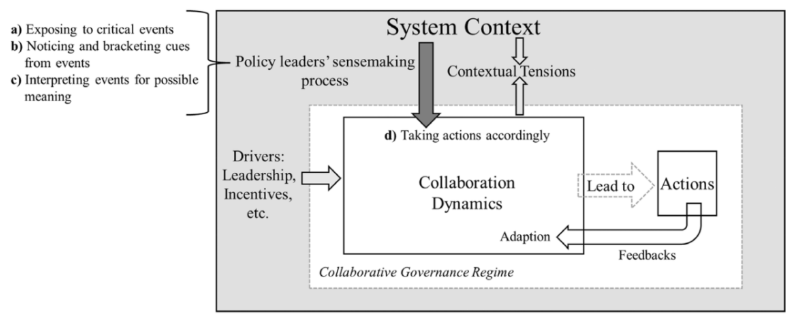
Figure 1. The Contextual Dynamic Collaboration (CDC) model.

Methodology

To understand how external context and environments shape collaboration, the authors analyzed the construction of the Hong Kong-Zhuhai-Macau Bridge (HZMB). The HZMB project represented the largest collaborative infrastructure undertaking in South China. Drawing on the legislative minutes of 495 HZMB-related government meetings from 2003 to 2017, the authors coded for disputes or policy concerns (contextual tensions) elevated by legislators. The content-analysis exercises produced a total of 890 identifiable cases of contextual tensions related to the HZMB. Furthermore, the authors interviewed 20 government officials collaborating on the HZMB to understand their decision-making circumstances.

Key Findings

Combative Sociopolitics Institutionalizes Legislative Conflict

After analyzing legislator statements, the authors found that a strong relationship exists between sociopolitical development and institutional tensions. The widespread unrest coming from the Hong Kong-Mainland China relationship at the time spurred an aggressive contextual environment. These circumstances caused many legislators to raise concerns that prompted changes in current institutional frameworks such as increasing project monitoring. This phenomenon shows that when political and social tensions erupt, this catalyzes a deteriorating contextual setting, and reshapes the current design of collaborative projects.

Economic Stagnation is “Ammunition” for Policy Conflict

Adding to the effects of a declining sociopolitical environment, the authors also found that worsened economic conditions can spark institutional tension. For example, during periods of a declining economy, legislators were more likely to disagree over procedures involving environmental impact evaluations. However, the caveat of this dynamic is that the sociopolitical environment has a stronger impact on institutional tensions than economic circumstances. This means that legislators are more reactive to changes in how people live and political decisions are made.

Political Identity Moderates these External Shocks

Interestingly, the political identity of legislators working on the HZMB project appears to moderate the relationship between contextual influences and institutional tension. As shown in Figure 3, legislators who identified as pro-democracy were more likely than pro-government legislators to share concerns prompting institutional changes—when the sociopolitical environment declined. For example, in the HZMB project, pro-democracy legislators tended to suggest changing the collaborative setup of the project when relations between Mainland China and Hong Kong soured, and economic conditions declined. These illustrations demonstrate that when external circumstances arise, legislative leaders defer to their political values to make sense of the situation and adjust the direction and outcomes of a collaborative project.
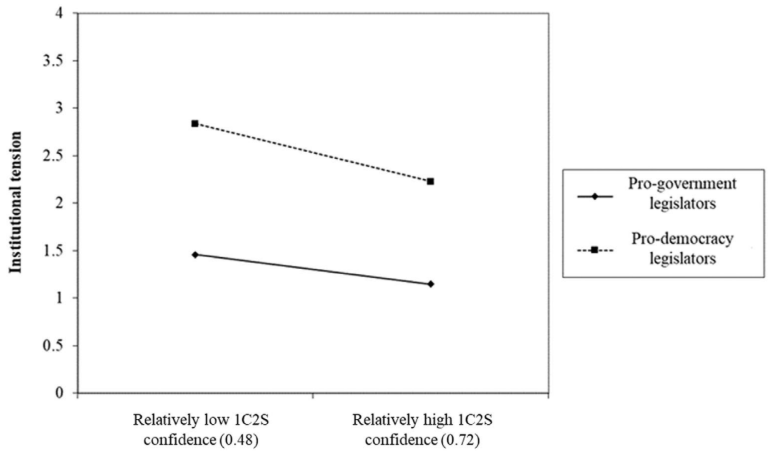
Figure 3. Political identity mitigates the association between sociopolitical context and tension severity levels—Pro-democracy legislators more likely to raise institutional tensions in deteriorating sociopolitical environment (the dotted line in the figure).

Why It Matters

For policy managers navigating the unpredictable, turbulent nature of modern sociopolitical environments, an important lesson is offered by this study: collaborating with your allies or partners is only one side of the coin. In an ever-changing contextual ecosystem that reshapes how people live, work, and make decisions, actively anticipating how those same allies/partners will interpret these changes is the other side. This article provides an important perspective for understanding how collaborative governance, and stakeholder interactions are shaped by external factors driving change. For future research, scholars should examine other cases of contextual influences molding the design(s) of collaborative governance systems. This direction will provide a more comprehensive picture for how impactful change to a joint system does not always come from within, but from outside.

Read the original article in Policy Studies Journal:

Yuan, Zhihang, Wang, XiaoHu, Li, Jinwei, & Jingyuan Xu. (2025). “Exploring Contextual Influences in Collaboration: A Sensemaking Perspective.” Policy Studies Journal 53(4): 899-924. https://doi.org/10.1111/psj.12586.

About the Article’s Author(s)

Zhihang Yuan is an Assistant Professor at School of Public Affairs, Zhejiang University. His research interests include collaborative governance, environmental governance, and fiscal governance, with a particular focus on the context of China. His work has been published in reputable journals such as China Review, International Journal of Disaster Risk Reduction, Ecological Economics, Sustainable Cities and Society, and Sustainable Energy Technologies and Assessments. 

XioaHu Wang is a scholar of public administration with a focus on fiscal, collaborative, and sustainable policy implementation in government. He has developed a capacity-building approach to study these issues in the United States, Mainland China, and Hong Kong. He is the author of more than 100 publications. He has consulted for the governments in the U.S. and Hong Kong. His research impact can be seen through citations, which include the governmental agencies in Sweden, Ireland, Belgium, and the U.S., the United Nations, the World Bank, the Asian Development Bank, the Inter-American Development Bank, the RAND Corporation, and the National Academy of Sciences in the U.S. He is a professor and the Associate Dean (Research) at the College of Liberal Arts and Social Sciences, City University of Hong Kong (City UHK), and he directs City UHK’s Greater Bay Area (GBA) Cluster. Previously, he was a professor at the University of Central Florida (UFC) in the U.S. He won many academic awards including an Article of Year Award from American Society for Public Administration (ASPA)’s Section on Chinese Public Administration 2023, and UCF’s Teaching Incentive Awards and Research Incentive Awards (multiple times). He is among Stanford’s top 2% most highly cited scientists.

Jinwei Li is a Lecturer at The Education University of Hong Kong and holds an affiliated research position at the Greater Bay Area Research Centre, City University of Hong Kong. She is a policy researcher specializing in public governance, social policy, and cross-border collaboration. Her work sits at the intersection of research and practice. She actively contributes to policy advisory and research initatives for the Hong Kong Legislative Council, the Office of a Deputy to the National People’s Congress of China, and Chinese Mainland government agencies. Her policy outputs—including Motions in the Hong Kong Legislative Council, Chinese Mainland planning proposals, policy papers, and advisory briefs—have directly informed policy deliberation and government decision-making in both Hong Kong and the Chinese mainland. Her academic work has been published in leading international journals such as The China Review and Policy Studies Journal. 

Jingyuan Xu is an Assistant Professor at Institute for Global Public Policy (IGPP) and a researcher at LSE-Fudan Research Centre for Global Public Policy, Fudan University. She is interested in analyzing the local government’s policy implementation capacity in response to the challenges in transboundary infrastructure building, environmental and climate change governance. Her recent published articles appear in Policy Studies Journal, Public Administration Review, Environmental Politics, Climate Policy, and other outlets.

“Big & Rich”: A New Way to Measure Attention and Participation Diversity

In public policy, we are often interested in attention and participation, and even more specifically in the concentration of attention and participation: are policymakers paying attention to many different issues, or are they focused on one main problem? Is one set of interests dominating a particular conversation or institution or are multiple interests able to have input in making decisions? These questions are important because they speak directly to many of the big ideas at the heart of studying public policy: power, representation, and governing capacity.

Policy process scholars have used a few different measures of concentration to answer these questions over the past several decades. The Herfindahl-Hirschman Index or HHI, was used by economists to measure market concentration; policy scholars used it to measure the clarity of legislative committee jurisdictions (Frank Baumgartner, Bryan Jones, and Michael MacLeod), policy coherence (Peter May, et al.), and the spread of attention in local government agendas (Brooke Shannon), among many other applications.

In 2014, Amber Boydstun, Shaun Bevan, and Herschel Thomas published an article in PSJ comparing the HHI to Shannon’s H, which traditionally measures information entropy or the relative degree of uncertainty about different possible states of being. Boydstun, Bevan, and Thomas found that Shannon’s H outperformed HHI, and Shannon’s H was quickly adopted as the new measure of choice for the relative concentration or spread of attention and participation, including the relative spread of policy target populations (Catherine Chen, Tanya Heikkila, and numerous co-authors), the breadth of issues on which interest groups devote attention (E.J. Fagan, Zac McGee, and Herschel Thomas), the variety of organizations engaged in coalitional lobbying (Maraam Dwidar), and the concentration (or lack thereof) of policymaker attention on Twitter (Annelise Russell).

In my new PSJ research note, I introduce a new set of measures: richness and evenness. From my own experience, I often found that Shannon’s H was highly correlated with a simple count of the number of different issues or groups represented. In my research note, I show that across a number of different datasets, the correlation between Shannon’s H and simple counts of observations can range between 0.74 and 0.97. So perhaps we can use simple counts as measures. But doing so would lose the key piece of information that speaks to questions of power and representation: the concentration or breadth of observations.

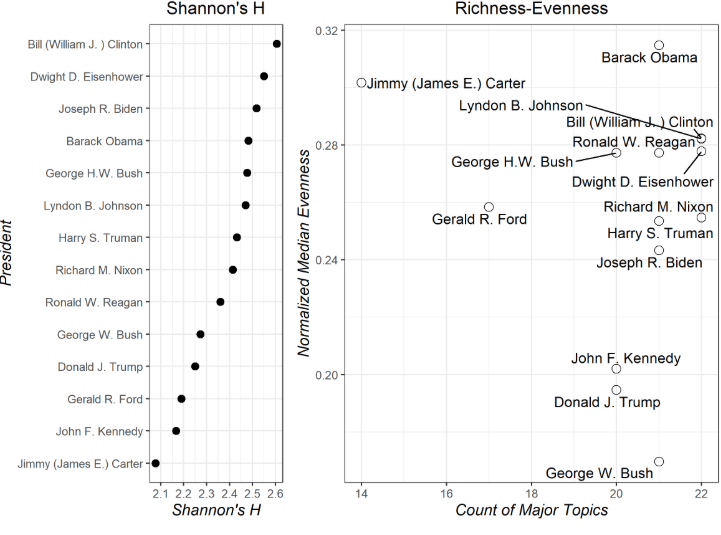
Population ecologists often are interested in the same question (albeit for species and not issues or organized interests), and have developed methods to show both the richness (count of observations) on the x-axis and evenness across observations on the y-axis of a plot. A few different evenness measures are available, and they are all fairly simple to implement and calculate either in a spreadsheet or using software like R and Stata.

As I write in my research note, the advantage of having two measures plotted against each other is that we can more precisely note differences across categories in our data. Depending on what the richness-evenness plots look like, we could even identify some trends or dynamics that Shannon’s H might otherwise hide. The plot below, for example, shows a comparison of the spread of issue attention in U.S. presidents’ State of the Union addresses (from Policy Agendas Project data) using Shannon’s H on the left and a richness-evenness plot on the right, the two plots tell different stories.

And depending on our data, we can separately trace trends in richness and evenness over time. We can therefore better understand whether changes we see in a particular issue area or institution reflect expansion or contraction of the issue agenda, shifts in attention within an unchanging issue space, or both. My hope is that richness-evenness measures and plots open up new questions for us to consider and help us re-examine what we think we know about dynamic policy processes.

Read the original article in Policy Studies Journal:

Lewallen, Jonathan. (2026). “Big & Rich: A New Way to Measure Attention and Participation Diversity.” Policy Studies Journal 54(1): e12593. https://doi.org/10.1111/psj.12593.

About the Article’s Author(s)

Jonathan Lewallen is an associate professor of political science at the University of Tampa. His research focuses on agenda setting and the policy process, and how issues and institutions evolve together over time. 

Coproduction as a Causal Process

How does public service delivery actually happen? Traditional literature has recognized that interactions between citizens and governments are vital to delivering key services such as public safety and education. However, scholars and practitioners have struggled to agree on how to define and visualize coproduction in the public sector. In his recent article, Dr. Gregg Van Ryzin addresses this ambiguity. He argues that coproduction can be understood as a dynamic, sequential causal process. And by visually mapping the causal pathways, scholars and practitioners can gain a new perspective on how to design and improve existing public services.

Mapping Van Ryzin’s Framework

The causal framework prescribed by Van Ryzin diagrams a highly dynamic, interactive process featuring three core variables:

  • Regular Producer (RP): This is represented by the government, municipal workforce, is public contractor who produces a public good or service.
  • Consumer Producer (CP): The client, citizen, or community group who assists in producing a public good or service.
  • Quality/Quantity (Q): The final quantifiable output or outcome—i.e., drivable roads, educated children, safe neighborhoods, etc.

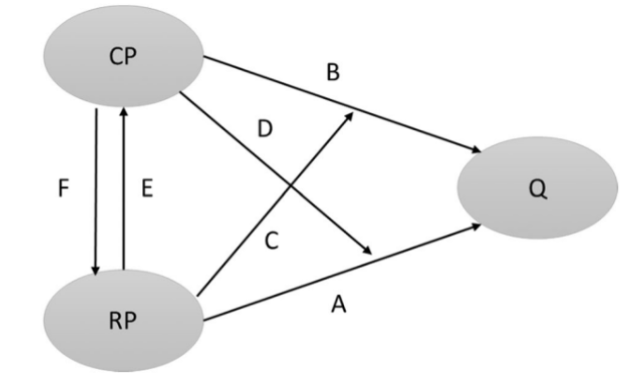
Furthermore, public service production is treated not as a one-way street, but as the result of relationships between citizens and the government in six distinctive causal pathways (Edges):

  • Edge A (Direct Government): The government acts alone to create and deliver the public good/service.
  • Edge B (Grassroots Action): Citizens act independently through grassroots infrastructure or self-help.
  • Edge C (Government Facilitation): The government interacts with and guides citizens in their efforts.
  • Edge D (Citizen Feedback): Citizens actively monitor and provide information or assistance to the government to improve operations.
  • Edge E (Coercion/Mandates): The government mandates citizen compliance through regulations, sanctions, or penalties.
  • Edge F (Political Advocacy): Citizens employ advocacy strategies to pressure the government.

Figure 1. Causal diagram of coproduction.

Real-World Applications Across Public Services

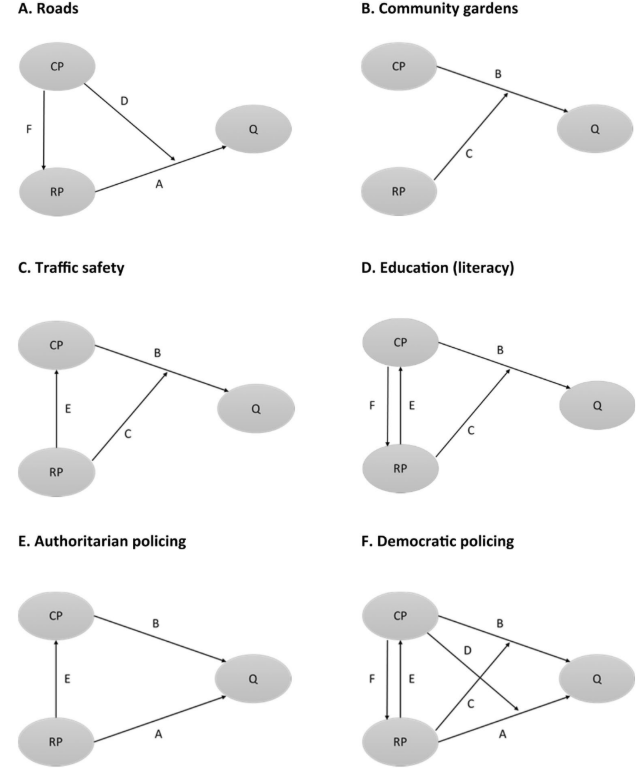
Public services do not rely on the same blueprint for coproduction. By applying the framework to diverse public services, Van Ryzin demonstrates how purpose and context combine to shape service delivery. For example, in the case of community gardens (2B), the grassroots efforts of citizens drive the creation of these services, with the support of government measures such as grants. To achieve traffic safety (2C), the government must, of necessity, rely on legal rules and educational campaigns to ensure driver compliance. These instances convey that coproduction is a context-dependent phenomenon, shaped by the actions and behaviors of citizens and government, unique to the public good or service being created.

Figure 2. Causal diagrams of the coproduction of various public goods and services.

Why It Matters

This perspective piece elegantly highlights how the coproduction of everyday public goods and services is not merely a static mixture of resources, but a dynamic causal process shaped by joint government and citizen inputs. The causal lens also helps clarify how coproduction relates to adjacent concepts like volunteering, participation, co-creation, and collaborative governance, sharpening a term that has long been difficult to pin down. For policymakers, the use of causal diagrams provides several concrete advantages for improving public service delivery. Visualizing similar causal dynamics between distinct public services can unlock opportunities for inter-agency learning and cross-sector collaboration. Moreover, program managers can map their operations to pinpoint pathways for improvements in service delivery by leveraging the input of clients and citizens. Collectively, these visual blueprints enable existing public programs to be optimized to achieve efficiency, equity, and quality in real-world practice.

Read the original article in Policy Studies Journal:

Van Ryzin, G.G. (2026). “Coproduction as a Causal Process.” Policy Studies Journal 54(1), e70053. https://doi.org/10.1111/psj.70053.

About the Article’s Author(s)

Gregg G. Van Ryzin is a professor in the School of Public Affairs and Administration (SPAA) at Rutgers University-Newark, where he is also director of the Lab for Experimental and Behavioral Public Administration (L-EBPA). His research focuses on various behavioral aspects of public policy and administration, including subjective evaluations of government performance, trust of institutions, coproduction, and the symbolic effects of representative bureaucracy. He is currently an editor of the International Public Management Journal, and he was a founding co-editor of the Journal of Behavioral Public Administration. 

Tradeoffs and Spillovers in U.S. Criminal Immigration Enforcement

Have you ever wondered if the enforcement of one set of laws creates “domino effects” on incarcerations for other crimes? This article investigates this phenomena in the area of immigration enforcement. As federal criminal prosecutions against immigration crimes continue to increase in the United States, this has raised questions as to how legal mechanisms deployed against other crimes have been impacted. The authors specifically explore whether a spillover effect is witnessed—if a disproportionate span of criminal enforcement toward immigration crimes led to a decrease in prosecutions toward other crimes. By delving into these dynamics, the authors shed light on the unintended policy consequences of prioritizing criminal enforcement in particular areas of law, and how bureaucratic functions are impacted by such decisions.

Hypotheses

The authors propose the following hypotheses to guide their study:

  1. Hypothesis 1 (Tradeoff): If there is an increase in criminal immigration enforcement, there will be a decrease in enforcement in other areas of law.
  2. Hypothesis 2 (Tradeoff): An increase in immigration enforcement should be correlated with a decrease in white-collar enforcement.
  3. Hypothesis 3 (Spillover): As immigration enforcement increases, there will be an increase in enforcement of other types of cases.
  4. Hypothesis 4 (Spillover-Within Unit): As immigration enforcement increases, enforcement for other types of cases for the unauthorized foreign national subgroup will increase.
  5. Hypothesis 5 (Spillover-Diagonal): As immigration enforcement increases, criminal immigration enforcement against Latino LPRs (Lawful Permanent Residents) in other areas of law increases.
  6. Hypothesis 6 (Spillover-Diagonal, Latino-Specific): As immigration enforcement increases, criminal immigration enforcement against Latino LPRs will be greater than Latino citizens.

Methodology

This study draws on several sources of data, primarily utilizing the U.S. Sentencing Commission’s (USSC) annual “Monitoring of Federal Criminal Sentences” volume. The 2001-2019 period is specifically analyzed to cover a longitudinal extension of immigration policy developments in the United States. Moreover, the authors utilized multivariate regression modeling to test for tradeoffs and spillovers in immigration crime enforcement in other areas of crime—mainly narcotics, firearms, and white-collar crimes. The modeling controlled for the effects of political, institutional, and legal variables such as ideology, congressional partisan control, etc.

Key Findings

A Spillover, Not Tradeoff

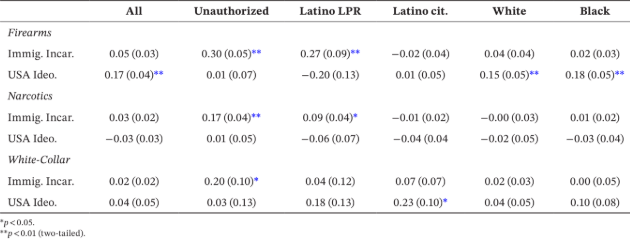
The authors discovered strong evidence of spillover effects rather than a tradeoff effect. As the criminal enforcement of immigration law increases, this coincides with the increase in federal incarcerations for non-immigration crimes. In Table 3, these effects are most pronounced for unauthorized foreign nationals and Latino LPRs. For both groups, an intensification of immigration enforcement yielded increases for firearm and narcotic-related incarcerations. However, these effects did not extend to Latino U.S. citizens, non-Latino whites, or blacks once all model controls were considered. Collectively, these findings show support for Hypotheses 4-6, and that increases in the criminal enforcement of immigration laws implicate arrest rates for other crimes in the United States.

Table 3. Negative binomial regression results.

Immigration Spillover Effects are Not Ideologically-Driven

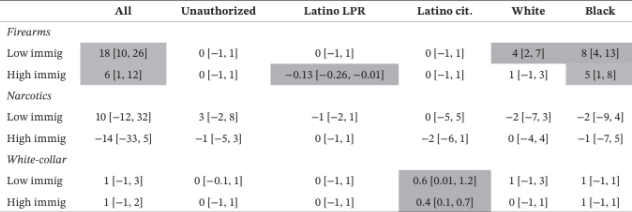
The results show that political ideology does not condition or influence spillover effects from the increased enforcement of immigration laws. As displayed in Table 5, the ideology of a U.S. Attorney does not alter incarcerations in narcotics, white-collar, or unauthorized foreign national cases. The isolated exception to this is firearm cases. During periods of low immigration enforcement, conservation U.S. Attorneys incarcerate more people per year for firearm offenses compared to liberal U.S. Attorneys. These patterns change when immigration enforcement increases, where conservative prosecutors incarcerate fewer individuals for firearm offenses. However, the authors recognized these results are driven primarily by race, not citizenship, as conservative U.S. Attorneys pursue greater prosecution against Black individuals than liberal prosecutors for firearm cases. Overall, the results hint that spillovers in criminal immigration enforcement are structural and mechanical, dictated by organizational routines rather than individual political philosophies.

Table 5. Immigration enforcement, USA interaction (Conserv.—Liberal).

Why It Matters

This article cogently illustrates the effects of intensifying enforcement of immigration laws on other non-related crime areas. The observed patterns convey that as immigration policy shifts, the same old bureaucratic practices and routines are triggered in the United States—impacting how laws are enforced. The authors recommend examining the impact(s) of immigration enforcement in localized settings to determine how environmental context affects the spillover effects observed in this study. Furthermore, the authors suggest that future research directions should explore which routine bureaucratic processes are closely connected to the spillover effects in criminal immigration enforcement. By pursuing these opportunities, scholars can add valuable insights regarding the impact of institutional and street-level practices to current conversations surrounding immigration policy.

Read the original article in Policy Studies Journal:

Stobb, Maureen, Banks Miller, and Brett Curry. 2026. “Tradeoffs and Spillovers in US Criminal Immigration Enforcement”. Policy Studies Journal 54(1): e70046. https://doi.org/10.1111/psj.70046.

About the Article’s Author(s)

Maureen Stobb is a professor of political science at Georgia Southern University. Her research specializes in law and courts, and immigration policy. Before her doctoral studies, she practiced law for seven years, primarily as an immigration and asylum attorney. 

Banks Miller is a assistant professor of Political Science, Public Policy and Political Economy at the University of Texas at Dallas. His research interests include judicial behavior, judicial politics, public policy, immigration, intellectual property, and American politics.

Brett Curry is a professor of political science at Georgia Southern University, teaching in the field of American politics, with a general focus on law and courts. His research interests encompass judicial decision-making, constitutional law, American government, American political institutions, and research methods.