Presidential Powers and the Evolution of Polycentric Governance Systems

A lot of media attention is paid to legislative gridlock on Capitol Hill. At the same time, public policy in the United States also moves beneath the surface, flowing through a complex network of bureaucratic agencies, courts, related actors and decision-making processes at varying levels of government. Policy scholars, Mark Lubell and Jennifer Victor, refer to this as polycentric governance. They further speak to how presidential administrations work through this network to reshape administrative and intergovernmental structures, as well as imprint their political preferences on the direction of public policy.

In their perspective piece, “Presidential Powers and the Evolution of Polycentric Governance Systems”, Drs. Lubell and Victor discuss how presidential administrations use executive actions to alter, sometimes drastically, this domain to pursue their political agendas. By comparing the environmental policies of Presidents Joe Biden and Donald Trump (2nd Term), the authors discuss how presidents exert policy influence through adjusting administrative structures and policies.

How Have Recent Presidential Administrations Reshaped Polycentric Governance

The authors highlight four ways that recent presidential administrations have actively reshaped the arena of polycentric governance in environmental policy:

  • Creating and Eliminating Forums: Presidents can use executive orders (EOs) to structurally create policy forums or spaces to accelerate their policy ambitions or eliminate those same forums to alter policymaking in a different direction.
  • Changing Forum Rules: In cases where presidents are unable to directly eliminate a policy forum as a result of legal protections, they can influence existing forums by altering the institutional rules, jurisdictional boundaries, or the blend of participating actors involved.
  • Shifting Forum Resources: Because policy forums require material resources such as funding and staffing, presidents can shift forum resources by defunding or reducing agency personnel.
  • Centralization: Given how fragmented and decentralized polycentric systems are, presidents can mandate whole-of-government approaches (i.e., centralized bodies) to overcome the independent specialization of some federal agencies and align them under a single executive policy agenda.

Why It Matters

A notable way that presidents can shape the policy process is through structural engineering of polycentric institutions. When executives systematically create, alter, or eliminate established policy forums and networks, they are effectively reshaping administrative and legal boundaries. While many scholars analyze polycentric governance as a mechanism for policy collaboration, it may also offer a lens through which to understand the varied ways that specific actors shape different aspects of the policy process.

Read the original article in Policy Studies Journal:

Lubell, Mark, and Jennifer Victor. 2026. Presidential Powers and the Evolution of Polycentric Governance Systems. Policy Studies Journal, 54(1), e70069: https://doi.org/10.1111/psj.70069.

About the Article’s Author(s)

Mark Lubell is a Professor at the Department of Environmental Science and Policy at the University of California, Davis. He also serves as the Director of the Center for Environmental Policy and Behavior at UC Davis. His research focuses on human behavior and the role of governance institutions in solving collective action problems and facilitating cooperation.

Jennifer Victor is an Associate Professor of Political Science at George Mason University’s Schar School Policy and Government. Her research focuses on the U.S. Congress, legislative organization and behavior, social network methods, political parties, campaign finance, organized interest groups, and lobbying.

The Five-Thread Model & Academic Policy Entrepreneurs: From the White Australia Policy to Multicultural Australia

Academics perform a much larger role beyond the classroom when it comes to shaping public policy decisions and outcomes. They provide data and evidence to political leaders, run trial experiments to test new ideas, and supply expert advice at government hearings. However, traditional frameworks often fail to examine how academics deploy specialized knowledge to shape policy within parliamentary settings. In this study, a core political puzzle is investigated: why Australia moved to a multicultural policy framework in the 1970s. To answer this, the author applies the Five-Thread Model (FTM) to synthesize policy stage activities and continuous policy streams (i.e., problems, solutions, politics, process, program), demonstrating how major societal shifts in controversial public policy are triggered by academic policy entrepreneurs capitalizing on “windows” of opportunity.

Hypotheses

The author proposes the following hypotheses:

H1: The more a cultural representation issue puts a politician’s (re-)election at risk, the more likely a policy window in the FTM will open.

H2: Multicultural policies are more likely to be adopted by a party if they are attached to that party’s ideology or core positions.

H3: The FTM’s critical juncture opens in the problem thread due to the ‘slow-onset’ crisis.

H4: Policy entrepreneurs of academics were consequential in accessing these critical junctures and employed an issue-linking strategy to link it to an urgent short-term issue.

Methodology

The author utilized a minimalist process tracing approach to explore how academic policy entrepreneurs engaged with Australia’s institutional context to shape multicultural policy. To maximize the number of observations and examine a comprehensive period of policy development in Australia’s multicultural framework, the time frame spans from 1945 to 1985. The author’s empirical analysis relies on tracking policy statements, oral histories (i.e., testimonies, interviews, diaries) along with regional and metropolitan news reporting.

Key Findings

Knowledge is Power: How Academics Shaped Australia’s Multiculturalism Policy

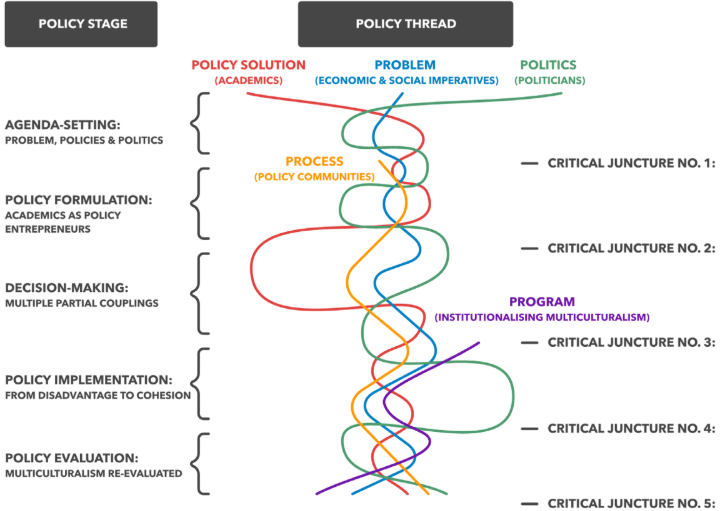
Academics successfully influenced Australian multicultural policy by directly securing seats within the Department of Immigration’s advisory systems, as shown in the continuous streams in Figure 2. This finding suggests that institutional credentials provide scholars with the leverage needed to create official administrative frameworks and reshape national narratives. These mechanisms proved important as systemic policy transformations were not solely driven by politicians rather by external scholarly communities who strategically reframed the “migrant issue”, to encourage multicultural policies. More importantly, this findings directly supports Hypothesis 4, showcasing that academic policy entrepreneurs can be consequential in accessing key policy venues and imprinting their influence on public policy decisions.

Figure 2. The FTM and Australian Multiculturalism Policymaking. Source: Author (adapted from Howlett et al. 2017).

Multiculturalism as a Vehicle for Political Survival

Demographic panic and high political anxieties compelled political parties in Australia to adjust their policy preferences to a diversifying electorate to ensure political survival, as seen in the political thread in Figure 2. This suggests that as thousands of non-British European migrants became naturalized citizens and were concentrated in inner-city electorates, electoral calculations shifted. As a result, this pattern exposes that underlying electoral calculus pressures political parties to alter their institutional ideologies and campaign practices. Therefore, the described political behavior provides strong support for Hypothesis 1 by highlighting that cultural representation issues open up policy windows, prompting politicians to attach their (re-)election prospects to embracing newer policy perspectives and ideas.

Why It Matters

This research adds to a growing body of public policy literature showing how major changes need not necessarily be driven by crisis alone. By using the Five-Thread Model (FTM) to analyze Australia’s embrace of multiculturalism, the author offers a more extacting account of how encroaching, long-term issues can generate enough structural friction to produce changes in deeply rooted, policy frameworks. More importantly, this research demonstrates that academic inputs into the policy process via ideas, expertise and narrative framing can significantly reshape policy approaches. This provides a potential roadmap for how academic research and contributions can inform government institutions and the quality of created policies in the long-term. Future research can build upon this study by applying the FTM to other jurisdictions and political systems to investigate how the intersection of policy and political sequences restructure longstanding institutional architectures.

Read the original article in Policy Studies Journal:

Mok, Julius C.S. 2025. “The Five-Thread Model & Academic Policy Entrepreneurs: From the White Australia Policy to Multicultural Australia.” Policy Studies Journal, 54(2), https://doi.org/10.1111/psj.70075.

About the Article’s Author(s)

Julius Mok is a doctoral candidate at the Asia Institute, the University of Melbourne. His research centers on the politics of multiculturalism and social cohesion.

Topics as Outcomes: Modeling the Influences of Intergovernmental Grants on Policy Diffusion

The innovation of newer policy ideas and initiatives has long been driven, in part by fiscal opportunities within the federal grant system. Grants have helped vitalize the imaginations and ambitions of states and localities, providing programs with the financial means to adapt to the preferences and needs of their constituents. However, some grants offered at the federal-level are not given by default, but require a competitive application process that states must enter to be considered for funds. During this process, states sometimes defer to their neighborhoring states for policy ideas to maximize their chances of receiving a federal grant or look to the national government for direction. To study how intergovernmental grants shape the spread of policy initiatives among states, this study takes a closer look at the federal competitive grant program, “Race to the Top” (RTTT), that was launched in 2009 to reward states for reforming and improving K-12 education.

Hypotheses

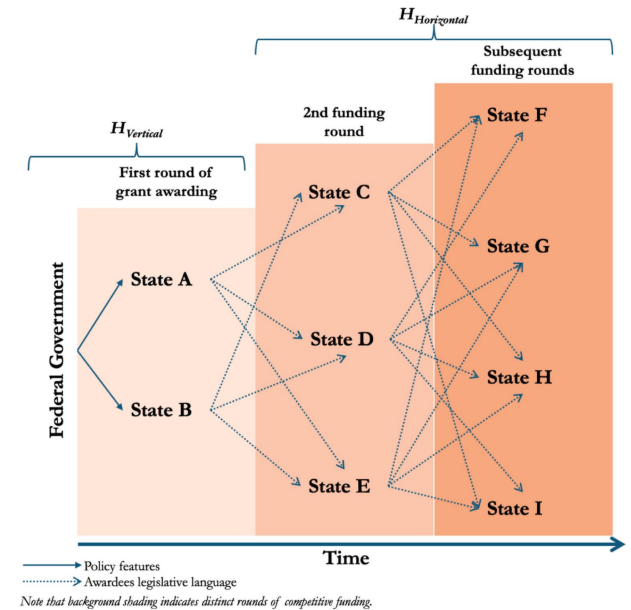
The authors examine how states proposed changes to laws governing teacher evaluation, one of the most prominent opportunities for reform outlined by the Race to the Top program. They introduce two hypotheses to test whether states modeled their policies on the federal government’s recommendations (vertical policy diffusion) or on the policies of other states (horizontal policy diffusion) (see also Figure 1):

Vertical Diffusion Hypothesis: The average prevalence of teacher evaluation legislation will rise during the competitive cycle.

Horizontal Diffusion Hypothesis: States that have not yet received an RTTT grant are more likely to consider legislation regarding teacher evaluation from states that have received a grant in a prior round of competition.

Figure 1. Vertical and horizontal diffusion processes for competitive federal grants for hypothetical states A through I.

Methodology

Instead of treating policy adoption as a binary metric, the authors measure the continuous flow of policy ideas using structural topic modeling (STM). This approach involved examining the text within 4,523 education-related bills introduced across U.S. state legislatures from 2009 to 2019, to locate prevalent or recurring topics. In addition, to track how much U.S. states mimic or copy the policy ideas of other states, the authors applied event history analysis (EHA) and network analysis. These procedures identified and confirmed that states adopted similar education policies mirroring prior grant-winning states, proving that the “Race to the Top” program encouraged horizontal policy diffusion.

Key Findings

States Copy Previous Grant-Winners to Secure Funding

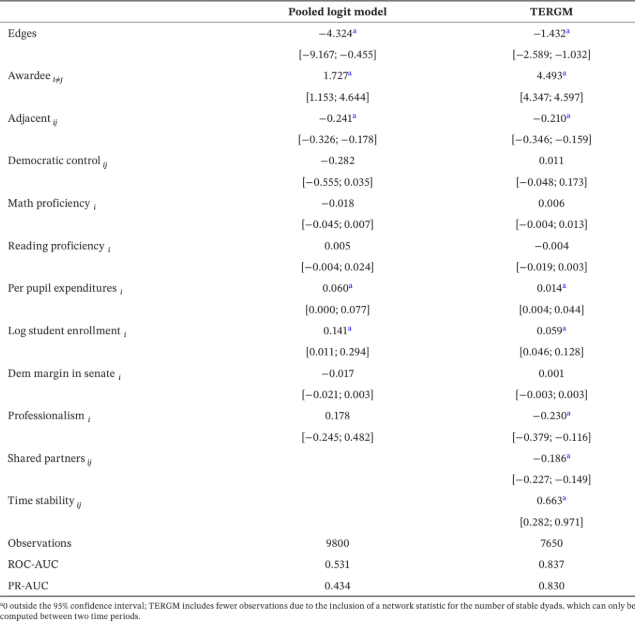
The statistical models showcase that horizontal diffusion or the spread of policy ideas among states is driven by emulation when a state wins a grant, non-winning states begin to significantly increase the presence of similar policy language, namely teacher evaluation measures in their legislative bills. This occurs because the intergovernmental nature of the “Race to the Top” grant program encourages states to use promising legislative ideas as a blueprint for securing funding. These patterns confirm the authors’ horizontal diffusion hypothesis—non-winning states maximize their chances of securing competitive grants by capitalizing on the experimental efforts of other states.

Table 5. Pooled logit and TERMG estimates.

Professionalization Drives Policy Innovation

The results also highlight that the internal capacity of a state legislature directly determines its emulative or mimicking behaviors. When states have fewer employees, lower pay scales, insufficient resources, and shorter sessions, they rely primarily on copying the policy language of grant-winning states. Because states with lower legislative professionalism lack the internal infrastructure to develop innovative and novel policies, this compels them to defer to other states. Meanwhile, state legislatures that are characterized as highly professionalized possess the resource mechanisms to cultivate viable legislative ideas with language matching federal grants.

Why It Matters

The study fundamentally reshapes how scholarship analyzes the diffusion of policy ideas, shifting the emphasis from what ideas are adopted to how ideas are circulated in multi-state legislative domains. For practitioners, the results provide a model for federal grant programs to operate not as centralized policy coordinators dictating public policy, but as conduits for learning from and improving upon established public programs. The authors encourage future research to investigate how ideas in multiple policy categories spread across the intergovernmental landscape and within each stage of the policy process. By further exploring the policy diffusion effects in the federal grant process, helpful insights can be gleaned regarding how states and other levels of government can contribute to, enhance, and mirrior the successes of policy experimentation.

Read the original article in Policy Studies Journal:

Brodnax, NaLette, and Sarah James. 2025. “Topics as Outcomes: Modeling the Influence of Intergovernmental Grants on Policy Diffusion.” Policy Studies Journal 54(2), e70074. https://doi.org/10.1111/psj.70074.

About the Article’s Author(s)

NaLette Brodnax is an assistant professor in the McCourt School of Public Policy at Georgetown University and a William T Grant Scholar (Class of 2028). Her research interests include education policy, policy diffusion, and computational social science. She has also worked as a data scientist both as a consultant and for organizations such as the Institute for Quantitative Social Science at Harvard University and Eli Lily Corporation. Brodnax earned a joint PhD in Public Policy and Political Science from the School of Public and Environmental Affairs at Indiana University, where she specialized in quantitative research methods.  

Sarah James is an assistant professor in the Political Science Department at Gonzaga University. Her research examines the role of organizations and institutions in perpetuating and addressing persistent inequality in the American political economy. James’ research emphasizes lenses of federalism, state & bureaucratic politics, and American political development. Her most recent book The Politics of Failed Politics (Oxford University Press) examines the role of institutions and state capacity in the recognition of policy failure. James earned her PhD in Government and Social Policy from Harvard University and has been a graduate fellow at the Radcliffe Institute for Advanced Study and in the Multidisciplinary Program in Inequality & Social Policy.