
The innovation of newer policy ideas and initiatives has long been driven, in part by fiscal opportunities within the federal grant system. Grants have helped vitalize the imaginations and ambitions of states and localities, providing programs with the financial means to adapt to the preferences and needs of their constituents. However, some grants offered at the federal-level are not given by default, but require a competitive application process that states must enter to be considered for funds. During this process, states sometimes defer to their neighborhoring states for policy ideas to maximize their chances of receiving a federal grant or look to the national government for direction. To study how intergovernmental grants shape the spread of policy initiatives among states, this study takes a closer look at the federal competitive grant program, “Race to the Top” (RTTT), that was launched in 2009 to reward states for reforming and improving K-12 education.
Hypotheses
The authors examine how states proposed changes to laws governing teacher evaluation, one of the most prominent opportunities for reform outlined by the Race to the Top program. They introduce two hypotheses to test whether states modeled their policies on the federal government’s recommendations (vertical policy diffusion) or on the policies of other states (horizontal policy diffusion) (see also Figure 1):
Vertical Diffusion Hypothesis: The average prevalence of teacher evaluation legislation will rise during the competitive cycle.
Horizontal Diffusion Hypothesis: States that have not yet received an RTTT grant are more likely to consider legislation regarding teacher evaluation from states that have received a grant in a prior round of competition.
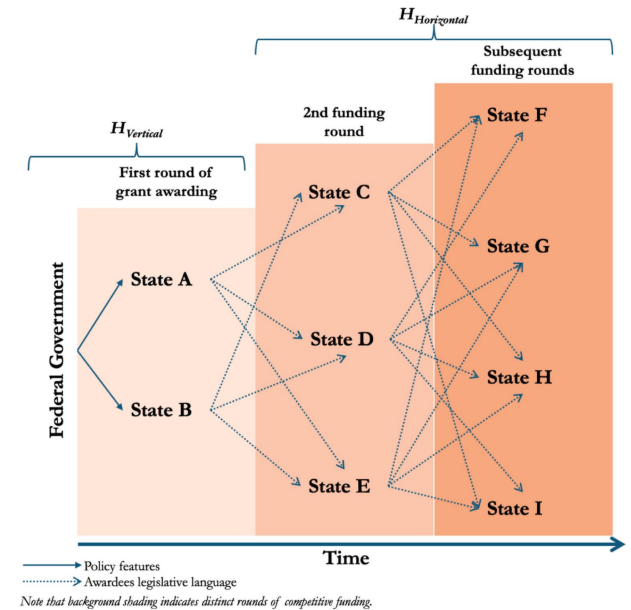
Figure 1. Vertical and horizontal diffusion processes for competitive federal grants for hypothetical states A through I.
Methodology
Instead of treating policy adoption as a binary metric, the authors measure the continuous flow of policy ideas using structural topic modeling (STM). This approach involved examining the text within 4,523 education-related bills introduced across U.S. state legislatures from 2009 to 2019, to locate prevalent or recurring topics. In addition, to track how much U.S. states mimic or copy the policy ideas of other states, the authors applied event history analysis (EHA) and network analysis. These procedures identified and confirmed that states adopted similar education policies mirroring prior grant-winning states, proving that the “Race to the Top” program encouraged horizontal policy diffusion.
Key Findings
States Copy Previous Grant-Winners to Secure Funding
The statistical models showcase that horizontal diffusion or the spread of policy ideas among states is driven by emulation when a state wins a grant, non-winning states begin to significantly increase the presence of similar policy language, namely teacher evaluation measures in their legislative bills. This occurs because the intergovernmental nature of the “Race to the Top” grant program encourages states to use promising legislative ideas as a blueprint for securing funding. These patterns confirm the authors’ horizontal diffusion hypothesis—non-winning states maximize their chances of securing competitive grants by capitalizing on the experimental efforts of other states.
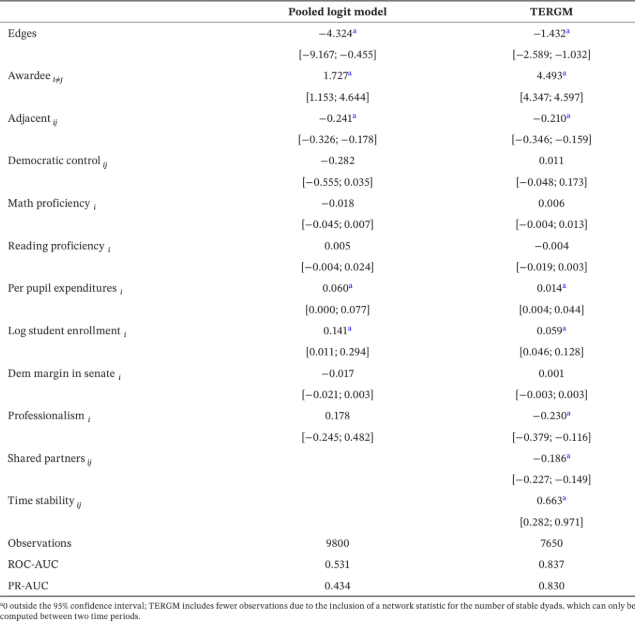
Table 5. Pooled logit and TERMG estimates.
Professionalization Drives Policy Innovation
The results also highlight that the internal capacity of a state legislature directly determines its emulative or mimicking behaviors. When states have fewer employees, lower pay scales, insufficient resources, and shorter sessions, they rely primarily on copying the policy language of grant-winning states. Because states with lower legislative professionalism lack the internal infrastructure to develop innovative and novel policies, this compels them to defer to other states. Meanwhile, state legislatures that are characterized as highly professionalized possess the resource mechanisms to cultivate viable legislative ideas with language matching federal grants.
Why It Matters
The study fundamentally reshapes how scholarship analyzes the diffusion of policy ideas, shifting the emphasis from what ideas are adopted to how ideas are circulated in multi-state legislative domains. For practitioners, the results provide a model for federal grant programs to operate not as centralized policy coordinators dictating public policy, but as conduits for learning from and improving upon established public programs. The authors encourage future research to investigate how ideas in multiple policy categories spread across the intergovernmental landscape and within each stage of the policy process. By further exploring the policy diffusion effects in the federal grant process, helpful insights can be gleaned regarding how states and other levels of government can contribute to, enhance, and mirrior the successes of policy experimentation.
Read the original article in Policy Studies Journal:
Brodnax, NaLette, and Sarah James. 2025. “Topics as Outcomes: Modeling the Influence of Intergovernmental Grants on Policy Diffusion.” Policy Studies Journal 54(2), e70074. https://doi.org/10.1111/psj.70074.
About the Article’s Author(s)

NaLette Brodnax is an assistant professor in the McCourt School of Public Policy at Georgetown University and a William T Grant Scholar (Class of 2028). Her research interests include education policy, policy diffusion, and computational social science. She has also worked as a data scientist both as a consultant and for organizations such as the Institute for Quantitative Social Science at Harvard University and Eli Lily Corporation. Brodnax earned a joint PhD in Public Policy and Political Science from the School of Public and Environmental Affairs at Indiana University, where she specialized in quantitative research methods.

Sarah James is an assistant professor in the Political Science Department at Gonzaga University. Her research examines the role of organizations and institutions in perpetuating and addressing persistent inequality in the American political economy. James’ research emphasizes lenses of federalism, state & bureaucratic politics, and American political development. Her most recent book The Politics of Failed Politics (Oxford University Press) examines the role of institutions and state capacity in the recognition of policy failure. James earned her PhD in Government and Social Policy from Harvard University and has been a graduate fellow at the Radcliffe Institute for Advanced Study and in the Multidisciplinary Program in Inequality & Social Policy.

