
How do collaborative projects survive when the external environment continues to rapidly change? Traditionally, scholars have looked internally, concentrating on capacity, communication, and trust. However, the study conducted by Zhihang Yuan and his colleagues challenge the intrinsic focus of public management literature. Their study builds upon existing research on collaborative governance by emphasizing external contextual factors and tensions such as sociopolitical trends, regulatory domains, and institutional parameters. The Contextual Dynamic Collaboration (CDC) framework, serving as the authors’ primary conceptual model, treats external context as an active, ever-changing element that can dominate collaborative outcomes. By shifting toward an extrinsic lens of collaborative governance, the authors spotlight how policy actors strategically navigate, process, and utilize environmental factors for enhancing project outcomes.
The CDC: How External Environments Shape Collaboration
The CDC framework charts a four-stage process demonstrating how external environments infiltrate into the internal dynamics of project collaboration (see Figure 1).
- System Shocks: Disruptive macro-events transpire externally via political polarization, economic turmoil, etc.
- Leader Sensemaking: Policy leaders employ a sense-making strategy to interpret these external events, using their own belief systems, identities, and political values.
- Contextual Tensions: Leaders utilize their interpretations for strategic action, thereby creating friction within the collaborative dynamics.
- Collaborative Adaptation: The internal dynamics of the collaborative regime must adapt or change to adjust to the newer external tensions.
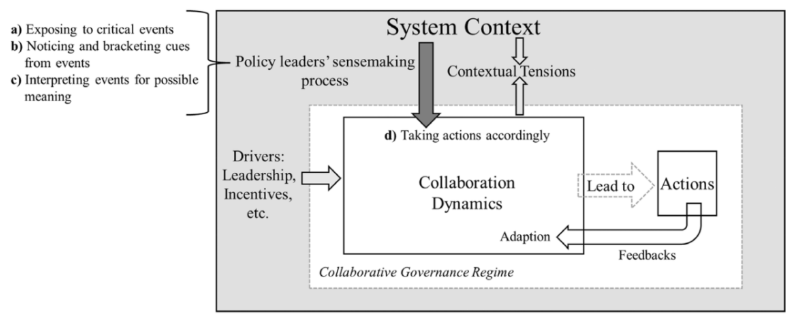
Figure 1. The Contextual Dynamic Collaboration (CDC) model.
Methodology
To understand how external context and environments shape collaboration, the authors analyzed the construction of the Hong Kong-Zhuhai-Macau Bridge (HZMB). The HZMB project represented the largest collaborative infrastructure undertaking in South China. Drawing on the legislative minutes of 495 HZMB-related government meetings from 2003 to 2017, the authors coded for disputes or policy concerns (contextual tensions) elevated by legislators. The content-analysis exercises produced a total of 890 identifiable cases of contextual tensions related to the HZMB. Furthermore, the authors interviewed 20 government officials collaborating on the HZMB to understand their decision-making circumstances.
Key Findings
Combative Sociopolitics Institutionalizes Legislative Conflict
After analyzing legislator statements, the authors found that a strong relationship exists between sociopolitical development and institutional tensions. The widespread unrest coming from the Hong Kong-Mainland China relationship at the time spurred an aggressive contextual environment. These circumstances caused many legislators to raise concerns that prompted changes in current institutional frameworks such as increasing project monitoring. This phenomenon shows that when political and social tensions erupt, this catalyzes a deteriorating contextual setting, and reshapes the current design of collaborative projects.
Economic Stagnation is “Ammunition” for Policy Conflict
Adding to the effects of a declining sociopolitical environment, the authors also found that worsened economic conditions can spark institutional tension. For example, during periods of a declining economy, legislators were more likely to disagree over procedures involving environmental impact evaluations. However, the caveat of this dynamic is that the sociopolitical environment has a stronger impact on institutional tensions than economic circumstances. This means that legislators are more reactive to changes in how people live and political decisions are made.
Political Identity Moderates these External Shocks
Interestingly, the political identity of legislators working on the HZMB project appears to moderate the relationship between contextual influences and institutional tension. As shown in Figure 3, legislators who identified as pro-democracy were more likely than pro-government legislators to share concerns prompting institutional changes—when the sociopolitical environment declined. For example, in the HZMB project, pro-democracy legislators tended to suggest changing the collaborative setup of the project when relations between Mainland China and Hong Kong soured, and economic conditions declined. These illustrations demonstrate that when external circumstances arise, legislative leaders defer to their political values to make sense of the situation and adjust the direction and outcomes of a collaborative project.
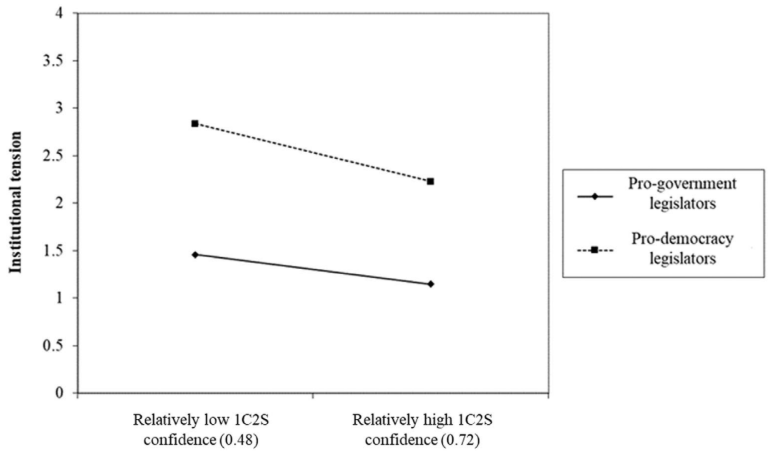
Figure 3. Political identity mitigates the association between sociopolitical context and tension severity levels—Pro-democracy legislators more likely to raise institutional tensions in deteriorating sociopolitical environment (the dotted line in the figure).
Why It Matters
For policy managers navigating the unpredictable, turbulent nature of modern sociopolitical environments, an important lesson is offered by this study: collaborating with your allies or partners is only one side of the coin. In an ever-changing contextual ecosystem that reshapes how people live, work, and make decisions, actively anticipating how those same allies/partners will interpret these changes is the other side. This article provides an important perspective for understanding how collaborative governance, and stakeholder interactions are shaped by external factors driving change. For future research, scholars should examine other cases of contextual influences molding the design(s) of collaborative governance systems. This direction will provide a more comprehensive picture for how impactful change to a joint system does not always come from within, but from outside.
Read the original article in Policy Studies Journal:
Yuan, Zhihang, Wang, XiaoHu, Li, Jinwei, & Jingyuan Xu. (2025). “Exploring Contextual Influences in Collaboration: A Sensemaking Perspective.” Policy Studies Journal 53(4): 899-924. https://doi.org/10.1111/psj.12586.
About the Article’s Author(s)

Zhihang Yuan is an Assistant Professor at School of Public Affairs, Zhejiang University. His research interests include collaborative governance, environmental governance, and fiscal governance, with a particular focus on the context of China. His work has been published in reputable journals such as China Review, International Journal of Disaster Risk Reduction, Ecological Economics, Sustainable Cities and Society, and Sustainable Energy Technologies and Assessments.

XioaHu Wang is a scholar of public administration with a focus on fiscal, collaborative, and sustainable policy implementation in government. He has developed a capacity-building approach to study these issues in the United States, Mainland China, and Hong Kong. He is the author of more than 100 publications. He has consulted for the governments in the U.S. and Hong Kong. His research impact can be seen through citations, which include the governmental agencies in Sweden, Ireland, Belgium, and the U.S., the United Nations, the World Bank, the Asian Development Bank, the Inter-American Development Bank, the RAND Corporation, and the National Academy of Sciences in the U.S. He is a professor and the Associate Dean (Research) at the College of Liberal Arts and Social Sciences, City University of Hong Kong (City UHK), and he directs City UHK’s Greater Bay Area (GBA) Cluster. Previously, he was a professor at the University of Central Florida (UFC) in the U.S. He won many academic awards including an Article of Year Award from American Society for Public Administration (ASPA)’s Section on Chinese Public Administration 2023, and UCF’s Teaching Incentive Awards and Research Incentive Awards (multiple times). He is among Stanford’s top 2% most highly cited scientists.

Jinwei Li is a Lecturer at The Education University of Hong Kong and holds an affiliated research position at the Greater Bay Area Research Centre, City University of Hong Kong. She is a policy researcher specializing in public governance, social policy, and cross-border collaboration. Her work sits at the intersection of research and practice. She actively contributes to policy advisory and research initatives for the Hong Kong Legislative Council, the Office of a Deputy to the National People’s Congress of China, and Chinese Mainland government agencies. Her policy outputs—including Motions in the Hong Kong Legislative Council, Chinese Mainland planning proposals, policy papers, and advisory briefs—have directly informed policy deliberation and government decision-making in both Hong Kong and the Chinese mainland. Her academic work has been published in leading international journals such as The China Review and Policy Studies Journal.

Jingyuan Xu is an Assistant Professor at Institute for Global Public Policy (IGPP) and a researcher at LSE-Fudan Research Centre for Global Public Policy, Fudan University. She is interested in analyzing the local government’s policy implementation capacity in response to the challenges in transboundary infrastructure building, environmental and climate change governance. Her recent published articles appear in Policy Studies Journal, Public Administration Review, Environmental Politics, Climate Policy, and other outlets.

