How Japanese Policymakers Talk About Integrating Immigrants without Saying “Immigrants”

Migration continues to be a major area of policymaking globally. Decisions about how to best manage the economic and social impacts of more diverse populations represent important policy challenges for governments. This is particularly true for industrialized Asian countries like Japan which are turning to immigration as a way of addressing shrinking workforces due to some of the world’s fastest rates of aging.

Recent Japanese resident registry data suggests foreign-born people comprised about 2.6% of the population as of 2025, or about 3.32 million people. While this is much lower than North American and European immigrant-receiving countries, it nevertheless marks a high point for Japan. Not surprisingly, this shift has renewed political and public attention towards how to successfully handle these increasing numbers.

While successive Japanese governments have consciously avoided publicly talking about “immigrants” or “immigration policy”, in practice they have devoted sizable national efforts and resources toward integrating them into society. Under the banner of “multicultural coexistence”, this approach has largely fallen to subnational (prefectural) governments to devise their own local policy plans and initiatives.

As of October 2025, two-thirds (31) of Japan’s 47 prefectures had publicly done so, either as an explicit coexistence plan or as part of broader internationalization efforts. These prefectures tend to have higher shares of foreign-born people (Figure 2). While we can’t say whether these plans reflect or attract growing numbers of immigrants, it is clear they theoretically apply to a large proportion of Japanese citizens and foreign-born people alike.
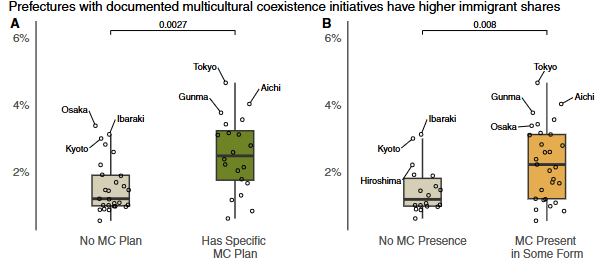
Figure 2. Share of foreign-born population by prefectures and public presence of multicultural coexistence initiatives.

Yet despite their widespread presence and policy importance, there is little systematic evidence about what is actually in these plans. In our recent study, we analyzed all 31 available sets of multicultural coexistence plans and implementation documents. We thematically identified three key areas: what is multicultural coexistence, why is it needed, and how is it meant to be implemented.

First, multicultural coexistence at the prefectural level involves creating a state of existence where foreign residents and native-born Japanese relate with each other on equal terms. Moreover, policymakers stress how these relationships involve mutual effort by both groups while emphasizing their “naturalness” by using metaphors like atoms or trees. Second, the plans justify coexistence on several grounds including the growing size and driver of change and an opportunity for Japan. Third, implementation ought to happen in two ways: first, by providing key services like language training and disaster preparedness; and second, by promoting greater awareness via intercultural exchanges involving festivals, volunteering, and civic education about rights and responsibilities. Notably, these mechanisms are ideally developed and supported by leaders within foreign-born communities, children of immigrants, and exchange students.

Identifying how prefectural-level plans present multicultural coexistence matters because these elements potentially shape how this approach to integrating immigrants gets put into practice. Although we focused on how these ideas are “imagined” and represented on paper, these documents play important roles in capturing and conveying national efforts at managing immigration to more local levels of government. These subnational levels of policymaking are likely to remain important places for a range of social policies that directly affect newcomers and citizens alike-especially in Asian contexts facing similar demographic challenges.

Read the original article in Policy Studies Journal:

Mariri Niino and William L. Allen. 2026. “Imagined Integration: The Logics of Japanese Immigrant Integration Policy” Policy Studies Journal 54(3). https://doi.org/10.1111/psj.70137.

About the Article’s Author(s)

Mariri Niino is a graduate of the MSc Migration Studies at the University of Oxford and St. Anne’s College. Her research interests are in policy-making and public opinion, particularly around migration. 

William Allen is an Associate Professor of Political Science in the Department of Politics and International Relations (PAIR) at the University of Southampton. His research focuses on how citizens engage with information about political and economic issues, notably migration, and what this means for global public opinion and policy-making.

Follow Willian Allen on BlueSky: @williamlallen.bsky.social

Follow the authors on LinkedIn: William Allen and Mariri Niino.
Unveiling and Explaining the Procedural Justice in the Policy Design of Renewable Energy Siting Process in the United States

Social justice has been understood to be a critical value necessary for ensuring that designed policies and practices ensure fairness and equality to the communities being served. Researchers have attempted to study the role of social justice in shaping the decisions and structure of public policy yet faced challenges in measuring particular facets of the concept. Specifically, procedural justice, or the level of fairness that is encoded into decision-making processes has not been properly examined in the context of policy design. This article aims to fill this literature gap by analyzing state renewable energy siting policies in the United States to evaluate how procedural justice, particularly public participation, is incorporated into state-level policy design. Through this approach, the authors seek to connect scholarly understandings of policy design and justice to spotlight potential opportunities for improving the social propriety of policymaking.

Methodology

The authors obtained state-level renewable energy siting rules using state government agency websites and filtered key words to extract relevant siting documents. To empirically evaluate policy design features of siting policies, policy statements and intentions were extracted from the policies and coded into two main segments: equity-related and non-equity-related goals. Additionally, the authors developed a procedural justice score (0 to 9 points) that assigned a score based on the measurement of three components: access, information, and decision-making. After assigning codes and scores to the dataset, cross-sectional analyses were conducted to determine whether equity goals correlated with procedural justice scores.

Key Findings

Most U.S. States Fall Behind in Designing Fair Renewable Siting Policies

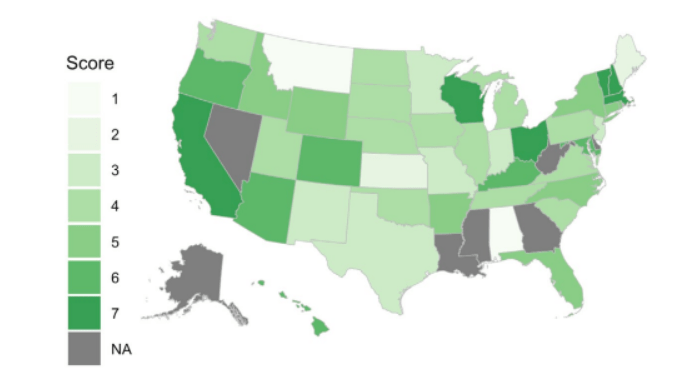
The vast majority of U.S. states fall behind in terms of designing renewable energy siting policies that are participatory, inclusive, and transparent to stakeholders. As shown in Figure 4, the national mean procedural justice score sits at 4.51, with most states achieving scores below 5. Although the top-performing states, such as California, Massachusetts, New Hampshire, and Wisconsin, achieved a score of 7, there is not a single state that exceeds this score. These results indicate that the procedural design of renewable energy siting policies varies across U.S. states, with notable limitations in stakeholder participation, inclusiveness, and transparency.

Figure 4. Geographic distribution of procedural justice scores.

The Role of Siting Agencies in Procedural Policy Design

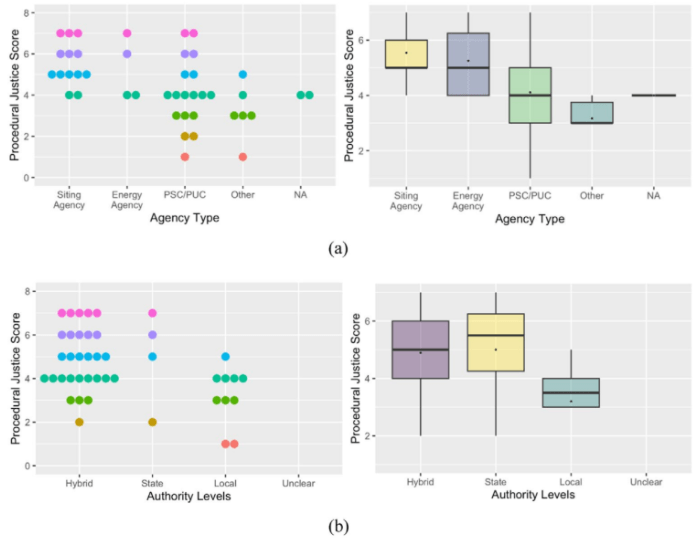
The extent to which renewable energy siting policies incorporate procedural justice principles appears to be associated with the type of agency responsible for siting decisions. Figure 7 illustrates that states with an existing siting agency exhibit the highest average procedural justice scores. Similarly, states possessing an energy agency assigned to siting policy also demonstrate relatively strong performance scores. These results suggest that specialized agencies may provide the technical capacity and institutional focus needed to develop renewable energy siting policies that support public participation.

Figure 7. The distribution of procedural justice scores by agency and authority. (a) presents the distribution of procedural justice scores by agency. (b) presents the distribution of procedural justice scores by authority.

Why It Matters

Ultimately, this article emphasizes a significant gap in the design of participatory renewable energy siting policies across most U.S. states. Because renewable energy siting often involves multiple stakeholders and locally specific impacts, policy design provides an important setting for examining how participation, transparency, and inclusiveness are incorporated into decision-making processes. This finding provides a valuable opportunity for researchers and policymakers to identify weaknesses in current design processes, as well as identify promising improvements. In terms of potential avenues for future research, the authors recommend analyzing procedural justice at the local-level and examining the conditions that explain high procedural justice scores amidst an absence of equity-related goals.

Read the original article in Policy Studies Journal:

Gao, Xue, Shan Zhou and Dori Schurr. 2025. “Unveiling and Explaining the Procedural Justice in the Policy Design of Renewable Energy Siting Process in the United States.” Policy Studies Journal, 53(3): 556-579. https://doi.org/10.1111/psj.12563.

About the Article’s Author(s)

Xue Gao is an assistant professor at the Askew School of Public Administration and Policy at Florida State University. Her research centers around the interplay between policy, politics, technology, economy, and society in the energy transition process. 

Shan Zhou is an assistant professor at the Department of Political Science at Purdue University. Her research focuses on the intersection of public policy, social equity, and sustainability.

Dori Schurr is an undergraduate student at the Harris School of Public Policy at the University of Chicago.