

Social justice has been understood to be a critical value necessary for ensuring that designed policies and practices ensure fairness and equality to the communities being served. Researchers have attempted to study the role of social justice in shaping the decisions and structure of public policy yet faced challenges in measuring particular facets of the concept. Specifically, procedural justice, or the level of fairness that is encoded into decision-making processes has not been properly examined in the context of policy design. This article aims to fill this literature gap by analyzing state renewable energy siting policies in the United States to evaluate how procedural justice, particularly public participation, is incorporated into state-level policy design. Through this approach, the authors seek to connect scholarly understandings of policy design and justice to spotlight potential opportunities for improving the social propriety of policymaking.
Methodology
The authors obtained state-level renewable energy siting rules using state government agency websites and filtered key words to extract relevant siting documents. To empirically evaluate policy design features of siting policies, policy statements and intentions were extracted from the policies and coded into two main segments: equity-related and non-equity-related goals. Additionally, the authors developed a procedural justice score (0 to 9 points) that assigned a score based on the measurement of three components: access, information, and decision-making. After assigning codes and scores to the dataset, cross-sectional analyses were conducted to determine whether equity goals correlated with procedural justice scores.
Key Findings
Most U.S. States Fall Behind in Designing Fair Renewable Siting Policies
The vast majority of U.S. states fall behind in terms of designing renewable energy siting policies that are participatory, inclusive, and transparent to stakeholders. As shown in Figure 4, the national mean procedural justice score sits at 4.51, with most states achieving scores below 5. Although the top-performing states, such as California, Massachusetts, New Hampshire, and Wisconsin, achieved a score of 7, there is not a single state that exceeds this score. These results indicate that the procedural design of renewable energy siting policies varies across U.S. states, with notable limitations in stakeholder participation, inclusiveness, and transparency.
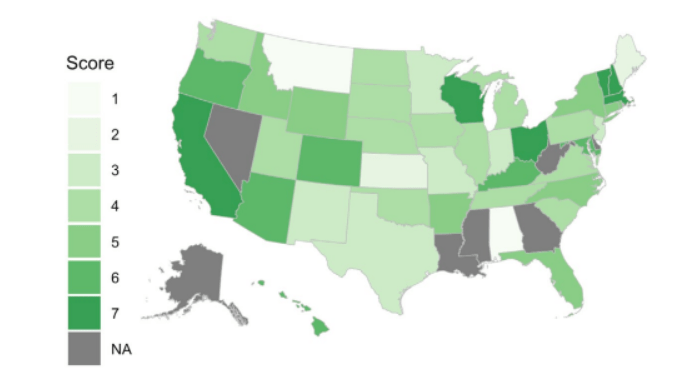
Figure 4. Geographic distribution of procedural justice scores.
The Role of Siting Agencies in Procedural Policy Design
The extent to which renewable energy siting policies incorporate procedural justice principles appears to be associated with the type of agency responsible for siting decisions. Figure 7 illustrates that states with an existing siting agency exhibit the highest average procedural justice scores. Similarly, states possessing an energy agency assigned to siting policy also demonstrate relatively strong performance scores. These results suggest that specialized agencies may provide the technical capacity and institutional focus needed to develop renewable energy siting policies that support public participation.
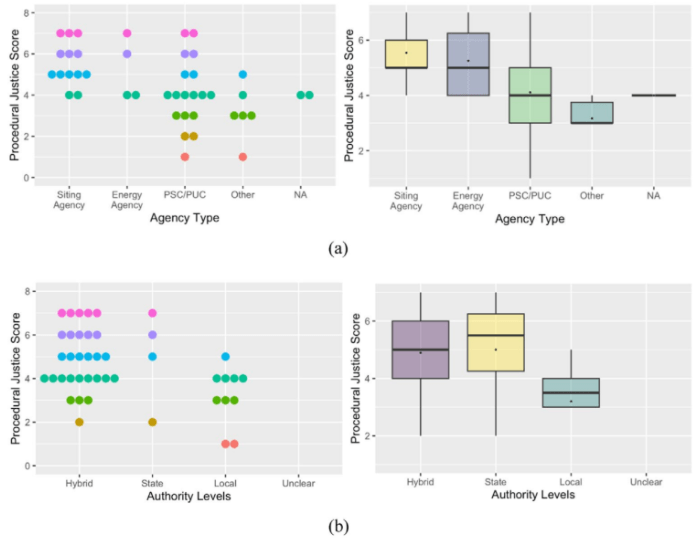
Figure 7. The distribution of procedural justice scores by agency and authority. (a) presents the distribution of procedural justice scores by agency. (b) presents the distribution of procedural justice scores by authority.
Why It Matters
Ultimately, this article emphasizes a significant gap in the design of participatory renewable energy siting policies across most U.S. states. Because renewable energy siting often involves multiple stakeholders and locally specific impacts, policy design provides an important setting for examining how participation, transparency, and inclusiveness are incorporated into decision-making processes. This finding provides a valuable opportunity for researchers and policymakers to identify weaknesses in current design processes, as well as identify promising improvements. In terms of potential avenues for future research, the authors recommend analyzing procedural justice at the local-level and examining the conditions that explain high procedural justice scores amidst an absence of equity-related goals.
Read the original article in Policy Studies Journal:
Gao, Xue, Shan Zhou and Dori Schurr. 2025. “Unveiling and Explaining the Procedural Justice in the Policy Design of Renewable Energy Siting Process in the United States.” Policy Studies Journal, 53(3): 556-579. https://doi.org/10.1111/psj.12563.
About the Article’s Author(s)

Xue Gao is an assistant professor at the Askew School of Public Administration and Policy at Florida State University. Her research centers around the interplay between policy, politics, technology, economy, and society in the energy transition process.

Shan Zhou is an assistant professor at the Department of Political Science at Purdue University. Her research focuses on the intersection of public policy, social equity, and sustainability.

Dori Schurr is an undergraduate student at the Harris School of Public Policy at the University of Chicago.

