
How Japanese Policymakers Talk About Integrating Immigrants without Saying “Immigrants”

Migration continues to be a major area of policymaking globally. Decisions about how to best manage the economic and social impacts of more diverse populations represent important policy challenges for governments. This is particularly true for industrialized Asian countries like Japan which are turning to immigration as a way of addressing shrinking workforces due to some of the world’s fastest rates of aging.

Recent Japanese resident registry data suggests foreign-born people comprised about 2.6% of the population as of 2025, or about 3.32 million people. While this is much lower than North American and European immigrant-receiving countries, it nevertheless marks a high point for Japan. Not surprisingly, this shift has renewed political and public attention towards how to successfully handle these increasing numbers.

While successive Japanese governments have consciously avoided publicly talking about “immigrants” or “immigration policy”, in practice they have devoted sizable national efforts and resources toward integrating them into society. Under the banner of “multicultural coexistence”, this approach has largely fallen to subnational (prefectural) governments to devise their own local policy plans and initiatives.

As of October 2025, two-thirds (31) of Japan’s 47 prefectures had publicly done so, either as an explicit coexistence plan or as part of broader internationalization efforts. These prefectures tend to have higher shares of foreign-born people (Figure 2). While we can’t say whether these plans reflect or attract growing numbers of immigrants, it is clear they theoretically apply to a large proportion of Japanese citizens and foreign-born people alike.
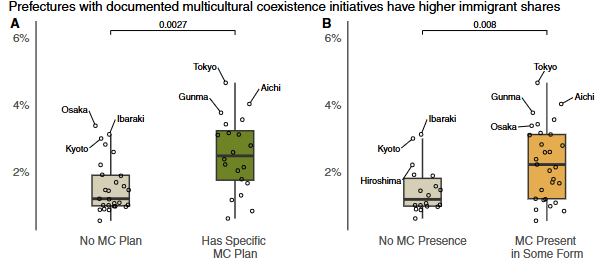
Figure 2. Share of foreign-born population by prefectures and public presence of multicultural coexistence initiatives.

Yet despite their widespread presence and policy importance, there is little systematic evidence about what is actually in these plans. In our recent study, we analyzed all 31 available sets of multicultural coexistence plans and implementation documents. We thematically identified three key areas: what is multicultural coexistence, why is it needed, and how is it meant to be implemented.

First, multicultural coexistence at the prefectural level involves creating a state of existence where foreign residents and native-born Japanese relate with each other on equal terms. Moreover, policymakers stress how these relationships involve mutual effort by both groups while emphasizing their “naturalness” by using metaphors like atoms or trees. Second, the plans justify coexistence on several grounds including the growing size and driver of change and an opportunity for Japan. Third, implementation ought to happen in two ways: first, by providing key services like language training and disaster preparedness; and second, by promoting greater awareness via intercultural exchanges involving festivals, volunteering, and civic education about rights and responsibilities. Notably, these mechanisms are ideally developed and supported by leaders within foreign-born communities, children of immigrants, and exchange students.

Identifying how prefectural-level plans present multicultural coexistence matters because these elements potentially shape how this approach to integrating immigrants gets put into practice. Although we focused on how these ideas are “imagined” and represented on paper, these documents play important roles in capturing and conveying national efforts at managing immigration to more local levels of government. These subnational levels of policymaking are likely to remain important places for a range of social policies that directly affect newcomers and citizens alike-especially in Asian contexts facing similar demographic challenges.

Read the original article in Policy Studies Journal:

Mariri Niino and William L. Allen. 2026. “Imagined Integration: The Logics of Japanese Immigrant Integration Policy” Policy Studies Journal 54(3). https://doi.org/10.1111/psj.70137.

About the Article’s Author(s)

Mariri Niino is a graduate of the MSc Migration Studies at the University of Oxford and St. Anne’s College. Her research interests are in policy-making and public opinion, particularly around migration. 

William Allen is an Associate Professor of Political Science in the Department of Politics and International Relations (PAIR) at the University of Southampton. His research focuses on how citizens engage with information about political and economic issues, notably migration, and what this means for global public opinion and policy-making.

Follow Willian Allen on BlueSky: @williamlallen.bsky.social

Follow the authors on LinkedIn: William Allen and Mariri Niino.
Using the Multiple Streams Framework to Connect Policy Adoption to Implementation

by Luke Fowler

Despite widespread application of the canonical model, a key criticism of the Multiple Streams Framework (MSF) is the primary focus on agenda-setting and policy adoption, and relatively little consideration of what happens after policy is adopted.  However, recent scholarship applies MSF to policy implementation and assesses agenda-setting, policy adoption, and implementation as components of an integrated process. Furthering this line of research, I use MSF to construct a theoretical model that connects policy-making and implementation.

Although policy adoption and implementation make up two distinct components of policy processes, recent scholarship largely argues that “policy systems and processes are nested, with policymaking and policy implementation existing in organized interdependent layers” (Fowler, 2019, p. 406). Based on this, I contend that there are separate outputs for policy adoption and implementation that are linked together and aggregate to policy process outputs.

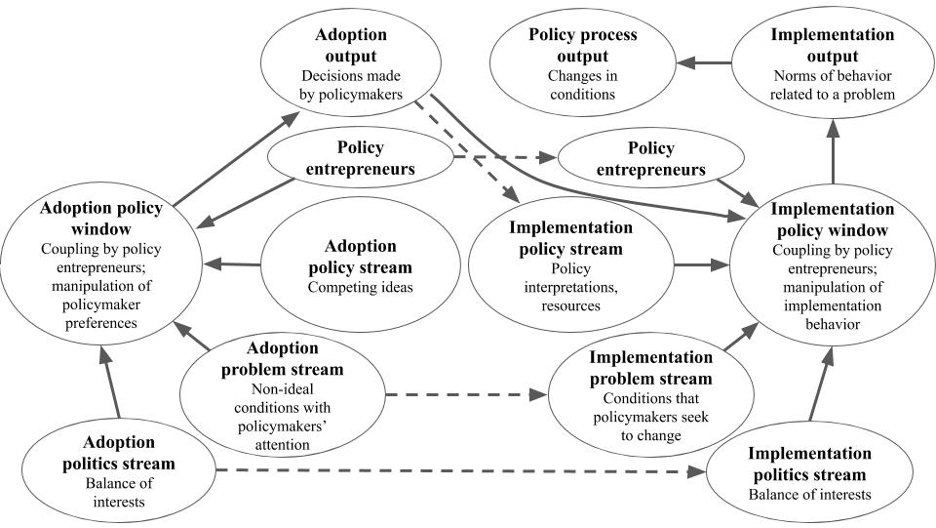
Figure 1. MSF Theoretical Model for Policymaking and Policy Implementation Processes

[Note: Solid lines represent a causal relationship between streams, policy windows, and outputs, while dashed lines represent the transition of streams from a policymaking orientation to an implementation orientation.]

Figure 1 illustrates an MSF policy process model that includes both policy adoption and implementation sub-processes. First, policy adoption outputs are new policies that result from decisions made during policy adoption, which address non-ideal social conditions. Second, once new policies are adopted, policy implementers respond.  Individual-level behaviors, then, aggregate to the norms of policies in practice, which constitute implementation outputs. Third, implementation outputs lead to changes in behaviors related to social conditions that new policies aim to affect. In turn, this suggests three hypotheses:

  • Policy adoption hypothesis: Effects of politics on policy adoption outputs are conditional on current problems and policies.
  • Policy Implementation hypothesis: Effects of politics on policy implementation outputs are conditional on current problems and policies.
  • Interdependent Processes hypothesis: Effects of politics, policy, and problems streams on policy adoption outputs are not independent from their effects on policy implementation outputs.

I test this model by using data from U.S. state implementation of federal environmental policy. I treat states as independent cases in which policy, politics, and problem streams are coupled (or not) to understand under which conditions policy adoption (i.e., budgetary changes) or implementation (i.e., changes in pollution) outputs are likely to experience non-marginal changes. Results provide support for all three hypotheses and suggest an interconnected process. Most importantly, they indicate that an interaction between political, problem, and policy streams is necessary in both the policy-making and implementation phases in order to spur non-marginal changes in environmental policy outcomes. Specifically, where any variable measuring one of the streams is held at its mean value, only marginal changes results (i.e., status quo maintained), but where all three reach extreme values, non-marginal changes occur (i.e., policy change).

This extends MSF to capture the entire policy process and unifies scholarship examining two different phases of policy to understand how ideas become actions and lead to changes in social or environmental conditions. It also suggests that MSF can be an important tool for analyzing governance processes and providing practical advice that connects decision-making with implementation. For instance, we can glean that while policy windows can be utilized to increase program resources, those new resources may not affect policy outputs unless the right political and problem circumstances exist.

You can read the original article in Policy Studies Journal at

Fowler, Luke. (2022), Using the Multiple Streams Framework to Connect Policy Adoption to Implementation. Policy Stud J, 50: 615-639. https://doi.org/10.1111/psj.12381

About the Author

Dr. Luke Fowler is an Associate Professor of Public Policy and Administration and serves as the Faculty Director for SPS. His research interests include policy implementation, collaboration and collective action, energy and environmental policy, and state and local government. Dr. Fowler is the author of more than four dozen journal articles appearing in many of the field’s top journals, including Perspectives on Public Management & GovernanceGovernancePublic AdministrationPolicy Studies JournalReview of Policy ResearchAdministration & SocietyAmerican Review of Public AdministrationState & Local Government Review, and State Politics & Policy Quarterly. His latest book is Democratic Policy Implementation in an Ambiguous World. He is also the author of Environmental Federalism: Old Legacies and New Challenges. Dr. Fowler is the co-host of The Big Tent, a weekly public affairs radio show on Radio Boise. Dr. Fowler previously served as MPA program lead, and completed his Ph.D. at Mississippi State University in 2013.