Does the Implementation Status of Gender Provisions Affect the Implementation of a Peace Agreement? Evidence from Colombia’s 2016 Peace Agreement Implementation Process

Consider these questions: How involved are women in the negotiation and implementation of peace agreements? Are the rights and well-being of women well-reflected in peace programs? The protection of women’s rights has been a cornerstone of recent discussions in post-war peacebuilding, as recent scholarship has begun to explore the extent to which women have a voice in negotiations and are able to include gendered protections. This article investigates whether such protections included in Colombia’s Final Agreement in 2016 were implemented. The 2016 agreement in Colombia was finalized after a series of negotiations in Havana that started in 2012 between the Colombian government and the leftist insurgency FARC (Fuerzas Armadas Revolucionarias de Colombia – Ejercito del Pueblo). To guide this study, the author specifically asks: To what degree are the gender provisions negotiated in a peace agreement implemented compared to gender-neutral provisions? Does the implementation status of gender provisions affect the implementation of the peace agreement?

Hypotheses

The author introduces two hypotheses to determine the relationship between the implementation of gender protections and the peace agreement’s success:

H1: The incorporation of gendered provisions in the peace agreement is negatively associated with implementation, compared to gender-neutral provisions.

H2: A positive relationship exists between the implementation status of gender provisions and the overall implementation success of the peace agreement.

    Methodology

    This study utilizes a quantitative analysis of the 2016 Colombian Peace Agreement. Monthly data from the PAM Barometer Initiative (PAM-BI) containing 578 commitments or provisions included in the 2016 Final Agreement were collected between December 2016 and April 2023. The author utilized two different measurement indicators: implementation status and gender-specific benchmarks — that were analyzed at two levels: the stipulation and sub-theme (reforms or programs) level. This allowed the implementation progress of gendered provisions to be compared against non-gendered provisions.

    Key Findings

    Gender Provisions Lag Behind Non-Gender Provisions

    Figure 2 demonstrates that the implementation of gender provisions in the peace agreement falls behind non-gendered provisions. This pattern is consistent across all points of the Final Agreement, suggesting widespread and systemic limitations in the implementation of gender protections. Furthermore, these dynamics indicate a significant implementation gap along gender dimensions, where gendered provisions experience less success in being part of negotiated peace deals compared to provisions not directly advocating for such protections. This reaffirms the challenge of ensuring that women’s perspectives and rights are reflected in the implementation of peace negotiations.
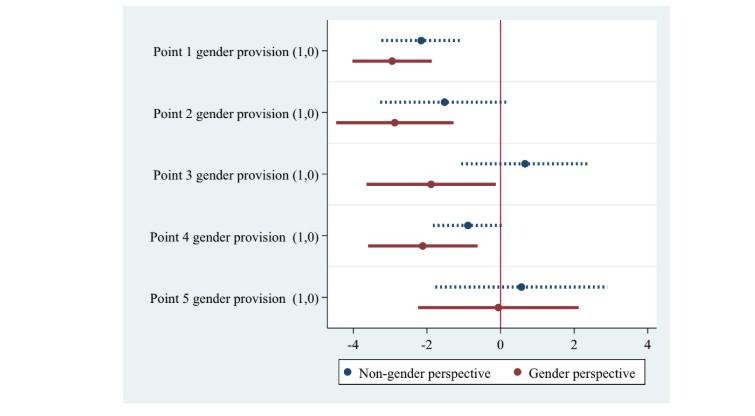
    Figure 2. Point Specific Analysis of Gender Provisions and Implementation Status.

    Implementing More Gender Provisions Uplifts the Entire Peace Agreement

    The complete or “full” implementation of gender provisions provides a significant boost to the success of the peace process, as shown in Figure 3. The addition of more completed gendered-provisions or stipulations improves the probability of the peace agreement being implemented. This confirms the author’s second hypothesis that the implementation of gendered provisions or protections are foundational to supporting broader reforms negotiated in the agreement. Gendered conditions, in this case, act as leverage for advancing peace and stability in post-war nations.
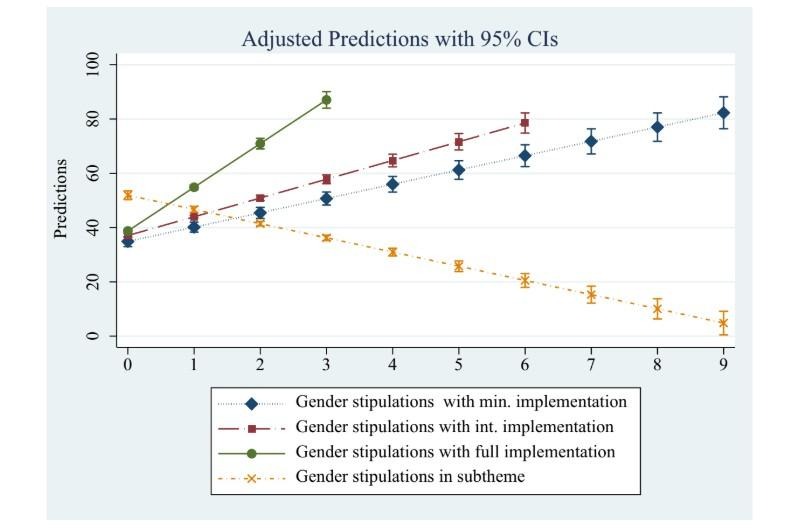
    Figure 3. Prediction of Level Implementation Rate.

    Why It Matters

    This article provides a helpful illustration for how gendered perspectives are implemented in and shape post-war peacebuilding, in comparison with non-gendered perspectives. A dynamic connection is clearly present between gendered provisions and the rate of success for implementing a peace agreement–highlighting their significance in the peace implementation process. The author encourages future research to build upon the findings of this study to determine what conditions or factors influence the inclusion of gender protections in peace negotiations in other settings. By doing this, scholarship will be able to magnify the role of women and their perspectives in implementing important peace agreements.

    Read the original article in Policy Studies Journal:

    Joshi, Madhav. 2025. “Does the Implementation Status of Gender Provisions Affect the Implementation of a Peace Agreement? Evidence From Colombia’s 2016 Peace Agreement Implementation Process.” Policy Studies Journal 53(4): 1152–1163. https://doi.org/10.1111/psj.12584

    About the Article’s Author(s)

    Madhav Joshi is a research professor and an associate director of the Peace Accords Matrix (PAM) at the Kroc Institute for International Peace Studies at the University of Notre Dame’s Keough School of Global Affairs. He oversees the data coding for the PAM project and leads the research initiatives on peace agreement design, implementation, and post-implementation political and economic developments. His current priorities focus on collaborative initiatives fulfilling the Kroc Institute’s mandate specific to developing methodology and verifying the implementation of the 2016 peace agreement between the Colombian government and the FARC (Fuerzas Armadas Revolucionarias de Colombia – Ejercito del Pueblo). In collaboration with Catholic Relief Services-Philippines, he leads the Peace Accords Matrix-Mindanao technical accompaniment support to the Joint Normalization Committee in monitoring and verifying the implementation of the Normalization Annex in the 2014 Comprehensive Agreement on the Bangsamoro. He holds a Ph.D. in Political Science from the University of North Texas. His works are published in Political Geography, Social Science Research, British Journal of Political Science, the Journal of Conflict Resolution, the Journal of Peace Research, Democratization, International Peacekeeping, International Studies Quarterly, and many other journals. 

    Mixed Messages and Bounded Rationality: The Perverse Consequences of REAL ID for Immigration Policy

    by Maureen Stobb, Banks Miller, & Joshua Kennedy

    The President and Congress have renewed efforts in the past year to reshape immigration policy. Yet, if history can teach us anything, it is that outcomes in this area tend not to match intent. Our research looks at a clear example of this mismatch, the REAL ID Act, a law aimed at tightening refugee admissions by taking control away from liberal judges on the U.S. Courts of Appeals. Despite its intent, it resulted in more people getting asylum. In our research we ask, what explains this policy gap?

    We contend that part of the answer lies in the REAL ID Act’s ambivalent language, a common characteristic of policy concerning undocumented immigrants. The law gave the street-level bureaucrats who decide asylum cases —immigration judges (IJs)— more discretion to deny bogus asylum claims. They no longer had to point to an inconsistency undermining a key aspect of the persecution claim to find the applicant not credible. They could deny based on inconsistencies such as birthdays and wedding dates that have no connection to the asylum claim. At the same time, the law required IJs to consider all the circumstances, potentially reincorporating some of the former rule.

    What did IJs do in this situation? They are supposed to follow the precedent in the circuit with jurisdiction over where they sit, but the President controls their hiring and firing, and Congress writes the law and determines their budget. We argue that IJs, behaving in a bounded rationality framework, relied on their professional training as lawyers as a shortcut and were considerably more deferential to the circuit courts who read every opinion they write.

    We find just that. As the figure below shows, the adoption of the REAL ID Act’s credibility standard enabled significantly closer ideological control by the courts. Before REAL ID, there was very little relationship between the presumed aggregate preferences of the appellate courts on asylum cases and IJ decision making in that circuit. But after the REAL ID Act is implemented by the circuit through the adoption of its standard in precedent, as the percentage of the circuit that is Democratic increases so too does the likelihood of an IJ granting asylum. The impact went from 3 to 52 percentage points.

    Image Description

    Figure 1: REAL ID & the Circuit Courts

    We saw an increase in influence for Congress and the President, but it was not nearly as large. We also show this is not just a result of the uniqueness of the first Trump administration.

    The findings suggest that any attempts to restrict asylum access through immigration courts during Trump’s second term would require precisely written policies. If the administration and a Republican-controlled Congress pursue such restrictions, vague or ambiguous language could backfire. In cases of unclear policy, IJs will turn to federal courts for guidance—potentially leading to interpretations that run counter to the administration’s goals.

    You can read the original article in Policy Studies Journal at

    Stobb, Maureen, Banks Miller, and Joshua Kennedy. 2023. Mixed messages & bounded rationality: The perverse consequences of real ID for immigration policy. Policy Studies Journal 51: 667–684. https://doi-org.echo.louisville.edu/10.1111/psj.12486

    About the Authors

    Maureen Stobb is an Associate Professor of Political Science at Georgia Southern University. Her research focuses on the expansion of judicial power relative to the legislature and the executive, particularly in the policy areas of immigration and citizenship. Her research has been published in various outlets including The Journal of Law & Courts, and Justice System Journal.

    Banks Miller is an Associate Professor of Political Science at the University of Texas at Dallas. His research focuses on judicial decision making, intellectual property policy, and immigration policy. Recent work has been published in the Journal of Law & Courts and American Politics Research.


    Joshua B. Kennedy is an Associate Professor of Political Science at Georgia Southern University. His research of late focuses on political control of the administrative state, and he has also published in the area of unilateral presidential power. His research has appeared in American Politics Research, Research & Politics, and Presidential Studies Quarterly, among other outlets.

    Using the Multiple Streams Framework to Connect Policy Adoption to Implementation

    by Luke Fowler

    Despite widespread application of the canonical model, a key criticism of the Multiple Streams Framework (MSF) is the primary focus on agenda-setting and policy adoption, and relatively little consideration of what happens after policy is adopted.  However, recent scholarship applies MSF to policy implementation and assesses agenda-setting, policy adoption, and implementation as components of an integrated process. Furthering this line of research, I use MSF to construct a theoretical model that connects policy-making and implementation.

    Although policy adoption and implementation make up two distinct components of policy processes, recent scholarship largely argues that “policy systems and processes are nested, with policymaking and policy implementation existing in organized interdependent layers” (Fowler, 2019, p. 406). Based on this, I contend that there are separate outputs for policy adoption and implementation that are linked together and aggregate to policy process outputs.

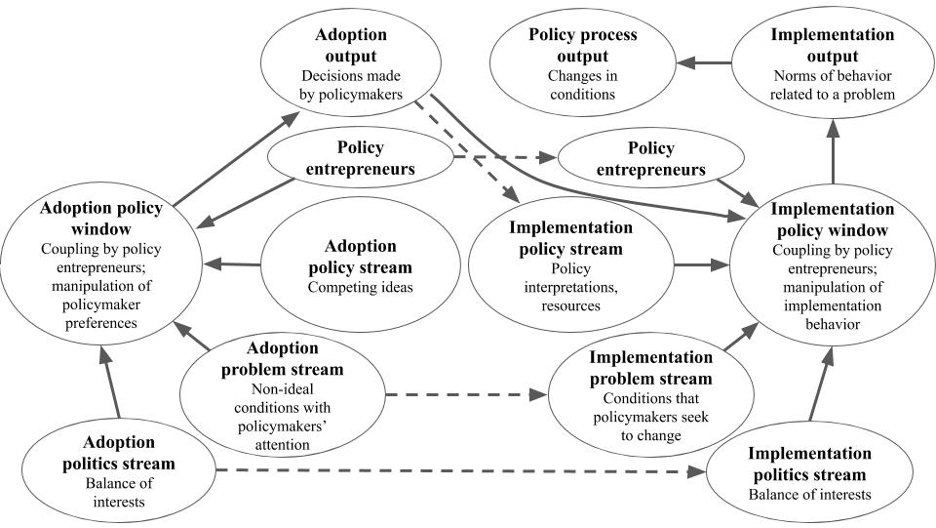
    Figure 1. MSF Theoretical Model for Policymaking and Policy Implementation Processes

    [Note: Solid lines represent a causal relationship between streams, policy windows, and outputs, while dashed lines represent the transition of streams from a policymaking orientation to an implementation orientation.]

    Figure 1 illustrates an MSF policy process model that includes both policy adoption and implementation sub-processes. First, policy adoption outputs are new policies that result from decisions made during policy adoption, which address non-ideal social conditions. Second, once new policies are adopted, policy implementers respond.  Individual-level behaviors, then, aggregate to the norms of policies in practice, which constitute implementation outputs. Third, implementation outputs lead to changes in behaviors related to social conditions that new policies aim to affect. In turn, this suggests three hypotheses:

    • Policy adoption hypothesis: Effects of politics on policy adoption outputs are conditional on current problems and policies.
    • Policy Implementation hypothesis: Effects of politics on policy implementation outputs are conditional on current problems and policies.
    • Interdependent Processes hypothesis: Effects of politics, policy, and problems streams on policy adoption outputs are not independent from their effects on policy implementation outputs.

    I test this model by using data from U.S. state implementation of federal environmental policy. I treat states as independent cases in which policy, politics, and problem streams are coupled (or not) to understand under which conditions policy adoption (i.e., budgetary changes) or implementation (i.e., changes in pollution) outputs are likely to experience non-marginal changes. Results provide support for all three hypotheses and suggest an interconnected process. Most importantly, they indicate that an interaction between political, problem, and policy streams is necessary in both the policy-making and implementation phases in order to spur non-marginal changes in environmental policy outcomes. Specifically, where any variable measuring one of the streams is held at its mean value, only marginal changes results (i.e., status quo maintained), but where all three reach extreme values, non-marginal changes occur (i.e., policy change).

    This extends MSF to capture the entire policy process and unifies scholarship examining two different phases of policy to understand how ideas become actions and lead to changes in social or environmental conditions. It also suggests that MSF can be an important tool for analyzing governance processes and providing practical advice that connects decision-making with implementation. For instance, we can glean that while policy windows can be utilized to increase program resources, those new resources may not affect policy outputs unless the right political and problem circumstances exist.

    You can read the original article in Policy Studies Journal at

    Fowler, Luke. (2022), Using the Multiple Streams Framework to Connect Policy Adoption to Implementation. Policy Stud J, 50: 615-639. https://doi.org/10.1111/psj.12381

    About the Author

    Dr. Luke Fowler is an Associate Professor of Public Policy and Administration and serves as the Faculty Director for SPS. His research interests include policy implementation, collaboration and collective action, energy and environmental policy, and state and local government. Dr. Fowler is the author of more than four dozen journal articles appearing in many of the field’s top journals, including Perspectives on Public Management & GovernanceGovernancePublic AdministrationPolicy Studies JournalReview of Policy ResearchAdministration & SocietyAmerican Review of Public AdministrationState & Local Government Review, and State Politics & Policy Quarterly. His latest book is Democratic Policy Implementation in an Ambiguous World. He is also the author of Environmental Federalism: Old Legacies and New Challenges. Dr. Fowler is the co-host of The Big Tent, a weekly public affairs radio show on Radio Boise. Dr. Fowler previously served as MPA program lead, and completed his Ph.D. at Mississippi State University in 2013.

    Analyzing the Association of Policy Narratives with Problem Tractability in the Implementation of EU Decisions: Evidence from the Phytosanitary Policy Area

    by Marco Schito 

    Stories can help us make sense of this world by building compelling narratives in which the motives of and interactions between heroes, victims, and villains weave a plot, resulting in the resolution of the problem. However, a growing number of policy issues are becoming “intractable” in the sense that there is no easy way to address and solve the problem.

    In this study, I employ the Narrative Policy Framework (NPF) to understand how the stories recounted during a mysterious epidemic decimating the population of olive trees in South-Eastern Italy were associated with the tractability of this policy problem. I analyze 79 editorials, opinion pieces, and guest columns published between 2014 and 2020 from five local and national news outlets across the political spectrum.

    The study focuses on the debate surrounding the implementation of EU decisions aimed at tackling this epidemic. EU implementing decisions are normally a very drab and straightforward affair that should leave little space for competing narratives to take root. Nevertheless, several competing narratives did emerge about the causes of the problem, the best practices of implementation, and even the policy solution. Theories of policy implementation offer a theoretical hook to the NPF to address the association between narratives and tractability by suggesting that problems may become more tractable if a theory about the causes of the problem the implementing policy is addressing is developed.

    In the study, I first test whether narratives that attribute different roles to characters and emphasize disagreements about the causes and solutions of the problem are suggestive of a higher degree of problem intractability. Secondly, I test whether the accumulation of scientific knowledge to generate a valid causal theory linking problems, means and solutions is associated with changes in the usage of narrative strategies.

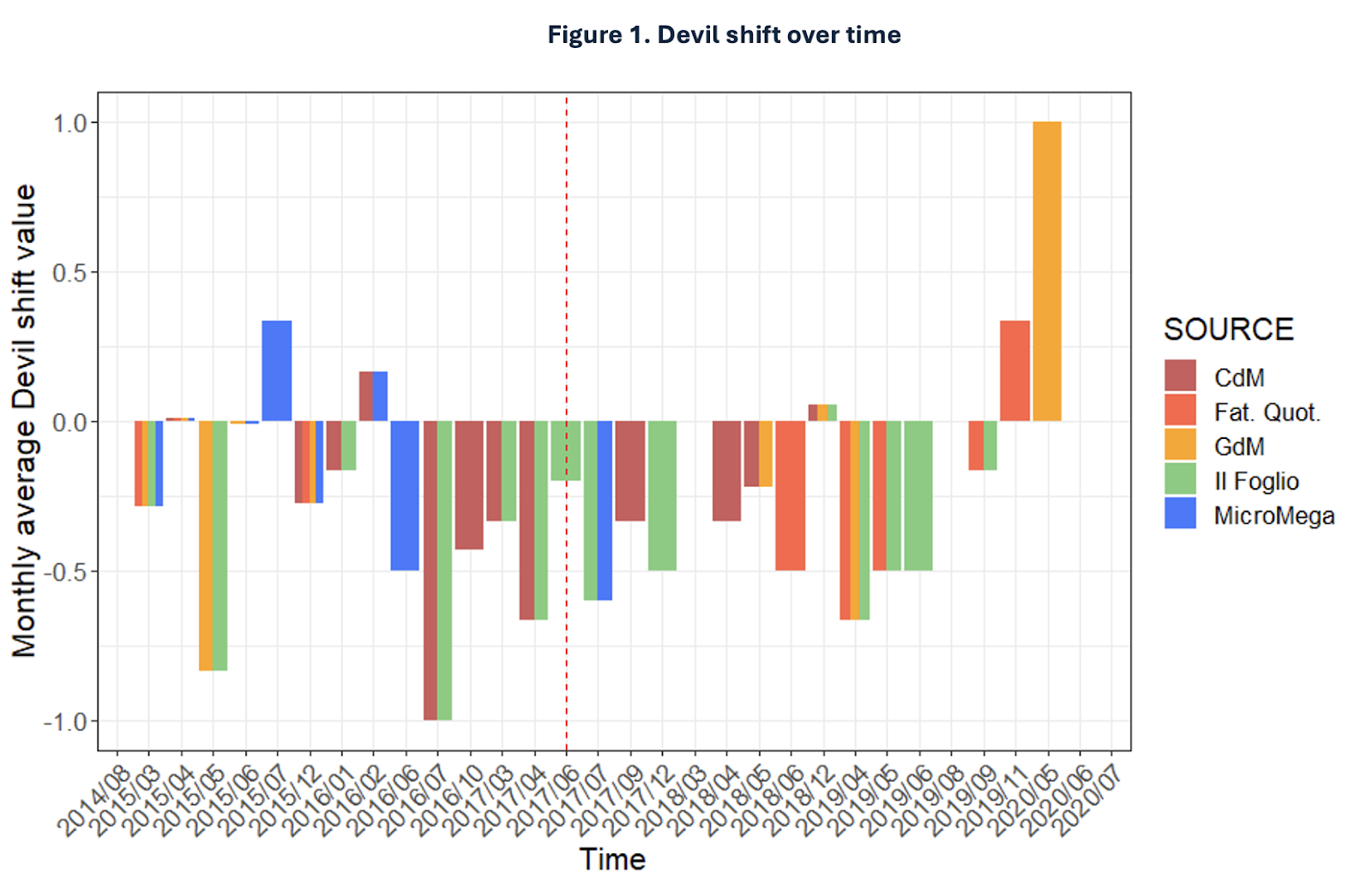
    The strongest differences in the use of characters were found for heroes, especially between the most ideologically opposed news outlets. Moreover, the analyzed documents differed in the way they weaved their plots, presented differing solutions, and made appeals to science to solve the problem. All but one news outlets also displayed a stronger use of blame-apportionment strategies (the so-called “devil shift”) as opposed to highlighting problem-fixers. Hence, these narrative elements created a vicious cycle of polarisation based on disagreements about the facts and theories and on the way forward, contributing to making this policy problem all the less tractable. 

    To assess whether the tractability of the problem changed over time thanks to the presence of established theories about the causes of the epidemic, I took a temporal approach to the devil shift. While scientists did manage to establish the causes of the epidemic in May 2017, Figure 1 shows that the news outlets continued to employ blame-apportionment strategies throughout the entire period of analysis. 

    From a substantive standpoint, the results of this study cast doubt on the ability of policy actors to engage in fruitful debates in an increasingly polarised world. Theoretically, however, the article represents a first attempt to bring the NPF together with the literature on problem definition and implementation. The three partly share a common language, and insights from each can add to the others’ theoretical and empirical developments.

    You can read the original article in Policy Studies Journal at

    Schito, Marco. 2023. Analyzing the association of policy narratives with problem tractability in the implementation of EU decisions: Evidence from the phytosanitary policy area. Policy Studies Journal, 51, 869–886. https://doi.org/10.1111/psj.12500

    About the Author

    Marco Schito is a researcher at the Public Policy and Management Institute (PPMI) in Vilnius, Lithuania. His research interests involve socio-economic issues and state-business relations. He was most recently involved in studies about the effect of inflation on small and medium enterprises in the EU-27.
    E-mail: marco.schito@ppmi.lt