
Most research on bureaucracy and Congress examines oversight of policy implementation. This article shifts focus to bureaucratic access to congressional agenda setting on global warming and climate change (GWCC) during the early-stage, pre-legislative period (1976-2007), when the issue was emerging and no major legislation had yet been drafted.
Concepts and Hypotheses
The authors conceptualize bureaucratic access to congressional hearings as a multidimensional construct with three key components:
Participation — Frequency of testimony appearances (measured by simple count).
Dispersion — Spread across congressional committees (measured by normalized Shannon’s entropy).
Centrality — Positional importance in the congressional hearing network (measured by closeness and eigenvector centrality).
Bureaucrats are expected to dominate early-stage GWCC hearings due to their specialized expertise, broad monitoring capacity, perceived neutrality, and institutional memory—advantages often lacking in other witness groups. The study tests three hypotheses:
H1: Bureaucrats provide more testimonies than other groups.
H2: Bureaucrats appear across a wider range of committees.
H3: Bureaucrats occupy more central positions in hearing networks.
Methodology
Using mixed methods, the authors analyzed original data from Lexis-Nexis Congressional Publications, including 153 GWCC hearings and 1,338 testimonies from 1976-2007. Witnesses were coded into five groups (bureaucracy, academia, industry/business, nonprofits, and other). Quantitative measures of participation, dispersion, and centrality, along with statistical tests, were used to evaluate the hypotheses.
Key Findings
Participation: Bureaucrats Dominated GWCC Testimonies
Table 2 below shows that out of 1,338 testimonies, bureaucrats provided 527 (39.4%), far more than academia (17.4%), non-profits (17.9%), industry and business (14.0%), or other organizations (11.2%). Statistical tests confirm that bureaucrats appeared significantly more often than any other witness group.
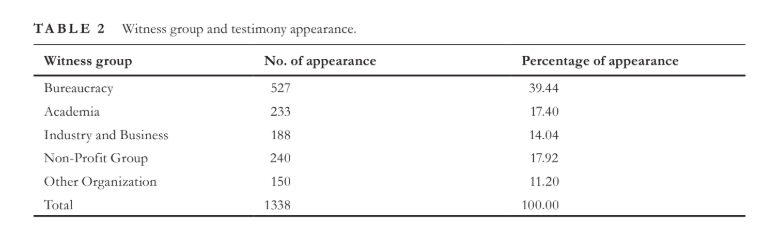
Table 2. Witness Group and Testimony Appearance.
Dispersion: Bureaucrats Were the Most Dispersed
Table 3 below shows the bureaucrats’ average normalized entropy score (0.67) was the highest among the five witness groups. Further statistical tests confirm they testified across a significantly wider range of congressional committees than any other group.
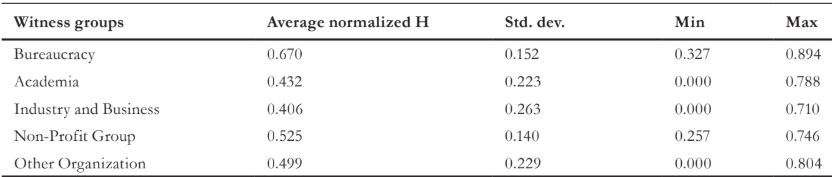
Table 3. Witness Group and Dispersion Score.
Centrality: Bureaucrats Occupied the Most Central Network Positions
As shown in Table 4, Bureaucrats scored the highest on both measures of network centrality: closeness centrality (more direct and efficient connections to other actors) and eigenvector centrality (connections to other well-connected actors). They acted as key hubs linking different committees and stakeholders. Further regression analysis (see Table 5) indicates these patterns of bureaucratic centrality held strongly during the early years of congressional GWCC agenda setting when Congress was seeking information from various witness groups on whether the problem was real and human caused.
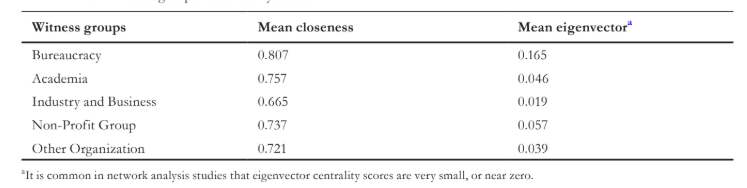
Table 4. Witness Group and Centrality Scores.
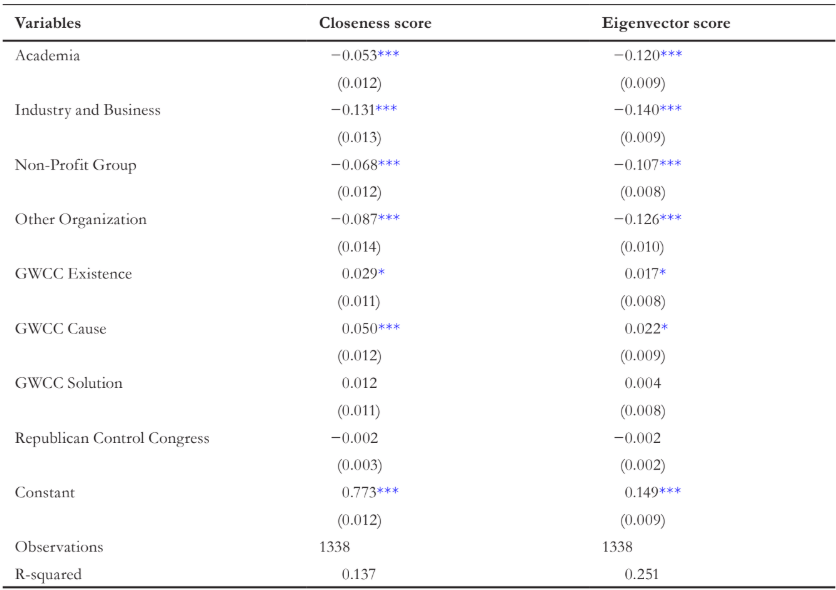
Table 5. Determinants of Closeness and Eigenvector Centrality (Bureaucracy as the Reference Group) for the Entire Study Period (1976-2007).
Why It Matters
This study demonstrates the bureaucracy’s prominent role in congressional GWCC agenda setting in terms of their testimony participation, committee dispersion, and network centrality. For policy scholars, it provides theoretical insights and empirical tools (e.g., entropy score and network metrics) for studying multidimensional agenda access. For practitioners, it highlights that bureaucrats shape policy agendas, not just implementation.
Read the original article in Policy Studies Journal:
Liu, Xinsheng, Bryce Hannibal, and Arnold Vedlitz. 2025. “Bureaucratic Access in National Policy Agenda Setting Process: Participation, Dispersion, and Centrality. ” Policy Studies Journal, 53(4): 833-851. https://doi.org/10.1111/psj.70023
About the Article’s Author(s)
Xinsheng Liu, Ph.D., Senior Research Scholar and Research Scientist, Institute for Science, Technology, and Public Policy, Bush School of Government and Public Service, Texas A&M University, College Station, Texas, USA.
Bryce Hannibal, Ph.D., Federal Statistical Research Data Center Administrator and Survey Statistician. U.S. Census Bureau. Suitland, Maryland, USA.
Arnold Vedlitz, Ph.D., Bob Bullock Chair in Government and Public Policy, Director & Distinguished Research Scholar, Institute for Science, Technology and Public Policy, Bush School of Government and Public Service, Texas A&M University, College Station, Texas, USA.

