
How can a policy be impactful if, by design, the policy text is highly symbolic? Symbolic policies communicate salient values such as equity or rights with minimal implementation guidelines. Despite their ubiquity, these policies have been overlooked by scholarship that largely views symbolic policies as performative and meaningless. The authors challenge this prevailing notion by showcasing how symbolic policies can serve as powerful vehicles of transformative sociopolitical change. To demonstrate this, the authors analyzed California’s highly symbolic human right to water law (AB 685, 2012). Results highlight the growth of collective political power and the law’s impact on state responsiveness to drinking water challenges.
Methodology
The authors employed a case study design, using a combination of semi-structured interviews, archival data, and document analysis, to assess the policy design of, and feedbacks from, AB 685. This law, deemed highly symbolic as it lacked enforcement measures, was also widely considered very impactful by a diverse array of policy actors, making it an excellent policy candidate for analyzing how symbolic policies can impact social change. Key informants involved in AB 685 passage or implementation were interviewed. The authors also analyzed state archives associated with AB 685 and a prior human right to water bill, as well as more than 40 state documents, such as legal cases and agency budgets.
Key Findings
Highly Symbolic Policies Can Drive Material and Transformational Change
Through dedicated community organizing and advocacy by grassroots and water justice coalitions in California, the symbolism within the text of AB 685 triggered interpretive consequences that eventually led to substantial material outcomes. For example, coalition members highlighted the negative health effects felt by communities with contaminated drinking water and affordability concerns for low-income users. This, along with high-visibility staging events as shown in Figure 2, not only united previously disconnected grassroots organizations, but also forced state agencies to acknowledge their concerns. By capitalizing on AB 685’s rhetoric, grassroots and water justice groups were able to influence and change existing regulations, as well as shape legislative decisions that ultimately provided $1.4 billion in funding for drinking water access. These developments underscore the ability of symbolic language in policies to incentivize material (resource effects) and transformational changes in policy over time through interpretive effects including narrative change, movement building and increased state responsiveness.
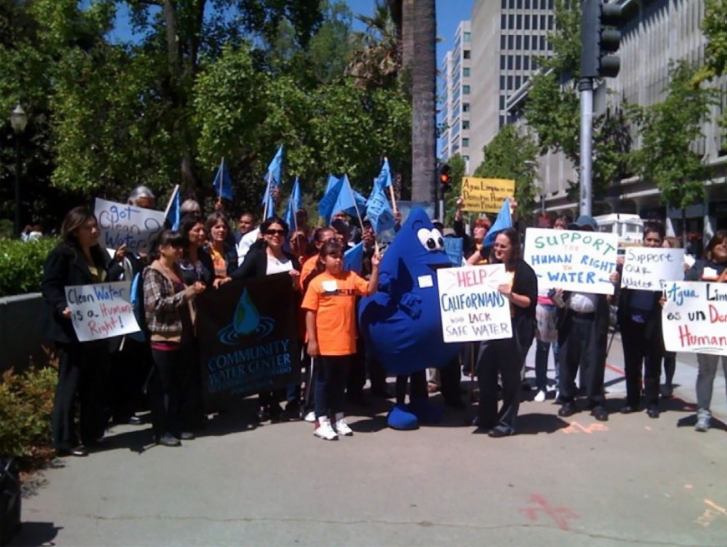
Figure 2. “La Gotita” (“the little water droplet” in Spanish) joined members of the Safe Water Alliance to advocate for the human right to water. Photo credit: Community Water Center.
Ambiguity Can be Key for Movement-Building and Agenda-Setting
The brief text and undefined terms such as “safe”, “clean”, “affordable”, and “accessible” in AB 685 proved helpful in activating a significant coalition-building effort in California. Supporters of AB 685 leveraged the vague legislation to humanize the issue of drinking water access through first-hand community testimonies, as shown in Figure 3. This allowed a highly diverse coalition of stakeolders—rural farmworkers, urban environmental advocacy groups, faith-based organizations, and Indigenous groups to coalesce around a shared frame of ensuring public health and dignity. Moreover, the ambiguous design of AB 685 facilitated relevance across policy venues, scales and time, thereby amplifying its impact across various water justice domains. Finally, the ambiguity of the policy design was key to the law’s passage. Not only were the bill’s proponents’ relative newcomers to state policy debates but the opposition was highly organized and influential. Combined, these results demonstrate that contrary to traditional literature that deems ambiguous symbolic legislation a failure such policy designs may actually be uniquely strategic for social movements.
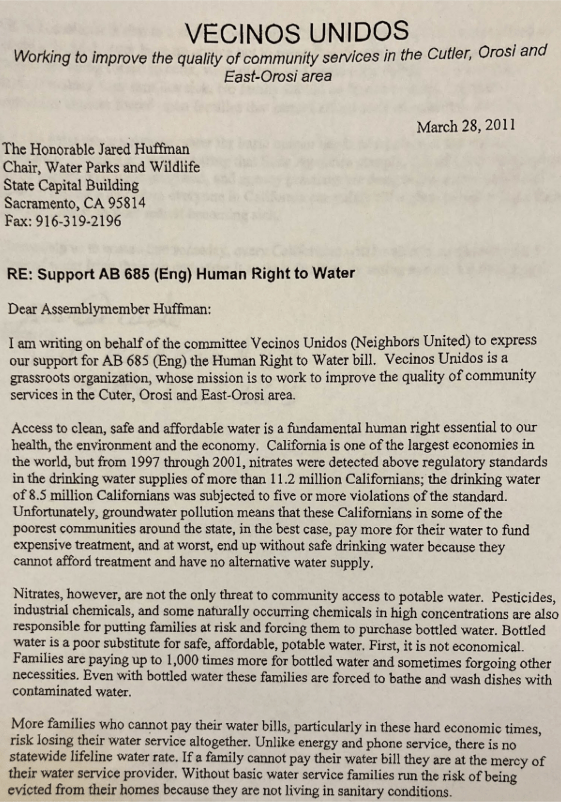
Figure 3. Page one of a 2011 support letter for AB 685 from Vecinos Unidos, which is a community-based organization and member of the grassroots AGUA (Asociación de Gente Unida por el Agua, or Association of People United for Water) coalition.
Why It Matters
Highly symbolic policies such as California’s AB 685 law can effectively act as foundational drivers for reshaping institutional communication and responsiveness to ensure long-term material changes. By elucidating how the feedbacks from symbolic policies can facilitate concrete, long-term changes to policy and regulatory frameworks, the authors address an important gap in policy feedback literature. Specifically, this work illustrates that grassroots movements can utilize symbolic policies as a tool for building long-term collective power and influencing the design of major policy programs. For future research endeavors, the authors recommend further investigating the role of symbolic policy in policy design and feedback beyond drinking water access, such as climate change or social justice, to determine its strategic currency in transforming institutional dynamics.
Read the original article in Policy Studies Journal:
Rempel, Jenny Linder and Kristin Babson Dobbin. 2025. “When “Symbolic” Policy is Anything But: Policy Design and Feedbacks from California’s Human Right to Water Law.” Policy Studies Journal 53(3): 701-722. https://doi.org/10.1111/psj.12564.
About the Article’s Author(s)

Jenny Linder Rempel is a postdoctoral scholar in the Department of Environmental Science, Policy, and Management at UC Berkeley.

Kristin Babson Dobbin is an Assistant Cooperative Extension Specialist in water justice policy and planning at UC Berkeley in the Department of Environmental Science Policy, and Management. Prior to coming to Berkeley, she was a NSF postdoctoral fellow at the Luskin Center for Innovation at UCLA and previously worked for the Community Water Center in Visalia, California. She received her PhD in the Graduate Group in Ecology at the University of California Davis in 2021.

