

Does the level of attention that politicians direct toward complex environmental problems impact how frontline bureaucrats in municipal settings form relationships? The collaborative interactions among civil servants are a defining feature of environmental governance, drastically shaping how issues are addressed. In this article, the authors incorporate political attention, or the priority status that an issue receives on the political agenda, to analyze how fluctuating attention levels affect the ties created between street-level bureaucrats and the policy outcomes produced. These dynamics are explored within the issue context of flood risk mitigation across municipal civil servant networks in Southern Sweden. Three actor types within municipal administration heavily involved in flood risk mitigation are examined: water & sewage, planning, and politicians and senior managers. By investigating the effects of political attention on collaborative environmental governance, the authors aim to illustrate how policy consequences and relationships at the municipal level are shaped by top-down influences.
Hypotheses
To evaluate the relationships between political attention and collaborative networks, the authors established the following hypotheses:
- When political attention is low, water and sewage actors tend to have more ties than each of the other types of actors.
- When political attention is high, planners, politicians, and senior-level managers tend to have more ties than each of the other types of actors.
- Actors appointed as coordinators tend to have more ties, the stronger the political attention is.
Methodology
The authors examined three municipalities in Southern Sweden, including Lomma, Lund, and Staffanstorp (as shown in Figure 2), that all exhibited varying degrees of political attention to flood risk mitigation. Three sources of data were utilized in the study, consisting of scientific literature, 143 qualitative interviews with local actors, and a national performance metric of climate adaptation performances by Swedish municipalities. In addition, social network analytical modeling in R was conducted to analyze the relationships between different municipal actors.
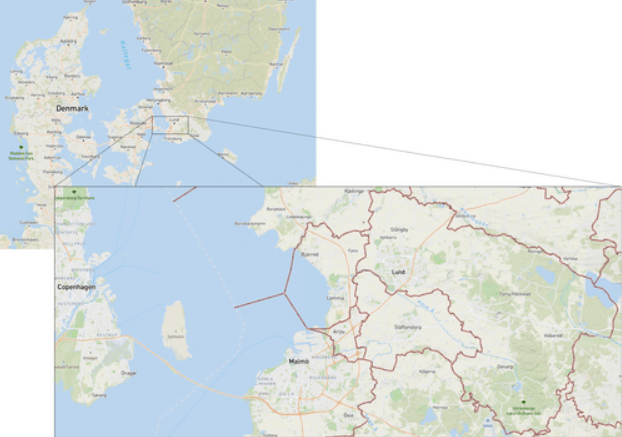
Figure 2. The location of Lomma, Lund, and Staffanstorp municipalities in Southern Sweden (developed from Vatten.Atlas.se).
Key Findings
Collaborative Network Dominance Varies by Actor Type and Attention
As shown in Table 3 below, the propensity of ties or relationships differ drastically across the examined municipalities. In Staffanstorp, an area of low political attention to flood risk mitigation, water & sewage actors exhibit more ties than any other category. However, in municipalities with high political attention such as Lomma and Lund, planners, as well as politicians and senior managers have more ties compared to water & sewage actors. These dynamics reveal that network collaborations differ by the level of political attention or prioritization that is given to flood risk mitigation issues. Subsequently, this confirms the authors’ two initial hypotheses (H1 & H2), demonstrasting political attention serves as a catalyst for dictating the types of collaborative relationships that develop.
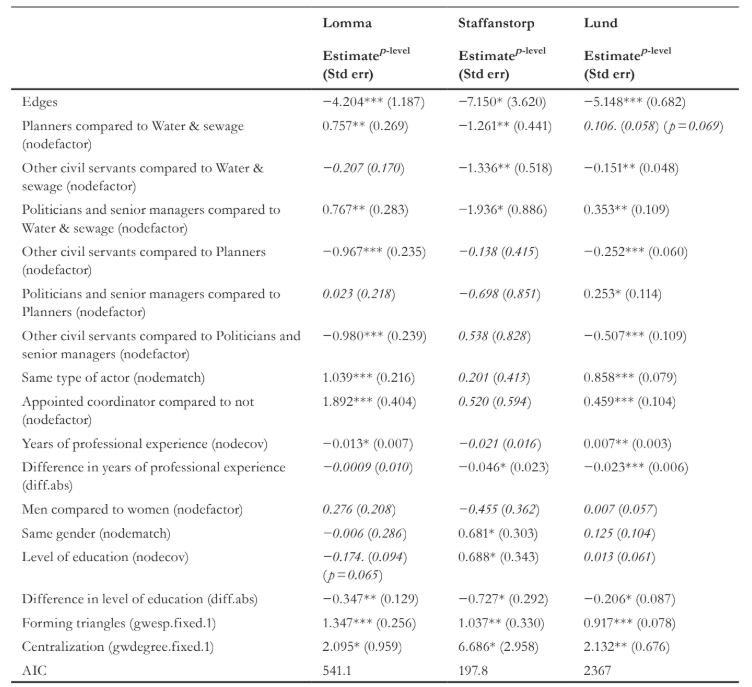
Table 3. Results of hypothesis testing model (including the type of actor, appointed coordinator, gender, level of education, and triangle formation).
Coordinators Act as a Bridge for Developing Network Ties
Being an appointed coordinator in a Swedish municipality with high political attention is shown to matter in fostering network ties between street-level bureaucrats. Figure 3 illustrates that in municipalities such as Lomma and Lund with high political attention to flood risk mitigation, coordinators who are appointed are critical to mobilizing different actors. In contrast, in Staffanstorp, the low political attention dynamics correspond to coordinators having no significant impact on their ability to form collaborative relationships. These results indicate that high political attention boosts the success of coordination between actors when an issue is being prioritized. Furthermore, the results imply that politicians’ attention to environmental challenges establishes the issue salience needed for collaborative networks to form and to incentivize cooperation.
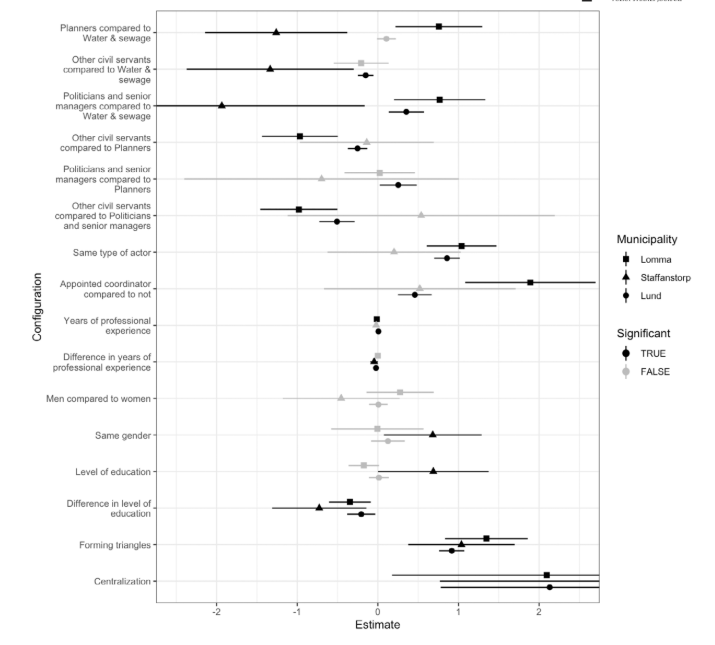
Figure 3. Ranges of estimates (+/-2 standard errors) for each configuration in the model per municipality. Ranges crossing zero correspond to the estimate not providing a significant result for the particular municipality, while overlapping ranges in the estimates for a particular configuration connote no significance difference between municipalities.
Why It Matters
The tendencies of street-level bureaucrats or public servants to work together is heavily defined by different environmental and institutional contexts. This article demonstrates that the level of political attention expressed toward complex environmental challenges facilitates varying degrees of network coordination among street-level actors. The described phenomenon signifies that networks are formed on the basis of a shared issue prioritization and preference for collaboration. More importantly, the authors acknowledge that the study could potentially explore additional factors that may influence the development of ties between street-level actors. Nonetheless, the study makes an important contribution to the field of collaborative governance by illuminating the patterns that drive network development in municipal settings.
Read the original article in Policy Studies Journal:
Becker, Per and Örjan Bodin. 2025. “The Impact of Political Attention on Collaborative Environmental Governance Among Municipal Street-level Bureaucrats.” Policy Studies Journal 53(4): 852–875. https://doi.org/10.1111/psj.70020.
About the Article’s Author(s)

Per Becker is Professor of Risk and Sustainability at Lund University, Professor of Leadership and Command & Control at the Swedish Defence University, Extraordinary Professor at North-West University. His research focuses on the systemic interactions between the physical environment, social organization and social behavior in relation to societal safety, security, and sustainability.

Örjan Bodin is Professor of Environmental and Sustainability Science at Stockholm Resilience Center, Stockholm University, and Visiting Professor at the Swedish Defence University. His research focuses on collaborative environmental governance using a combination of natural and social science methods and perspectives.

