
Abortion rights remain a high-stakes issue in American politics, provoking a lot of moral debate and public reactions. Since the landmark ruling in Dobbs v. Jackson (2022), several states have added more restrictions on abortion access. Researchers have found that public opinion shapes state policies on abortion, but it is not clear how citizens judge indirect restrictions on abortion rights. To investigate this phenomenon, this study examines how people’s judgments and political mobilization depends on whether the restrictions are indirect, such as defunding services, compared to direct, such as complete bans on abortion.
Hypotheses
The authors test two hypotheses to determine how the type and framing of abortion restrictions influence people’s judgments:
- Demobilization Hypothesis: Indirect restrictions demobilize abortion supporters by inciting less opposition compared to direct bans or restrictons.
- Exclusion Framing Hypothesis: Pro-choice (abortion) supporters will express greater opposition toward exclusion restrictions (indirect restrictions framed as direct) compared to direct restrictions.
Methodology
Two experiments were conducted in 2015 and 2016 with participants from the United States. In the first experiment, participants read one of three policy conditions: banning, defunding, or excluding. Then participants answered how much they support or oppose the policy, and their willingness to participate in politics to express their views. The second experiment replicated the prior design, except provided participants with a statement indicating the substantial number of women who would be deprived of abortion services because of the restriction, holding constant the number of women who would be affected across the three types of policy.
Key Findings
Pro-Choice Supporters Oppose Banning more than Defunding
Figure 1 from Experiment 1 reveals that pro-choice supporters expressed less opposition to policies defunding abortion services than to outright bans. Pro-choice supporters also opposed exclusion policies more than defunding policies. These patterns support the demobilization hypothesis, indicating that indirect restrictions reduce public and political opposition compared to direct restrictions. This finding suggests that subtle differences in policy design and framining could bypass mobilized opposition.
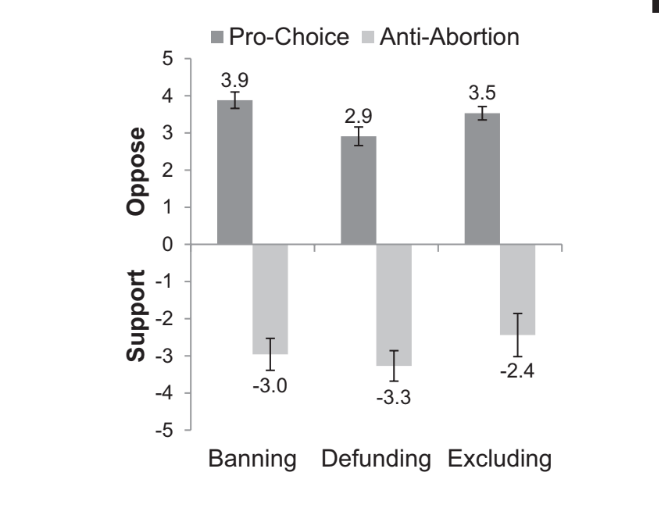
Figure 1. Participants’ judgments of abortion restrictions by abortion stance and policy type, Experiment 1. Error bars are standard errors. The sample sizes for the pro-choice groups were: banning n=104, defunding n=117, and excluding n=111. For the anti-abortion group, they were: banning n=43, defunding n=45, and excluding n=33.
Consequences Do Not Overcome Demobilization
Experiment 2 replicated the findings while holding constant the number of women who would be affected. Figure 2 shows that pro-choice participants opposed defunding abortion less than a complete ban, despite the fact that both policies prevented the same number of women from receiving abortion access. Even when participants knew the consequences, pro-choice supporters were still less opposed to the indirect restriction. The findings also demonstrated that pro-choice supporters opposed exclusionary policies less than direct bans. People’s judgements of restrictions depended on the framing of the policy, particularly how direct the restriction appeared.
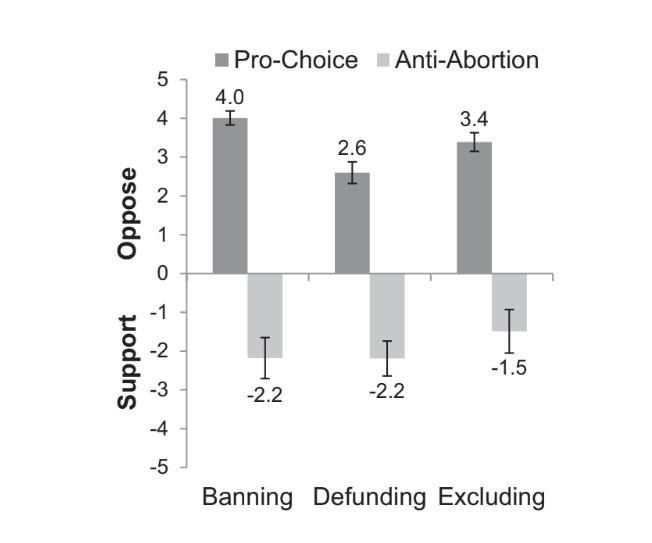
Figure 2. Participants’ judgements of abortion restrictions by abortion stance and policy type, Experiment 2. Error bars are standard errors. The sample sizes for the pro-choice groups were: banning n=103, defunding n=94, and excluding n=1-3. For the anti-abortion group, they were: banning n=40, defunding n=49, and excluding n=39.
Why It Matters
This study shows that people’s judgments of abortion restrictions depend on how directly they prevent abortion, determining their willingness to politically mobilize in response. For policymakers and political activists, the takeaway is clear: the directness of the policy, in design and framing, will determine how much people support and oppose those restrictions. As for future research, the authors call for more attention to the psychology of indirect restrictions to better understand public opinion on abortion rights and how state legislatures may seek to minimize opposition.
Read the original article in Policy Studies Journal:
Connors, Elizabeth C., Alessandro Del Ponte, and Peter DeScioli. 2025. “Indirect Restrictions Demobilize Supporters of Abortion Rights.” Policy Studies Journal 53(4): 1123–1137. https://doi.org/10.1111/psj.12575.
About the Article’s Author(s)

Elizabeth C. Connors is an associate professor in the Department of Political Science at the University of South Carolina.

Alessandro Del Ponte is an assistant professor in the Department of Political Science at the University of Alabama, a Visiting Research Professor at the Global Asia Institute at the National University of Singapore, and a Visiting Assistant Professor at the Smith Institute for Political Economy and Philosophy at Chapman University.

Peter DeScioli is an associate professor in the Department of Political Science at Stony Brook University.
 Policy Studies Journal Blog