After surpassing 500 submitted manuscripts in 2024, PSJ’s need for reviewers is at an all-time high. With this, our editorial team is immensely grateful to those who continue to contribute to our field by serving as manuscript reviewers. This commitment is central to our work as policy scholars and is essential to ensure publication of high-quality scholarship. We have relied heavily on many of you to provide valuable feedback on promising manuscripts, and we do not take the time you have dedicated lightly.
To lessen our reliance on our current pool of reviewers while still ensuring a timely review process, the PSJ editorial team has instituted a new policy for those submitting manuscripts to our system: moving forward, every submitter will be required to recommend five (5) reviewers.
With this change, our team wanted to share guidelines that can assist submitters in selecting applicable reviewers. When considering reviewers, we ask submitters to keep in mind the following:
First, please make sure that the reviewers collectively cover the three critical aspects of your manuscript: theory, methodology, and the substantive topic.
Second, please try to mix senior and emerging scholars. This diversity enriches the review process with varied perspectives and experiences.
Third, the reviewers should be those who can uphold the highest standards of editorial integrity, as this is of utmost importance to us.
Finally, please make sure that the selected reviewers do not have any obvious connections to you or other authors. This will help maintain anonymity and impartiality in the review process.
Thank you in advance to all submitters for supporting your individual manuscript’s review process, and we look forward to your submissions!
Diffusion has emerged as an important concept for studying how public policies spread across jurisdictions. Scholars have identified several mechanisms that drive policy diffusion, including learning, competition, emulation, and coercion. At the same time, policy diffusion is also a popular governance approach, particularly for higher levels of government that want to promote certain policies at lower levels, but do not want to or cannot mandate policy action. However, the governance potential of policy diffusion is poorly captured by the prevailing mechanism-centered concept, which is difficult to measure and typically emphasizes direct coercion or “hard” interventions, such as preemptive legislation or conditional funding. It therefore risks overlooking important less coercive or “soft” interventions that higher levels of government can use to promote policy development at lower levels.
This neglect of soft interventions limits the analytical value of the diffusion concept, especially in multilevel environments with varying levels of authority and in policy areas where direct coercion is unavailable or undesirable, including in climate policy. For example, in many countries, higher levels of government lack the constitutional authority to mandate local climate action, or local authorities lack the capacity to comply with such mandates, so they resort to various interventions that are scattered throughout the literature but have not yet been compared more systematically.
To address these issues, I present a new channel-centered framework that distinguishes between six soft policy diffusion channels that can be broadly placed on a continuum of coerciveness or state intervention: autonomous, collaborative, exemplary, persuasive, organized, and funded diffusion (see Table 1). Autonomous diffusion refers to voluntary and noninstitutionalized exchanges between jurisdictions at the same level of government, collaborative diffusion to the bottom-up creation of formal networks, exemplary diffusion to policy development by higher-level governments to set an example, persuasive diffusion to the provision of informational resources, organized diffusion to networks created by higher-level governments, and funded diffusion to financial incentives and the provision of additional resources.
I probe the framework by studying local climate change adaptation policy using original survey data collected from the administrations of 190 municipalities located in the central German state of Hessen. The regression results indicate that the local institutionalization of adaptation in Hessen such as the development of adaptation plans and new staff dealing with adaptation is associated with several interventions by higher levels of government, including the provision of a policy model, a municipal climate network, and grant programs. However, the density of concrete adaptation measures–such as the creation of open-air corridors, education programs, drainage and retention areas, and surface unsealing–is associated with noninstitutionalized exchanges between municipalities. These results demonstrate the usefulness of the framework for distinguishing and comparing different diffusion channels and thus for understanding policy diffusion as a governance approach. In particular, the results suggest that different types of interventions may be needed to support adaptation policy development at the local level. This is important information for the efficient allocation of scarce (local) resources and for policymakers seeking to capitalize on policy diffusion.
You can read the original article in Policy Studies Journal at
Schulze, Kai. 2024. “ The Soft Channels of Policy Diffusion: Insights From Local Climate Change Adaptation Policy.” Policy Studies Journal 52(4): 881–906. https://doi.org/10.1111/psj.12555.
About the Author
Kai Schulze is an Adjunct Professor with the Institute of Political Science at the Technical University of Darmstadt, Germany leading the Junior Research Group on Integrated Systems Analysis. His research focuses on comparative public policy and politics, particularly in the fields of energy, climate, and environment. His work has appeared in journals such as Climate Policy, European Journal of Political Research, Global Environmental Politics, Regional Environmental Change, Regulation & Governance, Review of Policy Research, WIREs Climate Change.
While ecomodernist ideas—e.g., the notion that modern technology can solve environmental problems—are widespread among citizens, we know little about their stability. In my article, I explore how ecomodernist beliefs are affected by major catastrophes. Leveraging the happenstance that the Fukushima-Daiichi accident occurred during the fieldwork of a 2011 public opinion survey in Israel, this piece makes several interesting inferences.
Ecomodernism advocates that humanity can reduce its environmental footprint through technological innovation while maintaining economic growth. Ecomodernists often promote technologies like nuclear power and geoengineering as vital tools for rapidly cutting carbon emissions. However, not everyone shares this optimism. Critics argue that a technology-first approach may overlook ecological limits and social risks. This raises an important question: how does techno-optimistism shift when technology fails dramatically?
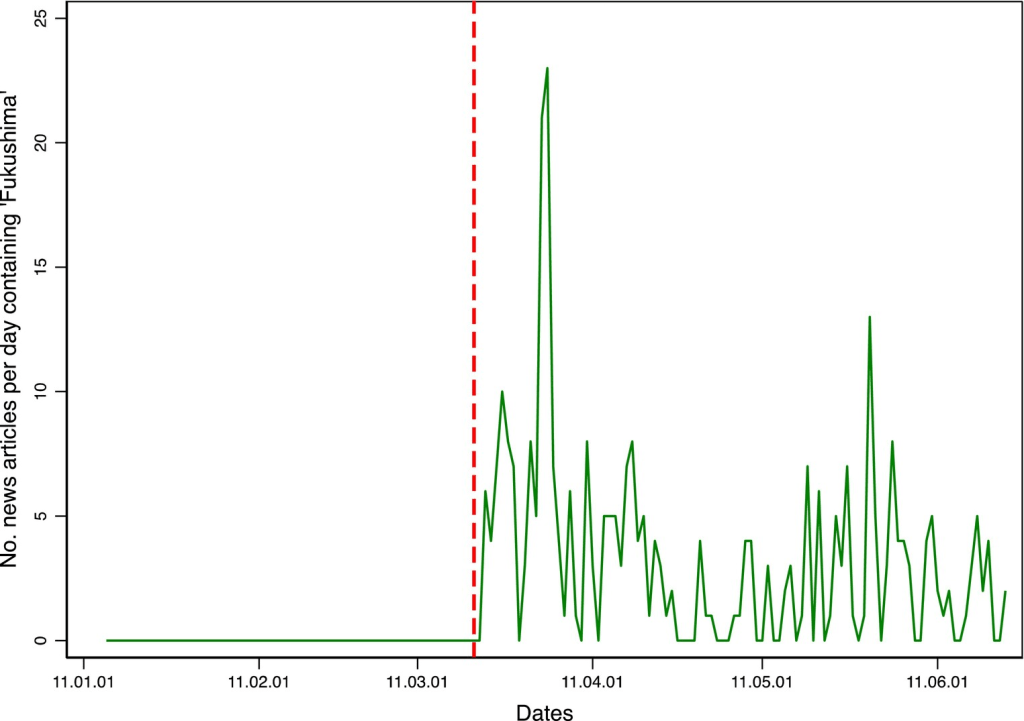
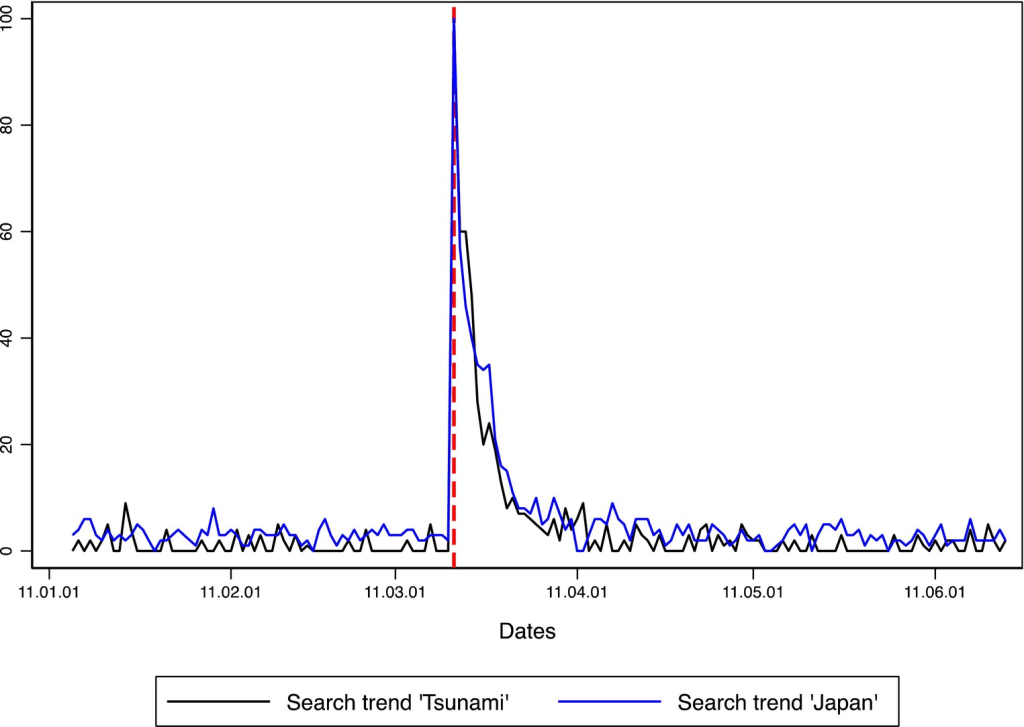
My study identifies a unique opportunity to investigate attitude shifts surrounding the Fukushima disaster. This event occurred during data collection for the European Social Survey (ESS) in Israel, a survey fieldwork that was unaffected by the events in Japan, creating quasi-natural conditions to experimentally analyze how sudden catastrophes influence ecomodernist beliefs. As seen in figures 1 and 2, both news media and people’s Google search trends in the country suggest that the events were very much present in the public debate.
Figure 1. Print media news attention.
Figure 2. Google search trends.
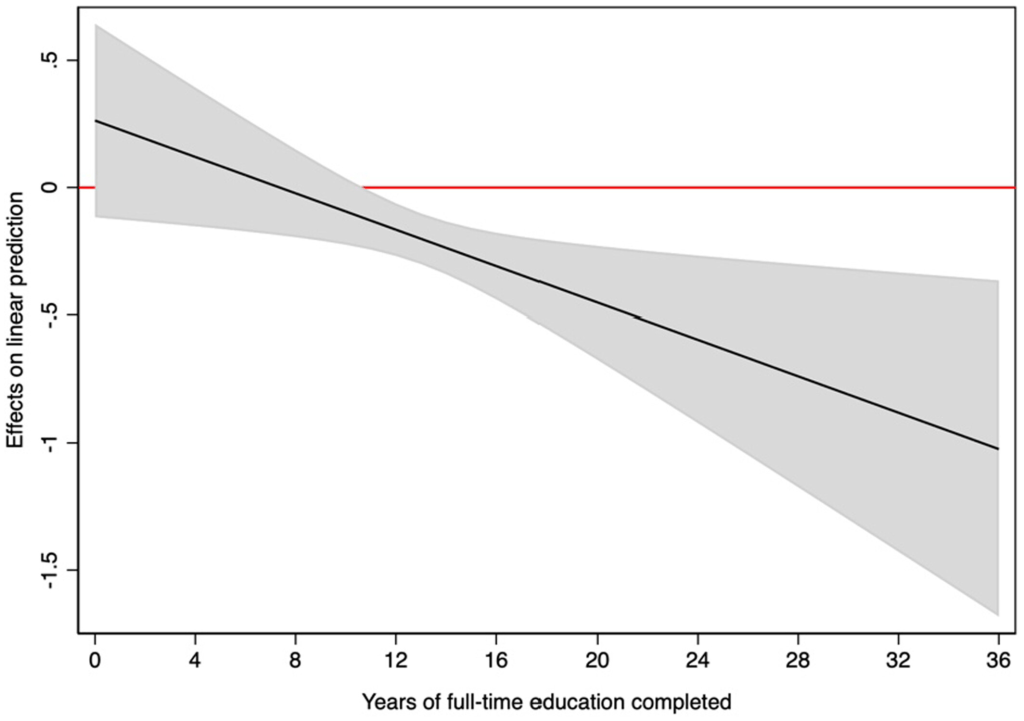
The ESS survey – rolled out to a nationally representative sample – measured survey participants’ agreement with the statement: “Modern science can be relied upon to solve environmental problems.” The disaster took place in the middle of the fieldwork period. Results reveal that those surveyed after Fukushima were, on average, less likely to agree with this statement than those interviewed before the disaster. The effect was particularly pronounced among respondents with higher education, a group typically more trusting of science and technology. Figure 3 illustrates this interaction, showing how the effect is stronger among those with longer education.
Figure 3. Main effects from Fukushima by respondents’ education years.
The study also corroborates these findings in a survey experiment with participants in two settings: Israel and the United States. In this extended analysis, an information vignette about the risk of nuclear power plant failures (compared to a control group that received no such information) provided similar effects on ecomodernist beliefs, suggesting that these effects are found when replicated with alternative approaches.
In the literature,environmental disasters can be seen as focusing events that draw attention to the risks of technological solutions. Interestingly, several authors have still described people’s beliefs about technological optimism as a “stable trait.” The events at Fukushima-Daiichi exposed vulnerabilities in complex technological systems, prompting heightened awareness of the risks with nuclear power and undermining broader trust in science’s ability to tackle environmental challenges. Hence, ecomodernist attitudes are more malleable than often assumed.
Given that public trust in technology wanes after disasters, it can become harder to rally support for large-scale technological initiatives, such as building new nuclear power plants or advancing geoengineering projects.
Policymakers need to recognize that trust in technological solutions is fragile and sensitive to external shocks. This study highlights that people’s beliefs about technology’s role in solving environmental problems are not static. By better understanding how such attitudes are shaped, we gain further insights in the public support for environmental policies in times of crises.
You can read the original article in Policy Studies Journal at
Sundström, Aksel. 2024. “ Environmental Disasters and Ecomodernist Beliefs: Insights From a Quasi-natural Experiment.” Policy Studies Journal 00(0): 1–31. https://doi.org/10.1111/psj.12562.
About the Author
Aksel Sundström is the PI of the Quality of Government (QoG) Data and an associate professor at the Department of Political Science, University of Gothenburg, Sweden. His research agenda is focused on comparative politics, with an interest in environmental politics, especially in the Global South, and the study of political representation.




 Policy Studies Journal Blog