
In 2020, the COVID-19 pandemic forced states to rethink election administration across the United States. To make voting safer, many states expanded mail voting options like no-excuse absentee voting (NEAV) and universal vote-by-mail (UVBM). While some scholars have studied how these reforms affect turnout, few have examined whether they influence voters’ trust in government itself. This article looks beyond turnout to ask a deeper question: Do voting access reforms change how citizens feel about their ability to participate in and trust government? The authors use a policy feedback lens to guide their inquiry.
Hypotheses
The authors test three hypotheses, with the understanding that partisanship and state politics may shape these effects:
- Internal Efficacy: NEAV and UVBM increase individuals’ sense of competence in political participation.
- External Efficacy: NEAV and UVBM increase individuals’ belief that government is responsive to them.
- Government Trust: NEAV and UVBM increase individuals’ trust in government.
Methodology
Using survey data from the American National Election Studies and state-level records of voting reforms, the authors used a statistical modeling approach called difference-in-difference estimation to compare states before and after adopting mail voting. They specifically estimated the average treatment effect of these reforms on internal efficacy, external efficacy, and trust in government. Subgroup analyses also explored overall trends and differences by party and state political control.
Key Findings
Making Voting Easier Doesn’t Boost Confidence
Table 1 reveals that adopting NEAV or UVBM did not significantly increase people’s sense of political competence or voice. In other words, the authors explain, making voting easier does not automatically make people feel more empowered. This finding challenges the assumption that lowering barriers builds democratic confidence; rather, it suggests that turnout gains from mail voting likely come from convenience, not deeper psychological engagement. Hypotheses 1 and 2 are therefore not supported.
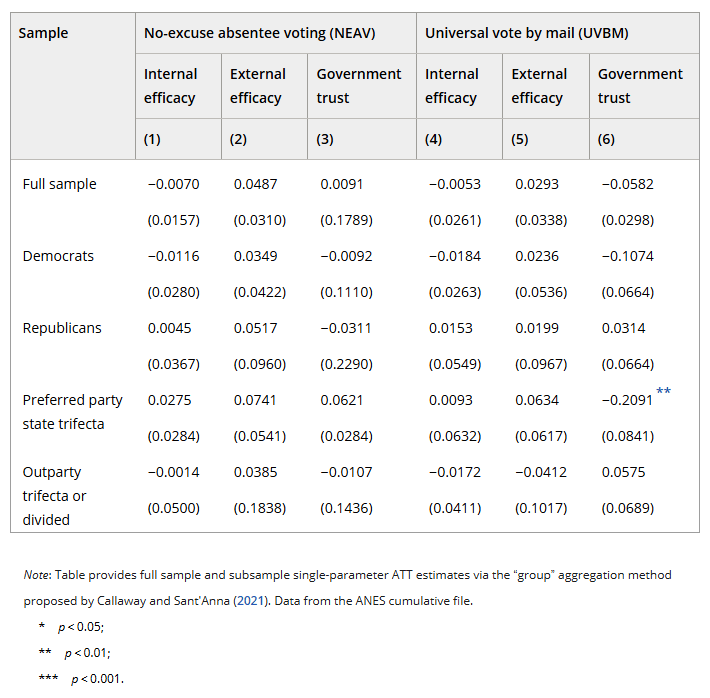
Table 1. Estimated average treatment on the treated (group aggregation by sample).
Limiting Choice May Undercut Trust in Voting Reforms
Figure 1 shows that neither NEAV nor UVBM mail voting reforms consistently improved trust in government, providing no support for H3. The authors even found some evidence that UVBM may undercut trust in government. The authors therefore argue that limiting access to in-person voting options, as typically occurs under UVBM systems, may inhibit the intended confidence-building effects of reforms.
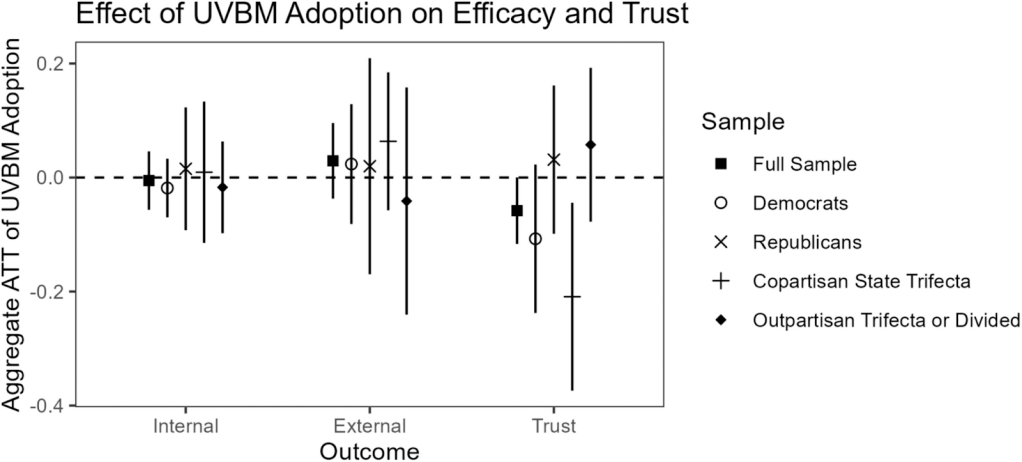
Figure 1. The group-average ATT estimate of the effect of UVBM adoption on each outcome by subsample.
Why It Matters
This article finds that expanding mail voting has not increased trust or feelings of empowerment amongst voters. The authors aim to reframe debates about election reforms, arguing that policymakers should focus on normative goals, like fairness and accessibility, rather than psychological or partisan benefits. They also argue that future research should develop better tools to measure trust and efficacy and explore whether repeated exposure to new voting systems changes attitudes over time.
Read the original article in Policy Studies Journal:
Trexler, Andrew, Marayna Martinez and Mallory E. SoRelle 2025. “Voting Access Reforms and Policy Feedback Effects on Political Efficacy and Trust.” Policy Studies Journal 53(2): 524-540. https://doi.org/10.1111/psj.70022.
About the Article’s Authors

Andrew Trexler is a PhD candidate in public policy and political science at Duke University. His research examines political communication, public opinion, and political behavior, with a focus on the United States. He draws on draw on a wide range of tools, including experimental methods, survey methods, text analysis, and machine learning. His work engages with several scholarly disciplines, including political science, public policy, mass communication, and psychology.

Marayna Martinez is an assistant professor of political science at the University of Colorado Boulder. Her research focuses on race and ethnic politics, political behavior, policy feedback, and K12 education policy. She is particularly interested in the feedback effects of public education on the political development of children of color. Her work has appeared in various journals, including Politics, Groups, and Identities and Policy Studies Journal.

Mallory E. SoRelle is an assistant professor of public policy at the Sanford School of Public Policy at Duke University. Her research investigates how public policies influence socioeconomic and political inequality in the United States. She is the author of Democracy Declined: The Failed Politics of Consumer Financial Protection, which explores the political response—by policymakers, public interest groups, and ordinary Americans—to one of the most consequential economic policy issues in the United States: consumer credit and financial regulation.
 Policy Studies Journal Blog