Learning to Avoid: The Long-term Effects of Adolescent Welfare Participation on Voting Habits in Adulthood

Despite many citizens in the United States first experiencing welfare policies during adolescence, we have yet to uncover the extent to which welfare participation during this period affects political participation in adulthood. While scholars have long studied the political consequences of adult program participation, we know relatively little about adolescent program participation. What are the political effects of adolescent participation in means-tested programs? This study provides evidence that ignoring early-life policy experiences can mask how people’s lived experiences with welfare policies influence political behaviors.

Hypotheses

The author tests the expectation that participating in welfare during adolescence sets individuals on a path toward nonparticipation in adulthood that is likely to persist over time.

Methodology

The author uses mixed methods, including longitudinal survey data and original qualitative interviews. Using the National Longitudinal Survey of Youth 1997 (NLSY97) with measures of adolescent program participation and voting in adulthood, the author estimates latent growth curve models that account for within- and between-person variation to overcome dependency between an individual’s response across survey rounds. The author then uses original qualitative data collected through interviews with young adults who were on welfare as adolescents. The interview transcripts are thematically coded using Atlas.ti and deductive and inductive approaches.

Key Findings

The Negative Relationship among Non-Hispanic White Individuals

Figure 1 shows how the probability of voting throughout early adulthood varies depending on an individual’s experience with welfare programs. The darkest line shows someone with no welfare experience, the middle tracks a person who used one program in adolescence and adds more in adulthood, and the lightest reflects someone with heavy adolescent program use who relies on fewer programs as an adult.
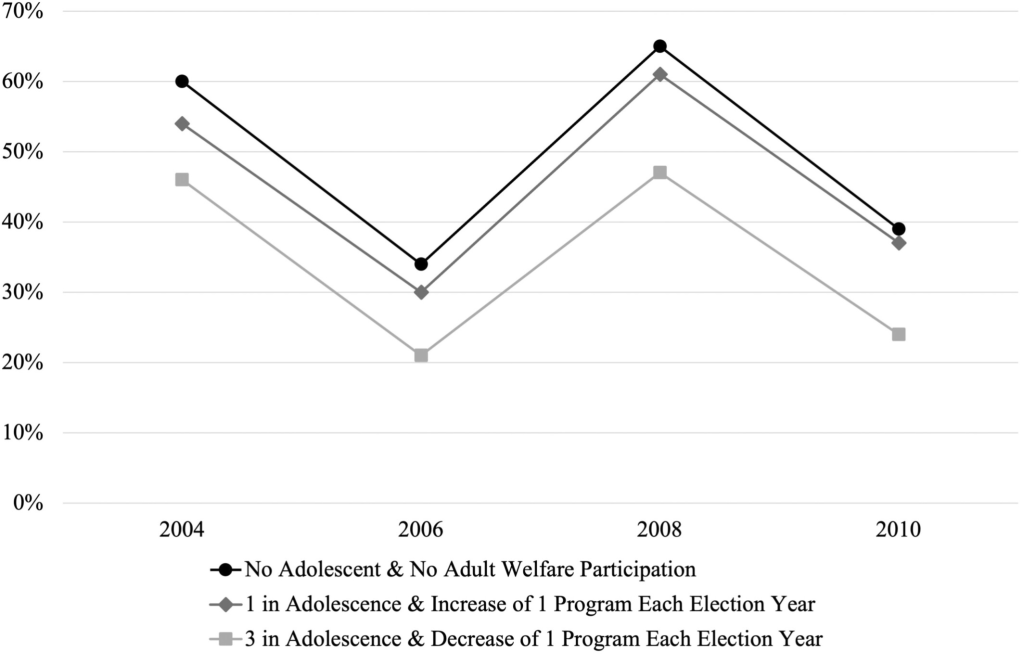
Image Description

Figure 1. Turnout between 2004 and 2010 based on changes in welfare participation among non-Hispanic White individuals.

The markers for the 2004 election indicate each’s propensity to vote in their first election, and the results show that those with no adolescent welfare experience are the most likely to vote (~ 60% predicted probability), while those with the most extensive adolescent program experience are the least likely to vote (~ 46% predicted probability). Additionally, Figure 1 shows that, over time, those with moderate adolescent program experience recover and are about just as likely to vote by the 2010 election as someone never on welfare, while those with extensive adolescent program experience remain significantly less likely to vote even as they use fewer programs as an adult.

Evidence from Qualitative Interviews

The qualitative evidence provides richer insights into the quantitative findings, providing support for the identified negative relationship. Interviews with young adults who grew up on welfare reveal three recurring themes that help explain lower voting rates. First, many described stigma and embarrassment tied to public-facing programs like food stamps, often avoiding situations where their participation was visible. Second, participants reported a lack of pro-civic role models, as parents focused on survival rarely modeled voting or political engagement. Finally, expectancy–disconfirmation emerged when government aid failed to meet expectations, fostering distrust and feelings of being “trapped” in poverty. These findings suggest that such experiences often translated into negative views of politics and a sense that participation is futile, reinforcing patterns of civic disengagement into adulthood.

Why It Matters

This study shows that the political consequences of welfare use are not confined to adulthood—they take shape much earlier. By looking at individuals over time, the findings indicate that growing up in households using means-tested programs is linked to lower voting rates among non-Hispanic white youth, even after accounting for adult circumstances. Because voting habits tend to persist over time, these early experiences likely have enduring consequences for democratic participation. Overlooking adolescence means missing a key piece of how social policy shapes political voice.

Read the original article in Policy Studies Journal:

Micatka, Nathan K. 2025. “Learning to Avoid: The Long-term Effects of Adolescent Welfare Participation on Voting Habits in Adulthood.” Policy Studies Journal 53(4): 1065–1087. https://doi.org/10.1111/psj.70003.

About the Article’s Author

Nathan K. Micatka is an Assistant Professor of Political Science in the Department of Political Science and Criminal Justice at the University of South Alabama. His work centers on American political behavior, poverty, and public policy. His research is published in outlets such as Policy Studies Journal, Political Research Quarterly, Electoral Studies, PLOS One, and Social Science Quarterly. Nathan’s research has also been supported by a Doctoral Dissertation Research Improvement Grant from the American Political Science Association and the National Science Foundation. Visit his website to learn more: nathanmicatka.com.
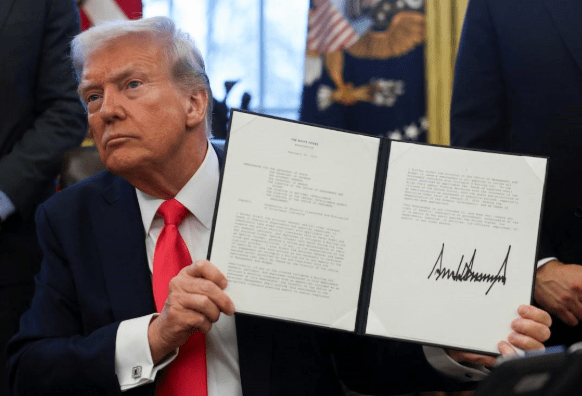

Four More Years! (of Policy Process Research in a Trump Administration)

Last January, the editorial staff of PSJ asked me to think about how the new Trump administration might affect policy process research. This is a huge task full of landmines – not only would I need to write something that engaged a vast policy process literature, but I’d have to do something that political scientists should never do: make predictions. With blind confidence befitting a Full Professor, I said yes.

There is little precedent for the Trump presidency in many ways, not least of which is Trump’s re-election in non-consecutive terms. Trump’s impact on American politics and policy choices of the Republican Party has thus far been significant, even in the years out of power. All that said, the conclusion of my article is that it is unclear that a new Trump administration will change how we study public policy; however, his actions should change what we study. I call out five areas of study we, as a community, could focus on.

Executive Policymaking

First, Trump’s focus on executive policymaking challenges the very institutional structure upon which much of the American politics and policymaking research relies. Congress somehow has less power than before – some might say it has lost power, but is it fair to say that something is lost if it is given away? Trump is pursuing a constitutional interpretation that envisions an executive with independent, unchecked powers relative to the legislative and judicial branches. Most of the modern policy process research conceives of a foundational American political environment with stable post-World War II institutions. Those are under threat, and American policy scholars would do well to borrow from the comparative politics literature to understanding policymaking during regime change.

The Politics of Mass Repeal

Second, Trump campaigned on and is engaged in the steadfast commitment to a systematic repeal of his four years out of power – part of his Biden erasure campaign which also includes, incredibly, the results of the 2020 election. Policy scholars, particularly feedback scholars, have the tools to consider the politics of this moment. It is difficult to imagine a repeal agenda of this magnitude across so many policy areas. Trump and Congress have scrubbed DEI language from federal publications (including flagging the above picture of the Enola Gay because of the word “gay”), repealed the majority of Biden’s signature legislative achievement – the Inflation Reduction Act, rescinded federal funding for basic science and on and on. Policy scholars might ask questions about the politics of repeal – not just of one or two policies, but the politics of mass policy repeal.

Siege Federalism

Third, Trump has vigorously asserted the dominance of the federal government over states – when convenient. Trump’s actions can be seen in his attempts to rescind funding to states that fail to comply with his directives, his activation of the national guard in California, Illinois, and Oregon to purportedly affect federal agents, and, currently, coercing states and localities to assist federal immigration and other agents in a large-scale deportation effort. The field of federalism is full of different ways of characterizing different moments of federalism (e.g. “marble cake”, “layer cake”, “variable speed”); I offer “siege federalism” in the article. Looking at images of American cities – currently Minneapolis and before that my home town of Portland (above) – I’m saddened by how accurate that phrase has turned out to be.

Identity Politics and Redistribution

Fourth, Trump campaigned on identity politics, but this isn’t just about reversing DEI policies of the Biden administration. Trump and allies are elevating particular identity groups within the United States, notably, white Americans. Trump’s policymaking on this front is redistributive, which should lead to conflict. Notions of power and deservingness are at the center of these politics and are, in my opinion, extremely volatile at the current moment.

Policymaking in Corrupt Times

Fifth, and finally, the Trump administration has overtly and directly incorporated business interests (including Trump’s) as part of public policymaking. Members of the private sector have the president’s ear, but have also bent the knee. Prominent corporate leaders, particularly in the technology sector, have formal or informal roles in government. Policy scholars might think more on direct executive lobbying – but, honestly, we need to talk more about corruption in American politics. Is this level of corruption the new normal? If so, how should we build that into our models of the policy process? Comparativists have wisdom here and we should listen to it.

Looking Forward

I could fill another blog post (or article) about what we might think about as a community regarding other government actions that have transpired since I wrote the original article. For example, how does the weaponization of the justice system affect policy process research? Also, policy scholars don’t often think about foreign policy, but Trump (surprisingly) has taken significant actions abroad that have shaken the very foundation of the world order using a unique set of tools including abduction (fugitive apprehension), extortion (deal-making), and murder (kinetic actions). How can we use our process models to explain foreign policy? The Republican president has engaged in significant interventions in the economy down to the individual corporation level. How does Trumpenomics influence the context of policymaking?

An overarching theme of the Trump administration is to inject politics into as many parts of the policymaking process as possible. Policy scholars, myself included tend to engage in more institutional analyses and de-emphasize politics. We are currently in a new reality where it seems like just about everything is political – especially policymaking.

Read the original article in Policy Studies Journal:

Koski, Chris. 2025. “Four More Years! (of Policy Process Research in a Trump Administration).” Policy Studies Journal 53(4): 1088–1097. https://doi.org/10.1111/psj.70025.

About the Article’s Author(s)

Chris Koski is the Daniel B. Greenberg chair of political science and environmental studies at Reed College. His research focuses on the development of theory in punctuated equilibrium theory and the social construction framework. Substantively, his work addresses climate change policy and the politics of state budgeting. His publications have appeared in Policy Studies Journal, Governance, JPART, and he is co-author of Means, Motives, and Opportunities: How Executives and Interest Groups Set Public Policy published by Cambridge University Press.

Does policy design matter for the effectiveness of local content requirements? A qualitative comparative analysis of renewable energy value chains

Governments around the world use local content requirements (LCR) to boost domestic industries by requiring renewable energy projects to use a certain share of locally-made components. The idea is simple: create jobs and build local supply chains. But the results have been mixed—some countries became major exporters of wind and solar technology, while others struggled. This article asks: Does the way these rules are designed explain why they succeed in some places and fail in others? To find out, the author uses Qualitative Comparative Analysis (QCA) to look for patterns in how different policy features and economic conditions combine to produce success.

Hypotheses

The author tests three hypotheses:

  1. Policies work best when countries already have strong technological capabilities.
  2. Combining LCR with other tools (e.g., financial incentives, renewable energy targets) helps in tougher economic environments.
  3. No single factor guarantees success; it’s about the right mix of design and context.

Methodology

The author analyze 27 LCR policies in wind and solar energy across 19 countries from 1995 to 2017, using fuzzy-set Qualitative Comparative Analysis (fsQCA) to uncover patterns. The research examines how policy design elements (e.g., restrictiveness, policy mixes, and targets) interact with the political economy (e.g., investment conditions, economic complexity). Success was measured by whether a country’s exports of wind and solar components grew four years after introducing LCR. The analysis looks for combinations of conditions that consistently led to positive outcomes rather than a one-size-fits-all solution.

Key Findings

Flexibility or Strong Capabilities Are Essential

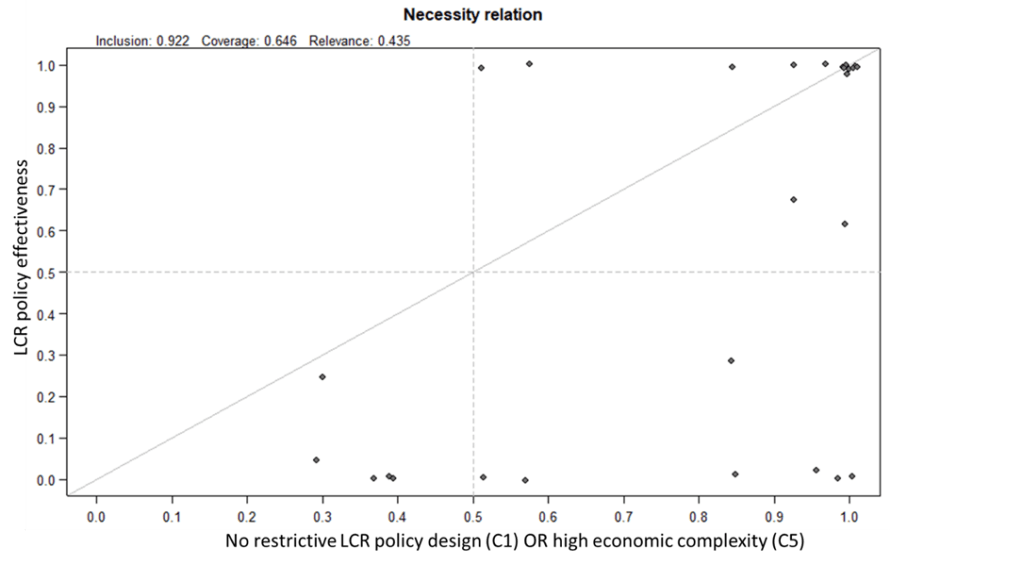
Figure 1 shows that either a flexible LCR design or a country’s high economic complexity must be present for a policy to be successful. While countries with advanced technology sectors can handle stricter rules without harming investment, those with limited capabilities need more lenient requirements to attract investment. This finding supports Hypothesis 1, demonstrating that there is no universal approach—what works in China or Spain may fail in India or Argentina. The author therefore argues that successful policies must be tailored to local conditions and political-economic contexts.

Image Description

Figure 1. XY-Plot of the necessity relation between (C1 or C5) and LCR Effectiveness.

Policy Bundles Make a Difference

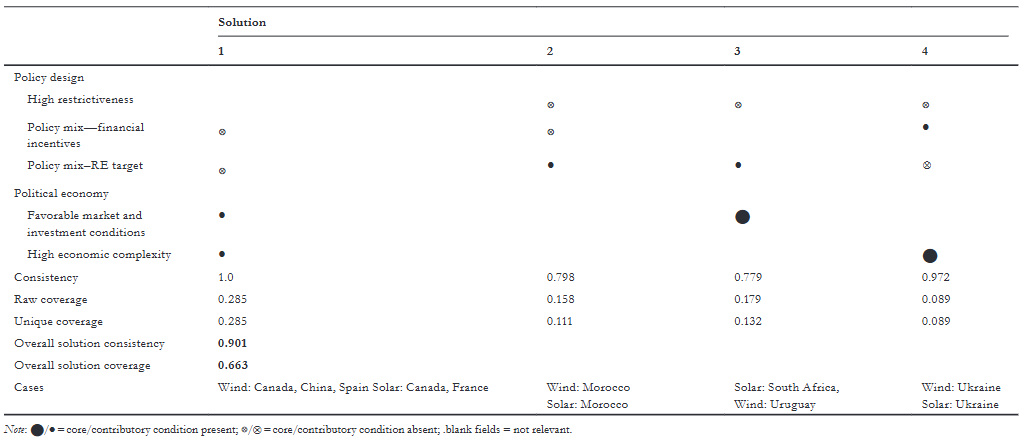
In countries with weaker investment conditions or limited technological capacity, LCR only worked when paired with financial incentives or renewable energy targets (Table 1). These extra measures help attract investors and signal future demand, giving local industries time to grow. This finding supports Hypothesis 2, underscoring the role of strategic policy bundling for green industrial success. Furthermore, the author explains, while simple rules can work in supportive environments, complex policy mixes are essential in challenging one.

Image Description

Table 1. Sufficient conjunctural patterns of policy design elements and contextual factors for LCR policy effectiveness.

Why It Matters

This article reveals that smart policy design matters. LCR effectiveness depends on tailoring rules to local conditions and, when needed, combining them with other supportive policies. This research challenges the idea of universal design principles and shows that success comes from the right mix of tools and context. Future studies should explore how these patterns apply in other sectors and dig deeper into why some policies fail. Scholars could also improve data on granular design features like technology transfer requirements. For policymakers, the message is clear: design green industrial policies with flexibility, consider context, and do not rely on a single instrument.

Read the original article in Policy Studies Journal:

Eicke, Laima. 2025. “Does Policy Design Matter For the Effectiveness of Local Content Requirements? A Qualitative Comparative Analysis of Renewable Energy Value Chains.” Policy Studies Journal 53(3): 604–617. https://doi.org/10.1111/psj.12590.

About the Article’s Author

Laima Eicke is a Research Associate at the Research Institute for Sustainability in Potsdam. Her research focuses on the international political economy of the energy transition, value chains of renewable energy technologies and hydrogen in particular as well as on green industrial policies. She is a former Associate and Research Fellow at the Belfer Center for Science and International Affairs at the Harvard Kennedy School and worked at the German Corporation for International Cooperation (GIZ), the Germany Ministry for International Affairs, NGOs and in consultancy.