Centering Critical Race Theory in Policy Design: A Reframing of Multiple Streams Framework

Policy outcomes and concerns about social and racial equity have long been discussed in policy scholarship. A question that often arises is why disparities persist even though scholars and practitioners have increasingly paid attention to equity in policy design.

In this article, I argue that policy design is not only a standalone process. The way policy agendas are set plays a role in shaping policy design. Agenda-setting influences how problems are defined, which issues are elevated, and which solutions are treated as legitimate or workable. Because of that, how we understand and explain agenda-setting matters. If agenda-setting is treated as neutral, it can miss how race, power, and exclusion shape what gets attention in the first place.

To further unpack what may be missing in mainstream approaches, I suggest using a race-conscious framework such as Critical Race Theory (CRT). CRT helps examine how race and racism can be embedded in systems that often present themselves as objective or race-neutral. This is not a claim that mainstream policy process theories lack value. Instead, it is a reminder that many of these theories were not built to center race, even though race and power shape policy processes and outcomes.

MSF & CRT

To illustrate how CRT can strengthen our understanding of agenda-setting, I use the Multiple Streams Framework (MSF), a widely used policy process theory. MSF is one example of a broader set of mainstream policy process theories that often rely on similar assumptions about neutrality and rationality. MSF includes several key elements: the problem stream, policy stream, policy entrepreneurs, and policy windows. It is commonly used to explain how agendas form and why some issues gain traction over others.

So, where does CRT come in? CRT includes key tenets such as interest convergence, voice of color, race as socially constructed, and racism as ordinary. These tenets help explain how race is constructed and how power operates through institutions and processes that are often described as “neutral”. When applying CRT to MSF, it becomes easier to see what race-neutral agenda-setting can overlook. For example, problem indicators can be discussed in ways that hide disparities, policy communities can reflect unequal representation, political institutions carry histories of exclusion, and policy windows can open without producing equity-centered change.

The point is not to dismiss MSF, but to show how a CRT lens can reframe MSF’s components and make racialized assumptions more visible in agenda-setting, which then shapes the foundations of policy design. In the article, I use CRT tenets to reinterpret each MSF component as part of agenda-setting, showing how race-neutral assumptions shape which problems and solutions become the foundation for policy design.

Why It Matters

The article’s contribution focuses on how we think about agenda-setting and policy design, especially the assumptions we bring to both. I argue that if we want to address inequitable policy outcomes, policy scholarship should take race consciousness more seriously and do it early. Centering race in agenda-setting theory can strengthen how we explain why certain problems and solutions become “designable”, and why some equity concerns remain sidelined.

Read the original article in Policy Studies Journal:

Wong, J. (2025). Centering Critical Race Theory in Policy Design: A Reframing of Multiple Streams Framework. Policy Studies Journal53(3), 795-805. https://doi.org/10.1111/psj.70059

About the Article’s Author(s)

Jonathan Wong (he/him) is a doctoral candidate in the School of Public Administration at the University of Nebraska Omaha. His research interests focus on public administration and public policy, with a particular emphasis on civic engagement, equity, and governance. His research explores how deliberative and participatory practices within public administration intersect with questions of racial equity, inclusion, and governance. Jonathan is also committed to integrating research and teaching to strengthen connections between public service, democratic engagement, and social justice.

The Place of Social Cohesion in Policy Design: Lessons from the Evolution of Pension Policy Instruments Mix in OECD Countries

How do countries strike a balance between keeping government budgets in check and providing strong social safety nets for their citizens? As the world becomes more interconnected and demands for services grow, governments must find a way to satisfy this. Scholars have overlooked the connections between government and citizens driving changes in policy design, especially in pension reform. This article investigates the factors that lead to changes in social and pension reform in OECD countries. To do this, the author incorporates “social cohesion” into the study design as a new perspective to determine how state-citizen cohesion (government trust) and civic engagement influence how to achieve policy changes in social and pension design. This study provides valuable insights into how coherence between governments and citizens resolves and encourages policy design problem-solving.

Hypotheses

The author explores the role of social cohesion in influencing the selection of policy tools to achieve changes in social and pension policies.

Methodology

The author analyzes panel data from 30 OECD countries over the period 2010-2020. Social cohesion is measured using “government trust” and “civic engagement” as key indicators to test the relationship with social and pension policy instruments. Because policy choices evolve over time and vary across countries, the analysis employs system Generalized Method of Moments (system GMM), a statistical method well suited to capturing country-specific contexts and policy dynamics in longitudinal data.

Key Findings

Government Trust and Civic Engagement Affect the Multi-Tier Pension System Differently

As shown in Table 3, government trust and civic engagement affect pension policy instruments differently. Model 1 shows that increases in government trust leads to an increase in measures for fiscal sustainability. However, increases in civic engagement correlate with pension benefit levels in a multi-tier system expanding. Interestingly, Model 2 shows that government trust helps sustain and enhance mandatory public pension benefits, while civic engagement reduces citizen reliance on mandatory public pensions, suggesting a gradual shift toward greater diversification through private pension arrangements. In short, government trust and civic engagement shape both policy instruments and citizens’ preferences for addressing pension design challenges in different ways.

Table 3. Impacts of Social Cohesion on Pension Policy Instruments in Multi-Tier Pension System.

Government Trust Strengthens while Civic Engagement Weakens First-Tier Pensions

Table 4 shows that government trust and civic engagement affect first-tier pension systems in different ways. Model 1 tells us that government trust positively affects first-tier pension benefit levels, making them robust. Meanwhile, civic engagement negatively affects the overall level of first-tier pensions by shifting dependency toward private pensions. Furthermore, Model 2 demonstrates that civic engagement strengthens the universal and redistributive nature of non-contributory schemes within first-tier pension systems.

Table 4 Impact of Social Cohesion on Pension Policy Instrument Mix in the First-Tier Pension System.

Why It Matters

This article highlights the importance of applying social cohesion, understood as the interactions between government(s) and citizens, in improving current policy processes. Social cohesion is needed for harmonization between government and citizens to achieve effective policy outcomes. For policymakers, this research shows that social cohesion connects government and citizens to the overall design and application of policy tools to fix structural problems within social and pension policies. Future studies should consider the role of social cohesion, with an emphasis on state-citizen dynamics, to understand how social connections influence the design of important policy programs.

Read the original article in Policy Studies Journal:

Kim, J. (2025). The Place of Social Cohesion in Policy Design: Lessons From the Evolution of Pension Policy Instruments Mix in OECD Countries. Policy Studies Journal53(3), 681-700. https://onlinelibrary.wiley.com/doi/10.1111/psj.70000.

About the Article’s Author(s)

Jiwon Kim, PhD (Seoul National University), is a Professor in the Department of Public Administration at the School of Social Integration, Hankyong National University. Her research centers on policy analysis and evaluation, welfare finance, and social welfare policy, with a particular focus on marginalized groups—such as persons with disabilities, industrial accident workers, and public servants injured in the line of duty—as well as on public performance management. She was a Visiting Scholar at the School of Public Affairs and Administration at Rutgers University—Newark from March 2023 to February 2024. In acknowledgement of her significant contributions to empirical research in social policy, she received the 2024 Commendation from the Deputy Prime Minister and Minister of Education of South Korea.

Mixing and matching: Intra-stream interdependence in the multiple streams framework and the adoption of policy mixes

Public policies rarely rely on a single solution. Instead, they often combine multiple tools—like incentives and regulations—to tackle complex problems. The Multiple Streams Framework (MSF) is an effective way to explain how policies get on the agenda and are eventually adopted, but it usually looks at ideas in isolation. This article asks: Do policy ideas within the same stream influence each other, and how does that shape the way policies are designed? To answer this, the authors introduce a new concept called intra-stream interdependence, specifically how policy ideas within the same stream interact and influence each other. The study applies the Multiple Streams Framework to examine interactions within the policy stream and integrates it with policy mix theory. They explore their research questions using electric vehicle (EV) policies in the United States, using advanced methods (i.e., clustering analysis and fuzzy set Qualitative Comparative Analysis) to uncover patterns of how policies are combined and which combinations work best.

Hypotheses

The authors test two hypotheses:

  1. Similar policy ideas are systematically linked during the policymaking process due to intra-stream interdependence.
  2. The design of different policy mixes will substantively influence the policy outcomes they achieve.

Methodology

The authors analyze 1,736 EV policy actions at the state and local level, using data from the Department of Energy’s Alternative Fuels Data Center. They used k-means clustering to identify which policy tools (e.g., tax credits, rebates, or pollution regulations) tend to appear together. Then, they examined whether certain combinations of tools were linked to higher policy adoption rates and, subsequently, higher EV market share in different states.

Key Findings

Policy Tools Form Consistent Clusters

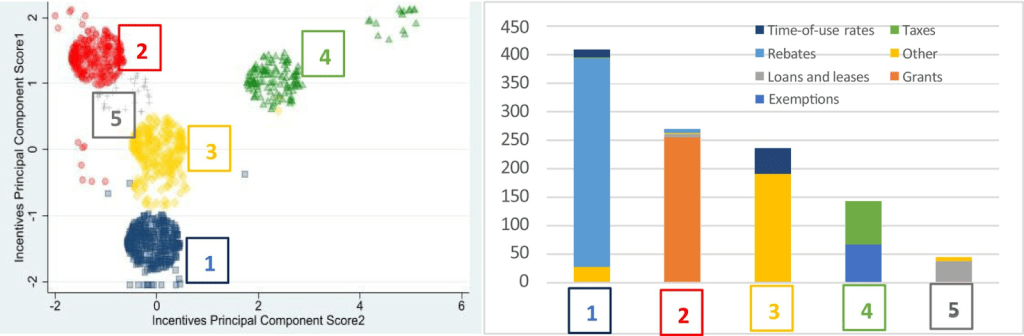
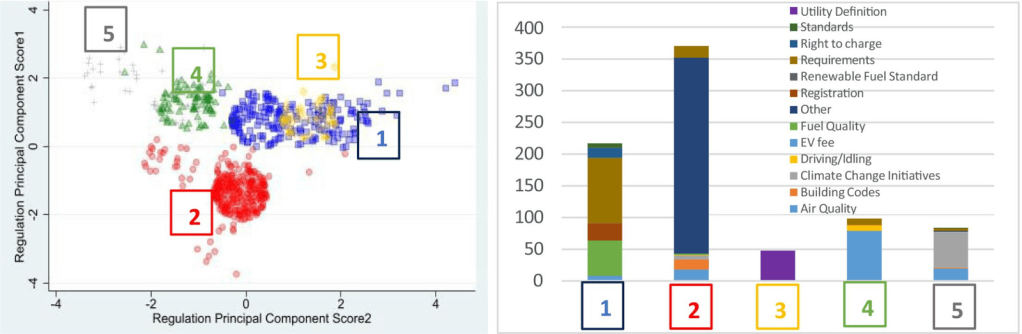
Policies do not operate in isolation; rather, Figures 1 and 2 show five distinct groupings of incentives and regulations. For example, tax credits and exemptions tended to appear together in the same policy actions, while grants and loans formed separate clusters. Similarly, regulations aimed at improving air quality and addressing climate change tend to cluster, while EV registration fees and vehicle standards combine in another group. These patterns suggest that policy ideas evolve together, not independently, and therefore supports Hypothesis 1. The authors argue that this finding ultimately challenges the idea that policies compete one by one; rather, policymakers actually design them as packages.

Image Description

Figure 1. Clusters of incentives and composition of instruments in each cluster.

Image Description

Figure 2. Clusters of regulations and composition of instruments in each cluster.

Pollution Regulations are Key to Success

To examine the relationship between policy mixes and outcomes, the authors use exploratory factor analysis to identify mixes and then deploy a fuzzy set Qualitative Comparative Analysis (fsQCA) to study the outcomes in the EV markets. Table 1 shows that every successful policy mix for higher EV market shares includes regulations targeting air pollution and climate change, often paired with incentives including tax credits and exemptions.. Financial incentives alone do not drive EV adoption; rather, they work best when combined with supportive regulations. This finding supports Hypothesis 2 and highlights an important lesson: effective policy design requires integrated approaches, not single tools. In this case, regulations create a supportive environment while incentives encourage adoption either at the individual or community levels.

Image Description

Table 1. Outcomes of fsQCA: Policy conditions combinations and outcomes

Why It Matters

This study shows that policy ideas interact and form structured mixes which influence real-world outcomes. By introducing the concept of intra-stream interdependence, the authors expand MSF theory and explain why policy mixes emerge. For policymakers, the takeaway is clear: combining regulations with incentives is essential for promoting EV adoption and more generally for successful environmental action. Future research should explore whether similar dynamics occur in other areas like health or education and examine how these mixes change over time. Furthermore, case studies could look at how advocacy tactics—specifically, the way issues are presented—work together with natural groupings of ideas to shape complex policy packages. Understanding these patterns can help governments design smarter, more effective policies for complex challenges.

Read the original article in Policy Studies Journal:

Soni, Anmol and Evan M. Mistur 2025. “Mixing and Matching: Intra-stream Interdependence in the Multiple Streams Framework and the Adoption of Policy Mixes.” Policy Studies Journal 53(3): 580–603. https://doi.org/10.1111/psj.12582.

About the Article’s Authors

Anmol Soni is an assistant professor in the Department of Public Administration at Louisiana State University. Her research focuses on energy and environmental policy action. Anmol’s recent work examines energy transitions in the global south and policy designs and mixes adopted by sub-national governments to address local sustainability issues.

Evan M. Mistur is an assistant professor in the Department of Public Affairs and Planning at the University of Texas at Arlington. He specializes in public policy, researching a diverse set of topics centered around environmental management, sustainability policy, and policy theory. Evan’s past work includes investigations of policy formation, diffusion, and implementation across both Texas and Georgia.