
by Andrew Gibbons & Rhonda Evans
Governments can pursue their public policy objectives through various means. What do they seek to accomplish through the lawmaking process? The executive’s role in the legislative process varies widely across political systems. In Westminster systems, like Australia’s, institutional rules allow executives to dominate the legislative agenda, though governments do face constraints, such as the need to balance competing interests, contend with bureaucratic processes, and attend to unforeseen events.
Drawing from the Comparative Agendas Project (CAP) and analyzing a data set of government bills in Australia, our research offers a new perspective on agenda-setting in Westminster systems, shedding light on the distinct agenda space we call the executive lawmaking agenda.
We addressed four research questions:
RQ1: What policy areas comprise the executive lawmaking agenda?
RQ2: How stable is the executive lawmaking agenda?
RQ3: Do the major political parties pursue different lawmaking agendas when in government?
RQ4: Does a change in prime minister affect which issues receive executive lawmaking attention?
Our study utilized an original dataset of 3,982 bills introduced into the Australian Federal Parliament between 2000 and 2017, focusing on government bills introduced by ministers. We coded each bill based on its policy content using the Australian Policy Agendas Codebook (APAP), measuring policy attention by counting the number of bills devoted to specific policy areas. We assessed agenda stability by using Sigelman and Buell’s measure of issue convergence, which calculates the degree of overlap in legislative attention distribution between different years.
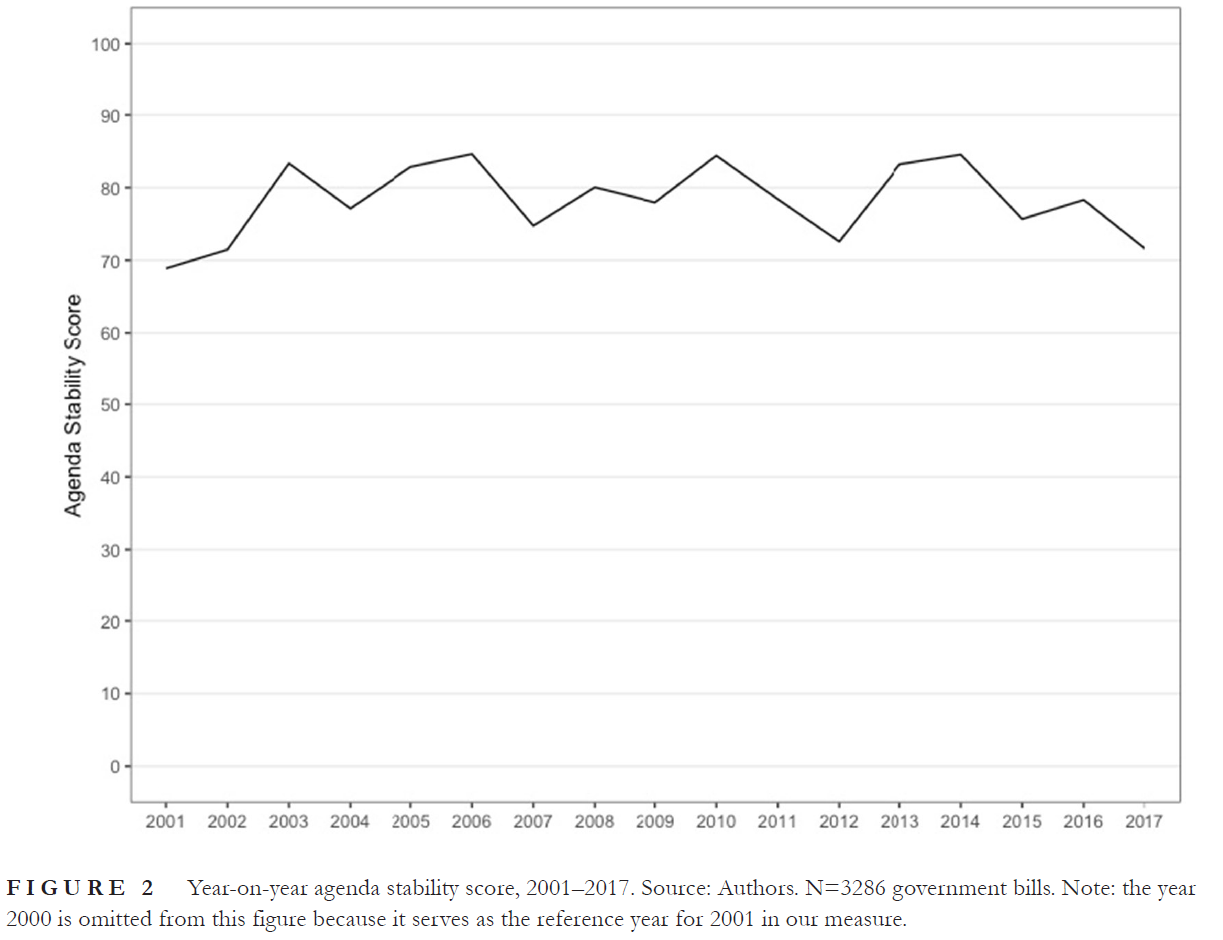
The results, illustrated in Figure 1, show that government operations and macroeconomics were the two largest policy areas on the executive lawmaking agenda, accounting for nearly 10% and over 8% of the agenda, respectively. Health, banking, and labor policy rounded out the top five policy areas, collectively making up over 40% of the entire executive lawmaking agenda. On the other hand, issues related to civil rights, minority concerns, civil liberties, housing, and community development, and cultural matters received limited attention. We also found a high degree of stability in the executive lawmaking agenda over time, with around 78% of the agenda overlapping from one year to the next.

Our analysis suggests that this stability persists even after power is shifted between political parties, as indicated in Figure 2. We also find that a change in prime minister is statistically related to a change in policy attention, but more work needs to be done to understand why. These findings seem to align with existing CAP research.
Further research needs to be done on executive policy agendas. Though we primarily looked at legislation, it is not the only kind of policy. Many executives have the ability to enact laws outside of the typical legislative process. Future research should focus on executive power in different stages of the policy process, non-legislative executive policy agendas, and examining alternative agenda spaces to deepen our understanding of executive lawmaking power.
You can read the original article in Policy Studies Journal at
Gibbons, A., and Evans, R.. 2023. “The executive lawmaking agenda: Political parties, prime ministers, and policy change in Australia”. Policy Studies Journal, 51, 307–325. https://doi.org/10.1111/psj.12503
About the Authors

Dr. Andrew Gibbons holds a PhD in political science from the University of Melbourne. His published research focuses on political communication and public policy, including policy responses to mis/disinformation, policy agendas, and the communication of policy ideas.

Dr Rhonda Evans is an Associate Professor of Instruction in the Department of Government and Director of the Edward A. Clark Center for Australian and New Zealand Studies at the University of Texas at Austin. She holds a J.D. and a Ph.D. in Government and studies agenda-setting politics, focusing on the Australian Human Rights Commission and Federal Parliament of Australia, as well as judicial politics in Australia and New Zealand. She is co-author of Legislating Equality: The Politics of Antidiscrimination Policy In Europe with Oxford University Press.
Find her on LinkedIn: https://www.linkedin.com/in/rhonda-evans-305aa4105/





 Policy Studies Journal Blog