Policy Design Receptivity and Target Populations: A Social Construction Framework Approach to Climate Change Policy

by Chris Koski & Paul Manson

Climate change is by any definition a wicked problem with myriad potential policy tools and even more potential targets. Policymakers face difficult political choices when designing policies to combat climate change. Among these choices are who should bear the costs and benefits of various policy tool options. Policy tools can be carrots and sticks, and policymakers assign these differently based on who will receive either option. Previous attempts to address climate change at the federal level have largely relied on subsidies and guidance rather than rules and punishment. Winners in these choices have been those with power to influence outcomes.

Previous research on federal climate policy has sought to explain failure both in legislation and executive action. Why have efforts to establish a carbon market in the US failed?  What was the source of demise for the Obama administration’s Clean Power Plan (and can Biden breathe life into it)?  Public opinion research has focused on understanding support for climate policies, including very specific proposals (e.g. cap and trade). Missing from this work is the general answer to the question: How do policy design features influence public support for policy?

Our article “Policy Design Receptivity and Target Populations: A Social Construction Framework Approach to Climate Change Policy,” recently published in Policy Studies Journal, addresses this question. Our work is situated in the literature on policy deservingness and the resurgence of interest in the social construction of target populations framework.

Using a national survey experiment, we assessed support for seven policy tools across the four archetypal target populations built on Schneider and Ingram’s Policy Design for Democracy.  We find that climate policies are popular across all target populations. Contemporary federal climate policy focuses on carrots: de-emphasizing regulations, leveraging subsidies, and creating carve-outs for firms. In contrast, we find the public prefers sticks: policies that impose burdens – in our case, policies that mandate behaviors – for nearly all target populations, even the positively constructed groups who have power.  The public still supports subsidizing most populations, but not those viewed as undeserving.  Perhaps the most striking contrast between our findings and the federal policy discourse on climate change is that we find Americans are broadly hostile to giving groups exceptions to climate rules, a carrot they will not share with others.

Future work could consider a more complex, and realistic, view of policymaking, namely, that policies target bundles of populations with multiple tools. For example, the Biden administration has taken two distinct approaches to electric vehicle policies in the US, creating subsidies to purchase or lease EVs as well as proposing fuel economy standards that require automakers to increase fleet efficiency. Our current research and research we plan for the future hope to improve the relationship between design and public support for policy.

Editor’s Note: This article won the 2024 Theodore J. Lowi Policy Studies Journal Best Article Award. Congratulations to the authors!

You can read the original article in Policy Studies Journal at

Koski, Chris and Paul Manson. 2024. “Policy Design Receptivity and Target Populations: A Social Construction Framework Approach to Climate Change Policy.” Policy Studies Journal, 52(2): 211–233. https://doi.org/10.1111/psj.12520.

About the Authors

Chris Koski is the Daniel B. Greenberg Professor of Political Science and Environmental Studies at Reed College in Portland, Oregon. He is co-author of Means, Motives, and Opportunities: How Executives and Interest Groups Set Public Policy with Christian Breunig published by Cambridge University Press (2024).

Paul Manson is Assistant Research Professor with the Center for Public Service at Portland State University in Portland, Oregon.


Bridging Policy Research Across Borders: Challenges and Opportunities for China

by Geoboo Song (PSJ Editor-in-Chief)

On June 14, 2024, I delivered a virtual keynote address at the inaugural International Conference on China Policy Studies (ICCPS) in Beijing, China. While primarily aimed at policy scholars in China, my presentation also holds significance for policy scholars in other non-Western countries. Recently, there were discussions about “Global South” issues during the Conference on Policy Process Research (COPPR) meeting in Syracuse, NY, which the PSJ editors took seriously, prompting immediate action. In light of these developments, I believe sharing my keynote speech here would be beneficial. Below is an excerpt from my keynote address:

As the Editor-in-Chief of the Policy Studies Journal, I have had the privilege of working closely with scholars from around the world, witnessing firsthand the transformative power of collaborative policy research. PSJ, a premier publication outlet for theory-driven policy research, has been at the forefront of delivering cutting-edge research that addresses some of the most pressing global challenges.

In today’s interconnected world, the challenges we face are increasingly complex, uncertain, and global in nature. Issues such as climate change, public health crises, and economic disparity do not recognize national boundaries. As such, the need for robust, collaborative policy research has never been greater. By working together, we can craft innovative solutions that benefit not just our own nations, but the world at large.

Tackling grand challenges, such as extreme weather events, disaster management, immigration crisis, and water and food insecurity, require collaborative and innovative efforts that transcend borders. Policy research plays a crucial role in addressing these issues by providing evidence-based solutions and fostering informed decision-making.

PSJ, a leading publication in the field, has been renowned for its contributions to policy process theory research over half a century. This area of research is pivotal, as the pressing policy issues we face are often fraught with uncertainty, complexity, and inherently “wicked” nature of such challenges. In these contexts, enhancing “procedural rationality” (which focuses on how decisions are made) is as important, if not more so, than “substantive rationality” (which focuses on what decisions are made). And, I firmly believe that this sort of process theory-driven approach ensures more robust problem-solving strategies in the long run, particularly when addressing the grand challenges we encounter.

Equally important is recognizing that mutual benefits arise from international policy research collaboration. By sharing knowledge, resources, and expertise across borders, we can elevate the quality and impact of our policy research. Such collaborative efforts also promote cultural exchange and mutual understanding, which are vital for addressing global challenges effectively.

China has made remarkable progress in policy research in recent years. During my five-year tenure as a PSJ editor, I’ve witnessed Chinese policy scholars, both domestically and internationally, contributing significantly to a broad spectrum of policy theories and substantive policy domains. Their work highlights innovative approaches and invaluable insights. In fact, policy scholars in China have published more articles in PSJ than any other Asian countries in recent years.

Despite this progress, significant challenges remain. Broadly, these can be examined on two levels: individual vs. research environment. On the individual level, many Chinese policy scholars, especially those from non-elite backgrounds, face difficulties in several areas. Developing compelling research questions, achieving theoretical innovation, designing robust methodologies, and effectively communicating their findings, particularly in English, are common challenges. Additionally, securing funding and publishing in top-tier policy journals remain significant hurdles. On the other hand, the research environment encompasses the tangible and intangible resources that maximize individuals’ research competencies. This includes the structure and culture of the researcher’s organization or program, as well as broader institutional and network dynamics. For example, major research universities in the United States provide substantial financial support and reduced teaching loads for pre-tenure assistant professors, fostering an environment conducive to high-level research. In contrast, many Chinese institutions may lack comparable support, making it difficult for scholars to focus on their research.

Of course, numerous opportunities for collaboration exist between policy scholars in China and their counterparts around the world. Establishing partnerships can facilitate the exchange of ideas and resources, leading to more comprehensive and impactful research outcomes. More meaningful academic exchange programs and joint research initiatives can play a crucial role in fostering collaboration, enabling policy scholars to work together, share their expertise, and develop innovative solutions to common challenges. Technology and innovation are also key enablers of collaboration. Digital platforms and tools can facilitate communication, data sharing, and joint research efforts, making it easier for scholars to collaborate across borders. By leveraging these opportunities, we can address the challenges faced by Chinese policy scholars and enhance the global impact of policy research.

In conclusion, bridging policy research across borders is essential for overcoming constraints inherent in research practices in China, addressing global challenges, and creating a sustainable future both intellectually and practically. By working together, we can leverage our collective knowledge and expertise to develop innovative solutions that benefit everybody. I particularly encourage Chinese policy scholars to engage in more international collaborations and seek out new opportunities for joint research. Together, we can overcome challenges and create a brighter future for all.

Does Data Drive Policymaking? A Multiple Streams Perspective on the Relationship Between Indicators and Agenda Setting

by Rob A DeLeo & Alex Duarte

The multiple streams framework (MSF) illustrates how policies are formed not through linear processes, but through the convergence of three independent streams: the problem stream, the policy stream, and the political stream. While the MSF offers numerous insights into the often chaotic nature of policy making, prior studies have not fully explored the relationship between problem indicators and agenda setting. In this study, we explore nuanced ways that changes in indicators either shape or fail to influence policy responses.

Within the MSF, changes in problem indicators have the potential to elevate issues on the policy agenda. In addition, indicators that threaten powerful economic or political interests may lead to reduced policy attention. Recognizing the possibility that policymakers might overlook or downplay information that poses risks to their power or that contradicts prevailing policy directions, we introduce the concept of “indicator politicization.” 

We apply the MSF to examine the US Congress’s response to changes in opioid overdose rates. Empirically, we employ a mixed-methods approach to examine the relationship between opioid-related data and policy responses. Drawing on data from congressional hearings and legislative actions from 1999 to 2019, we explore how the changes in opioid-related indicators influenced legislative actions (or inactions). We use negative binomial regression analysis to estimate the effect of opioid indicators–heroin, fentanyl, and prescription opioids–on the congressional agenda. We then provide a case study that investigates the differential patterns of agenda change identified in our quantitative model. 

On one hand, we confirm the substantial impact of indicator change on policy attention, exemplified by marked upticks in policymaker attention to heroin and fentanyl overdose deaths. Policymaker attention was likely magnified by electoral concerns, as the opioid epidemic was a prominent issue during the 2016 election cycle. On the other hand, public awareness and political responses to prescription opioids developed slowly over several years. Indeed, although increases in opioid overdose indicators occasionally spurred congressional attention and led to policy shifts, such responses were inconsistent. A major obstacle is “data politicization”–when data threatens powerful interests, these entities can minimize or downplay the information to turn aside policy scrutiny. When data politicization occurs, it undermines the urgency and attention the issues receive even in the face of an escalating crisis hence the lack of attention to prescription opioids observed in our study.

This study sheds light on data-driven policymaking, with a focus on the constraints imposed by entrenched political interests. Data alone cannot drive policy changes when it conflicts with the interests of powerful stakeholders. We reevaluate the multiple streams framework’s (MSF) initial assumptions, which may overestimate the direct impact of indicators on policy decisions. Practically, we encourage policymakers, scholars, and practitioners to assess the power dynamics that shape policy responses to social issues. This is particularly relevant in crafting effective strategies for public health crises, where ideally, data should inform and guide policy responses. As the opioid crisis continues to evolve, this study underscores the importance of how data is interpreted and used in policy formulation. Moreover, it paves the way for future investigations into other policy areas where data may be underutilized or overlooked, advocating for a broader and more integrated approach to evidence-based policy making. 

You can read the original article in Policy Studies Journal at

DeLeo, Rob A. and Alex Duarte. 2022. “Does Data Drive Policymaking? A Multiple Streams Perspective on the Relationship Between Indicators and Agenda Setting.” Policy Studies Journal, 50(3): 701-724. https://doi.org/10.1111/psj.12419

About the Authors

Rob A. DeLeo is an Associate Professor of Public Policy at Bentley University. A policy process scholar by training, Rob’s work examines policy change in anticipation of emerging hazards, including climate change, novel diseases, and other slow onset events. His research has appeared in Policy Studies Journal, Public Administration Review, Policy & Politics, PNAS Nexus, Publius, Review of Policy Research, Natural Hazards Review as well as various other peer-reviewed journals and edited volumes. Rob’s work has been funded by the National Science Foundation, the National Institutes of Health, and various academic and private organizations. Rob previously held a visiting fellowship at Harvard University’s Kennedy School of Government and is a founding member of the Risk & Social Policy Working Group, an interdisciplinary team of scholars examining the relationship between risk messaging and individual behavior during the COVID-19 pandemic. He was the 2021 co-recipient of the American Political Science Association’s Theodore Lowi Award for the best article written in Policy Studies Journal.

Alex Duarte is a doctoral student at the Heller School for Social Policy. Alex graduated from Bentley University in 2019 and received a dual bachelor degree in public policy and business studies. During his time at Bentley, Alex’s research focused on policy indicators found within the substance abuse policy domain. Alex has also worked at the Peace Corps Headquarters in Washington DC and Project Weber, a Rhode Island-based harm reduction center for male and transgender sex workers.

More than Agents: Federal Bureaucrats as Information Suppliers in Policymaking

by JoBeth S. Shafran

Despite the widespread notion of federal bureaucrats as implementers of congressional will, their role in the policymaking process extends far beyond. Traditionally understood through the lens of principal-agent theory, bureaucrats act as agents to their principal, Congress, executing and implementing legislative directives without much influence on policy shaping. However,  bureaucrats are also key information suppliers to Congress. In this paper, I explore the conditions that enable bureaucrats to become influential contributors who define problems and propose solutions during legislative discussions.

Policymakers, constrained by limited resources, time, and attention, selectively rely on key information sources. Certain political elites, such as bureaucrats and interest groups, are actively invited to participate in policy making, while others remain on the periphery. Congress delegates the tasks of information processing and knowledge accumulation to the bureaucracy in return for neutral expertise. As such, I argue that the information asymmetry, wherein bureaucrats hold specialized knowledge not readily available to legislators, can be strategically leveraged by Congress. Bureaucrats are more likely to testify at congressional hearings under three conditions: when alternative information sources are scarce; when their expertise is essential for committee tasks, such as agency oversight; and when their input can help manage diverse committee workloads. 

Focusing on congressional hearings across three policy domains—domestic commerce, energy, and health—from 1995 to 2010, I examine approximately 4,700 hearings and more than 33,000 testimonies. Given the count nature of the dependent variable (a count of bureaucrats testifying at a given hearing), I employ negative binomial regressions to examine the factors influencing the prevalence of bureaucrats among witnesses, such as the type of committee and the agenda of the committee.  

The findings reveal that bureaucrats are more likely to be called as witnesses when committees face limited access to alternative expert sources and when the information bureaucrats provide is directly relevant to the committee’s legislative goals. As indicated in the figure below, I find a higher reliance on bureaucratic testimony when committees address a broader scope of issues, which implies that bureaucrats’ ability to process information is valued in diverse legislative environments. 

Figure 5. Predicted number of careerist bureaucrats testifying at constituency, policy, and power committees as agenda diversity increases, 1995-2010

Additionally, the findings show that bureaucratic testimony is more prevalent in policy areas characterized by lower public engagement and high technical complexity, such as energy policy. Conversely, in domestic commerce, where multiple stakeholders are involved and information is abundant, bureaucrats are less likely to dominate the testimony. This study enhances our understanding of bureaucratic expertise and knowledge in the legislative process. Bureaucrats do more than implement policy–they actively shape it through information provision in policy debates. 

You can read the original article in Policy Studies Journal at

Shafran, JoBeth S. 2022. “More than Agents: Federal Bureaucrats as Information Suppliers in Policymaking.” Policy Studies Journal, 50(4): 921–943. https://doi.org/10.1111/psj.12455

About the Author

JoBeth S. Shafran is an assistant professor at Western Carolina University, where she teaches public policy courses for both the Political Science and Master of Public Affairs programs. Her research focuses on information processing in Congress and the federal bureaucracy. Her work has been published in Policy Studies Journal and Cognitive Systems Research, among others.

Birds of a Feather Fight Together: Forum Involvement in a Weakly Institutionalized Ecology of Policy Games

by Tomás Olivier & Ramiro Berardo

Policy forums play a crucial role in polycentric governance because they can facilitate collective action among diverse actors who are invested in a policy domain. Many of these arguments assume that forums are stable over time and that they attract actors with different ideas or interests. But, what happens in unstable policy settings where forums operate in a context of periodic rule change and limited enforcement?  To answer this question, we look at how policy forums can facilitate interactions among actors with different perceptions about collective action challenges regarding water governance in Patagonia, Argentina. 

Forums can facilitate collective action by attracting actors with different perceptions about policy problems. This fosters interactions among actors who would otherwise not interact, potentially facilitating collaboration and the generation of new insights about how to solve joint problems. 

We study water governance in the Lower Valley of the Chubut River, located in Argentina’s Patagonia region. In 2017 and 2018, we surveyed 58 individuals from 34 different stakeholder groups, including government entities, private companies, and researchers. Our survey presented stakeholders with various scenarios regarding water governance in the Lower Valley and asked them to rate the extent to which they saw the scenarios as accurate or inaccurate. We also asked them about their perceptions of the forums overseeing water governance in the Lower Valley (e.g., whether they were fair, effective, etc.) and environmental conditions in the basin.  

We found that out of the 31 active forums in the Lower Valley, many were attended by just one stakeholder. Furthermore, we observed that government entities do not appear to be very active in these forums, preferring to operate outside of them as needed. Part of the reason for low participation is that the forums in the Lower Valley tend to be short-lived, formed to tackle a specific problem or crisis and then dissolved shortly thereafter. 

Most importantly, we found that actors who participate in the same forums tend to have similar perceptions about the dominant collective action problem in the region. This finding is meaningful from a governance perspective: in a context of high transaction costs, forums may serve as the first space where actors with similar perceptions may build the necessary commitments to engage in collective action. These forums can be problematic, as the range of views represented in them on how to solve a problem are limited. However, a silver lining is that they can also foster collaboration among actors who would otherwise may be distrustful of one another.

Our study deepens our understanding of how actors may organize to address complex policy problems in a context of weak institutions, and argues that the stability of forums in time is key to maintaining consistent stakeholder participation, a necessary condition for the solution of system-wide environmental problems. 

You can read the original article in Policy Studies Journal at

Olivier, Tomas and Ramiro Berardo. 2022. “Birds of a Feather Fight Together: Forum Involvement in a Weakly Institutionalized Ecology of Policy Games.” Policy Studies Journal, 50(1): 176-198. https://doi.org/10.1111/psj.12418

About the Authors

Tomás Olivier is an Assistant Professor of Public Administration at the Maxwell School of Citizenship & Public Affairs at Syracuse University.

Follow him on X/Twitter: @tolivier9

Ramiro Berardo is a Professor of Environmental and Natural Resource Policy at the School of Environment and Natural Resources at The Ohio State University.

Follow him on X/Twitter: @BerardoRamiro

The Paradoxical Power of Policy Loss in Group Identity and Action: A Study of the NRA’s Strategic Resilience

by Matthew J. Lacombe

Policy feedback scholarship has illustrated how policies shape group behaviors and political processes, primarily focusing on the benefits accrued by their proponents and supporters. This narrative typically celebrates the “winners”—those who benefit from policy enactments. However, less attention is paid to the groups that oppose the policies—what happens to the policy “losers”? 

I shift the focus to these overlooked groups and explore how policy losers turn their defeats into strategic opportunities for power-building. These groups often successfully engage in post-loss power-building efforts, especially when the policy (1) recognizes their members as a distinct class, and (2) does not undercut incentives for membership and mobilization. Such policy setbacks enable organized groups to point to the negative consequences these changes could have on their members, thereby increasing the political relevance and salience of their membership. In turn, organized groups strategically leverage these setbacks to their advantage, transforming defeats into opportunities to strengthen their group identity and collective action. 

I apply this framework to the realm of gun politics, focusing on the National Rifle Association (NRA) and its responses to two legislative defeats: the Gun Control Act of 1968, and the Brady Act of 1993 and the Federal Assault Weapons Ban of 1994. Both losses mark significant moments when the NRA failed to prevent the enactment of stringent gun regulations. The data is obtained from various sources, including public records of gun legislation and its amendments, key NRA communications such as newsletters, press releases, and statements, as well as gun sales and membership data. 

Here are some of the key findings:

  • In the aftermath of legislative defeats, the NRA framed new policies as targeted threats to gun owners as a group. The NRA leveraged these perceived threats to cultivate shared grievances among its members and to rally support for pro-gun candidates in subsequent elections and policy battles. 
  • In response to losses, NRA supporters, following the organization’s lead, expressed frustration with how the new laws treated them. These sentiments likely influenced the NRA’s membership numbers and gun sales, with each increasing in the aftermath of gun laws being enacted. 
  • The NRA’s post-loss actions manifested in subsequent political battles, often as strong opposition against the policy. The NRA, in short, was able to use anger about losses to mobilize strong support during downstream policy debates.

This study highlights the power of strategic framing in political mobilization. Policy losses can fortify a group’s resolve, cohesion, and future political capabilities when these losses do not disrupt the incentives that groups rely on to drive collective action. This paper invites policymakers and political strategists to reconsider the effects of legislative outcomes not just on policy winners, but also on those who initially face defeats. Understanding that policy losers might use defeats as a springboard for greater organizational cohesion and political power could influence both the design and communication strategies around new policies.  

You can read the original article in Policy Studies Journal at

 Lacombe, M.J. (2022) “Post-loss power building: The feedback effects of policy loss on group identity and collective action.” Policy Studies Journal, 50, 507–526. https://doi.org/10.1111/psj.12446

About the Author

Matthew Lacombe is the Alexander P. Lamis Associate Professor in American Politics in the Department of Political Science at Case Western Reserve University and the author of Firepower: How the NRA Turned Gun Owners into a Political Force.


The Adoption of Culturally Contentious Innovations: The Case of Citizen Oversight of Police

by Mir Usman Ali

The deaths of George Floyd and Broenna Taylor at the hands of police in 2020 brought the issue of police accountability to the forefront of public debate. One reform that has been a long-standing demand of police accountability advocates is Citizen Oversight Agencies (COAs). COAs are institutional arrangements at the local level that provide a platform for non-sworn review complaints about the police. While there is growing scholarly interest in these agencies, little research has examined factors associated with their adoption. In this paper, I use innovation diffusion theory to help fill this gap. 

In particular, I investigate the role of cultural contentiousness, a previously understudied concept. When an innovation is culturally contentious, it challenges an existing institution’s dominant cultural meaning, leading to resistance. I argue that COAs are culturally contentious because they highlight the disconnect between the race- and class-neutral way police are supposed to perform their role in a liberal-capitalist society and the non-neutral way in which they actually perform it. Moreover, I argue that investigative COAs (i.e., COAs that can independently investigate allegations of police misconduct and recommend discipline) are more contentious than non-investigative COAs (which merely review or monitor police investigations of citizen complaints) because the former can be viewed as undermining the professional autonomy of the police.

To identify the factors associated with the adoption and diffusion of COAs at the municipal level in the United States between 1980 and 2016, I assembled a panel data set of all cities with a population greater than 100,000 persons as of 2010. There were 77 municipalities with COAs and 154 municipalities without COAs that met the criteria for inclusion in the study. I used event history modeling (EHM) to estimate the impact of various antecedents on the likelihood of adoption and diffusion of COAs. 

Results indicate that a federal investigation or entering a consent decree, an increase in the number of civil rights nonprofits, or an increase in own-source revenue per capita was associated with the adoption of investigative COAs, while not being associated with non-investigative COAs. These findings underscore the importance of antecedents that reveal contradictions between cultural assumptions and non-neutral material effects of policing.

I also find that antecedents that symbolically obfuscate the above contradiction, or whose meaning is unclear, tend to reduce the likelihood of adoption of COAs overall or increase the likelihood of adoption of non-investigative COAs. For instance, the presence of a Law Enforcement Officers’ Bill of Rights (LEOBOR) law, an increase in the violent crime rate, or an increase in the number of neighboring cities with a COA either increased the likelihood of adopting a non-investigative COA or no COA at all.

In summary, this work highlights the importance of cultural contentiousness in innovation adoption and diffusion. While the results indicate that less culturally contentious change is more common, more contentious change does occur. However, for such change to be institutionalized, it needs to be supported by other levels of government and sustained advocacy efforts for police accountability. 

You can read the original article in Policy Studies Journal at 

Ali, M. U.. 2023. “The adoption of culturally contentious innovations: The case of citizen oversight of police.” Policy Studies Journal, 51, 905–928. https://doi.org/10.1111/psj.12499

About the Author

Mir Usman Ali is an Assistant Professor in the School of Public Policy at the University of Maryland-Baltimore County. His research revolves around building a theory of the conditions under which public managers and organizations can foster social equity-enhancing institutional change. His research has looked at a variety of topics such as citizen oversight of police, impact of body-worn cameras, policies intended to curb domestic violence, and pandemic preparedness among local health departments. He holds a Ph.D. in Public Affairs Indiana University-Bloomington, an M.S. in Statistics from Texas A&M University, College Station and MBA and BBA degrees from the Institute of Business Administration, Karachi. His research has been published in Public Administration Review, Public Performance and Management Review, American Review of Public Administration, and Policy Studies Journal.

Global Diffusion of COVID-19 Policies: The Role of Geographic, Institutional, and Cultural Cues

by Brian Y. An, Simon Porcher, & Shui-Yan Tang

Amid the COVID-19 pandemic, governments worldwide have grappled with the adoption of non-pharmaceutical interventions (NPIs), offering a unique opportunity to study policy diffusion dynamics. As the pandemic unfolded globally, leaders were faced with the dual challenges of responding to the pace of disease development while navigating socio-economic circumstances unique to their countries. With limited international coordination, each nation independently established its policy approaches, making the study of horizontal diffusion within global governance feasible. 

This study seeks to address critical questions regarding the diffusion of COVID-19 policies:

  1. Do government leaders draw cues from other countries’ policy behaviors?
  2. If so, which countries do they benchmark their policymaking against in terms of geographic, cultural, and institutional similarities?
  3. How do these diffusion dynamics evolve over time, and do certain cues become more prominent as policy learning progresses?

By analyzing worldwide government responses from January 1, 2020, to June 1, 2021, this study employs event history and time fixed-effects ordered logistic regression models. The analysis focuses on nine universal NPIs, including domestic lockdowns, travel bans, and mask mandates. The findings suggest that leaders indeed draw policy cues from geographic, cultural, and institutional peers, with significant temporal nuances. While geographic and institutional influences wane over time, cultural cues become increasingly prominent in shaping policy adoptions.

These empirical findings offer novel insights into policy diffusion dynamics during crises. The study reaffirms the relevance of geographic clustering in policy adoption, although its influence diminishes over time as more information becomes available. Similarly, the declining role of institutional proximity highlights the evolving nature of policy learning. Notably, the growing influence of cultural cues underscores the significance of cultural considerations in crisis management policymaking. This finding emphasizes the importance of policy-culture fit, where successful interventions are closely linked to public cooperation and compliance.

In conclusion, the study sheds light on the dynamic processes of global policy diffusion during the COVID-19 pandemic. By unraveling the evolving role of geographic, cultural, and institutional similarities, it offers valuable insights for policymakers and practitioners. Understanding these dynamics is essential for effective crisis management and policy design in an interconnected world.

You can read the original article in Policy Studies Journal at 

An, Brian Y., Simon Porcher and Shui-Yan Tang. 2024. “ Global Diffusion of COVID-19 Policies: The Role of Geographic, Institutional, and Cultural Cues.” Policy Studies Journal 52(1): 169–198. https://doi.org/10.1111/psj.12514.

About the Authors

Brian An is an assistant professor, Director of Master of Science in Public Policy (MSPP) program, and Co-Director of Center for Urban Research in the School of Public Policy at Georgia Institute of Technology.


Dr. Simon Porcher is a full professor of Strategy and Public Management at Université Paris Panthéon-Assas. He studies how cross-sector partnerships create value and respond to grand challenges.

Check out his personal website here: https://sites.google.com/site/simporcher/?pli=1

Shui-Yan Tang is Frances R. and John J. Duggan Professor of Public Administration and Chair of the Department of Public Policy and Management in Sol Price School of Public Policy at the University of Southern California.


Operationalizing social equity in public policy design: A comparative analysis of solar equity policies in the United States

by Shan Zhou, Xue Gao, Adam M. Wellstead, & Dong Min Kim

Concerns over climate change and the decreasing costs of clean energy in the United States have resulted in large public investment in alternative energy sources, such as solar power. While government officials have recently made widespread efforts to usher in this transition, public concern has emerged over social equity in government policies promoting solar energy. Evidence exists that low-income and minority communities are less likely to adopt rooftop solar photovoltaic (PV) systems caused by cost barriers, information gaps, principal-agent issues, and income-targeted marketing by PV installers. Consequently, many recent policies promoting clean energy neglect distributional justice concerns or even increase inequities.

In response, different levels of government in the United States are taking action to address inequities through policy intervention. Despite these interventions being perceived as improvements over traditional alternative energy policies, a gap in the research exists surrounding how solar policies have been formulated and designed to incorporate equity concerns. This research addresses this gap by answering the following research question: How have social concerns about solar equity been incorporated in public policy design?

To answer this question, we constructed a nationwide dataset of solar equity policies, defined as policies and programs in the United States that promote equity in distributed solar deployment. The data set includes over 50 policies adopted across 24 states and Washington D.C. We then examined how justice and equity considerations manifested at three levels of policy design in practice, including macro-level policy goals, meso-level policy tools, and micro-level policy settings (i.e., target populations and eligibility criteria) and calibrations.

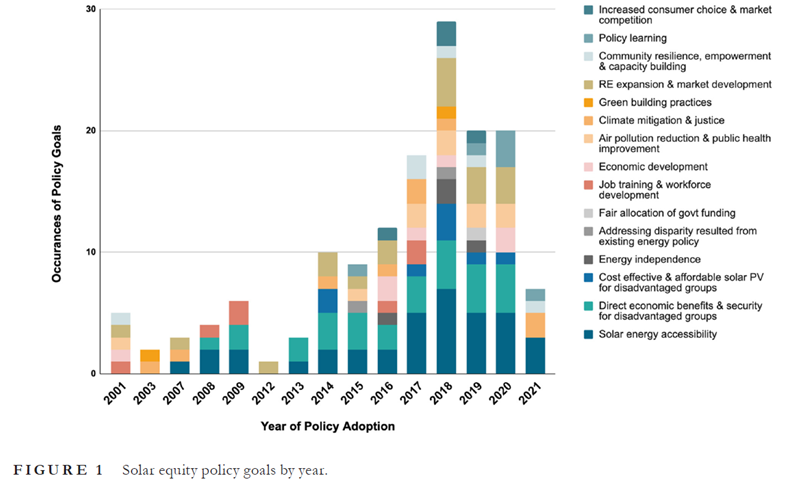
As illustrated in Figure 1, results suggest that policy actors attempt to address unequal distribution of benefits and costs regarding solar PV deployment, as issues of accessibility and affordability for diverse and disadvantaged groups are among the most common solar equity policy goals. Financial incentives that directly benefit disadvantaged groups and organizations serving underrepresented groups are the most common policy instrument utilized, and economic vulnerability (defined by income benchmarks) is often used to define target populations, but the benchmarks used varied over time and geographic area.

This research offers a valuable contribution by joining energy justice and public policy literature to provide a more detailed understanding of meaningful ways to analyze energy justice. It also confirms the argument of Curley et al. (2020) that policymakers use different types of tools to target different takers and advance different policy goals. Finally, it contributes to the policy design literature by applying Schneider and Ingram (1990) and Howlett and Cashore’s (2009) policy design elements to a comparative analysis of solar equity policies. Moreover, research findings in this paper can be particularly useful to policy actors interested in creating policies and programs that reduce solar inequities.

You can read the original article in Policy Studies Journal at

Zhou, Shan, Xue Gao, Adam M. Wellstead and Dong Min Kim. 2023. “Operationalizing social equity in public policy design: A comparative analysis of solar equity policies in the United States.” Policy Studies Journal 51 (4): 741–772. https://doi.org/10.1111/psj.12505.

About the Authors

Shan Zhou is an assistant professor in the Department of Political Science at Purdue University. Her research interests focus on the intersection of public policy, social equity, and sustainability. She has extensive experience in analyzing the justice implications of clean energy policies and infrastructure development in both developed and developing countries (e.g., U.S. and China), using quantitative and qualitative research methods. She has also worked on policy design research promoting effective and equitable clean energy adoption.

Xue Gao is an Assistant Professor at the Askew School of Public Administration and Policy at Florida State University. Her research focuses on the interplay between policy, politics, technology, and society in the energy transition process. Her research encompasses various aspects of the energy transition, including the policy-making process, evaluation of energy programs, innovation and entrepreneurship in renewable energy, and energy justice. 

Adam M. Wellstead is a Professor of Public Policy with the Department of Social Sciences at Michigan Technological University. His research interests include policy innovation labs, policy capacity, policy design, and public value. 


Dane Kim is a PhD Candidate in Environmental and Energy Policy at Michigan Technological University. He holds a Bachelor of Science degree in Environmental Engineering and a Master of Science degree in Environmental Engineering, both from the University of Southern California. His research interests include energy transition, energy policy, air pollution, governance, and data analytic research methods.

Theory into Action: The Important Role of Policy Theory and Practice (PT&P)

Policy Studies Journal has long been known for publishing cutting-edge policy theory research. Our authors develop new and test theories and concepts or innovate on existing theoretical frameworks, generating insights into the nature of the policy process.  At the same time, much public policy scholarship is practical, offering actionable recommendations to policymakers in local, state, national, and even international policy arenas. 

Recognizing the value of more applied research, our team has introduced a rolling special issue under the PSJ banner called Policy Theory and Practice (PT&P). Similar to the PSJ Yearbook model, PT&P is curated by our editorial team and published regularly. Manuscripts submitted go through the same review process as regular PSJ submissions, and accepted articles are still published under the PSJ name. 

While the focal areas for PT&P articles can vary, we note some specific forms that advance our theoretical discussion of the policy process to the real-world applications we strive for, including:   

  1. Manuscripts that engage in policy analysis and evaluation; 
  1. Manuscripts that apply policy theories to previously understudied issues areas, geographic regions, etc.; and 
  1. Manuscripts that examine previously identified hypotheses, seek to replicate previous findings, or report null findings.  

Each of these brings us closer to understanding how our theoretical findings can be formulated into meaningful policy action. If you are interested in having your manuscript considered as either a traditional PSJ or PT&P article, please indicate as such in our Rex submission system by selecting “Yes” in the “Policy Theory and Practice Collection” field:

We look forward to reading your submissions!