
by Jing Vivian Zhan & Jiangnan Zhu
Anticorruption agencies in authoritarian regimes are constrained by scant resources, particularly attention. Attention is the prime scarce resource in governing; it guides the flow of other resources, such as budgets and manpower. Therefore, the allocation of anticorruption attention becomes especially important in influencing both the allocation of corresponding resources and the level of corruption control in authoritarian countries. Existing research has told us to some extent when authoritarian leaders may pay more attention to certain cases or corrupt officials due to political calculations. However, little is known about whether and how anticorruption agencies allocate their attention across policy areas in autocracies. This question warrants investigation because anticorruption programs targeting specific sectors treat the root causes of corruption more directly and are more effective than broad anticorruption policies.
Our article, “Policy Coordination and Selective Corruption Control in China,” answers this question by scrutinizing the case of China. An understudied facet of selective corruption control is that the Chinese procuratorate, the state judicial branch responsible for the investigation, prevention, and prosecution of corruption. The procuratorate has constantly shifted its anticorruption attention across different policy sectors. Figure 1 visualizes this tendency.

Figure 1. Anticorruption Attention by Area (1998-2016)
Note: Policy areas are listed in descending order by the overall degree of anticorruption attention of each area (i.e., sum of anticorruption attention across years). Darker colors indicate more anticorruption attention.
The shifting attention is especially puzzling given the widespread corruption across Chinese industries and the low likelihood that serious sectoral corruption will be resolved once and for all.
We coin a theory of “cross-organizational policy coordination under a single-party authoritarian regime” to explain the puzzle: Single-party regimes can use the centralized party discipline and personnel management system as leverage to direct bureaucratic attention toward the signals given by top policymakers. The policy objectives prioritized by top leaders not only prompt the directly responsible functional sectors to act, but also motivate other bureaucracies, including anticorruption agencies, to coordinate their policies with the national agenda. Thus, the Chinese procuratorate has been mobilized to align anticorruption work with central policy agendas to facilitate the Chinese Communist Party’s major policy initiatives by preventing corruption and investigating more cases in those areas.
We test the correlation between anticorruption attention and policy significance, respectively measured by analyzing voluminous government documents. As shown in Figure 2, except in a few areas chronically ignored by the procurators between 1998 and 2016 (e.g., culture), anticorruption attention and policy significance have similar fluctuating patterns in most areas, with near-matching trend lines in areas such as land & real estate, state-owned enterprise, people’s livelihood, and work safety. Greater policy significance is usually accompanied by augmented anticorruption attention, whereas a steady decrease in policy significance often leads to reduced anticorruption attention.
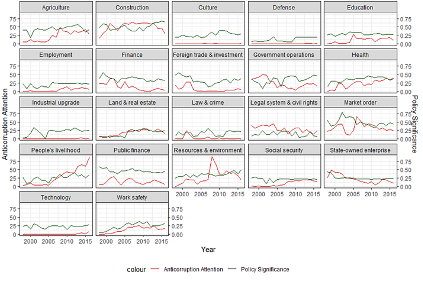
Figure 2. Anticorruption Attention and Policy Significance by Area
Note: For each policy area, the horizontal axis is year; the vertical axis on the left and the red line represent anticorruption attention, while the vertical axis on the right and the green line represent policy significance.
We are among the first to explore authoritarian anticorruption enforcement from the perspective of attention allocation to policy issues. Our study brings a new perspective to understanding anticorruption endeavors in authoritarian regimes by showing that in addition to being motivated by political calculations such as elite power competition, single-party authoritarian regimes can strategically deploy anticorruption efforts as a policy tool to facilitate grand policy portfolios. Our findings resonated with research in predemocratic Brazil and Mexico, Kazakhstan, and Vietnam, in which the state could use political appointments to instrumentalize regulatory bureaucracies with expertise to serve government policies.
You can read the original article in Policy Studies Journal at
Zhan, Jing Vivian, and Zhu, Jiangnan. 2023. Policy coordination and selective corruption control in China. Policy Studies Journal 51: 685–702. https://doi.org/10.1111/psj.12487
About the Authors

Jing Vivian Zhan is a Professor at the Department of Government and Public Administration at the Chinese University of Hong Kong.
Email: zhan@cukh.edu.hk, Facebook: @Vivian Zhan, X: @jvzhan1

Jiangnan Zhu is an Associate Professor at the Department of Politics and Public Administration at the University of Hong Kong.
Email: zhujn@hku.hk, Facebook: @Jiangnan Zhu, X: jian_nan_zhu
 Policy Studies Journal Blog