Bridging Policy Research Across Borders: Challenges and Opportunities for China

by Geoboo Song (PSJ Editor-in-Chief)

On June 14, 2024, I delivered a virtual keynote address at the inaugural International Conference on China Policy Studies (ICCPS) in Beijing, China. While primarily aimed at policy scholars in China, my presentation also holds significance for policy scholars in other non-Western countries. Recently, there were discussions about “Global South” issues during the Conference on Policy Process Research (COPPR) meeting in Syracuse, NY, which the PSJ editors took seriously, prompting immediate action. In light of these developments, I believe sharing my keynote speech here would be beneficial. Below is an excerpt from my keynote address:

As the Editor-in-Chief of the Policy Studies Journal, I have had the privilege of working closely with scholars from around the world, witnessing firsthand the transformative power of collaborative policy research. PSJ, a premier publication outlet for theory-driven policy research, has been at the forefront of delivering cutting-edge research that addresses some of the most pressing global challenges.

In today’s interconnected world, the challenges we face are increasingly complex, uncertain, and global in nature. Issues such as climate change, public health crises, and economic disparity do not recognize national boundaries. As such, the need for robust, collaborative policy research has never been greater. By working together, we can craft innovative solutions that benefit not just our own nations, but the world at large.

Tackling grand challenges, such as extreme weather events, disaster management, immigration crisis, and water and food insecurity, require collaborative and innovative efforts that transcend borders. Policy research plays a crucial role in addressing these issues by providing evidence-based solutions and fostering informed decision-making.

PSJ, a leading publication in the field, has been renowned for its contributions to policy process theory research over half a century. This area of research is pivotal, as the pressing policy issues we face are often fraught with uncertainty, complexity, and inherently “wicked” nature of such challenges. In these contexts, enhancing “procedural rationality” (which focuses on how decisions are made) is as important, if not more so, than “substantive rationality” (which focuses on what decisions are made). And, I firmly believe that this sort of process theory-driven approach ensures more robust problem-solving strategies in the long run, particularly when addressing the grand challenges we encounter.

Equally important is recognizing that mutual benefits arise from international policy research collaboration. By sharing knowledge, resources, and expertise across borders, we can elevate the quality and impact of our policy research. Such collaborative efforts also promote cultural exchange and mutual understanding, which are vital for addressing global challenges effectively.

China has made remarkable progress in policy research in recent years. During my five-year tenure as a PSJ editor, I’ve witnessed Chinese policy scholars, both domestically and internationally, contributing significantly to a broad spectrum of policy theories and substantive policy domains. Their work highlights innovative approaches and invaluable insights. In fact, policy scholars in China have published more articles in PSJ than any other Asian countries in recent years.

Despite this progress, significant challenges remain. Broadly, these can be examined on two levels: individual vs. research environment. On the individual level, many Chinese policy scholars, especially those from non-elite backgrounds, face difficulties in several areas. Developing compelling research questions, achieving theoretical innovation, designing robust methodologies, and effectively communicating their findings, particularly in English, are common challenges. Additionally, securing funding and publishing in top-tier policy journals remain significant hurdles. On the other hand, the research environment encompasses the tangible and intangible resources that maximize individuals’ research competencies. This includes the structure and culture of the researcher’s organization or program, as well as broader institutional and network dynamics. For example, major research universities in the United States provide substantial financial support and reduced teaching loads for pre-tenure assistant professors, fostering an environment conducive to high-level research. In contrast, many Chinese institutions may lack comparable support, making it difficult for scholars to focus on their research.

Of course, numerous opportunities for collaboration exist between policy scholars in China and their counterparts around the world. Establishing partnerships can facilitate the exchange of ideas and resources, leading to more comprehensive and impactful research outcomes. More meaningful academic exchange programs and joint research initiatives can play a crucial role in fostering collaboration, enabling policy scholars to work together, share their expertise, and develop innovative solutions to common challenges. Technology and innovation are also key enablers of collaboration. Digital platforms and tools can facilitate communication, data sharing, and joint research efforts, making it easier for scholars to collaborate across borders. By leveraging these opportunities, we can address the challenges faced by Chinese policy scholars and enhance the global impact of policy research.

In conclusion, bridging policy research across borders is essential for overcoming constraints inherent in research practices in China, addressing global challenges, and creating a sustainable future both intellectually and practically. By working together, we can leverage our collective knowledge and expertise to develop innovative solutions that benefit everybody. I particularly encourage Chinese policy scholars to engage in more international collaborations and seek out new opportunities for joint research. Together, we can overcome challenges and create a brighter future for all.


Policy Stability and Policy Change in China: A Systematic Literature Review of the Punctuated Equilibrium Theory

by Annemieke van den Dool & Jialin Cammie Li

To what extent do government policies in China change over time? Measuring the magnitude and frequency of policy change is an important step in understanding the driving forces of policymaking in China, which we know surprisingly little about despite the country’s large population and growing role in global governance. To answer this question, we turned to the Punctuated Equilibrium Theory, which holds that government policies tend to be stable over time with occasional major change.

Although the PET’s explanatory power is considered to be universal, most English-language studies test the theory in democracies. In late 2021, we found only eight English-language peer-reviewed journal articles that apply the PET to China. These pioneering studies demonstrate the punctuated equilibrium pattern in policymaking in China, yet many questions remain unanswered, especially regarding policy change across different policy issues and venues, the frequency of large policy change, and information processing.

Remarkably, however, the Chinese-language PET literature on mainland China is much larger, albeit fragmented. We decided to conduct a systematic literature review to synthesize existing findings and identify research priorities, before we purposively design new studies. This is important given the effort and time required to conduct PET studies, which is exacerbated by limited data transparency and availability in China.

Through CNKI – China’s largest academic research database – we found 88 China-focused PET journal articles, which we analyzed in terms of methodology, operationalization, and patterns of policy change. We found that Chinese-language PET research is increasing. Moreover, contrary to the English-language PET literature, most Chinese studies are qualitative. Like in the English-language PET literature, weak operationalization of the PET core concepts is common.

One important takeaway from our systematic review is the consensus that government policymaking in China follows a punctuated equilibrium pattern with long periods of stability alternated with bursts of major policy change.

However, contrary to our expectations, our dataset contains only limited evidence in support of the hypothesis that government budgetary change in autocracies is more intensified compared to democracies, i.e., less frequent but larger budgetary adjustments. This hypothesis was first proposed by Chan and Zhao’s (2016) pioneering study on budget change in China. They and others have argued that state control over information flows inhibits the capacity of policymakers in autocracies to respond to problems in a timely and proportional manner because they miss out on important problem signals.

However, our analysis shows that there are very few studies that have tested this hypothesis in a systematic way. Moreover, we observed methodological variation in existing China-focused PET literature, which is illustrated in the table below. In our dataset, only one article (Li et al., 2019) is similar to Chan and Zhao (2016) in terms of methods and findings. All other studies are either qualitative in nature or differ in terms of period, scope (i.e., including only selected policy areas rather than the entire budget), data, and calculation methods. This makes it difficult to compare existing research findings.


Table 1. Regional-level punctuated equilibrium theory budget studies on China (Chinese and English)

To better understand policymaking in China and how it differs from other countries, we advocate for more quantitative PET studies on China that are broad in scope (rather than focusing on selected policy areas), cover a long period of time, and use the exact same methods as existing studies on democracies.A study that does this is Qin & Huang’s (2023) impressive analysis of national-level agenda diversity in China, which is methodologically similar to existing studies in democracies. In this study, the authors manually coded 40 years of State Council Gazettes and found a higher intensity of punctuations in China compared to democracies. We look forward to more such long-term studies across different policy venues.

References

Chan, K. N., & Zhao, S. (2016). Punctuated Equilibrium and the Information Disadvantage of Authoritarianism: Evidence from the People’s Republic of China. Policy Studies Journal, 44(2), 134-155.

Qin, X., & Huang, J. (2023). Policy punctuations and agenda diversity in China: a national level analysis from 1980 to 2019. Policy Studies, 1-21.

You can read the original article in Policy Studies Journal

van den Dool, A., & Li, J. (2023). What do we know about the punctuated equilibrium theory in China? A systematic review and research priorities. Policy Studies Journal. https://doi.org/10.1111/psj.12502

About the Authors

Annemieke van den Dool is an assistant professor in the Social Sciences Division at Duke Kunshan University in Jiangsu, China. Her research focuses on policymaking, policy process theories, and crisis management in China, especially in the areas of health and the environment. Learn more about her research at: http://www.annemiekevandendool.com.

Follow her on X @PubPolicyChina or on BlueSky @avandendool.bsky.social.

Jialin Li is an undergraduate student at Duke Kunshan University in Jiangsu, China. Li majors in Political Economy with a minor in Public Policy. Her research focuses on policy process theories and policy change in China.

Follow her on X @li_cammie or on BlueSky @cammieli.bsky.social.

“Mobile Shooting”: The Shifting Anticorruption Attention in China

by Jing Vivian Zhan & Jiangnan Zhu

Anticorruption agencies in authoritarian regimes are constrained by scant resources, particularly attention. Attention is the prime scarce resource in governing; it guides the flow of other resources, such as budgets and manpower. Therefore, the allocation of anticorruption attention becomes especially important in influencing both the allocation of corresponding resources and the level of corruption control in authoritarian countries. Existing research has told us to some extent when authoritarian leaders may pay more attention to certain cases or corrupt officials due to political calculations. However, little is known about whether and how anticorruption agencies allocate their attention across policy areas in autocracies. This question warrants investigation because anticorruption programs targeting specific sectors treat the root causes of corruption more directly and are more effective than broad anticorruption policies.

Our article, “Policy Coordination and Selective Corruption Control in China,” answers this question by scrutinizing the case of China. An understudied facet of selective corruption control is that the Chinese procuratorate, the state judicial branch responsible for the investigation, prevention, and prosecution of corruption.  The procuratorate has constantly shifted its anticorruption attention across different policy sectors. Figure 1 visualizes this tendency.

Figure 1. Anticorruption Attention by Area (1998-2016)

Note: Policy areas are listed in descending order by the overall degree of anticorruption attention of each area (i.e., sum of anticorruption attention across years). Darker colors indicate more anticorruption attention.

The shifting attention is especially puzzling given the widespread corruption across Chinese industries and the low likelihood that serious sectoral corruption will be resolved once and for all.

We coin a theory of “cross-organizational policy coordination under a single-party authoritarian regime” to explain the puzzle: Single-party regimes can use the centralized party discipline and personnel management system as leverage to direct bureaucratic attention toward the signals given by top policymakers. The policy objectives prioritized by top leaders not only prompt the directly responsible functional sectors to act, but also motivate other bureaucracies, including anticorruption agencies, to coordinate their policies with the national agenda. Thus, the Chinese procuratorate has been mobilized to align anticorruption work with central policy agendas to facilitate the Chinese Communist Party’s major policy initiatives by preventing corruption and investigating more cases in those areas.

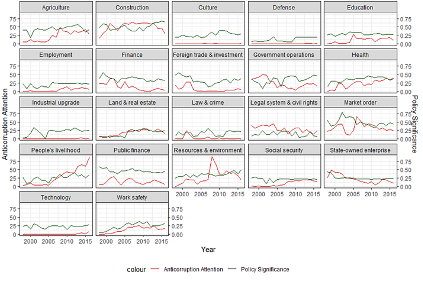
We test the correlation between anticorruption attention and policy significance, respectively measured by analyzing voluminous government documents. As shown in Figure 2, except in a few areas chronically ignored by the procurators between 1998 and 2016 (e.g., culture), anticorruption attention and policy significance have similar fluctuating patterns in most areas, with near-matching trend lines in areas such as land & real estate, state-owned enterprise, people’s livelihood, and work safety. Greater policy significance is usually accompanied by augmented anticorruption attention, whereas a steady decrease in policy significance often leads to reduced anticorruption attention.

Figure 2. Anticorruption Attention and Policy Significance by Area

Note: For each policy area, the horizontal axis is year; the vertical axis on the left and the red line represent anticorruption attention, while the vertical axis on the right and the green line represent policy significance.

We are among the first to explore authoritarian anticorruption enforcement from the perspective of attention allocation to policy issues. Our study brings a new perspective to understanding anticorruption endeavors in authoritarian regimes by showing that in addition to being motivated by political calculations such as elite power competition, single-party authoritarian regimes can strategically deploy anticorruption efforts as a policy tool to facilitate grand policy portfolios. Our findings resonated with research in predemocratic Brazil and Mexico, Kazakhstan, and Vietnam, in which the state could use political appointments to instrumentalize regulatory bureaucracies with expertise to serve government policies.

You can read the original article in Policy Studies Journal at

Zhan, Jing Vivian, and Zhu, Jiangnan. 2023. Policy coordination and selective corruption control in China. Policy Studies Journal 51: 685–702. https://doi.org/10.1111/psj.12487

About the Authors

Jing Vivian Zhan is a Professor at the Department of Government and Public Administration at the Chinese University of Hong Kong.

Email: zhan@cukh.edu.hk, Facebook: @Vivian Zhan, X: @jvzhan1


Jiangnan Zhu is an Associate Professor at the Department of Politics and Public Administration at the University of Hong Kong.

Email: zhujn@hku.hk, Facebook: @Jiangnan Zhu, X: jian_nan_zhu