External drivers of participation in regional collaborative water planning

by Emily V. Bell, Amanda Fencl, & Megan Mullin

Collaborative governance has gained significant attention in recent years, particularly in understanding why stakeholders choose to engage—or not engage—in these processes. At its core, collaborative governance involves multilateral decision-making, where diverse participants collectively identify and address shared problems, seeking consensus on public policy decisions. These processes typically occur within “collaboratives,” which are designed to represent the needs of interconnected stakeholders aiming to solve a common issue.

One prominent area of research in collaborative governance draws on transaction cost theory. This perspective examines whether the benefits of participating in a collaborative outweigh the costs, especially considering potential cooperation challenges and unequal distribution of benefits. Recent studies, however, have expanded this focus to explore the external drivers of cooperation among stakeholders, such as perceived risks of future hazards and systemic capacity. 

Our research focuses on the participation of public water systems (PWSs) in collaborative planning for regional water governance. We hypothesize that perceived risks, defined as beliefs held by water system decision makers about the potential for a harmful event to occur (e.g., droughts, reduced precipitation, insufficient supply, etc.), often prompt collaborative action, especially when they result in collective, interconnected problems. Moreover, we suspect that system capacity—which includes technical, managerial, and financial resources—influences participation by constraining behavior or establishing means necessary for collaboration. We propose three hypotheses:

H1: Actors perceiving greater risk of future hazards will be more likely to participate in regional collaborative planning.

H2: Actors perceiving future demand that exceeds ability to provide public services will be more likely to participate in regional collaborative planning.

H3: Actors with higher capacity will be more likely to participate in regional collaborative planning.

Figure 1. Reported concern for future drought, reduced precipitation, and demand on water supplies in California and North Carolina, respectively.

To test these hypotheses, we analyzed data from California and North Carolina. These states provide an opportunity to investigate collaborative participation in two differing political and institutional contexts. Using binomial logistic regression models, we found support for hypotheses 1 and 3. In other words, the data suggests that an increase in perceived risks and system capacity increases the likelihood of participation in collaborative governance. Our results, however, showed little support for hypothesis 2.

Figure 2. Frequency of system participation in regional planning by system size and state, where the frequency summed is 100% of respondents per state.

This study takes a crucial step toward understanding the role of contextual and external factors in decisions to participate in collaborative governance. By shifting focus outward, it aims to enrich our knowledge of why governance stakeholders engage, complementing existing research on forum-focused perceptions and social dynamics. While previous work has explored interpersonal relations and externalities, this study emphasizes the need for a closer, systematic evaluation of institutional and biophysical contexts. Although participation alone may not guarantee effective collaboration, understanding what motivates stakeholders to join these processes is vital for fostering meaningful engagement.

You can read the original article in Policy Studies Journal at

Bell, Emily V., Amanda Fencl and Megan Mullin. 2022. “ External drivers of participation in regional collaborative water planning.” Policy Studies Journal 50 (4): 945–969. https://doi.org/10.1111/psj.12473.

About the Authors

Emily V. Bell is an Assistant Professor in the Department of Public Administration and Policy at the University of Georgia (UGA), with appointments at the UGA Center for International Trade and Security and the River Basin Center. Her research examines local and regional environmental governance, focusing on coordination, policy learning, and collaborative processes. A key component of her work involves descriptive and inferential social network analysis to learn how water policy and management stakeholders mitigate hazards of natural disasters such as flooding and drought.

Amanda Fencl is a Western States Senior Climate Scientist for the Climate & Energy program at the Union of Concerned Scientists. Dr. Fencl is an expert in water, climate adaptation, and environmental justice issues with an emphasis on research that informs equitable policy solutions. Their research at UCS focuses on the risks and opportunities from climate change in California and the Western United States. She is committed to advancing climate justice and sustainable water management through her work.
Megan Mullin is a political scientist focused on environmental politics. Her research examines how coordination problems, accountability failure, and inequality in environmental risks and benefits shape political response to environmental change. Her current projects focus on the governance and finance of urban water services, public opinion about climate change, and the local politics of climate adaptation. She also has published on federalism, election rules and voter turnout, and local and state institutional design.


Manifesting Symbolic Representation through Collaborative Policymaking

by Jack Mewhirter, Danielle McLaughlin, & Brian Calfano

Representation is crucial to any collaborative governance arrangement. The makeup of those who participate in collaborative forums impacts not just who “wins” and “loses” in the policymaking process, but also how the public perceives participating organizations. Generally speaking, if citizens feel that their interests and incentives are being represented by those participating in a collaboration, they will hold more positive beliefs toward those organizations involved, a phenomenon referred to as “symbolic representation.” Conversely, a perceived lack of representation can potentially engender distrust and negative perceptions toward participating organizations.

The inclusion of civil society organizations in collaborative policymaking is crucial to making citizens feel represented in collaborative forums. Compared to, for example, business and government stakeholders, civil society organizations tend to be more embedded in local communities and thus more responsive to their wants and needs. Thus, we argue that collaborative policymaking forums that feature high participation from civil society organizations should produce a symbolic effect toward participating organizations for citizens aware of this representation.

We test this hypothesis in the context of the Collaborative Settlement Agreement (or CA) governing policing in Cincinnati, Ohio. Established following the controversial killing of a Black teenager in 2001, the CA created a collaborative forum that brought together the Cincinnati Police Department and civil society organizations to address concerns around policing. The CA is a good case study for our hypothesis because civil society organizations have been well-represented and very active within the forum, using it to bring about numerous reforms to department practices.

To capture respondents most representative of Cincinnati’s urban core, we conducted surveys at several community events in the city of Cincinnati between June and September 2017. We asked respondents about their familiarity with the CA and their subsequent feelings toward the Cincinnati Police Department, anticipating that the two will be positively related (i.e., those who are more knowledgeable about the CA will feel more warmly towards the police). We also asked a number of demographic and personal history questions (e.g., regarding race, age, income, any interactions with police, etc.) to see how such variables might correlate with respondents’ knowledge and attitudes. 

And indeed, we found a strong positive relationship between knowledge about the CA and attitudes towards the police. In our survey we also asked respondents to indicate whether they thought that Cincinnati police officers “looked like” them – otherwise referred to as “passive representation” – and found that those who agreed also felt more positively about the police. Other variables that showed positive correlations included age, employment, and income. 

Our study demonstrates the important role that representation in collaborative policymaking forums can play in how people feel about those who participate in it. The case of the Collaborative Agreement in Cincinnati particularly illustrates how the inclusion of civil society organizations can contribute to feelings of symbolic representation, an important finding in the context of police-community relationships. Our findings point to the need to involve groups with close community ties in collaborative policymaking endeavors, as this will go a long way to securing buy-in and coproduction from the broader population. Our findings also reinforce that passive representation – having participants in forums who “look like you” – can bolster symbolic representation. While the CA is a powerful example of inclusion and representation done well, further studies need to be done to see whether collaborative forums that don’t feature robust involvement from civil society organizations are indeed looked upon less favorably. Furthermore, our study took for granted that citizens feel represented by civil society organizations, but this assumption requires empirical testing as well. 

You can read the original article in Policy Studies Journal at

Mewhirter, Jack, Danielle McLaughlin, and Brian Calfano. 2024. “Manifesting Symbolic Representation Through Collaborative Policymaking.” Policy Studies Journal, 52(2): 283–318. https://doi.org/10.1111/psj.12525.

About the Authors

Jack Mewhirter is an Associate Professor in the Baker School of Public Policy and Public Affairs at the University of Tennessee. His research assesses the origins, implementation, and impacts of public policies meant to address complex social problems. This work is done in various contexts, including environmental, health and policing policy. 

Danielle M. McLaughlin is an Assistant Professor in the Department of Political Science at Kent State University. Her research focuses on the impact of institutions in solving collective action problems, mainly in the context of environmental policy issues.

Brian Calfano is a Professor at the University of Cincinnati. His research focuses on media and politics, religion and politics, and community engagement with local government. 

Mitigating conflict with collaboration: Reaching negotiated agreement amidst belief divergence in environmental governance

by Elizabeth A. Koebele & Deserai Anderson Crow

Conflict is a natural part of democratic processes. However, understanding what drives conflict – and how it can be mitigated to a level where negotiation can occur – is essential for fostering productive policy making.

The Advocacy Coalition Framework (ACF) argues that policy conflict is fundamentally driven by belief divergence among coalitions, or groups of policy actors who share beliefs about a policy subsystem and coordinate to achieve their goals. It makes sense, then, that bringing coalitions’ beliefs closer together may also reduce conflict. However, the ACF warns that beliefs are hard to change, especially in high-conflict settings where actors are prone to biased assimilation of information, the devil-shift, and other tendencies that exacerbate conflict.

Collaborative governance is touted as a way to reduce policy conflict under such circumstances by encouraging diverse policy actors to engage in sustained, consensus-oriented deliberation around a shared problem. While collaborative governance may foster some level of belief convergence through information sharing and collective learning, it may also encourage opposing coalitions to negotiate through other mechanisms. For example, as they participate in a collaborative process, coalitions may come to better understand one another’s needs over time, build trust and mutual respect, and support collaborative institutions they perceive to be fair, even as they maintain unique beliefs.

To better understand the relationship between beliefs, conflict, and negotiation, we empirically analyze how two adversarial coalitions’ beliefs changed as they participated in a collaborative water governance process in Colorado, U.S., over the course of a decade. While the collaborative process ended in negotiated agreement, our analyses of longitudinal survey and interview data show that the coalitions’ beliefs actually diverged more at the end of the process than they did at the start – a finding contrary to what we would expect if negotiation was driven primarily by belief convergence.

We then identify several other aspects of the collaborative process and broader policy context that facilitated negotiation among the coalitions. Most importantly, societal value shifts, process norms that institutionalized actor roles and encouraged “multi-purpose” solutions, and the development of respect and social capital among actors appear to have promoted successful negotiation amidst belief divergence. We also found that the trend toward greater belief divergence was primarily attributed to one coalition strengthening their own unique beliefs over time while the other coalition’s beliefs remained fairly stable throughout the process.

Our results demonstrate that while belief divergence was likely a driver of conflict in this policy process, collaborative governance helped adversarial policy actors identify places where they could agree on, or at least consent to, common solutions over time. These findings have important implications for how collaborative processes can be designed to mitigate conflict among opposing coalitions and encourage future research on who changes their beliefs, how, and why while participating in a collaborative process. Scholars should also examine how collaborative governance affects different policy beliefs in different ways, which can help support the development of a more robust typology of beliefs in the ACF literature.

You can read the original article in Policy Studies Journal at

Koebele, Elizabeth A., and Deserai A., Crow. 2023. “ Mitigating conflict with collaboration: Reaching negotiated agreement amidst belief divergence in environmental governance.” Policy Studies Journal, 51, 439–458. https://doi.org/10.1111/psj.12496.

About the Authors

Elizabeth A. Koebele, Ph.D., is an Associate Professor of Political Science and Associate Director of the Graduate Program of Hydrologic Sciences at the University of Nevada, Reno. She holds a Ph.D. and M.S. in Environmental Studies from the University of Colorado-Boulder, and B.A.s in English and Education from Arizona State University. Dr. Koebele researches and teaches about water policy and management in the western United States, with a focus on understanding the impacts of collaborative policy-making processes on governance and environmental outcomes in the Colorado River Basin. She also co-edits the scholarly journal Policy & Politics.

Dr. Deserai Anderson Crow is a Professor in the School of Public Affairs at the University of Colorado Denver. Her work focuses on environmental policy as well as crisis and disaster recovery, risk mitigation in local communities, and stakeholder involvement in decision-making processes. She earned her PhD from Duke University, and her B.S. and MPA from the University of Colorado.

Drivers of (In)equity in Collaborative Environmental Governance

by Kristin Babson Dobbin

In recent decades, collaborative governance has reshaped environmental policy by encouraging horizontal cooperation among stakeholders in an effort to create more mutually beneficial, locally appropriate policies. However, despite its potential advantages, there is a lack of empirical evaluation of the approach, particularly regarding equity. Our study focuses on California’s groundwater management overhaul, known as the Sustainable Groundwater Management Act (SGMA), to examine the conditions under which equity is or is not promoted in collaborative processes.

The chronic groundwater management challenges in California, especially in the San Joaquin Valley, contribute to the state’s widespread drinking water inequities disproportionately affecting low-income rural communities. The severe drought from 2012 to 2016 exacerbated these issues, leading to the implementation of SGMA. Under SGMA, local agencies formed Groundwater Sustainability Agencies (GSAs) to manage groundwater and develop Groundwater Sustainability Plans (GSPs) addressing undesirable groundwater outcomes. Our study analyzes GSPs in critically overdrafted basins to assess their impact on vulnerable drinking water users and environmental justice communities.

We derive five hypotheses for factors influencing equity in collaborative governance derived from the existing literature— the extent of collaboration, representation, elite capture, stakeholder engagement, and problem severity/salience. We then test these hypotheses using Boosted Regression and Classification Trees (BRCT) comparing results across three models, each with a distinct measure of drinking water equity used as the dependent variable. 

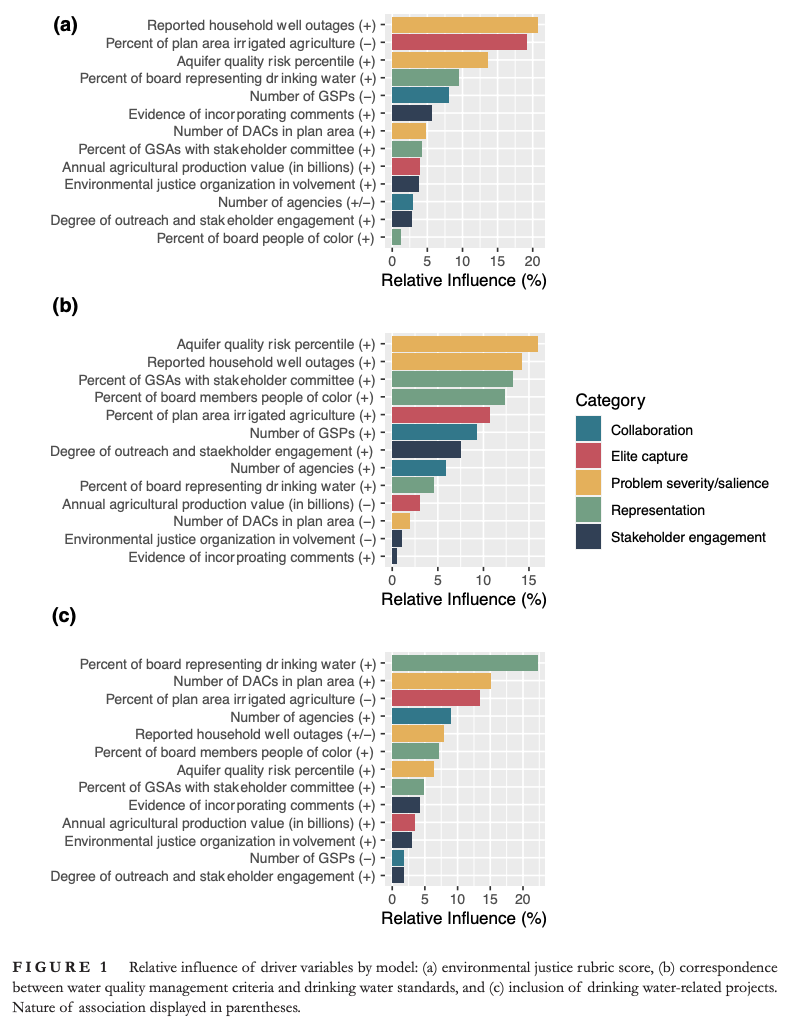
Across all three models, our results support the hypotheses, underscoring the importance of collaboration, representation, elite capture, stakeholder engagement, and problem severity/salience in influencing the distribution of benefits, costs, and risks for vulnerable drinking water users in groundwater plans(see Figure 1). Nonetheless, the raw change in the dependent variables associated with these factors is in most cases quite limited. For example, when moving from zero to eighty percent representation for drinking water users on the GSA board of directors, we only predict a six-percentage point increase in environmental justice rubric score from 40.65 to 46.60. Thus, we assert additional interventions beyond the scope of the factors studied herein are likely essential if we are to increase social equity in decentralized collaborative decision making. 

Comparing the influence of these five factors within and among the models lends additional important insights. Among them, our findings suggest that it might be easier to improve equity in the distribution of collaborative governance benefits than in the distribution of risks or burdens. Also notable is that across equity measures, representation in decision-making roles is consistently more influential than traditional stakeholder engagement. Finally,  given that many of the estimated associations are nonlinear, our findings underscore the importance of addressing threshold effects and optima, rather than presence or absence, when seeking to advance specific collaborative outcomes.

Future research should focus on a nuanced understanding of local institutional design as well as the potential role of external linkages with outside organizations given that some research indicates they may increase accountability. Such work can help us understand the potential and limits of collaborative governance for ensuring positive environmental outcomes for all.

You can read the original article in Policy Studies Journal at

Dobbin, Kristin Babson, Kuo, Michael, Lubell, Mark, Bostic, Darcy, Mendoza, Jessica, and Echeveste, Ernest 2023. “ Drivers of (in)equity in collaborative environmental governance”. Policy Studies Journal 51, 375–395. https://doi-org.echo.louisville.edu/10.1111/psj.12483

About the Authors

Kristin Dobbin (she/her) is an assistant professor of cooperative extension in water justice policy and planning at UC Berkeley in the Department of Environmental Science, Policy and Management. Her work focuses on understanding the causes of, and solutions to, drinking water inequities in California. Kristin holds a PhD from the University of California Davis and was a NSF Social, Behavior and Economic Sciences postdoctoral fellow at UCLA.