

Public support is critical for reaching net-zero goals, yet most research treats climate policies as a single, homogenous category. This approach effectively overlooks how climate policies differ in how much they reflect people’s cultural values and sense of personal freedom. This article therefore asks: Does support for climate policies in the UK depend on the interaction between policy type and cultural worldview? The authors use a UK case study with a representative sample and actual policy proposals to examine how preferences vary by both worldview and the degree of freedom offered by different policy instruments.
Hypotheses
The authors test three sets of hypotheses:
- Hypothesis 1: Support for different policy types varies across cultural worldview groups.
- Hypothesis 2a: Communitarian-egalitarians prefer command-and-control policies most, followed by market-based, information-based, and voluntary policies.
- Hypothesis 2b: Individualist-hierarchists prefer voluntary policies most, followed by information-based, market-based, and command-and-control policies.
- Hypothesis 3a: Support for command-and-control and market-based policies is strongest among communitarian-egalitarians and weakest among individualist-hierarchists.
- Hypothesis 3b: Support for information-based and voluntary policies is strongest among individualist-hierarchists and weakest among communitarian-egalitarians.
- Hypothesis 3c & 3d: Differences between individualist-egalitarians and communitarian-hierarchists follow similar patterns.
Methodology
The authors surveyed 1,911 UK residents using a validated cultural cognition scale to measure worldviews and support for 16 real-world decarbonization proposals grouped into four policy types:
- Command-and-control (strict regulations)
- Market-based (taxes or incentives)
- Information-based (education and awareness)
- Voluntary (encouragement without mandates)
Through a two-step statistical analysis, the authors examined whether policy support relates to a policy type—cultural worldview interaction (step 1) and the likelihood of agreeing with a policy type depending on cultural worldview (step 2).
Key Findings
Egalitarians Prefer Information Over Regulation
Figure 1 shows how cultural worldviews interact with policy types. Surprisingly, egalitarian-commutarians, who often favor strong regulation, preferred information-based policies over command-and-control. They also showed high support for voluntary and market-based measures, which indicates a broader openness to diverse policy instruments. This finding challenges the assumption that collectivist groups always want heavy-handed regulation, therefore disproving hypothesis 2a.
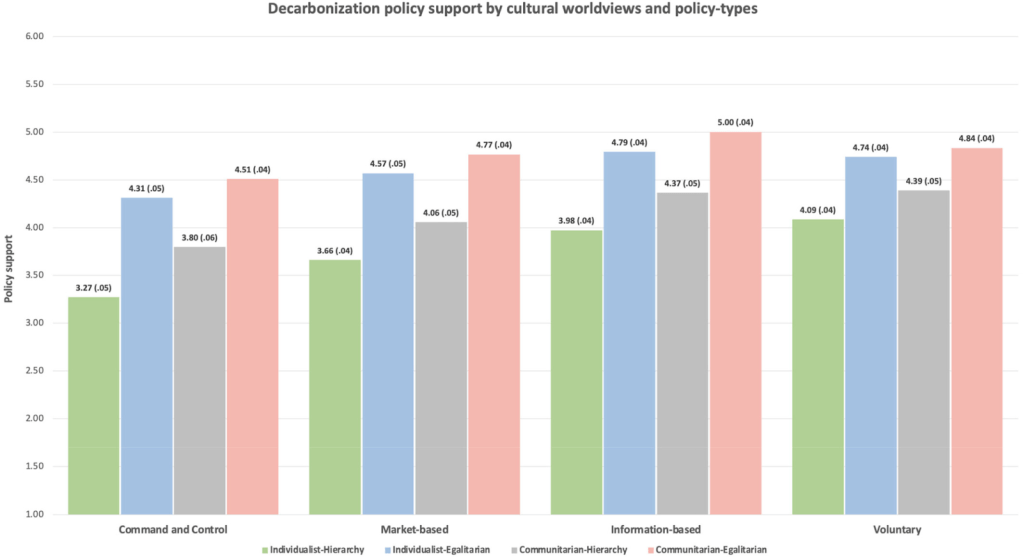
Figure 1. Decarbonization policy support by cultural worldviews and policy types. The numbers show the estimated marginal means. Standard errors are shown in parentheses. N = 1911.
Individualists Favor Freedom Over Regulation
On the other hand, Figure 1 also shows that individualist-hierarchists strongly favored voluntary policies and were least supportive of strict regulations. This pattern closely aligns with cultural cognition theory, which suggests that people who value hierarchy and personal autonomy prefer policies that minimize government coercion. The finding underscores the role of individual freedom as a key determinant of climate policy preferences, thereby supporting hypothesis 2b. It also highlights the significant challenges of implementing stringent decarbonization policies among groups that value autonomy and market-driven solutions.
Why It Matters
This case study reveals that climate policy support is not just about being “for” or “against” climate action; rather, it is about whether policies align with deeper values around freedom and authority. The authors build on cultural cognition theory scholarship by providing actionable guidance for policymakers: that one-size-fits-all policy strategies do not work. Voluntary and informational measures may resonate better with some groups, while others accept market-based tools. The authors call on scholars to test these patterns in other countries, explore how mixed-policy packages influence support, and examine the role of trust and political polarization over time.
Read the original article in Policy Studies Journal:
Bretter, Christian and Felix Schulz. 2025. “Climate Policy Support in the UK: An Interaction of Worldviews and Policy Types.” Policy Studies Journal 53(2): 388–413. https://doi.org/10.1111/psj.12570.
About the Article’s Authors
Christian Bretter is a research fellow in environmental psychology at the Net-Zero Observatory at the University of Queensland. By integrating psychology and environmental behavior research, he is interested in why and when individuals are behaving or thinking in environmentally (un)friendly ways and in designing and testing interventions that create positive behavior change.
Felix Schulz is an interdisciplinary researcher at Lund University Centre for Sustainability Studies. His research draws from labor economics, sociology of work and social psychology to understand individuals and institutions’ perceptions of climate change and just transition policies.
 Policy Studies Journal Blog