Nascent policy subsystems in polycentric governance networks: The case of sea-level rise governance in the San Francisco Bay Area

by Tara Pozzi, Elise Zufall, Kyra Gmoser-Daskalakis, & Francesca Vantaggiato

The biggest environmental policy challenges of our time cut across policy sectors and levels of governance. The wide scope of these issues requires collaboration across sectoral, geographical, and administrative boundaries. Recent literature utilizing the Advocacy Coalition Framework (ACF) has explored the behavior of nascent subsystems, which emerge in response to novel policy challenges and feature developing coalitions. 

However, we still lack an empirical approach to identify and analyze the structural characteristics of these nascent (i.e., emergent) subsystems and assess their implications for theoretical and subsystem development. How do we recognize a nascent policy subsystem when we see one, and what are the drivers of its coalitional structure?

This study builds and expands upon Ingold et al.’s (2017) study of nascent fracking policy subsystems in the United Kingdom and Switzerland, which found that network structure was better explained by actors’ secondary policy beliefs and former collaborative relationships than by actors’ deep core beliefs. We examine the case of the governance of sea-level rise (SLR) adaptation in the San Francisco Bay Area (SF Bay Area), utilizing a 2018 online survey to identify whether its governance system is nascent, whether actors’ policy core beliefs (specific to the subsystem) form discernible advocacy coalitions, and whether those beliefs inform network partner selection.

Image Description

Employing community detection methods and a Bayesian model for statistical analysis of networks (the Bayesian Exponential Random Graph Model, or BERGM) to test for core policy belief homophily between actors, we found that the network does not divide into fully fledged coalitions (illustrated in Figure 1), and that belief homophily is a driver of network structure (Figure 2), suggesting that coalitions are emerging. Moreover, we determined that emerging coalitions dovetail existing policy divides in the SF Bay Area around environmental protection and environmental justice goals.

Image Description

Taken together, these results suggest that coalition formation in the nascent subsystem of SLR in the SF Bay Area is associated with actors’ beliefs imported from pre-existing, related subsystems. At present, communities do not display the adversarial coalitional structure consistent with mature subsystems; instead, overlapping membership by actors in communities creates a core-periphery structure consistent with a collaborative policy subsystem.

Our analysis has important implications for theory, methods, and practice. It shows that nascent subsystems addressing new collective action problems such as SLR derive at least part of their emerging structure from existing coalitions. However, most policy actors in our network display heterogeneous policy core beliefs which do not clearly refer to either pre-existing environmental protection or environmental justice coalitions. This underscores the role that learning plays in coalition formation, particularly when actors face new issues and need to gather information to form their positions. Thus, while pre-existing coalitions shape collaborative ties in the current network structure, they need not prevent the development of entirely new coalitions in the future. Additionally, our empirical approach for recognizing a nascent policy subsystem, parsing out its structural characteristics, and understanding the drivers of its structure can be replicated in other emerging policy subsystem studies.

The implications of this analysis for practice are twofold: for one, understanding the structure of nascent policy subsystems can alert policymakers to the likely trade-offs to be faced in decision-making; and secondly, tracking subsystem development can ensure policymakers include affected interests in the governance process.

You can read the original article in Policy Studies Journal at

Pozzi, Tara, Elise Zufall, Kyra Gmoser-Daskalakis and Francesca Vantaggiato. 2024. “ Nascent Policy Subsystems in Polycentric Governance Networks: The Case of Sea-level Rise Governance in the San Francisco Bay Area.” Policy Studies Journal 52 (3): 561–581. https://doi.org/10.1111/psj.12549.

About the Authors

Tara Pozzi is a PhD candidate in the Graduate Group in Ecology at the University of California, Davis and a Delta Science Fellow. Her research focuses on how governance networks influence effective climate adaptation policy and planning decision-making. Prior to UC Davis, she completed her M.S. in Human-Environment Systems from Boise State University and her B.S. in Civil Engineering from Santa Clara University.  

Website: https://tarapozzi.github.io/ 
LinkedIn: https://www.linkedin.com/in/tara-pozzi-74587856/ 

Elise Zufall is a PhD candidate in the Geography Graduate Group at the University of California, Davis. Zufall studies the role of actor relationships, beliefs, and knowledge in environmental resource management and decision-making. Zufall received her M.S. and B.S. in Earth Systems from Stanford University.  

Kyra Gmoser-Daskalakis is a PhD candidate in the Graduate Group in Ecology at the University of California, Davis. She studies collaborative environmental governance, with a particular focus on the implementation of multi-benefit green infrastructure. She holds a B.S. in Environmental Economics and Policy from UC Berkeley and a Master of Urban and Regional Planning from UCLA.

LinkedIn: https://www.linkedin.com/in/kyra-gmoser-daskalakis-939375b3
X (Twitter): @kyraskyegd

Francesca Pia Vantaggiato is Senior Lecturer in Public Policy at the Department of Political Economy at King’s College London (UK). Her research focuses on how policy-makers and stakeholders use collaborative relationships to tackle change and uncertainty. Her work has been published in journals such as the Journal of Public Administration Research and Theory, Policy Studies Journal and Global Environmental Change. Prior to King’s College London, Vantaggiato was a postdoctoral researcher in the Department of Environmental Science & Policy at the University of California, Davis.

Website: https://francescavantaggiato.github.io/ 
Bsky: https://bsky.app/profile/fpvantaggiato.bsky.social 

Whose Water Crisis? How Policy Responses to Acute Environmental Change Widen Inequality

by Olivia David & Sara Hughes

People experience environmental and climate change in different, uneven ways, shaped largely by how governments respond to these changes. Policy responses to acute environmental events like droughts, floods, and wildfires are important for mitigating environmental and social harm, but can also reveal structural biases and entrenched power dynamics. Such events therefore offer opportunities to evaluate the mechanisms by which policy decisions affect existing socioeconomic inequality, and relatedly, how policy choices may either contribute to or stifle environmental justice.

In our paper, we address these questions by examining policy responses to severe drought events in California, USA (2012-2016) and the Western Cape Province, South Africa (2015-2018). Both regions received significant public and media attention for their respective water crises and the policies that determined how populations experienced and perceived them. The regions share other common features that make drought policy responses particularly consequential including high contributions to their respective national GDPs through agricultural production, and high socioeconomic inequality.

In our examination of these drought events, we ask what constitutes a “water crisis” – who experiences “crisis” and how – and how policy responses mediate those experiences. Some of our key findings are:

  • Californians living in cities largely felt distanced from the effects of drought, while rural populations reliant on domestic wells felt acute impacts. The state’s policy decisions around drastically reducing water deliveries for agriculture contributed to these disparate impacts, as agricultural users shifted to withdrawing more groundwater – producing scarcity and water quality issues for the communities normally reliant on that same resource.
  • California’s poorest communities were forced to spend additional money on bottled water in addition to paying for chronically toxic tap water, deepening water unaffordability conditions.  
  • In Cape Town – the Western Cape’s only large city, and water crisis epicenter – many wealthy households invested in expensive off-grid water supply infrastructure, such as construction of backyard boreholes and installation of rainwater catchment tanks, enabled by lax policies around licensing for private groundwater extraction.
  • The City of Cape Town’s new water pricing structures intending to incentivize conservation not only targeted high-consumption households, but also impacted many poor households with already-low water use.

Based on our findings, we proposed two main causal mechanisms linking policy response and widened inequality in both cases: “values reinforcement” and “strategic communication.” Put differently, we identified how both governments made policy decisions that 1) reinforced dominant political-economic priority values of their respective contexts – mainly, the agricultural economy in California and the status quo of racialized distribution of wealth and power in the Western Cape, and 2) generated and communicated information that leveraged content, framing, and targeting to instill particular populations with a sense of responsibility for mitigating drought crises.

Identifying these two mechanisms leads us to suggest that in contexts of drought and other severe environmental events anticipated under climate change, governments should pay particular attention to how their policy responses perform “values reinforcement” and “strategic communication,” and the outcomes these responses are designed to pursue. Understanding these mechanisms helps clarify how policy choices shape social outcomes of environmental events and raises questions about how policy design might narrow inequalities. As droughts and other environmental events become increasingly frequent and severe, we hope these insights can guide policymaking toward responding in ways that consider and even advance environmental justice, rather than exacerbating inequalities.

You can read the original article in Policy Studies Journal at

David, Olivia and Sara Hughes. 2024. “Whose Water Crisis? How Policy Responses to Acute Environmental Change Widen Inequality.” Policy Studies Journal 52 (2): 425–450. https://doi.org/10.1111/psj.12524.

About the Authors

Olivia David is a doctoral student at the School for Environment and Sustainability at the University of Michigan. Her current research focuses on the politics of water policy and infrastructures, and activism around water injustice as a potential lever of policy change.


E-Mail: odavid@umich.edu
Twitter: @Olivia_David_ 
https://orcid.org/0000-0003-0412-9795

Sara Hughes is an associate professor at the School for Environment and Sustainability at the University of Michigan. She studies policy agendas, policy analysis, and governance processes, focusing on decisions about water resources and climate change mitigation and adaptation.


E-Mail: shughes@rand.org
Twitter: @Prof_Shughes
https://orcid.org/0000-0002-1282-6235

Drivers of (In)equity in Collaborative Environmental Governance

by Kristin Babson Dobbin

In recent decades, collaborative governance has reshaped environmental policy by encouraging horizontal cooperation among stakeholders in an effort to create more mutually beneficial, locally appropriate policies. However, despite its potential advantages, there is a lack of empirical evaluation of the approach, particularly regarding equity. Our study focuses on California’s groundwater management overhaul, known as the Sustainable Groundwater Management Act (SGMA), to examine the conditions under which equity is or is not promoted in collaborative processes.

The chronic groundwater management challenges in California, especially in the San Joaquin Valley, contribute to the state’s widespread drinking water inequities disproportionately affecting low-income rural communities. The severe drought from 2012 to 2016 exacerbated these issues, leading to the implementation of SGMA. Under SGMA, local agencies formed Groundwater Sustainability Agencies (GSAs) to manage groundwater and develop Groundwater Sustainability Plans (GSPs) addressing undesirable groundwater outcomes. Our study analyzes GSPs in critically overdrafted basins to assess their impact on vulnerable drinking water users and environmental justice communities.

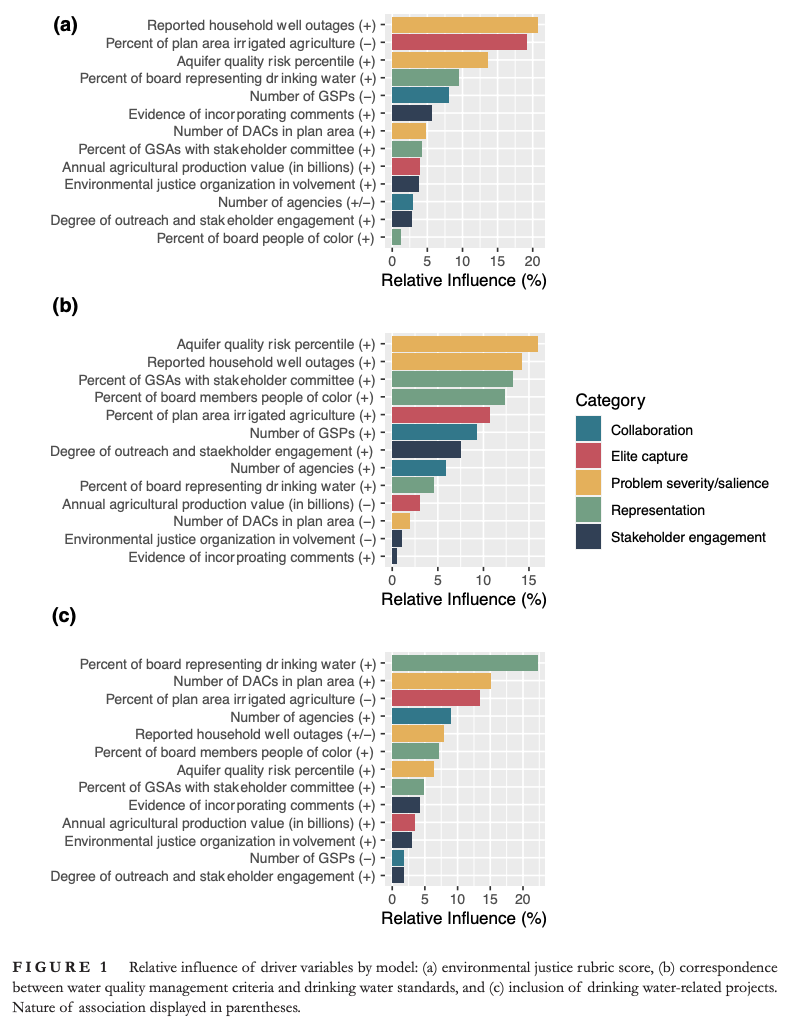
We derive five hypotheses for factors influencing equity in collaborative governance derived from the existing literature— the extent of collaboration, representation, elite capture, stakeholder engagement, and problem severity/salience. We then test these hypotheses using Boosted Regression and Classification Trees (BRCT) comparing results across three models, each with a distinct measure of drinking water equity used as the dependent variable. 

Across all three models, our results support the hypotheses, underscoring the importance of collaboration, representation, elite capture, stakeholder engagement, and problem severity/salience in influencing the distribution of benefits, costs, and risks for vulnerable drinking water users in groundwater plans(see Figure 1). Nonetheless, the raw change in the dependent variables associated with these factors is in most cases quite limited. For example, when moving from zero to eighty percent representation for drinking water users on the GSA board of directors, we only predict a six-percentage point increase in environmental justice rubric score from 40.65 to 46.60. Thus, we assert additional interventions beyond the scope of the factors studied herein are likely essential if we are to increase social equity in decentralized collaborative decision making. 

Comparing the influence of these five factors within and among the models lends additional important insights. Among them, our findings suggest that it might be easier to improve equity in the distribution of collaborative governance benefits than in the distribution of risks or burdens. Also notable is that across equity measures, representation in decision-making roles is consistently more influential than traditional stakeholder engagement. Finally,  given that many of the estimated associations are nonlinear, our findings underscore the importance of addressing threshold effects and optima, rather than presence or absence, when seeking to advance specific collaborative outcomes.

Future research should focus on a nuanced understanding of local institutional design as well as the potential role of external linkages with outside organizations given that some research indicates they may increase accountability. Such work can help us understand the potential and limits of collaborative governance for ensuring positive environmental outcomes for all.

You can read the original article in Policy Studies Journal at

Dobbin, Kristin Babson, Kuo, Michael, Lubell, Mark, Bostic, Darcy, Mendoza, Jessica, and Echeveste, Ernest 2023. “ Drivers of (in)equity in collaborative environmental governance”. Policy Studies Journal 51, 375–395. https://doi-org.echo.louisville.edu/10.1111/psj.12483

About the Authors

Kristin Dobbin (she/her) is an assistant professor of cooperative extension in water justice policy and planning at UC Berkeley in the Department of Environmental Science, Policy and Management. Her work focuses on understanding the causes of, and solutions to, drinking water inequities in California. Kristin holds a PhD from the University of California Davis and was a NSF Social, Behavior and Economic Sciences postdoctoral fellow at UCLA.