

by Kristin Babson Dobbin
In recent decades, collaborative governance has reshaped environmental policy by encouraging horizontal cooperation among stakeholders in an effort to create more mutually beneficial, locally appropriate policies. However, despite its potential advantages, there is a lack of empirical evaluation of the approach, particularly regarding equity. Our study focuses on California’s groundwater management overhaul, known as the Sustainable Groundwater Management Act (SGMA), to examine the conditions under which equity is or is not promoted in collaborative processes.
The chronic groundwater management challenges in California, especially in the San Joaquin Valley, contribute to the state’s widespread drinking water inequities disproportionately affecting low-income rural communities. The severe drought from 2012 to 2016 exacerbated these issues, leading to the implementation of SGMA. Under SGMA, local agencies formed Groundwater Sustainability Agencies (GSAs) to manage groundwater and develop Groundwater Sustainability Plans (GSPs) addressing undesirable groundwater outcomes. Our study analyzes GSPs in critically overdrafted basins to assess their impact on vulnerable drinking water users and environmental justice communities.
We derive five hypotheses for factors influencing equity in collaborative governance derived from the existing literature— the extent of collaboration, representation, elite capture, stakeholder engagement, and problem severity/salience. We then test these hypotheses using Boosted Regression and Classification Trees (BRCT) comparing results across three models, each with a distinct measure of drinking water equity used as the dependent variable.
Across all three models, our results support the hypotheses, underscoring the importance of collaboration, representation, elite capture, stakeholder engagement, and problem severity/salience in influencing the distribution of benefits, costs, and risks for vulnerable drinking water users in groundwater plans(see Figure 1). Nonetheless, the raw change in the dependent variables associated with these factors is in most cases quite limited. For example, when moving from zero to eighty percent representation for drinking water users on the GSA board of directors, we only predict a six-percentage point increase in environmental justice rubric score from 40.65 to 46.60. Thus, we assert additional interventions beyond the scope of the factors studied herein are likely essential if we are to increase social equity in decentralized collaborative decision making.
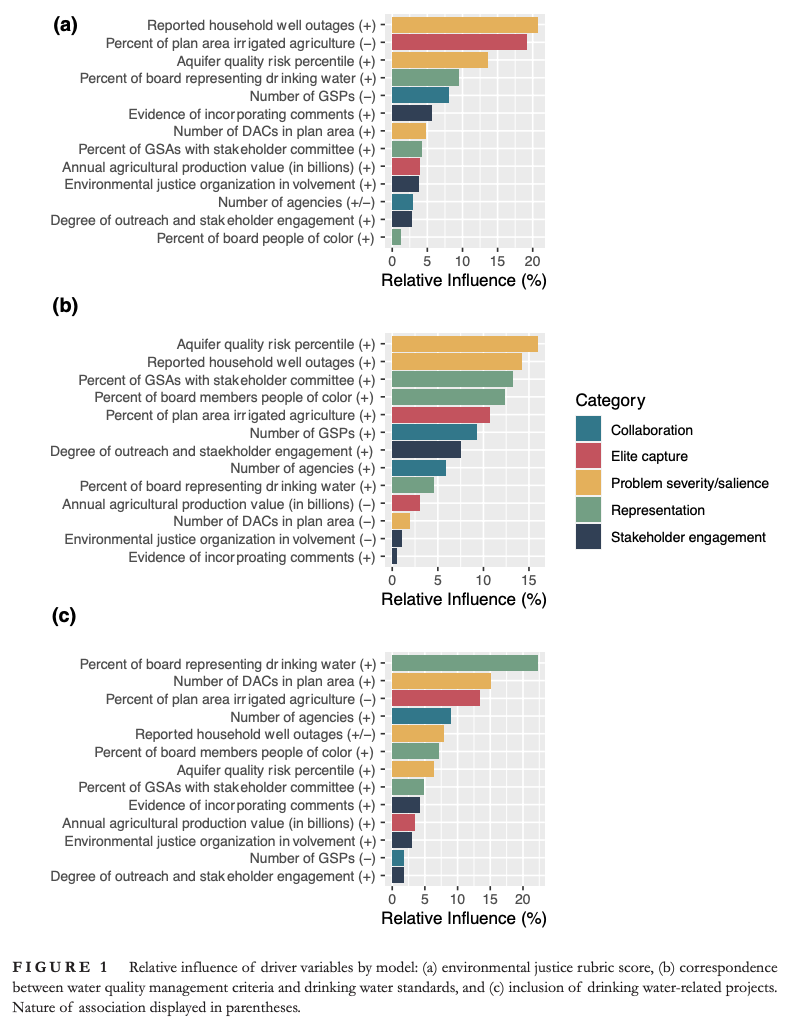
Comparing the influence of these five factors within and among the models lends additional important insights. Among them, our findings suggest that it might be easier to improve equity in the distribution of collaborative governance benefits than in the distribution of risks or burdens. Also notable is that across equity measures, representation in decision-making roles is consistently more influential than traditional stakeholder engagement. Finally, given that many of the estimated associations are nonlinear, our findings underscore the importance of addressing threshold effects and optima, rather than presence or absence, when seeking to advance specific collaborative outcomes.
Future research should focus on a nuanced understanding of local institutional design as well as the potential role of external linkages with outside organizations given that some research indicates they may increase accountability. Such work can help us understand the potential and limits of collaborative governance for ensuring positive environmental outcomes for all.
You can read the original article in Policy Studies Journal at
Dobbin, Kristin Babson, Kuo, Michael, Lubell, Mark, Bostic, Darcy, Mendoza, Jessica, and Echeveste, Ernest 2023. “ Drivers of (in)equity in collaborative environmental governance”. Policy Studies Journal 51, 375–395. https://doi-org.echo.louisville.edu/10.1111/psj.12483
About the Authors

Kristin Dobbin (she/her) is an assistant professor of cooperative extension in water justice policy and planning at UC Berkeley in the Department of Environmental Science, Policy and Management. Her work focuses on understanding the causes of, and solutions to, drinking water inequities in California. Kristin holds a PhD from the University of California Davis and was a NSF Social, Behavior and Economic Sciences postdoctoral fellow at UCLA.
 Policy Studies Journal Blog