The Policy Feedback Effects of Preemption

by Mallory E. SoRelle & Allegra H. Fullerton

Preemption has become a powerful tool for policymakers to disrupt policymaking at lower levels of government and consolidate governing authority. It occurs when a higher level of government enacts laws that override or limit the authority of lower levels of government. The federal government can preempt state governments; likewise, state governments can preempt local governments. This tactic can prevent local governments from implementing their own regulations on issues like public health, labor rights, and civil rights, leading to a centralization of power and often stifling local innovation and responsiveness.

Existing scholarship on preemption has focused on explaining its causes. Very little research has investigated the consequences of preemptive policies for policymaking and governance. In our paper, we develop a theoretical framework to examine these effects systematically, focusing on the lasting impacts of preemption on political engagement, policy innovation, and public trust. 

In developing this framework, we expand on policy feedback theory, which examines how policies, once enacted, can influence future political behavior and policy development. Feedback occurs through two mechanisms: resource effects and interpretive effects. The former includes the effects that influence the capacity of actors to participate in politics by changing access to resources (i.e., monetary, education, civic skills, etc.). The latter includes the effects that shape values and attitudes associated with a policy that influence policy preferences and political actions. We suggest ways of analyzing the resource and interpretive feedback effects of preemption on policymakers, interest groups, and individuals (see Table 1).

We apply the framework to two cases. First, we discuss federal preemption of consumer financial protections. When the federal government overrides state-level protections, consumers may lose trust in their ability to influence financial regulations, and state policymakers may become less inclined to innovate or push for stronger consumer protections. This centralization of power can also empower certain interest groups while weakening others, leading to a shift in the political landscape.

Next, we analyze the consequences of state preemption of municipal anti-discrimination ordinances, particularly in the context of LGBTQ+ rights. When states pass laws that prevent cities from enacting their own anti-discrimination measures, this preemption can stifle innovation and reduce the capacity of local governments to respond to their constituents’ needs. For LGBTQ+ individuals, these laws can lead to worsened health outcomes, decreased political efficacy, and a diminished sense of belonging, as the state sends a clear message about whose rights are prioritized.

This article highlights the significant and far-reaching impacts of preemption on politics, and it proposes a research agenda for future scholarship on the feedback effects of this common policy tool. By understanding how preemption shapes political behavior, policy development, and social attitudes, scholars and policymakers can better navigate the complexities of federalism and work towards more equitable and responsive governance. 

You can read the original article in Policy Studies Journal at

SoRelle, Mallory E. and Allegra H. Fullerton 2024. “ The Policy Feedback Effects of Preemption.” Policy Studies Journal 52 (2): 235–255. https://doi.org/10.1111/psj.12528.

About the Authors

Mallory SoRelle is an Assistant Professor at the Sanford School of Public Policy at Duke University. Her research and teaching explore how public policies are produced by, and critically how they reproduce, socioeconomic and political inequality in the United States. She focuses primarily on issues like consumer financial protection and access to civil justice that fundamentally shape the welfare of marginalized communities yet are often overlooked by scholars of the welfare state because they are not traditional redistributive programs. Mallory is the author of Democracy Declined: The Failed Politics of Consumer Financial Protection (University of Chicago Press, 2020), which explores the political response—by policymakers, public interest groups, and ordinary Americans—to one of the most consequential economic policy issues in the United States: consumer credit and financial regulation.

Allegra H. Fullerton is a PhD Candidate at the University of Colorado Denver School of Public Affairs. The bulk of her research examines the intricate relationships between emotions, beliefs, and coalition dynamics within marginalized communities. She has published in Policy Studies Journal, Review of Policy Research, International Review of Public Policy, and more on gender policy, policy feedback in the US and Germany, transgender healthcare, power, and policy learning. She teaches courses on policy processes and democracy, as well as negotiation. She sits on the organizing committee for the Conference on Policy Process Research, a community dedicated to advancing policy process theories and methods internationally. She also serves as the Digital Associate Editor at Policy and Politics.

Athletic Competition Between the States: The Rapid Spread of Name, Image, Likeness Laws and Why it Matters for Understanding Policy Diffusion

by Roshaun Colvin & Joshua M. Jansa

Name, Image, and Likeness (NIL) policies have rapidly spread across the United States and are dramatically changing the landscape of college sports. NIL enables student-athletes to earn compensation and secure offers and sponsorships while pursuing their education. State lawmakers hope NIL policies will attract premiere student athletes and make their states’ university athletic programs successful (see Figure 1 below). 

The spread of NIL policies allows us to examine mechanisms at work in the policy diffusion process and to consider a new dimension of competition between states related to protecting or enhancing states’ reputations rather than directly accruing economic resources. To improve theory and measurement of competition as a policy diffusion mechanism, we ask: how does national athletic competition influence a state’s decision to adopt NIL policies?

To answer this, we observed the adoption of NIL across all 50 states within 39 months. This data can be used to model the diffusion of NIL through directed dyad event history analysis, a common method in policy diffusion research that allows for the study of how interstate dynamics and internal determinants influence policy adoption. 

A map of the united states

Description automatically generated

We consider that states may engage in different forms of competition. States engage in offensive competition by setting policies with the aim of maintaining their reputations to gain an advantage over other states. In order to measure the internal determinants of a state’s athletic reputation, and therefore its susceptibility to engage in offensive competition, we use the number, value, and success of the state’s Division 1 Football Bowl Subdivision (FBS) programs. States may also engage in defensive competition, adopting policies to keep up with other states by reacting to what rival states are doing to build their reputations. We measure the interstate dynamics driving athletics competition, and therefore the likelihood of defensive competitive behavior using measures of sport-, conference-, and league-wide competition.

The results indicate that athletic competition best explains a state’s decision to adopt NIL. Particularly, states appear more likely to adopt NIL based on their national competitors’ actions and to preserve their status as premiere football programs. However, there is not compelling evidence that conference competition is a motivating force driving NIL adoptions. Rather, it appears that the states with the highest reputed football programs responded to national competition rather than competition within their conference. Other interstate dynamics, such as geographic contiguity or having the same party in power, do not appear to consistently spur the spread of NIL throughout states, suggesting NIL may be a policy in which a new dimension of competition better explains its diffusion than previous tendencies for states to consistently mimic other states.

The spread of NIL provides an excellent opportunity to understand diffusion mechanisms, specifically the limits of the competition mechanism. Furthermore, it provides the opportunity to generate new ways to operationalize competition for empirical analysis. In the case of NIL policy, states adjusted their status as major destinations for college athletes by hurrying to adopt NIL policy prior to other states adopting NIL policy.

You can read the original article in Policy Studies Journal at

Colvin, Roshaun and Joshua M. Jansa. 2024. “Athletic Competition Between the States: The Rapid Spread of Name, Image, Likeness Laws and Why It Matters For Understanding Policy Diffusion.” Policy Studies Journal 52 (2): 451–468. https://doi.org/10.1111/psj.12522.

About the Authors

Roshaun Colvin is a graduate student at University of Florida and received his Master’s in Political Science at Oklahoma State University.

Joshua M. Jansa is an Associate Professor of Political Science at Oklahoma State University. His research focuses on policy diffusion, state politics, political and economic inequality, and civic education.

Design Paths of Federal Intergovernmental Cooperation

by Simon Montfort, Manuel Fischer, James Hollway, & Nicolas W. Jager

In the analysis of intergovernmental cooperation within federal systems, conventional explanations have centered on problem characteristics, governance incentives, and actor interdependencies. Here, we seek to understand why institutions evolve in different directions even though they address similar problems. To address this puzzle, we investigate forms of cooperation. We seek to understand the process of institutionalization by which new agreements with specific forms of cooperation, captured through institutional design mechanisms, build upon existing ones. Our paper explores the nuanced dynamics of federal cooperation, examining how earlier institutional design choices condition subsequent cooperation.

Institutional design mechanisms are the agreed-upon rules shaping interactions during intergovernmental collaboration. This study focuses on three key mechanisms: provisions for monitoring, conflict resolution, and agreement commissions. We use these three mechanisms to investigate whether cooperation between subnational governance units, called substates, follows specific institutional design paths consisting of particular sequences of design mechanisms over time in their collaborative relationships. We expect, for instance, that conflict resolution mechanisms and monitoring provisions serve as an entry point to more strongly institutionalized forms of cooperation. The latter forms of cooperation include, for instance, agreement commissions, where substates concede more authority for shared decision-making, potentially rather slowing down other forms of cooperation. 

We analyze substate cooperation in Switzerland’s federal water systems—an ideal-typical setting with robust substate competencies and a history of institutionalized cooperation. Swiss cantons, endowed with a range of voluntary cooperation options, manifest these in formal treaties known as “concordats” around water management issues. The study scrutinizes the uptake and design mechanisms in concordats spanning the last 40 years, offering insights into the dynamics of federal cooperation. We manually code formal treaties between cantons and use a semi-parametric Cox proportional hazards model to analyze the data.

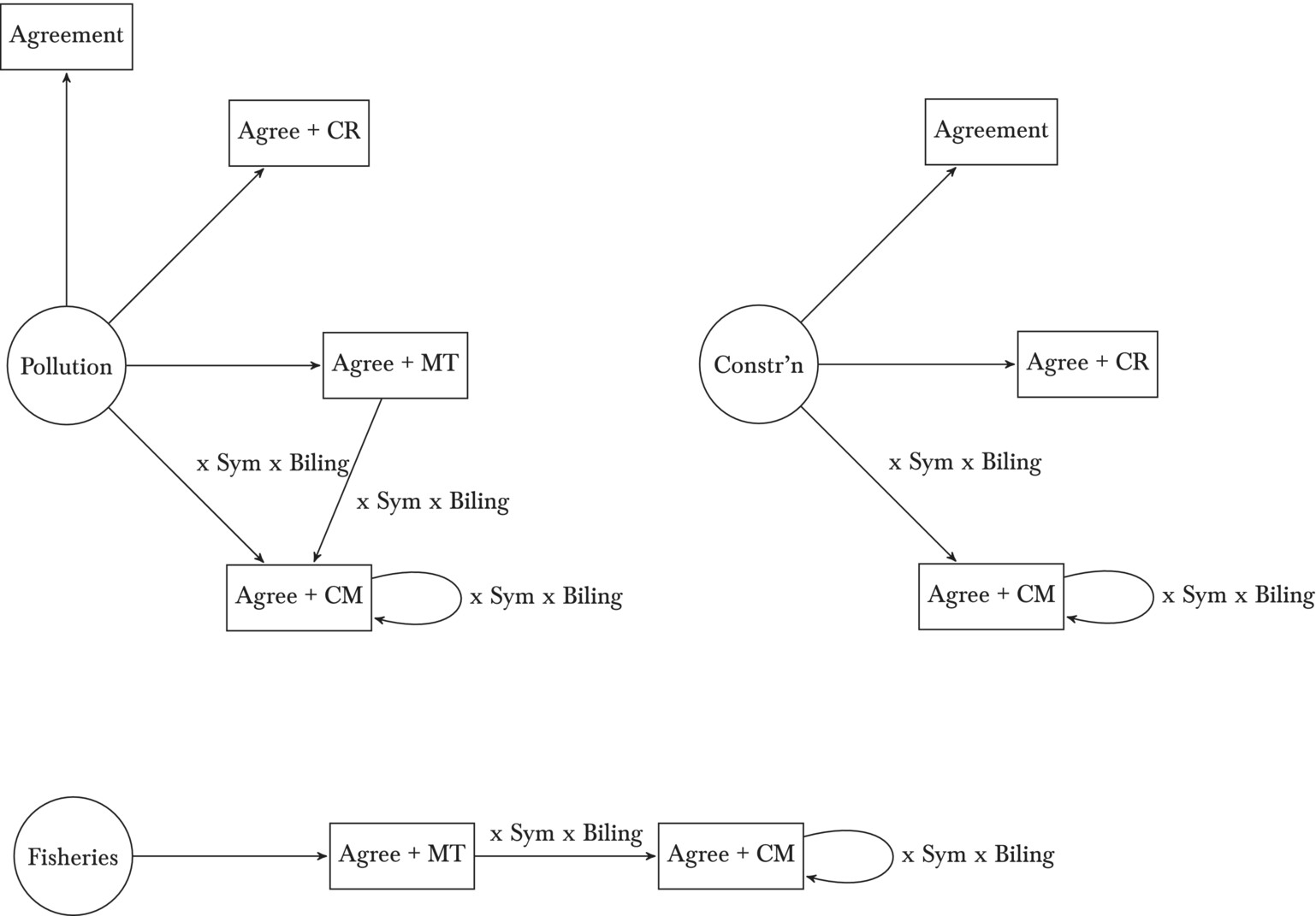
Figure 1. Issue-specific pathways.

Our findings show that institutional design mechanisms contribute to specific design paths, either facilitating or hindering the inclusion of similar mechanisms in the future. For instance, the establishment of a commission often leads to further use of agreement commissions in the future. However, once a commission is in place, adding independent monitoring or conflict resolution mechanisms becomes less likely. We also identified a few design paths in which substates utilized multiple mechanisms. Additionally, we see unique pathways on pollution and fishing cooperation. These design pathways are illustrated in Figure 1.

This research enriches the literature on intergovernmental cooperation in federal systems by examining cooperation as a long-term, evolving process. By focusing on institutional design mechanisms rather than a binary assessment of cooperation, the study provides insights into the nuanced patterns of federal cooperation for similar underlying problem characteristics. Additionally, the exploration contributes to the common pool resource governance literature by shedding light on the development and layering of institutional design mechanisms over time.

In conclusion, identifying existing institutional design mechanisms can advance our understanding of intergovernmental cooperation. The Swiss case study offers valuable insights into the dynamics of federal water systems, illustrating the long-term impact of earlier institutional choices on the paths taken in subsequent cooperative ventures. As federal systems continue to evolve, understanding these design mechanisms becomes paramount for fostering effective and adaptive intergovernmental cooperation.

You can read the original article in Policy Studies Journal at

Montfort, Simon, Manuel Fischer, James Hollway, and Nicolas W. Jager. 2023. Design paths of federal intergovernmental cooperation. Policy Studies Journal, 51, 773–792. https://doi.org/10.1111/psj.12498

About the Authors

Simon Montfort is a Doctoral Candidate at the Institute of Political Science at the University of Bern. His research, supported by a Swiss National Science Foundation Doc.CH grant, focuses on pathways to ambitious environmental policy. He works at the intersection between natural language processing, public opinion surveys and social network analysis.

Manuel Fischer is a research group leader in Policy Analysis and Environmental Governance (research group PEGO) at the Department of Environmental Social Sciences at Eawag and an adjunct professor (Titularprofessor) at the Institute of Political Science, University of Bern. His research analyzes governance arrangements, decision-making processes, and political networks, focussing on water and environmental issues.

James Hollway is Co-Director of the Global Governance Centre, Head of the Environment and Sustainability Specialisation, and Associate Professor of International Relations/Political Science at the Graduate Institute of International and Development Studies in Geneva. His research develops multilevel and dynamic network theories, methods, and data for studying institutionalised cooperation and conflict on trade, health, and environmental issues such as fisheries and freshwater. His book “Multimodal Political Networks” came out in 2021 with Cambridge University Press. He is currently working on a 4-year SNSF funded project “Power and Networks and the Rate of Change in Institutional Complexes”.

Nicolas W. Jager is Assistant Professor of Governance of Sustainability Transformations with the Public Administration and Policy Group at Wageningen University and Research (NL). He is further an Associate Junior Fellow at the Hanse Wissenschaftskolleg – Institute for Advanced Study Delmenhorst (DE). His research interests include issues of sustainability and climate policy, collaborative governance, and institutional change and stasis.