
A postcode lottery in education? Explaining regional inequality in multilevel systems

Existing research focuses predominantly on inequality among individuals. But inequality also has a territorial dimension. This article seeks to better understand the drivers of regional inequality in education, a key area in modern knowledge-based societies. The article specifically explores the conditions that shape regional differences in student enrolment and educational attainment across 14 OECD countries: Australia, Austria, Belgium, Canada, Denmark, France, Germany, Italy, Norway, Spain, Sweden, Switzerland, the United Kingdom, and the United States. It uses Qualitative Comparative Analysis (QCA) to identify necessary and sufficient conditions of regional inequality.

The article is guided by the strong assumption in the literature on federalism, decentralization, and multilevel governance that regional authority (or, decentralization) is a key driver of regional inequality. Considering that regional authority might not be a direct cause of regional inequality, the article also explores the impact of several other factors; government spending, population size, and socioeconomic status.

More specifically, it examines the following four hypotheses:

  1. Level of Regional Authority: A high level of regional authority over educational policy is a necessary condition for a high level of regional inequality in education.
  2. Expenditures: The combination of a high level of regional authority over education policy and strong regional differences in education spending is a sufficient condition for a high level of regional inequality in education.
  3. Regional Size: The combination of a high level of regional authority over education policy and strong regional differences in population size is a sufficient condition for regional inequality in education.
  4. Socioeconomic Status: Strong regional differences in socioeconomic status are a sufficient condition for a high level of regional inequality in education.

The analysis relies on the OECD Regional Statistics database, which contains internationally comparable regional data on student enrolment and educational attainment. To measure regional authority over education, the article uses the Regional Education Authority Index developed by Garritzmann et al. (2021).

This study offers insights into how educational outcomes, and in turn opportunity and quality of life, can vary greatly across regions in any given nation (see Figures 1 and 2).
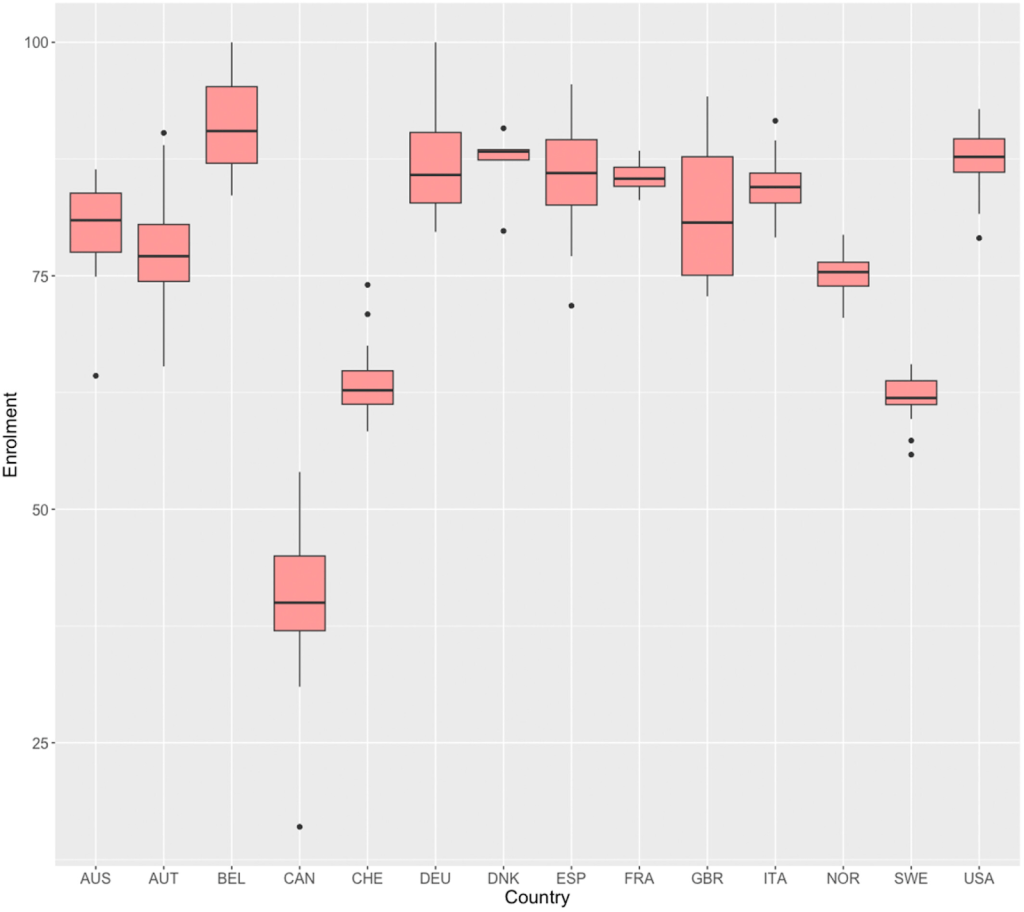
Image Description

Figure 1. Regional differences in enrolment in upper secondary education; data: OECD Regional Statistics, Statistics Norway, Statistics Sweden, Swedish National Agency for Education, Federal Statistical Office (Switzerland).
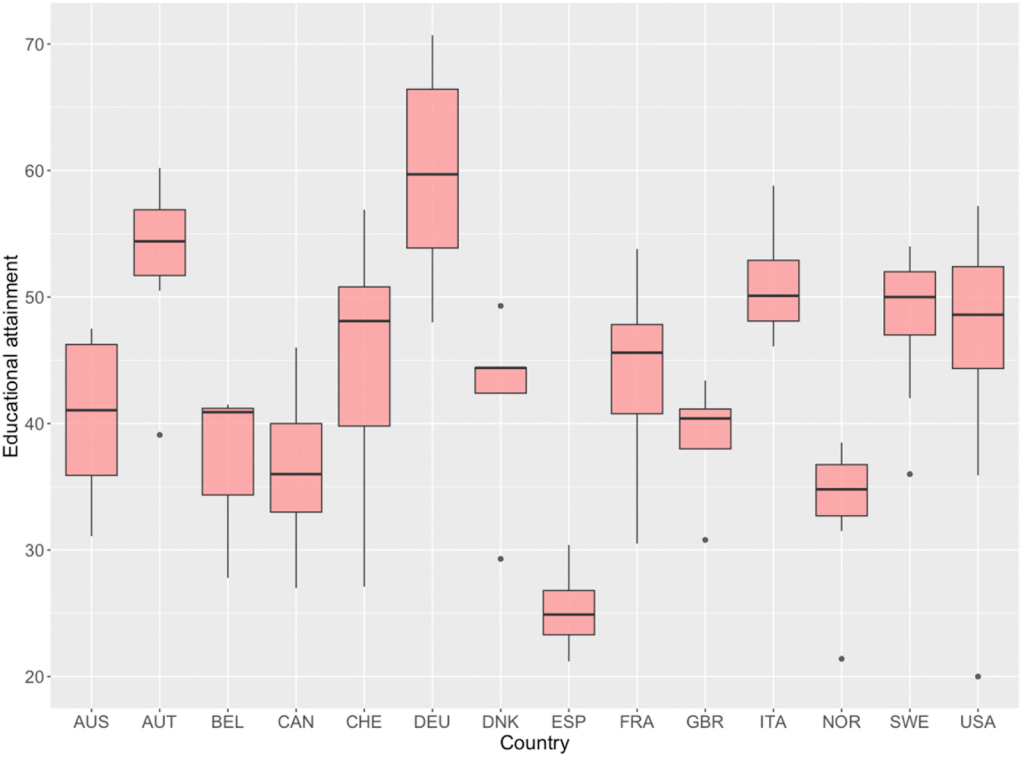
Image Description

Figure 2. Regional differences in attainment of upper secondary education; data: OECD Regional Statistics, Statistics Norway, Statistics Sweden.

Regarding the drivers of these inequalities, the analyses in the article show that regional authority over education is not a necessary condition for high regional inequality, as enrolment rates vary across regions in Austria and educational attainment varies in France despite low regional authority over education in both countries. Regional authority is also not an individually sufficient condition. However, it seems to be an important factor, as it is part of all configurations associated with high levels of regional inequality in educational attainment and student enrolment:

  • Educational Attainment: (1) A high degree of regional authority over education and strong regional spending differences. (2) A high degree of regional authority over education and strong differences in regional population size.
  • Student Enrolment: (1) A high level of regional authority over education, strong regional spending differences, and strong regional differences in population size.

Because the inclusion of Belgium might undermine the robustness of these findings due to data issues and the low number of regions, analyses were also run without Belgium. These confirmed that regional authority over education is an important factor, in combination with others.

In conclusion, the article demonstrates that regional authority over education plays an essential role in shaping educational inequality–but is not the only factor.

Read the original article in Policy Studies Journal:

Schnabel, Johanna. 2025. “A Postcode Lottery in Education? Explaining Regional Inequality in Multilevel Systems.” Policy Studies Journal 53(2): 263–284. https://doi.org/10.1111/psj.12565.

About the Article’s Author

Johanna Schnabel is a Lecturer and Researcher at the Chair of German Politics, Otto Suhr Institute of Political Science, Freie Universität Berlin. Her research largely focuses on intergovernmental relations and public policy in federal and decentralized countries. She received her Ph.D. in Political Science at the Institute of Political Studies at the University of Lausanne, Switzerland.

Potholes, 311 reports, and a theory of heterogeneous resident demand for city services

by Scott J. Cook, Samantha Zuhlke, & Robin Saywitz

An important criterion for evaluating the effectiveness of local governments is how – and whether – they respond to the needs of their residents. Sometimes, local governments proactively provide basic services to meet their residents’ needs. Other times, residents make their needs known to government officials by requesting these services. Importantly, not all residents are equally likely to request services from government when government fails to address a need. In this study, we examine which areas are more likely to produce requests for services from government when faced with a common service need: potholes.

We use 311 reports to measure resident demand for specific kinds of services – in our case, pothole repair. Many localities in the U.S. have adopted 311 systems as a way for residents to request government services. For practitioners, 311 systems are a valuable means of connecting with residents. For researchers, 311 reports are a valuable source of data, providing information on what service was requested, when and where the request was made, and how the locality responded to the request. We study potholes because it is easy to measure whether potholes have been serviced, local governments have nearly full autonomy to repair potholes, and residents are widely in favor of reducing potholes. Ultimately, we wanted to understand whether and to what extent requests for pothole repairs varied according to the racial/ethnic and socioeconomic makeup of a city neighborhood, anticipating that requests for services made via 311 systems may follow patterns seen in other forms of political participation.

We apply a three-part general model for understanding how local governments provide public services, which breaks down according to need for services, demand for services, and service provision. Need reflects what residents require, demand represents the expression of need by residents to government, and service provision is the action that the government takes to meet the need and/or demand for services. In our study, we focus on how need (the presence of potholes) translates into demand (a 311 request about a pothole placed by a resident).

Image Description

Figure 1. General model for local service provision

Our dataset includes 311 reports on potholes in Houston, Texas from 2016 to 2020. Houston is a useful case since it has a long-running 311 system and an economically and demographically diverse population. Potholes were a salient policy priority in Houston during this period. We secured data on the number of potholes proactively filled by the City of Houston in a FOIA request, which we use as a proxy for pothole presence within a census tract. To evaluate area demand, we utilize the number of 311 reports in each census tract. We measure a census tract’s socioeconomic status using a single variable constructed from several measures, including the poverty rate, median household income, and the percentage of residents who are high school and college graduates. We measure race as the percentage of Black, Hispanic, and Asian residents in a tract.

Image Description

Figure 2. Total 311 reports about potholes in Houston, TX from 2016 to 2020

We find that tracts with higher percentages of Black and Hispanic residents correlated with higher numbers of potholes. Lower socioeconomic status was also associated with more potholes. Despite being more likely to have potholes, we find that those same areas had fewer 311 reports. Instead, tracts with fewer Black and Hispanic residents, as well as those of higher socioeconomic status, were more likely to file 311 reports. Taken together, these results reveal that those areas of Houston with the most need for pothole remediation are least likely to demand it.

Our findings serve as a note of caution to local governments about the potential danger of overreliance on self-reporting systems like 311 to allocate public services. The case of potholes in Houston demonstrates that demand for services does not always align with need. Consequently, 311 systems have the potential to exacerbate existing inequalities along lines of race and socioeconomic status if public administrators assume that individuals are equally likely to engage with these systems. We advise local governments to a) find ways to encourage greater 311 reporting more broadly, and b) proactively provide services, anticipating that some residents will be less likely to request services to meet unmet needs.

You can read the original article in Policy Studies Journal at

Cook, Scott J., Samantha Zuhlke and Robin Saywitz. 2024. “ Potholes, 311 Reports, and a Theory of Heterogeneous Resident Demand For City Services.” Policy Studies Journal 52 (3): 647–669. https://doi.org/10.1111/psj.12540.

About the Authors

Scott J. Cook is an associate professor in the Department of Political Science at the Bush School of Government and Public Service at Texas A&M University. The core aim of his research was to improve our ability to effectively learn about political processes from otherwise imperfect data. Examples of this work have been published in the American Journal of Political Science, the American Political Science Review, and the Annals of Applied Statistics.

Samantha Zuhlke is an assistant professor in the School of Planning and Public Affairs at the University of Iowa. Her research examines how individuals relate to government and nonprofit organizations, particularly in the wake of government failure. Her work has been published by Cambridge University Press and the Journal of Public Administration Research and Theory. She previously worked at the National Geographic Society.

Robin Rose Saywitz is an Assistant Professor in the Department of Political Science at Saint Louis University. Her research falls along three, often overlapping lines: environmental policy, political institutions and performance, and the drivers of human capital decisions in the bureaucracy.