
Intergovernmental Implementation in a Time of Uncooperative Federalism: Immigration Enforcement and Federal Secure Communities Program, 2011–14

by William D. Schreckhise & Daniel E. Chand

On the first day of his second term, Present Trump signed an executive order taking aim at “so-called sanctuary jurisdictions,” marking his latest attempt to step up immigration enforcement in progressive, pro-immigrant communities. While there’s no universal definition as to what constitutes “sanctuary” jurisdictions, the most accepted definition are communities that limit state and local law enforcement participation with Immigration and Customs Enforcement (ICE), enforcement program known as Secure Communities (S-Comm).

S-Comm is, essentially, a nationwide immigration screening program. It has long been commonplace for jails to share an individual’s name and biometric information (e.g., photo, fingerprints, etc.) with federal authorities to see if the person has a criminal record or any outstanding warrants when an individual is arrested and booked. S-Comm further shares this information with ICE, which screens the individual for immigration violations.

If ICE suspects an individual of being in the country without proper authorization, it can issue an ICE detainer, which requests the jail to hold the individual for up to 48 hours so that ICE can take custody of the person and begin deportation proceedings. ICE can, and frequently does, detain individuals under S-Comm regardless of whether the charges for the original arrest are dropped. From the time S-Comm became nationwide operational in 2013 through 2020, roughly 700,00 individuals were removed from the country.

S-Comm was (and still is) controversial. Numerous local governments, mostly counties, have passed various measures in opposition to the program. Other governments went further, explicitly prohibiting their officers from contacting ICE and prohibiting their agencies from spending money in ways that otherwise could help ICE. However, other governments essentially did the opposite with some states requiring their counties to honor ICE detainer requests.

In our PSJ article, we examined the extent to which state and local governments play a role in implementing federal policy, focusing on the patterns of interaction between federal actors and nonfederal actors implementing S-Comm. Specifically, we examine the extent to which localities and states could hinder or help with the program’s implementation.

To determine what role these subnational policies could play, we collected county-level ICE removal data and information about which states and localities adopted policies aimed at either helping ICE by mandating their agencies honor detainer requests or hindering ICE’s efforts prohibiting that they cooperate with ICE’s detainer requests.

We found that states and counties can indeed play a prominent role. Taking these various other factors into account, counties that passed so-called “sanctuary” ordinances saw roughly 30% fewer deportations. Counties in states that had passed their own state-level “sanctuary” laws saw a similar decline. States that passed legislation requiring their localities to cooperate with ICE saw 44% more deportations.

We also wanted to determine to what extent the presence of the cooperative and noncooperative policies was reflected in what ICE itself was doing. It is one thing for counties and states to simply refuse to cooperate; it is entirely another for ICE to modify its own behavior because of these policies. To do this, we redirected the variables to determine whether they could help explain the extent to which ICE was making detainer requests in the first place. Again, we found that ICE was making fewer detainer requests in states and counties where cooperation with ICE was prohibited and making more in states where the counties were directed to cooperate.

Considering the ongoing debate over immigration enforcement policies, our findings underscore the significant impact of state and local policies on the implementation of federal initiatives, like S-Comm. The presence of subnational policies not only shape the outcome of the policy, but also how the federal agencies, like ICE, behave when implementing federal programs.

You can read the original article in Policy Studies Journal at

Schreckhise, W.D. and Chand, D.E. (2021), Intergovernmental Implementation in a Time of Uncooperative Federalism: Immigration Enforcement and Federal Secure Communities Program, 2011–14. Policy Stud J, 49: 1160-1188. https://doi.org/10.1111/psj.12426

About the Authors

William D. Schreckhise is professor in the University of Arkansas’ Department of Political Science. He earned his Ph.D. from Washington State University’s Department of Political Science. His research interests include policy implementation and bureaucratic discretion. His the author of Evaluating American Democracy and Public Policy.


Daniel E. Chand (“Danny”) received his Ph.D. in Public Policy in the Policy Management specialization at the University of Arkansas. His research focuses on the implementation of immigration policy, examining the roles of actors such as immigrant-serving nonprofits, immigration judges, and ICE officers. In addition to PSJ, his work has appeared in journals like Policy Sciences and Voluntas.
Design Paths of Federal Intergovernmental Cooperation

by Simon Montfort, Manuel Fischer, James Hollway, & Nicolas W. Jager

In the analysis of intergovernmental cooperation within federal systems, conventional explanations have centered on problem characteristics, governance incentives, and actor interdependencies. Here, we seek to understand why institutions evolve in different directions even though they address similar problems. To address this puzzle, we investigate forms of cooperation. We seek to understand the process of institutionalization by which new agreements with specific forms of cooperation, captured through institutional design mechanisms, build upon existing ones. Our paper explores the nuanced dynamics of federal cooperation, examining how earlier institutional design choices condition subsequent cooperation.

Institutional design mechanisms are the agreed-upon rules shaping interactions during intergovernmental collaboration. This study focuses on three key mechanisms: provisions for monitoring, conflict resolution, and agreement commissions. We use these three mechanisms to investigate whether cooperation between subnational governance units, called substates, follows specific institutional design paths consisting of particular sequences of design mechanisms over time in their collaborative relationships. We expect, for instance, that conflict resolution mechanisms and monitoring provisions serve as an entry point to more strongly institutionalized forms of cooperation. The latter forms of cooperation include, for instance, agreement commissions, where substates concede more authority for shared decision-making, potentially rather slowing down other forms of cooperation. 

We analyze substate cooperation in Switzerland’s federal water systems—an ideal-typical setting with robust substate competencies and a history of institutionalized cooperation. Swiss cantons, endowed with a range of voluntary cooperation options, manifest these in formal treaties known as “concordats” around water management issues. The study scrutinizes the uptake and design mechanisms in concordats spanning the last 40 years, offering insights into the dynamics of federal cooperation. We manually code formal treaties between cantons and use a semi-parametric Cox proportional hazards model to analyze the data.

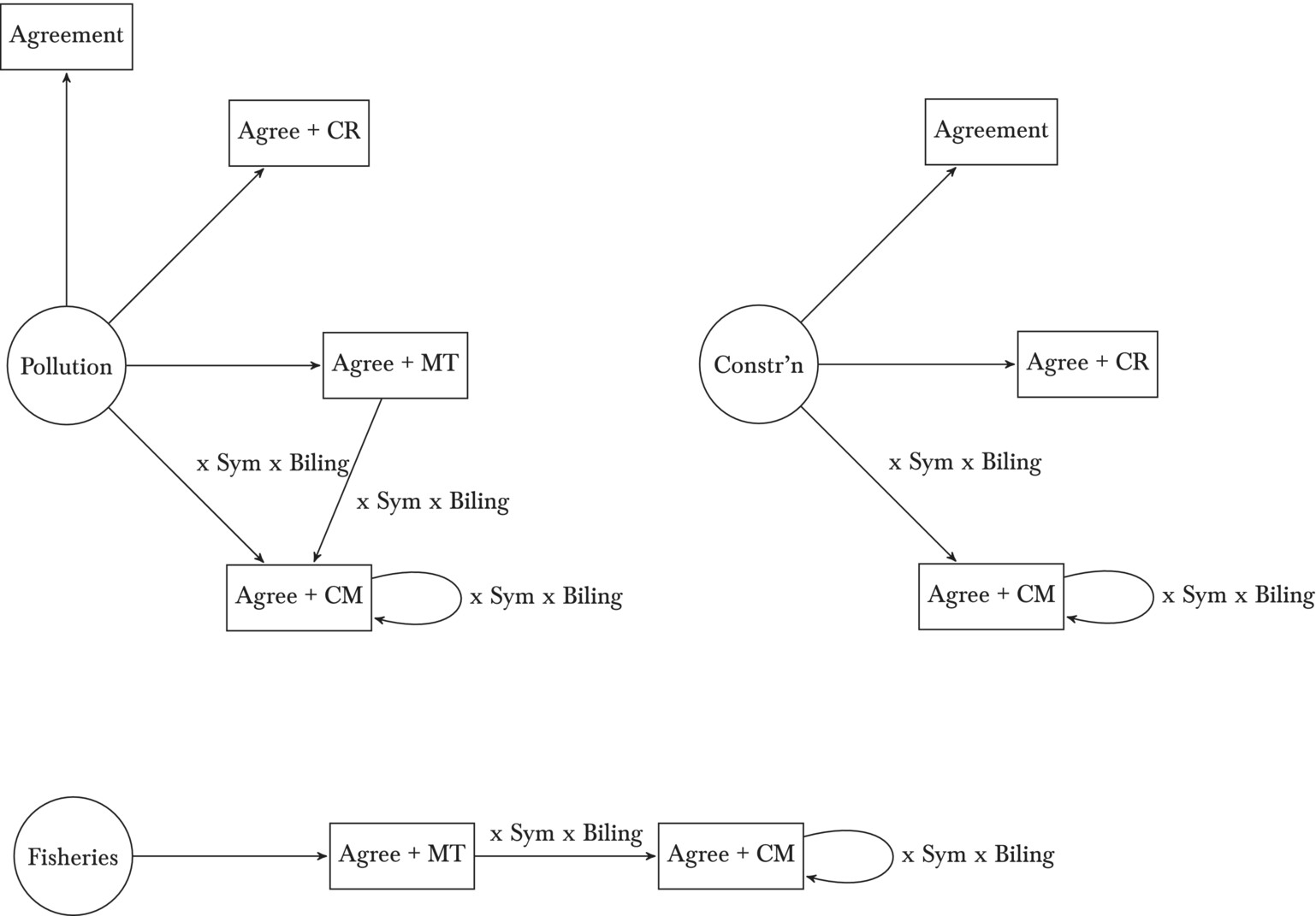
Figure 1. Issue-specific pathways.

Our findings show that institutional design mechanisms contribute to specific design paths, either facilitating or hindering the inclusion of similar mechanisms in the future. For instance, the establishment of a commission often leads to further use of agreement commissions in the future. However, once a commission is in place, adding independent monitoring or conflict resolution mechanisms becomes less likely. We also identified a few design paths in which substates utilized multiple mechanisms. Additionally, we see unique pathways on pollution and fishing cooperation. These design pathways are illustrated in Figure 1.

This research enriches the literature on intergovernmental cooperation in federal systems by examining cooperation as a long-term, evolving process. By focusing on institutional design mechanisms rather than a binary assessment of cooperation, the study provides insights into the nuanced patterns of federal cooperation for similar underlying problem characteristics. Additionally, the exploration contributes to the common pool resource governance literature by shedding light on the development and layering of institutional design mechanisms over time.

In conclusion, identifying existing institutional design mechanisms can advance our understanding of intergovernmental cooperation. The Swiss case study offers valuable insights into the dynamics of federal water systems, illustrating the long-term impact of earlier institutional choices on the paths taken in subsequent cooperative ventures. As federal systems continue to evolve, understanding these design mechanisms becomes paramount for fostering effective and adaptive intergovernmental cooperation.

You can read the original article in Policy Studies Journal at

Montfort, Simon, Manuel Fischer, James Hollway, and Nicolas W. Jager. 2023. Design paths of federal intergovernmental cooperation. Policy Studies Journal, 51, 773–792. https://doi.org/10.1111/psj.12498

About the Authors

Simon Montfort is a Doctoral Candidate at the Institute of Political Science at the University of Bern. His research, supported by a Swiss National Science Foundation Doc.CH grant, focuses on pathways to ambitious environmental policy. He works at the intersection between natural language processing, public opinion surveys and social network analysis.

Manuel Fischer is a research group leader in Policy Analysis and Environmental Governance (research group PEGO) at the Department of Environmental Social Sciences at Eawag and an adjunct professor (Titularprofessor) at the Institute of Political Science, University of Bern. His research analyzes governance arrangements, decision-making processes, and political networks, focussing on water and environmental issues.

James Hollway is Co-Director of the Global Governance Centre, Head of the Environment and Sustainability Specialisation, and Associate Professor of International Relations/Political Science at the Graduate Institute of International and Development Studies in Geneva. His research develops multilevel and dynamic network theories, methods, and data for studying institutionalised cooperation and conflict on trade, health, and environmental issues such as fisheries and freshwater. His book “Multimodal Political Networks” came out in 2021 with Cambridge University Press. He is currently working on a 4-year SNSF funded project “Power and Networks and the Rate of Change in Institutional Complexes”.

Nicolas W. Jager is Assistant Professor of Governance of Sustainability Transformations with the Public Administration and Policy Group at Wageningen University and Research (NL). He is further an Associate Junior Fellow at the Hanse Wissenschaftskolleg – Institute for Advanced Study Delmenhorst (DE). His research interests include issues of sustainability and climate policy, collaborative governance, and institutional change and stasis.