The Dark Side of Policy Learning: When Learning Leads to Value Destruction

Understanding why policy actors do what they do and how their actions influence the public have always been fundamental questions in not only public policy but also public administration and governance scholarship. To address these questions, scholars rely on various approaches. Those approaches for example include viewing policymaking and governance to be outcomes of belief updates, power struggles, crisis induced shocks, political opportunity structures, and/or the rules and traditions by which public institutions operate, among others. These different approaches provide important insights into the world of policymaking and governance, albeit of course, within certain contexts and under particular conditions.

Among these different approaches, policy learning stands out as one of the most omnipresent and fundamental. Simply put, in this approach, we analyze, dissect, and even predict why policy actors do what they do by tracing how, when, and why they learn about policy and governance problems. The potency of the policy learning lens owes to several reasons, chief of which is that it allows us to peek into the kernel of policy actors’ behavior. This is rooted in the “Homo discentis” view of the individual, which sees people as “learning beings” who are constantly collecting information and knowledge within the context of rapidly changing environments. So, in a policy learning process, individual and collective policy actors pursue and process information and knowledge about emerging problems, in an attempt to develop understandings of potential viable solutions. This is while reconciling this information and knowledge with existing cognitive and institutional structures, and biases within various contexts. This renders policy learning – at heart – a problem solving activity. Hence,  the idea of learning is normatively appealing, where all policy actors like to proclaim that their decisions are based on learning the ‘right lessons.’

Accordingly, policy learning is often hailed as a tool for helping policymakers make better policy decisions, ultimately creating value for the general public. But is this always the case? For years, existing research has done an outstanding job using a policy learning lens to analyze why and how policies change or do not change, and how it contributes to improvements in policy making and governance. However, scholarship only occasionally alludes to the unintended negative consequences of learning gone wrong. I therefore ask, is the story of learning always one of success, improvement, and glory?

My recent article explores the often-overlooked dark side of policy learning, demonstrating how learning failures can systematically lead to value destruction rather than value creation. Despite its normative appeal and origins, this article highlights that learning is not inherently positive. In fact, when misdirected, learning can also contribute to the erosion democratic values, weaken trust in institutions, and distort policy outcomes. To illustrate this, I conceptualized two main categories of learning failures that contribute to value destruction:

  1. Misdirected Learning Design Failures (non-intentional and cybernetic): These occur when policymakers genuinely attempt to solve problems but make errors in designing and undertaking the learning process. This is often facilitated by factors such as ambiguity and uncertainty underlying policy problems, or the influence of crisis shocks. 
  2. Normative Failures (intentional and deontological): These happen when policymakers intentionally manipulate learning processes for political or self-serving goals, such as justifying unpopular policies, limiting public participation, or consolidating power.

In building a conceptual framework that links policy learning to value destruction, I demonstrate how these failures negatively impact both public values (i.e., norms and principles guiding policymaking and governance) (e.g., democratic participation, accountability, transparency) and public value (i.e., added value that citizens experience and receive through public products and services) (e.g., the effectiveness, and efficiency of public offerings).

Figure 1. From policy learning governance to value destruction.

First, let’s begin by looking at Misdirected Learning Design Failures. When policymakers must address complex and/or rapidly changing issues, they may rely on poorly designed learning processes–which could eventually cause the misidentification of solutions or the development of ineffective, or even harmful, policies. For example, during the COVID-19 pandemic, the constraints of uncertainty and urgency often caused governments to undertake non-optimal learning, for example by mis-defining the policy problem at hand, excluding key stakeholders to be involved in the learning process, or misidentifying the optimal experts to learn from. These poor learning choices ultimately contributed to the loss of lives and livelihoods around the world. 

Second, in Normative failures, we see for example when policy actors attempt to deliberately limit learning to a particular group of actors that are known to legitimize predetermined political agendas, or engage in political learning to sidestep democratic decision-making norms, or exclude certain demographics from government services. These failures tend to take place when malintended policy actors strategically leverage ambiguity, complexity, and urgency to steer learning towards self-serving outcomes. 

My article ultimately challenges the assumption that learning always leads to better policies. By exposing the risks of learning failures, and theorizing failure types, it highlights the potential pitfalls of learning within the policymaking process and calls for stronger safeguards to prevent them. This is rooted in the idea that policy learning itself is a deliberately designed and governed process, where policy actors engineer how learning occurs, thus influencing its outcomes.

This serves as a crucial reminder that learning is inherently positive, and that without careful deliberate design and accountability, policy learning can just as easily contribute to value destruction as it can to value creation. To build on these theoretical developments, future research is encouraged to explore how different forms of governance (e.g., democratic vs. authoritarian) shape policy learning failures. It can also consider the increasing role of polycentricity and decentralization, and how learning therein contributes to value destruction at the subnational, national, and transnational levels.

Read the original article in Policy Studies Journal:

Zaki, Bishoy L. 2024. “ Hello Darkness My Old Friend: How Policy Learning Can Contribute to Value Destruction.” Policy Studies Journal 52(4): 907–924. https://doi.org/10.1111/psj.12566.

About the Article’s Author

Bishoy Louis Zaki is a professor of public policy and Administration at the department of Public Governance and Management at Ghent University, Belgium. His research and teaching focus on policy process theory with a focus on policy learning, and public management. He has several publications in leading international public administration and public policy journals including Public Administration ReviewPolicy & SocietyPublic Policy and Administration, the Journal of European Public PolicyPolicy & PoliticsPolicy Design and Practice among others. He is also an editor at International Review of Public Policy journal, and a co-chair of the permanent study group on policy design and evaluation at the European Group for Public Administration (EGPA). Bishoy has over 14 years of experience in consulting, strategy, and policy where he served in different roles with several governments and international organizations worldwide. As a practitioner, Bishoy has overseen the design, implementation, and monitoring of large-scale international strategic capacity development, planning, and knowledge transfer initiatives.


Learning in Polycentric Governance: Insights from the California Delta Science Enterprise

by Tara Pozzi, Mark Lubell, Tanya Heikkila, Andrea K. Gerlak, & Pamela Rittelmeyer

Science enterprises play an increasingly important role in shaping the policy process. While existing literature explores the nexus of science and decision-making, research is limited by a lack of empirical institutional analysis—specifically how science is shaped by and a feature of governance institutions. To address this gap, we integrate the ecology of games framework (EGF) and collective learning framework (CLF) to examine how polycentric systems of science actors and forums influence policy-relevant learning. This exploration is guided by three types of hypotheses to account for diverse actors:

  1.  Individual-level hypotheses consider how organizational affiliation, professional involvement, forum participation, and expertise on diverse issues of individual actors participating in a science enterprise may shape perceived learning.
  2. Forum-level hypotheses consider how variance in forum social dynamics, institutional structure, and functional domain characteristics may shape perceived learning.
  3. The learning stage hypothesis suggests that the perceived level of learning will be lower at later stages of the adaptive management cycle.

In 2021, we conducted a survey of science actors involved in managing and governing the California Delta. The survey participants were individuals who produce, interpret, or use science for Delta policymaking, including academics, government agency officials, and nonprofit and community representatives. Respondents were identified through a purposive sampling, using the Delta Science Program to disseminate the survey electronically to numerous listservs. The survey measured core perceptions of the regional science forums, such as extent of professional involvement and participation, expertise of diverse issues, leadership effectiveness, representative engagement, coordination, resources, and forum purpose.

To analyze the data, we estimated four generalized linear multi-level models using Bayesian methods. The models analyze the effect of individual- and forum-level variables on perceived learning across different science forums, with a separate model for a composite scale and each stage of the adaptive management cycle.

As illustrated in Figure 5, the social and institutional attributes of science forums are the most important drivers of learning, relative to the human and financial capital attributes of the forums or the level of individual actor engagement. For example, the variables of leadership, trust, and coordination consistently have the largest positive influence on all learning stages of adaptive management, whereas the resources variable is consistently less positive. This finding suggests that administrative and financial resource limitations are less important for learning than social drivers.

Image Description

Figure 5. Bayesian plot for learning models associated with “plan,” “do,” and “evaluate and respond” stages of adaptive management, and combined stages.

Through integrating two policy process frameworks, we have created a new theoretical basis for analyzing policy-related learning within polycentric governance systems. Our Bayesian approach allowed us to visualize the changing importance of social dynamics versus administrative resources across developmental stages of scientific forums. As polycentric systems grow over time, resources pose less limitations on their effectiveness. Our forum-level results also reaffirm findings in a comparative case study that social capital plays an important role in policy-related learning. The findings shed light on how science shapes and is shaped by the policy process, providing valuable insights into how policy-relevant learning occurs in polycentric governance systems.

You can read the original article in Policy Studies Journal at

Lubell, Mark, Tara Pozzi, Tanya Heikkila, Andrea K. Gerlak and Pamela Rittelmeyer. 2025. “ Learning in Polycentric Governance: Insights From the California Delta Science Enterprise.” Policy Studies Journal 53(1): 7–28. https://doi.org/10.1111/psj.12581.

About the Authors


Tara Pozzi is a PhD candidate in the Graduate Group in Ecology at the University of California, Davis. Her research focuses on how governance networks influence climate adaptation policy and planning.


Mark Lubell is a Professor in the Department of Environmental Science and Policy at University of California Davis. His research focuses on human behavior and the role of governance institutions in solving collective action problems and facilitating cooperation.


Tanya Heikkila is a Professor in the School of Public Affairs at University of Colorado Denver. Her work investigates how conflict and collaboration arise in policy processes, and what types of institutions support collaboration, learning, and conflict resolution.


Andrea K. Gerlak is a Professor in the School of Geography and Development and Director of the Udall Center for Studies in Public Policy at the University of Arizona. Her work addresses institutions, learning,  and governance of environmental challenges.


Pamela Rittelmeyer is a Senior Regulatory Analyst of energy efficiency programs at the California Public Utilities Commission.  Her work centers around better understanding various perspectives of environmental problems and supporting policy development.

Interlocal learning mechanisms and policy diffusion: The case of new energy vehicles in Chinese Cities

by Weixing Liu, Liang Ma, Xuan Wang, & Hongtao Yi

While policy diffusion based on learning mechanisms has received extensive scholarly interest, this literature has at least two limitations. First, policy learning is usually identified through indirect evidence, such as geographical proximity or successful policy innovations adopted in other jurisdictions. Second, measures of policy learning are used without considering how they interact with other factors. 

To address these limitations, our study measures policy learning through field learning conducted by local government officials, using the case of Chinese local financial subsidy policy for new energy vehicles (NEVs). Site visits from local government officials offer a direct mechanism of policy learning by enabling policymakers to exchange strategies and information with peers about the “know-how” of policy implementation. 

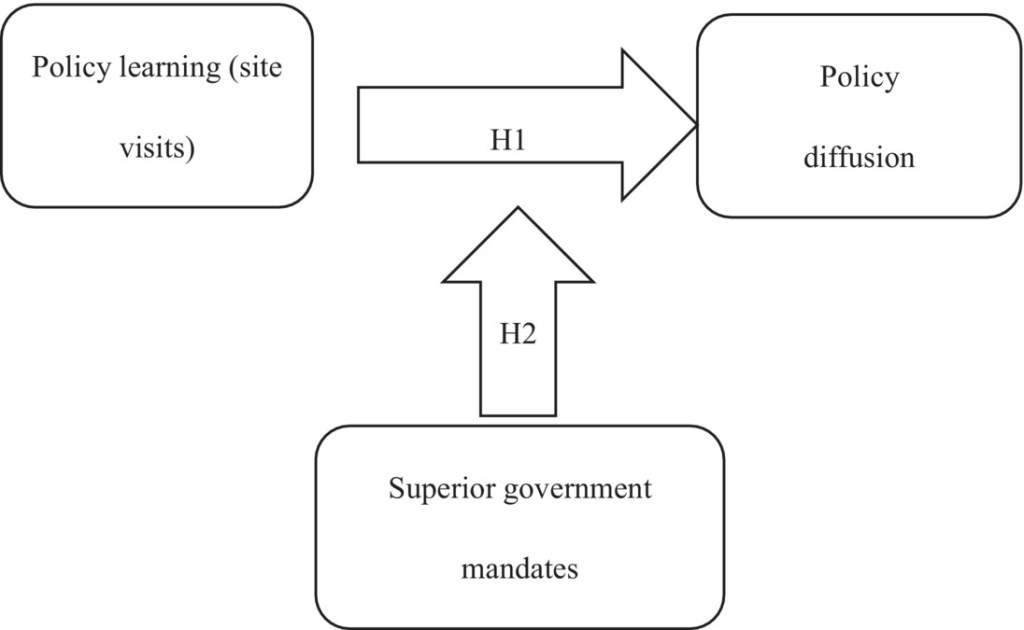
H1: When city i initiates policy learning from city j, policy innovation is more likely to diffuse from city j to city i.

We also examine the moderating effect of top-down mandates on . While governments learn from each other, they are also embedded in a multi-level regime, in which higher level authorities mandate or incentivize subordinate governments to adopt policies they favor. If the top-down signals are strong, peer-to-peer learning may be weakened.

H2: The adoption of the focal policy by the superior government will attenuate the impact of policy learning on policy diffusion across jurisdictions.

Image Description

Figure 1. The theoretical framework and hypothesis

To test these hypotheses, we collected data on the adoption of NEV policies in 282 cities between 2014 and 2018. The key independent variable captures interlocal learning between cities. To identify site visits, we searched for the keywords of “visits and learning” and “learning and exchange” on official websites and official papers in the cities. To examine the role of top-down mandates, we included a variable indicating whether NEV policies had been adopted by the superior government. Finally, we controlled for other horizontal diffusion mechanisms.

Using a directed EHA method based on a logit model, we find that the direct information exchange between local governments can significantly promote the diffusion of the NEVs’ local financial subsidy policies between cities. However, the purpose for the site visit has different implications on the diffusion of the policy. Empirical results indicate that compared with policy learning within public services, urbanization, government management, and cooperative projects, learning in the field of economic development, which is more related to the NEVs financial subsidy policy, can significantly promote the diffusion of policy innovation.

Consistent with H2, the results also show that policy behavior signals from a superior government can replace or decrease the impact of interlocal policy learning on policy diffusion. Lastly, the research shows that the level of authority of the government official who conducts the site visit plays a role in the adoption of the policy. That is to say, the more authority that the visiting government official has, the higher the chance of adoption of that policy in the other city. 

In summary, the findings indicate that policy learning plays a crucial role in policy diffusion, and governments can leverage site visits and other learning approaches to facilitate policy adoption. While conventional information channels help policymakers to learn about emerging policy innovations, face-to-face interactions may be more influential in policy diffusion. Particularly for leading government officials with scarce attention to specific policies, their dedicated site visits could boost policy learning and then policy diffusion and spread.

You can read the original article in Policy Studies Journal at

Liu, Weixing, Liang Ma, Xuan Wang and Hongtao Yi. 2025. “ Interlocal Learning Mechanisms and Policy Diffusion: The Case of New Energy Vehicles Finance in Chinese Cities.” Policy Studies Journal 53(1): 49–68. https://doi.org/10.1111/psj.12576.

About the Authors

Weixing Liu is an assistant professor at the School of Government, University of International Business and Economics. His research focuses on policy process, environmental policy, and networks.

Liang Ma is a professor at the School of Government at Peking University. His research interests include digital governance and performance management.

Xuan Wang is an assistant professor at the National School of Development at Peking University. His research interests include tax policy, China’s economy, and policy innovations.

Hongtao Yi is a professor at Askew School of Public Administration and Policy at Florida State University. His research interest focuses on network governance and environmental policy.

Advocacy Coalitions, Beliefs, and Learning: An Analysis of Stability, Change, and Reinforcement

by Christopher Weible, Kristin L. Oloffson, & Tanya Heikkila 

The Advocacy Coalition Framework (ACF) is one of the primary approaches for studying advocacy coalitions, belief systems, and policy learning. While hundreds of empirical studies have confirmed the framework’s major expectations, research is limited by a lack of longitudinal studies, comparisons between panel and non-panel data, and multiple measures of policy-oriented learning in the same study. To fill these gaps, we examine the characteristics of advocacy coalitions in the ever-evolving landscape of energy policy. Three questions guide the exploration: 

  1. What defines the characteristics of advocacy coalitions in the setting of shale oil and gas development, and to what extent do these coalitions exhibit stability over time? 
  2. To what degree do members within advocacy coalitions undergo changes in their beliefs, and how does this impact their sustained alignment within the same coalition? 
  3. What are the prevalent trends regarding advocacy coalition members self-reporting belief changes or expressing a willingness to shift their positions?

In 2013, 2015, and 2017, we conducted surveys of policy actors involved in shale oil and gas extraction in Colorado. The survey participants comprised individuals actively involved or knowledgeable about the pertinent policy issues, including industry stakeholders, government officials, non-profit and community group representatives, consultants, academics, and reporters. Respondents were identified through a purposive sampling approach, utilizing evidence from media reports, online sources, public hearings, testimonies, and recommendations. The survey included measures of policy core beliefs, such as positions on oil and gas development, problem perceptions, coordination, and interactions with other policy actors. 

To analyze the data, we used K-Means Clustering, a method that identifies distinct groups within a dataset. The K-Means Clustering method categorized respondents into two coalitions based on minimizing distances within each cluster.

As illustrated in Figure 2, while beliefs remained relatively constant, specific indicators signaled some movement, reflecting shifts in the policy subsystem’s circumstances. For instance, concerns over public nuisances rose during a period of increased drilling activity, only to subside when drilling declined due to falling oil prices. The coalitional characteristics remained relatively stable across the three time periods, confirming patterns typical for environmental policy issues.

Figure 2. Frequency of belief change for respondents by panels

This analytical approach provides valuable insights into the dynamics of advocacy coalitions, shedding light on their composition and stability over time in the context of shale oil and gas development policy. One key contribution lies in the identification and characterization of two distinct advocacy coalitions, namely the anti-oil and gas coalition primarily comprising environmental and citizen group representatives, and the pro-oil and gas coalition dominated by industry stakeholders. The stability of these coalitions over the five-year period underscores the enduring nature of these groupings. The research also delves into the nuanced realm of belief change and policy learning among coalition members. The findings provide crucial insights into the tendencies of coalition members to either reinforce their existing beliefs or undergo shifts in response to evolving circumstances, contributing to the broader discourse on policy learning. 

You can read the original article in Policy Studies Journal at

Weible, C. M., Olofsson, K. L. and Heikkila, T. 2023. “Advocacy coalitions, beliefs, and learning: An analysis of stability, change, and reinforcement.” Policy Studies Journal 51: 209–229. https://doi.org/10.1111/psj.12458

About the Authors

Chris Weible is a professor at the University of Colorado Denver School of Public Affairs. His research and teaching center on policy process theories and methods, democracy, and environmental policy. He is the Co-Founder and Co-Director of the Center for Policy and Democracy (CPD) and Co-Editor of Policy & Politics. He teaches courses in environmental politics, public policy and democracy, policy analysis, and research methods and design. Recent and current research includes studying policy conflicts in energy issues (e.g., siting energy infrastructure and oil and gas development), the role of emotions in public discourse, the institutional configurations of public policies, politics involving marginalized communities, and patterns and explanations of advocacy coalitions, learning, and policy change. He has published over a hundred articles and book chapters and has been awarded millions of dollars in external funding. His edited volumes include “Theories of the Policy Process,” “Methods of the Policy Process,” and “Policy Debates in Hydraulic Fracturing.” He regularly engages and enjoys collaborating with students and communities in research projects. Professor Weible earned his Ph.D. in Ecology from the University of California Davis and a Master of Public Administration and a Bachelor of Science in Mathematics and Statistics from the University of Washington. He has an Honorary Doctor of Philosophy and a Visiting Professor position at Luleå University of Technology (LTU), Sweden. Before coming to CU Denver, Professor Weible was an Assistant Professor at the Georgia Institute of Technology. He is a returned Peace Corps Volunteer.

Dr. Kristin L. Olofsson’s research focuses on public policy, institutional design, and stakeholder participation. She specializes in policy process scholarship through the lens of environmental and energy justice to focus on the dynamics of policy coalitions and networks of policy actors. Dr. Olofsson explores differentiation in institutional settings to better understand how the people involved in the policy process shape policy outcomes. Her research questions how decisions are made in contentious politics, using both quantitative and qualitative methods.

Professor Tanya Heikkila’s research and teaching focus on policy processes and environmental governance. She is particularly interested in how conflict and collaboration arise in policy processes, and what types of institutions support collaboration, learning, and conflict resolution. Some of her recent research has explored these issues in the context of interstate watersheds, large-scale ecosystem restoration programs, and unconventional oil and gas development. Prof. Heikkila has published numerous articles and books on these topics and has participated in several interdisciplinary research and education projects. She enjoys collaborating with faculty and students, especially through the Center for Policy and Democracy (CPD) at CU Denver, which she co-directs. She also serves as a member of the Delta Independent Science Board for the state of California. Prior to coming to CU Denver, Prof. Heikkila was a post-doctoral fellow at Indiana University’s Workshop in Political Theory and Policy Analysis and an Assistant Professor at Columbia University’s School of International and Public Affairs. A native of Oregon, she received her BA from the University of Oregon and then learned to appreciate desert life while completing her MPA and PhD at the University of Arizona.