

Despite many citizens in the United States first experiencing welfare policies during adolescence, we have yet to uncover the extent to which welfare participation during this period affects political participation in adulthood. While scholars have long studied the political consequences of adult program participation, we know relatively little about adolescent program participation. What are the political effects of adolescent participation in means-tested programs? This study provides evidence that ignoring early-life policy experiences can mask how people’s lived experiences with welfare policies influence political behaviors.
Hypotheses
The author tests the expectation that participating in welfare during adolescence sets individuals on a path toward nonparticipation in adulthood that is likely to persist over time.
Methodology
The author uses mixed methods, including longitudinal survey data and original qualitative interviews. Using the National Longitudinal Survey of Youth 1997 (NLSY97) with measures of adolescent program participation and voting in adulthood, the author estimates latent growth curve models that account for within- and between-person variation to overcome dependency between an individual’s response across survey rounds. The author then uses original qualitative data collected through interviews with young adults who were on welfare as adolescents. The interview transcripts are thematically coded using Atlas.ti and deductive and inductive approaches.
Key Findings
The Negative Relationship among Non-Hispanic White Individuals
Figure 1 shows how the probability of voting throughout early adulthood varies depending on an individual’s experience with welfare programs. The darkest line shows someone with no welfare experience, the middle tracks a person who used one program in adolescence and adds more in adulthood, and the lightest reflects someone with heavy adolescent program use who relies on fewer programs as an adult.
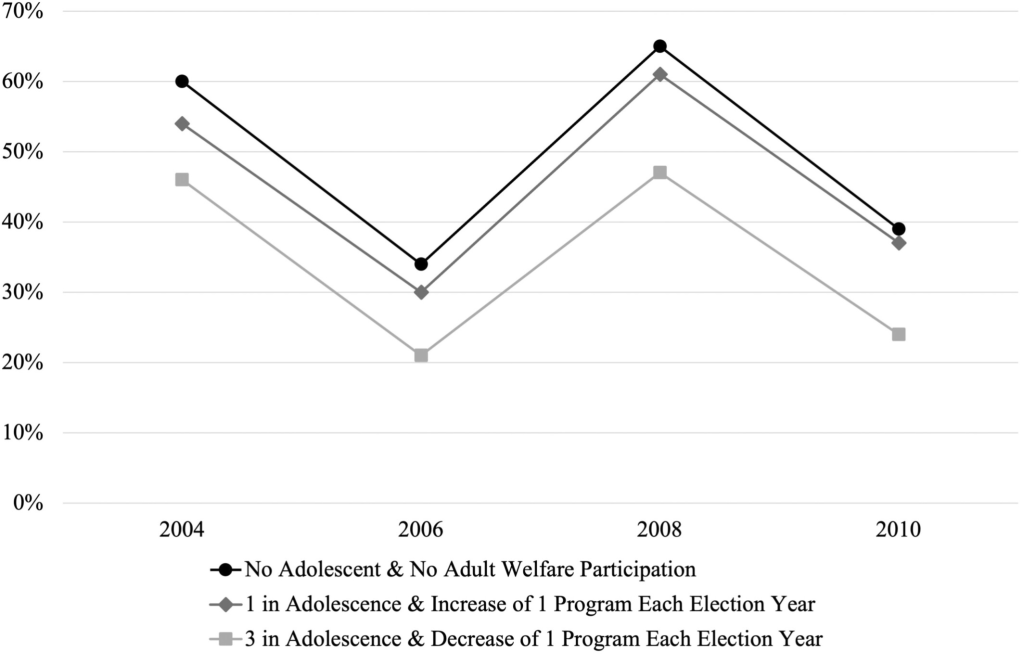
Figure 1. Turnout between 2004 and 2010 based on changes in welfare participation among non-Hispanic White individuals.
The markers for the 2004 election indicate each’s propensity to vote in their first election, and the results show that those with no adolescent welfare experience are the most likely to vote (~ 60% predicted probability), while those with the most extensive adolescent program experience are the least likely to vote (~ 46% predicted probability). Additionally, Figure 1 shows that, over time, those with moderate adolescent program experience recover and are about just as likely to vote by the 2010 election as someone never on welfare, while those with extensive adolescent program experience remain significantly less likely to vote even as they use fewer programs as an adult.
Evidence from Qualitative Interviews
The qualitative evidence provides richer insights into the quantitative findings, providing support for the identified negative relationship. Interviews with young adults who grew up on welfare reveal three recurring themes that help explain lower voting rates. First, many described stigma and embarrassment tied to public-facing programs like food stamps, often avoiding situations where their participation was visible. Second, participants reported a lack of pro-civic role models, as parents focused on survival rarely modeled voting or political engagement. Finally, expectancy–disconfirmation emerged when government aid failed to meet expectations, fostering distrust and feelings of being “trapped” in poverty. These findings suggest that such experiences often translated into negative views of politics and a sense that participation is futile, reinforcing patterns of civic disengagement into adulthood.
Why It Matters
This study shows that the political consequences of welfare use are not confined to adulthood—they take shape much earlier. By looking at individuals over time, the findings indicate that growing up in households using means-tested programs is linked to lower voting rates among non-Hispanic white youth, even after accounting for adult circumstances. Because voting habits tend to persist over time, these early experiences likely have enduring consequences for democratic participation. Overlooking adolescence means missing a key piece of how social policy shapes political voice.
Read the original article in Policy Studies Journal:
Micatka, Nathan K. 2025. “Learning to Avoid: The Long-term Effects of Adolescent Welfare Participation on Voting Habits in Adulthood.” Policy Studies Journal 53(4): 1065–1087. https://doi.org/10.1111/psj.70003.
About the Article’s Author

Nathan K. Micatka is an Assistant Professor of Political Science in the Department of Political Science and Criminal Justice at the University of South Alabama. His work centers on American political behavior, poverty, and public policy. His research is published in outlets such as Policy Studies Journal, Political Research Quarterly, Electoral Studies, PLOS One, and Social Science Quarterly. Nathan’s research has also been supported by a Doctoral Dissertation Research Improvement Grant from the American Political Science Association and the National Science Foundation. Visit his website to learn more: nathanmicatka.com.
 Policy Studies Journal Blog