
In Policy Paradox, Deborah Stone (1989) argues that the work of policy analysis is too often divorced from the politics of the democratic process. To truly understand policies and their effects, one must consider politics.
Yet, many areas of policy research remain siloed including from understanding the politics of the process. We believe there is much to be gained by bringing policy design and policy diffusion research into dialogue with one another with an eye toward the political motivations of policy designers. Indeed, it is likely that policy designers make purposeful choices to increase the chances lawmakers adopt their policy. In other words, the design of policy should have some bearing on policy adoption and diffusion.
In our article, we argue that a key policy attribute – complexity – is one missing link between policy design and policy diffusion. We present a theory for how each of the five elements of design – goals, tools, targets, causal models, and implementation – map onto the attribute of policy complexity. By making purposeful choices during the political process over framing goals, telling causal stories, identifying targets, and picking tools and implementation strategies, policy designers can affect the level of complexity of the policy. And a policy’s complexity shapes its diffusion breadth and speed.
We leveraged several data sources and methodological tools to provide a proof-of-concept test that these literatures belong in dialogue with one another. First, we hand coded policy design elements across 84 model policies promulgated by the Uniform Law Commission (ULC). The ULC is ideal because, as an interstate organization that writes model laws and disseminates the bills for passage in as many states possible, it is a clearly identifiable policy designer with the desire to seed policy adoption across the states. The ULC also provides policy texts, allowing us to measure complexity using automated text analysis tools. On the diffusion side, ULC provides detailed accounts of which states adopted each of their model policies and when.
Interestingly, we found substantial variation in how the ULC designed its model policies, with clusters of design elements identified. For example, some policies use direct provision tools and top-down implementation to advance the welfare goals of weakly constructed populations (e.g., Child Witness Testimony by Alternative Methods Act).
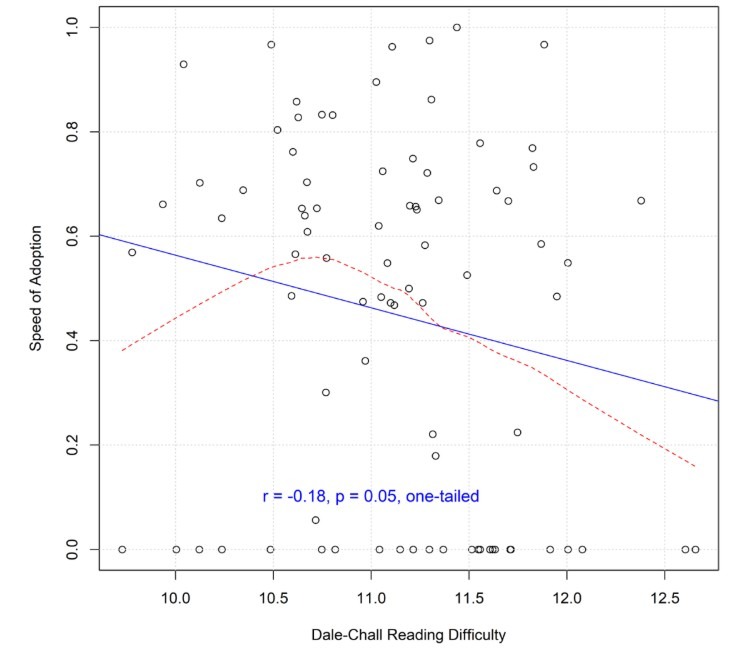
Figure 5. Dale-Chall Reading Difficulty for Diffusion Speed.
We posit that some design choices imbue the policy with more complexity than others, like using the direct provision of government services rather than tax expenditures. Indeed, we find that when you add up all these design choices, the policies that have more complex elements are indeed more textually complex. The level of complexity, in turn, affects the diffusion patterns we observe. More complex policies are less likely to be adopted and are slower to be adopted, though the strength of this relationship depends on the measure used.
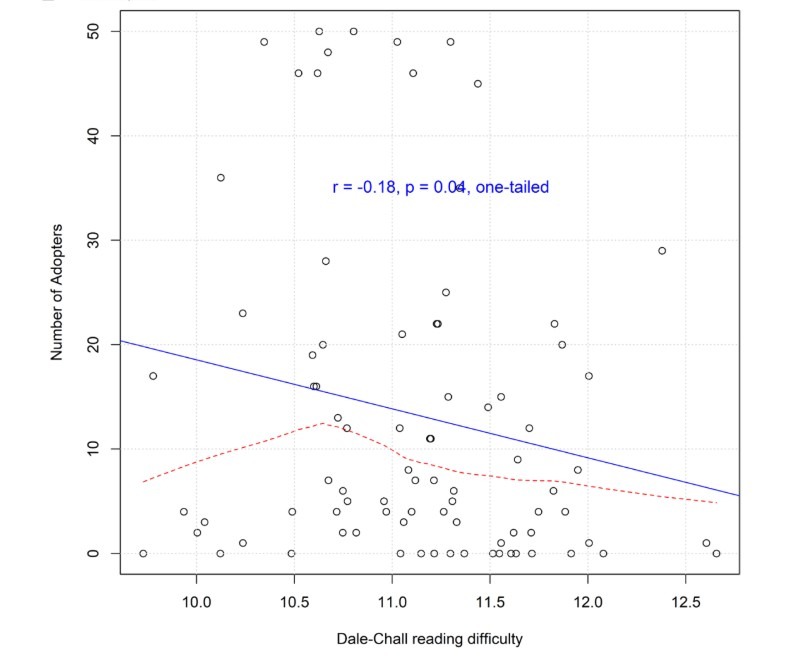
Figure 6. Dale-Chall Reading Difficulty for Number of Adopters.
We see this piece as the beginning of an effort to bring design and diffusion research together for the purpose of better understanding the policy process. We hope others will join in expanding this work to the full breadth of innovation diffusion attributes (relative advantage, compatability, complexity, trialability, and observability) and policy design elements.
Read the original article in Policy Studies Journal:
Jansa, J. M., & Mallinson, D. J. (2025). Linking policy design and policy diffusion to advance both theories: Evidence from the elements, attributes, and adoptions of Uniform Law Commission model legislation. Policy Studies Journal, 53(3), 747-773. https://doi.org/10.1111/psj.12591
About the Article’s Author(s)

Joshua M. Jansa is an Associate Professor of Political Science at Oklahoma State University. His research focuses on policy diffusion, state politics, political and economic inequality, and civic education.

Daniel J. Mallinson is an Associate Professor of Public Policy Administration at Penn State Harrisburg. His research focuses on policy process theory (principally policy diffusion and punctuated equilibrium theory), cannabis policy, and energy policy.
 Policy Studies Journal Blog