Why Did a Progressive Tax Reform Succeed in Mexico Under a Pro-Business Party?

by Oswaldo Mena Aguilar

In 2013, Mexico passed a sweeping tax reform that, surprisingly, included measures to increase taxes on the wealthiest individuals and corporations—despite being led by a party often aligned with elite economic interests. A decade earlier, under similar institutional conditions and with widespread support from the business sector, a far more modest reform effort had collapsed. What explains this contrast?

My article tackles this puzzle by comparing two major reform efforts: President Vicente Fox’s failed 2001 attempt and President Enrique Peña Nieto’s successful 2013 overhaul. Despite similar levels of party fragmentation and legislative constraints, the outcomes were drastically different—not only in terms of success, but also in ideological orientation.

To make sense of these differences, I assess two major policy process theories: the Advocacy Coalition Framework (ACF) and Kingdon’s Multiple Streams Framework (MSF). The ACF suggests that lasting policy change results from coalitions of actors united by deep normative commitments. Yet in Mexico, such ideological coherence was absent in 2013. Instead, I argue that policy entrepreneurs took advantage of fleeting political windows—exemplifying the kind of opportunistic “coupling of streams” Kingdon describes.

In 2001, Fox’s proposal to extend the Value Added Tax (VAT) to basic goods failed because the PRI—then the main opposition party—refused to pay the political cost, despite sharing the PAN’s economic preferences. And yet, the Income Tax portion of that bill passed unanimously, after PRD legislators accepted corporate-friendly provisions in exchange for key progressive concessions. This trade-off exemplified a strategic, if ideologically messy, compromise enabled by a temporary alignment of interests.

Fast forward to 2013, when PRI, back in power, launched a tax reform that defied expectations: it dropped controversial VAT expansions and instead raised income and capital taxes on top earners. The reform succeeded not due to ideological conviction, but because it was part of a broader legislative package negotiated under the “Pacto por México.” PRI’s flexibility—along with the PRD’s willingness to strike a deal—made it possible to capitalize on a narrow legislative opportunity.

This case shows that policy change—even in rigid institutional environments—does not always reflect stable coalitions or shared beliefs. Sometimes, it’s about seizing the moment.

You can read the original article in Policy Studies Journal at

Mena Aguilar, Oswaldo A. 2024. “ Advocacy Coalitions or Pragmatic Coupling of Streams? Explaining Policy Change in Mexico: The Tax Reforms of Vicente Fox and Enrique Peña (2001 and 2013).” Policy Studies Journal 00 (0): 1–27. https://doi.org/10.1111/psj.12537.

About the Author

Oswaldo A. Mena is a Ph.D. Candidate in Political Science at the Graduate Center of the City University of New York. His research focuses on comparative politics, political economy, and the political determinants of inequality, poverty, and redistributive politics and policies in Latin America. He is a Data Research Fellow at the Center for Latin American, Caribbean, and Latino Studies and was a 2024 Junior Scholar of the Stone Center on Socio-Economic Inequality. He previously worked in Mexico’s public sector for nearly a decade.

Bluesky: @omenaguilar.bsky.social
X: @omenaguilar
Google Scholar: Here
Orcid: Here

Advocacy Groups, Policy Subsidies, and Policy Change: The Case of Teacher Evaluations

by Leslie K. Finger

In many policy areas, powerful interest groups—such as labor unions or industry associations—shape and protect the status quo. When these vested interests have significant financial and political clout, how do policymakers manage to enact major reforms against their preferences? My paper examines this question through the lens of teacher evaluation policy in the U.S., revealing that advocacy groups play a crucial role in facilitating policy change by providing what I call policy subsidies: information, resources, and capacity that enable reform-minded policymakers to push past entrenched opposition.

My primary research question is: How are powerful interest groups with a stake in the status quo overcome? In the case of teacher evaluations, many states moved to incorporate student growth measures—often derived from standardized testing—as a sizable portion of their teacher evaluation systems despite fierce resistance from teachers’ unions. I investigate why some states were more successful than others in adopting and sustaining these reforms, focusing on the role of advocacy groups in supporting policy change.

Teachers’ unions have long been among the most influential state-level interest groups, using their financial resources and political leverage to shape education policy. Given their strength, it would be expected that states would avoid implementing teacher evaluations that include student achievement as a key factor. Yet, from 2009 to 2015, a growing number of states adopted such provisions. Why?

I argue that advocacy groups—such as education reform organizations—provided information (i.e., policy ideas, analysis, data) and capacity (i.e., time-consuming actions). I call these assets policy subsidies. By reducing the costs associated with enacting and implementing controversial reforms, policy subsidies can make it easier for policymakers to challenge vested interests and push through significant policy changes.

Image Description

To test this theory, I conducted a 50-state quantitative analysis of teacher evaluation policymaking between 2010 and 2011 and case studies of Minnesota and Wisconsin, two states that took different policy paths. The study tested two primary hypotheses:

Hypothesis 1: States where advocacy groups provide policy subsidies are more likely to implement policy change opposed by vested interests than those without such groups.

Hypothesis 2: States where those in power are open to change are more likely to implement significant policy change opposed by vested interests than those without such politicians in power.

Image Description

My quantitative analysis showed that states where advocacy groups were active were significantly more likely to pass teacher evaluation reforms (see Figure 1). The effect of advocacy groups was strongest in states where Republicans controlled the legislature. In these states, advocacy groups helped craft policies that successfully incorporated student achievement as a “significant” factor in teacher evaluations (see Table 5). My case studies of Minnesota and Wisconsin illustrate this dynamic in action. In Minnesota, advocacy groups worked closely with Republican lawmakers to provide both technical policy assistance and political support, leading to the adoption of evaluation reforms. In contrast, Wisconsin—despite similar political conditions where Republicans were in control—lacked strong advocacy group engagement, and teacher evaluation reform was delegated to the bureaucracy, where, in the absence of advocacy group involvement, the student achievement provision was compromised during implementation..

Image Description

This study demonstrates that interest group influence is not absolute; advocacy groups can play a decisive role in shifting policy outcomes by lowering the costs of reform, even where vested interests are strong. Additionally, having policymakers favorable to a particular policy is not enough to overcome vested interests— policymakers need interest group allies to help them craft and implement those policies that might otherwise be stopped in their tracks by powerful interest groups. The concept of policy subsidies extends beyond education, offering insights into how policy entrepreneurs in other domains—such as climate change, healthcare, or labor policy—can challenge entrenched interests.

You can read the original article in Policy Studies Journal at

Finger, Leslie K. 2024. “ Advocacy Groups, Policy Subsidies, and Policy Change: The Case of Teacher Evaluations.” Policy Studies Journal 52 (4): 777–808. https://doi.org/10.1111/psj.12538.

About the Author

Leslie K. Finger is an Assistant Professor of Political Science at the University of North Texas. Her research focuses on interest groups, policymaking, and state and local politics with a focus on education policy. Her work has appeared in various journals, including Perspectives on Politics, Governance, Policy Studies Journal, Interest Groups & Advocacy, American Politics Research, and State Politics & Policy.

Farmed Out: Agricultural Lobbying in a Polarized Congress  

by Clare Brock

Food and Agriculture policy has often been referred to as one of the last bastions of bipartisanship. Policymakers in the space claim that policymaking in this area has historically been special and uniquely cooperative. And yet, recent fights over the Farm Bill and other food and nutrition policy have made clear that food policymaking is no more exempt from bitter partisan battles than any other policy area.

Farmed Out: Agricultural Lobbying in a Polarized Congress considers the relationship between partisan polarization, lobbying, and policy dynamics. The evidence presented in the book shows that partisan polarization has a dual impact on lobbying in that space. On the one hand, partisan polarization has increasingly frustrated lobbyists who hope to see lawmakers move forward on policy change in a timely fashion; one lobbyist explained, “I find the issues that should have been a lighter lift have become a Herculean lift” (Brock 2023, 111). The consequence is that, as the legislative pace slows, lobbyists must persistently work on the same issues over a longer time horizon, exacerbating the already large advantage to business and well-organized and funded interests. This trend is particularly visible among business interests, whose behavior, characteristics, and resources we have a clearer picture of compared to other types of interest groups.

Figure 7.1. Relationship between lobbying reports and firm revenue, by year.

Figure 7.1 (Brock 2023, 113) illustrates the increasingly exaggerated relationship between lobbying reports and resources over time, particularly among business interests. It is clear that access to resource allows firms to engage in politics more aggressively than their less well-resourced counterparts.

Advocacy groups are adapting and finding new (and old) ways to overcome legislative sluggishness, however. Reliance on coalitions and cross-cutting partnerships, also known as “unlikely bedfellows” or “boot-leggers and Baptist” partnerships, are particularly desirable coalitional strategies as they provide “air cover” to politicians and create new pathways to cooperation in a Congress with increasingly slim majorities and challenging dynamics (Brock 2023, 126).

Farmed Out explores both the practical and normative consequences of partisan polarization on lobbying, and specifically, the consequences of these dynamics on policymaking in the food and agricultural subsystem. “Legislators spend more time fighting, flying home, and rallying their bases, and less time on policymaking. Congress has lost expertise and has outsourced brainpower to lobbyists. As lobbying increasingly becomes more skewed toward the ultra-wealthy interest groups and corporations, we risk moving the food system even further from the ideal points of the public” (Brock 2023, 140). In short, partisan polarization has consequences not only for our politics, but also for our diets.

You can find the full book at

Brock, Clare R., Farmed Out: Agricultural Lobbying in a Polarized Congress (New York, 2024; online edn, Oxford Academic, 23 Nov. 2023), https://doi.org/10.1093/oso/9780197683798.001.0001

About the Author

Clare Brock is an Assistant Professor of Political Science at Colorado State University. Her research interests include public policy process, interest groups and advocacy, food politics, and the impact of polarization on policymaking.


The Executive Lawmaking Agenda: Political Parties, Prime Ministers, and Policy Change in Australia

by Andrew Gibbons & Rhonda Evans

Governments can pursue their public policy objectives through various means. What do they seek to accomplish through the lawmaking process? The executive’s role in the legislative process varies widely across political systems. In Westminster systems, like Australia’s, institutional rules allow executives to dominate the legislative agenda, though governments do face constraints, such as the need to balance competing interests, contend with bureaucratic processes, and attend to unforeseen events. 

Drawing from the Comparative Agendas Project (CAP) and analyzing a data set of government bills in Australia, our research offers a new perspective on agenda-setting in Westminster systems, shedding light on the distinct agenda space we call the executive lawmaking agenda.

We addressed four research questions:

RQ1: What policy areas comprise the executive lawmaking agenda?

RQ2: How stable is the executive lawmaking agenda?

RQ3: Do the major political parties pursue different lawmaking agendas when in government? 

RQ4: Does a change in prime minister affect which issues receive executive lawmaking attention? 

Our study utilized an original dataset of 3,982 bills introduced into the Australian Federal Parliament between 2000 and 2017, focusing on government bills introduced by ministers. We coded each bill based on its policy content using the Australian Policy Agendas Codebook (APAP), measuring policy attention by counting the number of bills devoted to specific policy areas. We assessed agenda stability by using Sigelman and Buell’s measure of issue convergence, which calculates the degree of overlap in legislative attention distribution between different years. 

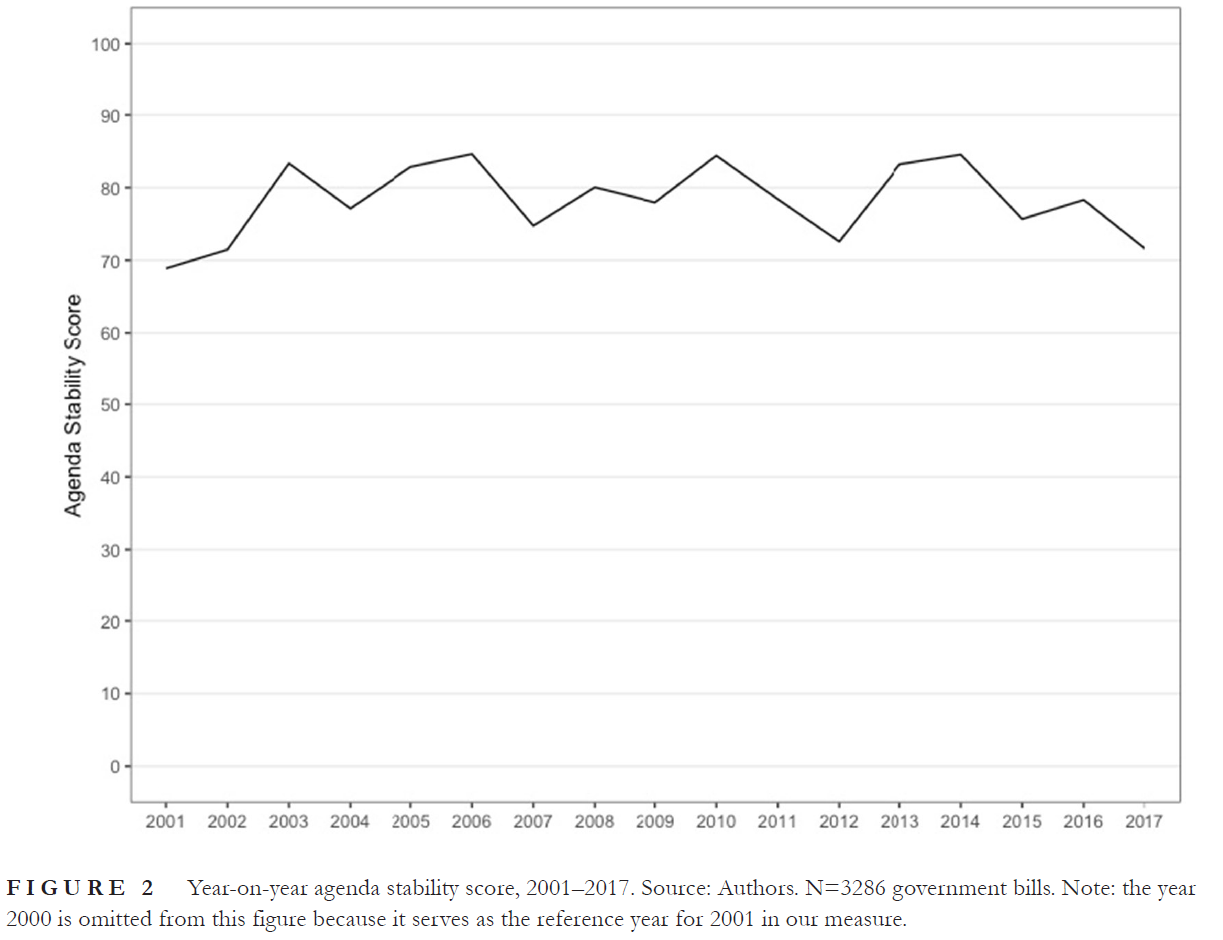
The results, illustrated in Figure 1, show that government operations and macroeconomics were the two largest policy areas on the executive lawmaking agenda, accounting for nearly 10% and over 8% of the agenda, respectively. Health, banking, and labor policy rounded out the top five policy areas, collectively making up over 40% of the entire executive lawmaking agenda. On the other hand, issues related to civil rights, minority concerns, civil liberties, housing, and community development, and cultural matters received limited attention. We also found a high degree of stability in the executive lawmaking agenda over time, with around 78% of the agenda overlapping from one year to the next.

Our analysis suggests that this stability persists even after power is shifted between political parties, as indicated in Figure 2. We also find that a change in prime minister is statistically related to a change in policy attention, but more work needs to be done to understand why. These findings seem to align with existing CAP research.

Further research needs to be done on executive policy agendas. Though we primarily looked at legislation, it is not the only kind of policy. Many executives have the ability to enact laws outside of the typical legislative process. Future research should focus on executive power in different stages of the policy process, non-legislative executive policy agendas, and examining alternative agenda spaces to deepen our understanding of executive lawmaking power.

You can read the original article in Policy Studies Journal at

Gibbons, A., and Evans, R.. 2023. “The executive lawmaking agenda: Political parties, prime ministers, and policy change in Australia”. Policy Studies Journal, 51, 307–325. https://doi.org/10.1111/psj.12503

About the Authors

Dr. Andrew Gibbons holds a PhD in political science from the University of Melbourne. His published research focuses on political communication and public policy, including policy responses to mis/disinformation, policy agendas, and the communication of policy ideas. 

Dr Rhonda Evans is an Associate Professor of Instruction in the Department of Government and Director of the Edward A. Clark Center for Australian and New Zealand Studies at the University of Texas at Austin. She holds a J.D. and a Ph.D. in Government and studies agenda-setting politics, focusing on the Australian Human Rights Commission and Federal Parliament of Australia, as well as judicial politics in Australia and New Zealand. She is co-author of Legislating Equality: The Politics of Antidiscrimination Policy In Europe with Oxford University Press. 
Find her on LinkedIn: https://www.linkedin.com/in/rhonda-evans-305aa4105/