Interlocal learning mechanisms and policy diffusion: The case of new energy vehicles in Chinese Cities

by Weixing Liu, Liang Ma, Xuan Wang, & Hongtao Yi

While policy diffusion based on learning mechanisms has received extensive scholarly interest, this literature has at least two limitations. First, policy learning is usually identified through indirect evidence, such as geographical proximity or successful policy innovations adopted in other jurisdictions. Second, measures of policy learning are used without considering how they interact with other factors. 

To address these limitations, our study measures policy learning through field learning conducted by local government officials, using the case of Chinese local financial subsidy policy for new energy vehicles (NEVs). Site visits from local government officials offer a direct mechanism of policy learning by enabling policymakers to exchange strategies and information with peers about the “know-how” of policy implementation. 

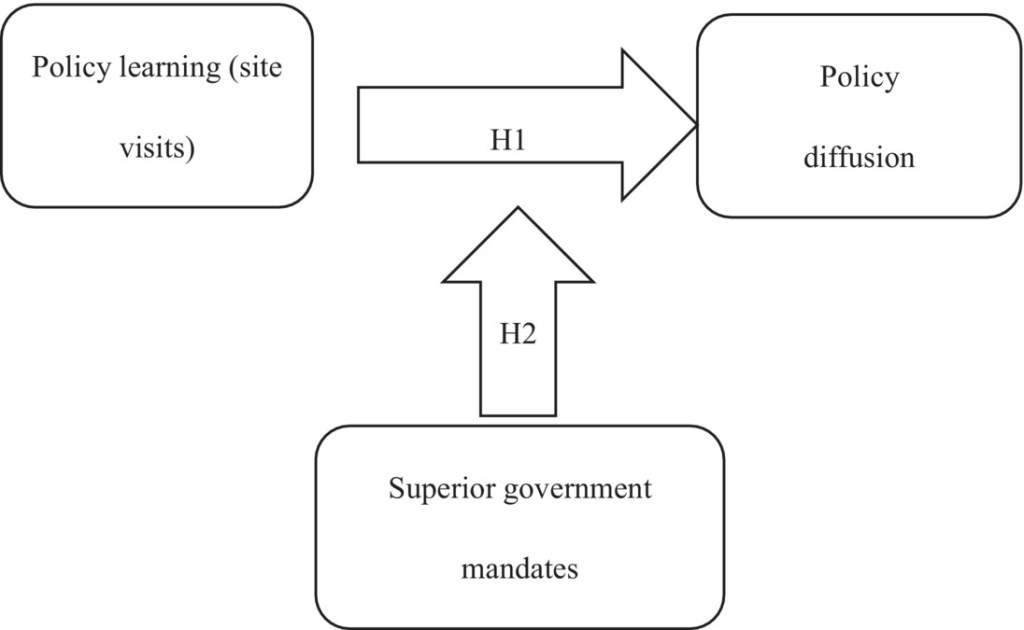
H1: When city i initiates policy learning from city j, policy innovation is more likely to diffuse from city j to city i.

We also examine the moderating effect of top-down mandates on . While governments learn from each other, they are also embedded in a multi-level regime, in which higher level authorities mandate or incentivize subordinate governments to adopt policies they favor. If the top-down signals are strong, peer-to-peer learning may be weakened.

H2: The adoption of the focal policy by the superior government will attenuate the impact of policy learning on policy diffusion across jurisdictions.

Image Description

Figure 1. The theoretical framework and hypothesis

To test these hypotheses, we collected data on the adoption of NEV policies in 282 cities between 2014 and 2018. The key independent variable captures interlocal learning between cities. To identify site visits, we searched for the keywords of “visits and learning” and “learning and exchange” on official websites and official papers in the cities. To examine the role of top-down mandates, we included a variable indicating whether NEV policies had been adopted by the superior government. Finally, we controlled for other horizontal diffusion mechanisms.

Using a directed EHA method based on a logit model, we find that the direct information exchange between local governments can significantly promote the diffusion of the NEVs’ local financial subsidy policies between cities. However, the purpose for the site visit has different implications on the diffusion of the policy. Empirical results indicate that compared with policy learning within public services, urbanization, government management, and cooperative projects, learning in the field of economic development, which is more related to the NEVs financial subsidy policy, can significantly promote the diffusion of policy innovation.

Consistent with H2, the results also show that policy behavior signals from a superior government can replace or decrease the impact of interlocal policy learning on policy diffusion. Lastly, the research shows that the level of authority of the government official who conducts the site visit plays a role in the adoption of the policy. That is to say, the more authority that the visiting government official has, the higher the chance of adoption of that policy in the other city. 

In summary, the findings indicate that policy learning plays a crucial role in policy diffusion, and governments can leverage site visits and other learning approaches to facilitate policy adoption. While conventional information channels help policymakers to learn about emerging policy innovations, face-to-face interactions may be more influential in policy diffusion. Particularly for leading government officials with scarce attention to specific policies, their dedicated site visits could boost policy learning and then policy diffusion and spread.

You can read the original article in Policy Studies Journal at

Liu, Weixing, Liang Ma, Xuan Wang and Hongtao Yi. 2025. “ Interlocal Learning Mechanisms and Policy Diffusion: The Case of New Energy Vehicles Finance in Chinese Cities.” Policy Studies Journal 53(1): 49–68. https://doi.org/10.1111/psj.12576.

About the Authors

Weixing Liu is an assistant professor at the School of Government, University of International Business and Economics. His research focuses on policy process, environmental policy, and networks.

Liang Ma is a professor at the School of Government at Peking University. His research interests include digital governance and performance management.

Xuan Wang is an assistant professor at the National School of Development at Peking University. His research interests include tax policy, China’s economy, and policy innovations.

Hongtao Yi is a professor at Askew School of Public Administration and Policy at Florida State University. His research interest focuses on network governance and environmental policy.

How do public policies diffuse, and how can diffusion processes be actively governed without direct coercion?

by Kai Schulze

Diffusion has emerged as an important concept for studying how public policies spread across jurisdictions. Scholars have identified several mechanisms that drive policy diffusion, including learning, competition, emulation, and coercion. At the same time, policy diffusion is also a popular governance approach, particularly for higher levels of government that want to promote certain policies at lower levels, but do not want to or cannot mandate policy action. However, the governance potential of policy diffusion is poorly captured by the prevailing mechanism-centered concept, which is difficult to measure and typically emphasizes direct coercion or “hard” interventions, such as preemptive legislation or conditional funding. It therefore risks overlooking important less coercive or “soft” interventions that higher levels of government can use to promote policy development at lower levels. 

This neglect of soft interventions limits the analytical value of the diffusion concept, especially in multilevel environments with varying levels of authority and in policy areas where direct coercion is unavailable or undesirable, including in climate policy. For example, in many countries, higher levels of government lack the constitutional authority to mandate local climate action, or local authorities lack the capacity to comply with such mandates, so they resort to various interventions that are scattered throughout the literature but have not yet been compared more systematically.

To address these issues, I present a new channel-centered framework that distinguishes between six soft policy diffusion channels that can be broadly placed on a continuum of coerciveness or state intervention: autonomous, collaborative, exemplary, persuasive, organized, and funded diffusion (see Table 1). Autonomous diffusion refers to voluntary and noninstitutionalized exchanges between jurisdictions at the same level of government, collaborative diffusion to the bottom-up creation of formal networks, exemplary diffusion to policy development by higher-level governments to set an example, persuasive diffusion to the provision of informational resources, organized diffusion to networks created by higher-level governments, and funded diffusion to financial incentives and the provision of additional resources.    

Image Description

I probe the framework by studying local climate change adaptation policy using original survey data collected from the administrations of 190 municipalities located in the central German state of Hessen. The regression results indicate that the local institutionalization of adaptation in Hessen such as the development of adaptation plans and new staff dealing with adaptation is associated with several interventions by higher levels of government, including the provision of a policy model, a municipal climate network, and grant programs. However, the density of concrete adaptation measures–such as the creation of open-air corridors, education programs, drainage and retention areas, and surface unsealing–is associated with noninstitutionalized exchanges between municipalities. These results demonstrate the usefulness of the framework for distinguishing and comparing different diffusion channels and thus for understanding policy diffusion as a governance approach. In particular, the results suggest that different types of interventions may be needed to support adaptation policy development at the local level. This is important information for the efficient allocation of scarce (local) resources and for policymakers seeking to capitalize on policy diffusion.

You can read the original article in Policy Studies Journal at

Schulze, Kai. 2024. “ The Soft Channels of Policy Diffusion: Insights From Local Climate Change Adaptation Policy.” Policy Studies Journal 52(4): 881–906. https://doi.org/10.1111/psj.12555.

About the Author

Kai Schulze is an Adjunct Professor with the Institute of Political Science at the Technical University of Darmstadt, Germany leading the Junior Research Group on Integrated Systems Analysis. His research focuses on comparative public policy and politics, particularly in the fields of energy, climate, and environment. His work has appeared in journals such as Climate Policy, European Journal of Political Research, Global Environmental Politics, Regional Environmental Change, Regulation & Governance, Review of Policy Research, WIREs Climate Change.

Athletic Competition Between the States: The Rapid Spread of Name, Image, Likeness Laws and Why it Matters for Understanding Policy Diffusion

by Roshaun Colvin & Joshua M. Jansa

Name, Image, and Likeness (NIL) policies have rapidly spread across the United States and are dramatically changing the landscape of college sports. NIL enables student-athletes to earn compensation and secure offers and sponsorships while pursuing their education. State lawmakers hope NIL policies will attract premiere student athletes and make their states’ university athletic programs successful (see Figure 1 below). 

The spread of NIL policies allows us to examine mechanisms at work in the policy diffusion process and to consider a new dimension of competition between states related to protecting or enhancing states’ reputations rather than directly accruing economic resources. To improve theory and measurement of competition as a policy diffusion mechanism, we ask: how does national athletic competition influence a state’s decision to adopt NIL policies?

To answer this, we observed the adoption of NIL across all 50 states within 39 months. This data can be used to model the diffusion of NIL through directed dyad event history analysis, a common method in policy diffusion research that allows for the study of how interstate dynamics and internal determinants influence policy adoption. 

A map of the united states

Description automatically generated

We consider that states may engage in different forms of competition. States engage in offensive competition by setting policies with the aim of maintaining their reputations to gain an advantage over other states. In order to measure the internal determinants of a state’s athletic reputation, and therefore its susceptibility to engage in offensive competition, we use the number, value, and success of the state’s Division 1 Football Bowl Subdivision (FBS) programs. States may also engage in defensive competition, adopting policies to keep up with other states by reacting to what rival states are doing to build their reputations. We measure the interstate dynamics driving athletics competition, and therefore the likelihood of defensive competitive behavior using measures of sport-, conference-, and league-wide competition.

The results indicate that athletic competition best explains a state’s decision to adopt NIL. Particularly, states appear more likely to adopt NIL based on their national competitors’ actions and to preserve their status as premiere football programs. However, there is not compelling evidence that conference competition is a motivating force driving NIL adoptions. Rather, it appears that the states with the highest reputed football programs responded to national competition rather than competition within their conference. Other interstate dynamics, such as geographic contiguity or having the same party in power, do not appear to consistently spur the spread of NIL throughout states, suggesting NIL may be a policy in which a new dimension of competition better explains its diffusion than previous tendencies for states to consistently mimic other states.

The spread of NIL provides an excellent opportunity to understand diffusion mechanisms, specifically the limits of the competition mechanism. Furthermore, it provides the opportunity to generate new ways to operationalize competition for empirical analysis. In the case of NIL policy, states adjusted their status as major destinations for college athletes by hurrying to adopt NIL policy prior to other states adopting NIL policy.

You can read the original article in Policy Studies Journal at

Colvin, Roshaun and Joshua M. Jansa. 2024. “Athletic Competition Between the States: The Rapid Spread of Name, Image, Likeness Laws and Why It Matters For Understanding Policy Diffusion.” Policy Studies Journal 52 (2): 451–468. https://doi.org/10.1111/psj.12522.

About the Authors

Roshaun Colvin is a graduate student at University of Florida and received his Master’s in Political Science at Oklahoma State University.

Joshua M. Jansa is an Associate Professor of Political Science at Oklahoma State University. His research focuses on policy diffusion, state politics, political and economic inequality, and civic education.