
by E.J. Fagan
The classic authoritarian promise is to impose order on a disorderly society. Benito promised to make the trains run on time. Donald Trump promised that he alone could save the country. The Chinese Communist Party promises record economic growth. All authoritarians ask that, in return, societies give up their political freedoms. If they can just push through all the noise and enact their vision for public policy without friction, they will make your life better. It is a tempting bargain for many people.
However, these promises are false. The political institutions of liberal democracies–such as free speech, rule of law, a vibrant political society, and an egalitarian democratic system–also make it better off. Liberal democracies are not only freer societies, but also have higher economic growth and human development indices.
In “Political institutions, punctuated equilibrium theory and policy disasters,” I add to that literature, using punctuated equilibrium theory (PET) to examine why some countries experience more of the most extreme policy failures than others. Briefly, PET posits that governments show a pattern of policy change where very little happens for a long period of time followed by short periods of explosive change. Governments that ignore problems for longer tend to have more pronounced policy punctuations to make up for lost time, while governments that address problems sooner tend to enact smaller changes. Authoritarian countries tend to have an even more punctuated pattern of change: they ignore problems for longer, then pass very large changes when they finally get around to doing something about it.
I study two very different types of policy disasters in this article. First, I use data on financial crises, such as sovereign debt defaults, hyperinflation, and major bank failures. Second, I use data on high-casualty natural and technological disasters. Each dataset contains observations beginning in the 1960s.
Figure 1 shows the relative frequency of both types of disaster in governing systems, compared to liberal democracies. Notably, authoritarian countries experience nearly twice as many financial crises. Closed autocracies, such as China or North Korea, experience more natural and technological disasters, but the result is not statistically significant. Electoral autocracy, which hold non-competitive single-party elections, are even worse.
Electoral democracies, which hold competitive elections but lack the free speech, press, civil society, and rule of law of liberal democracies, perform just as poorly, or even worse, as authoritarian systems. This result suggests that democracy needs these liberal institutions to function. Without them, countries like Turkey and Nigeria struggle to detect and solve problems before they become disasters.
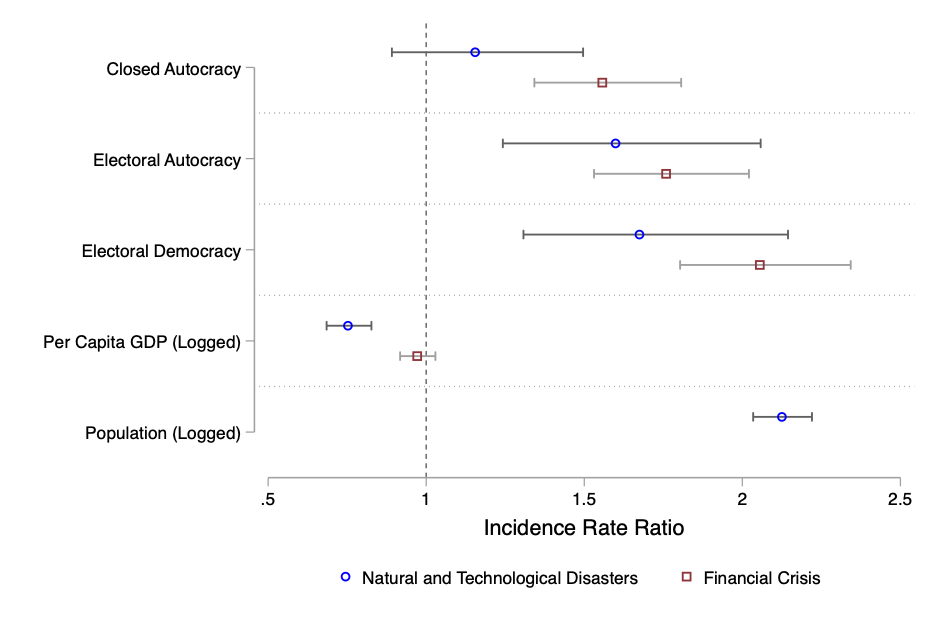
Figure 1: Regime Types and the Frequency of Policy Disasters
Figure 2 examines the relationship between policy disasters and political institutions. The results suggest that countries with political institutions that are more inclusive and allow for free society have fewer policy disasters. Further, countries with more streamlined institutions, such as unitary systems and parliamentary systems, are better at solving problems before they become disasters.
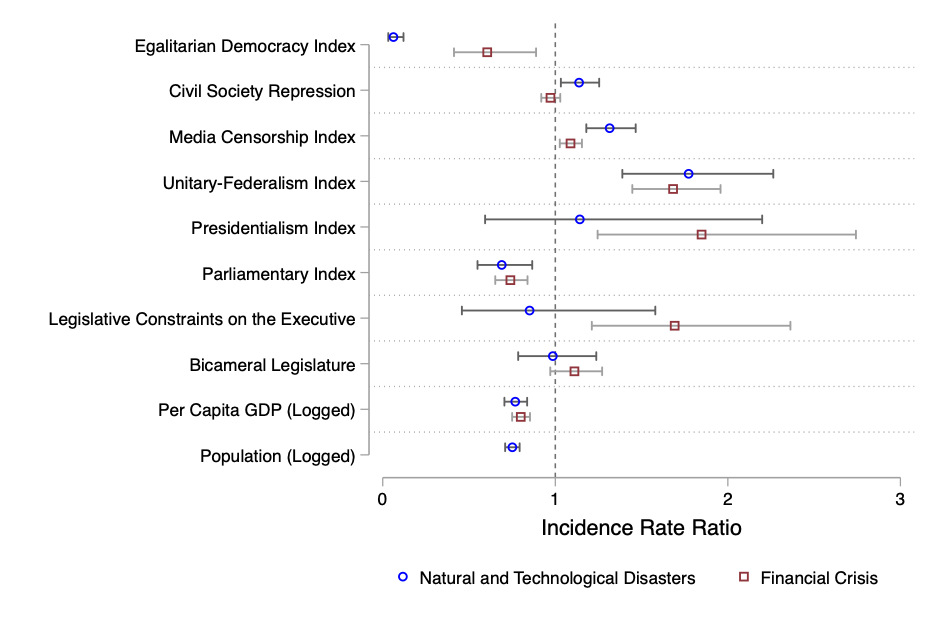
Figure 2: Policy Disasters and Political Institutions
In conclusion, authoritarians make far more mistakes than their liberal democratic counterparts. Nobel Prize-winning economist Amartya Sen once observed that every famine in world history occurred under an authoritarian government. These results suggest that authoritarian mistakes are broader than just famines; detecting problems before they become severe is authoritarianism’s biggest weakness.
At the same time, these results are a warning for backsliding democracies. Some leaders may want to maintain some semblance of a democracy, but eliminate the annoying problems created by a free press, independent judiciary or empowered civil society. But, democracy can’t function without these institutions. Without them, leaders in weak democracies are flying blind.
You can read the original article in Policy Studies Journal at
Fagan, E. J.(2023). Political institutions, punctuated equilibrium theory, and policy disasters. Policy Studies Journal, 51: 243–263. https://doi.org/10.1111/psj.12460
About the Author

E.J. Fagan is an Assistant Professor of Political Science at the University of Illinois Chicago. He studies agenda setting, think tanks, political parties and policymaking in the U.S. Congress.
 Policy Studies Journal Blog