Are bureaucrats’ interactions with politicians linked to the bureaucrats’ policy entrepreneurship tendencies?

by Mariana Costa Silveira, Nissim Cohen, & Gabriela Lotta

Policy entrepreneurs – individuals who seek to shape policy outcomes that they could not otherwise achieve on their own – play a crucial role in the policymaking process. Typical examples of policy entrepreneurs include lobbyists, consultants, and even politicians. Bureaucrats, too, can also be policy entrepreneurs.

Our paper looks at the relationship between bureaucrats’ interactions with other policy actors – specifically politicians, peers, and non-state actors – and how confident the bureaucrats feel about engaging in policy entrepreneurship activities. At a broad level, we know that these interactions impact whether bureaucrats act as policy entrepreneurs, but we don’t have studies that have looked at how these interactions might be related to bureaucrats’ perceptions of their own policy entrepreneurship skills. We also assess how the reputation of a bureaucrat’s organization impacts their self-efficacy. The below research model outlines our hypotheses.

Image Description

Figure 1. Research model.

To test our hypotheses, we used a survey of 2,000 bureaucrats in Brazil taken between October and December 2017 by the country’s National School of Public Administration, of whom approximately 30% completed the survey. The survey asked respondents about their levels of confidence performing different sorts of tasks, their frequency of interactions with actors from different groups (e.g., politicians, private companies, unions, etc.), and their motivations for doing their jobs.

In the course of analyzing the data, we found that the bureaucrats surveyed sorted into three profiles, based on their levels of interactions as well as with whom they interacted: brokers, who have high levels of interactions inside and outside of their organization with both state and non-state actors; insiders, who have high levels of interactions mainly inside their organization, with other state actors; and loners, who have low levels of interactions across all actor types. 

We found that bureaucrats who interacted more regularly with peers and politicians displayed more confidence about their ability to engage in policy entrepreneurship. As far as non-state actors were concerned, we found positive – and statistically significant – relationships as regards interactions with the press and unions, but not statistically significant relationships with other non-state actors, such as private companies. Lastly, bureaucrats’ self-efficacy was also positively correlated with the reputation of their organization. We observed some variation across the three bureaucrat profiles: interactions with politicians were most strongly associated with feelings of self-efficacy among brokers than either insiders or loners. Regarding bureaucrats’ motivations to engage in policy entrepreneurship, we found that both the desire to advance the public good and their own careers were associated with greater policy entrepreneurship self-efficacy. This suggests that public- and self-interest motivations aren’t mutually exclusive, and that both can drive policy entrepreneurship. 

We want to caution that, when it comes to bureaucratic self-efficacy about policy entrepreneurship, we have identified correlations rather than causations. The dataset used for this study does not allow us to conclude whether, for example, frequent interactions with politicians makes bureaucrats more confident about engaging in policy entrepreneurship, or whether those bureaucrats already confident in their abilities as policy entrepreneurs are more likely to seek out interactions with politicians. 

Nevertheless, in identifying these correlations, we draw attention to those factors that likely impact whether – and to what extent – bureaucrats engage in policy entrepreneurship. Our findings suggest that expanding opportunities for bureaucrats to grow their networks and interact with different types of actors – such as politicians and those outside of the government – is important for cultivating policy entrepreneurship among bureaucrats. Ultimately, more research will need to be done to identify the precise causal mechanisms at play. Moreover, our study looked only at bureaucrats in Brazil, so additional case studies will confirm the extent to which our findings are generalizable. 

You can read the original article in Policy Studies Journal at

Silveira, Mariana Costa, Nissim Cohen and Gabriela Lotta. 2024. “ Are Bureaucrats’ Interactions With Politicians Linked to the Bureaucrats’ Policy Entrepreneurship Tendencies?.” Policy Studies Journal 52 (3): 533–559. https://doi.org/10.1111/psj.12536.

About the Authors

Mariana Costa Silveira is a postdoctoral research fellow at the Swiss Graduate School of Public Administration (IDHEAP) at Lausanne University. Her research interests include behavioral public administration, organizational behavior, policy entrepreneurship, and collaborative governance.

Nissim (Nessi) Cohen is a professor of Public Administration and Policy at the University of Haifa. His research interests include interactions between politicians and bureaucrats, public administration reform, street level bureaucracy and policy entrepreneurship.
Gabriela Lotta is an Associate Professor of Public Administration at Fundação Getulio Vargas’s Sao Paulo School of Business Administration. Her current research interests include policy implementation, street-level bureaucracy and bureaucratic politics.


Not Just the Nation’s Hostess: First Ladies as Policy Actors

by Mary R. Anderson & Jonathan Lewallen

Popular culture likes to view the First Lady as a symbol of American womanhood, the nation’s hostess, fashion icon, and mom-in-chief. Yet, modern First Ladies often develop their own policy priorities and programs, and the Office of the First Lady is integral to modern presidential administrations. In this article we make the case for studying First Ladies as policy actors by examining the audiences to which First Ladies speak, the roles they adopt in doing so, including an explicit policy role, and the degree of substantive policy content in their public speeches and remarks. 

We use archived First Lady public speeches and remarks from 1993-2022 covering First Ladies Clinton, Laura Bush, Obama, Trump, and Biden to illustrate that First Ladies actively adopt policy roles across their speeches and other appearances; speak to policy-focused audiences like policy summits, interest groups, and government personnel and often discuss substantive policy issues in these appearances.

First Ladies adopt roles beyond the ceremonial role established by Martha Washington. She also plays the roles of policy advocate and party supporter and leader.  We depart from other scholars in our view that these roles are not “either-or” but rather “both-and,” the First Lady can be both engaging in a ceremonial role AND a policy role. For example, when the First Lady gives a commencement speech, she is acting in a ceremonial role. She may also discuss policy in that speech, in which case she is acting in a policy role, thus she is assuming both roles simultaneously, ceremonial and policy. Our analysis of First Lady roles demonstrates that the combination of Policy + Ceremonial roles is the most common configuration in our data. While First Ladies adopt the Ceremonial role more often than the others, the Policy role is a large part of the First Lady’s activities, about 72% of the data involve a Policy role in some way. 

Image Description

We argue that First Ladies are significant policy actors and that they discuss policy when they are addressing various audiences. Our data supports this characterization because we see First Ladies often addressing policy relevant audiences in their activities. Our analysis shows that First Ladies talk to three “clusters” of groups.  Excluding the broad “other” category, First Ladies have spoken most often to national interest groups (14.4%) and at policy events (14%).

Image Description

Figure 1: Percentage of First Lady Speeches and Remarks Delivered to Different Audiences

Finally, we find that First Ladies address substantive policy content frequently. We find that First Ladies address substantive policy content in about 63% of their speeches; when we dive more deeply into those observations where the First Lady adopted a Policy role, they addressed substantive policy issues about 90% of the time.  The presence of substantive policy content varies across First Ladies’ audiences as shown in the figure below.  First Ladies since 1993 mentioned some substantive policy issue in about 91% of their remarks to party supporters and 90% to policy events. 

Image Description

Figure 2: Speeches and Remarks with Substantive Policy Mentions by Audience

In this article, we challenge the traditional view of the First Lady as a largely ceremonial public figure and behind-the-scenes presidential advisor. Using her public speeches and remarks over a 30-year period we find that First Ladies consistently discuss policy issues across their different audiences and adopt the Policy role in more than three-quarters of their speeches in statements. Over time the role of the First Lady has evolved, their unique position permits them to play a role in policy that might not be obvious at first glance. They are particularly well-situated and well-resourced to engage in the policy process as executive branch actors and thus should be studied more often for their engagement in policymaking. 

You can read the original article in Policy Studies Journal at

Anderson, Mary and Jonathan Lewallen. 2024. “ Not Just the Nation’s Hostess: First Ladies As Policy Actors.” Policy Studies Journal 00(0): 1–19. https://doi.org/10.1111/psj.12558.

About the Authors

Mary Anderson is the brodsky chair for Constitutional Democracy and Culture and professor of Political Science at Salve Regina University in Newport, RI. She studies women and politics and civic participation.


Jonathan Lewallen is an associate professor of political science at the University of Tampa. His research focuses on agenda setting and the policy process and how issues and institutions evolve together over time. Dr. Lewallen’s book Committees and the Decline of Lawmaking in Congress was published in 2020 by the University of Michigan Press.

Narratives and Expert Information in Agenda-Setting: Experimental Evidence on State Legislator Engagement with Artificial Intelligence Policy

by Daniel S. Schiff & Kaylyn Jackson Schiff

Previous scholarship has investigated how policy entrepreneurs use narratives and expert information to influence policy agendas. In particular, narratives can be powerful tools for communicating policy problems and solutions, while expert information can help clarify complicated subject matters and increase confidence in policy proposals. This raises a question: can policy entrepreneurs effectively use narratives to influence policymakers even in complex, technical policy domains where we might think the technical details might be traditionally most important?

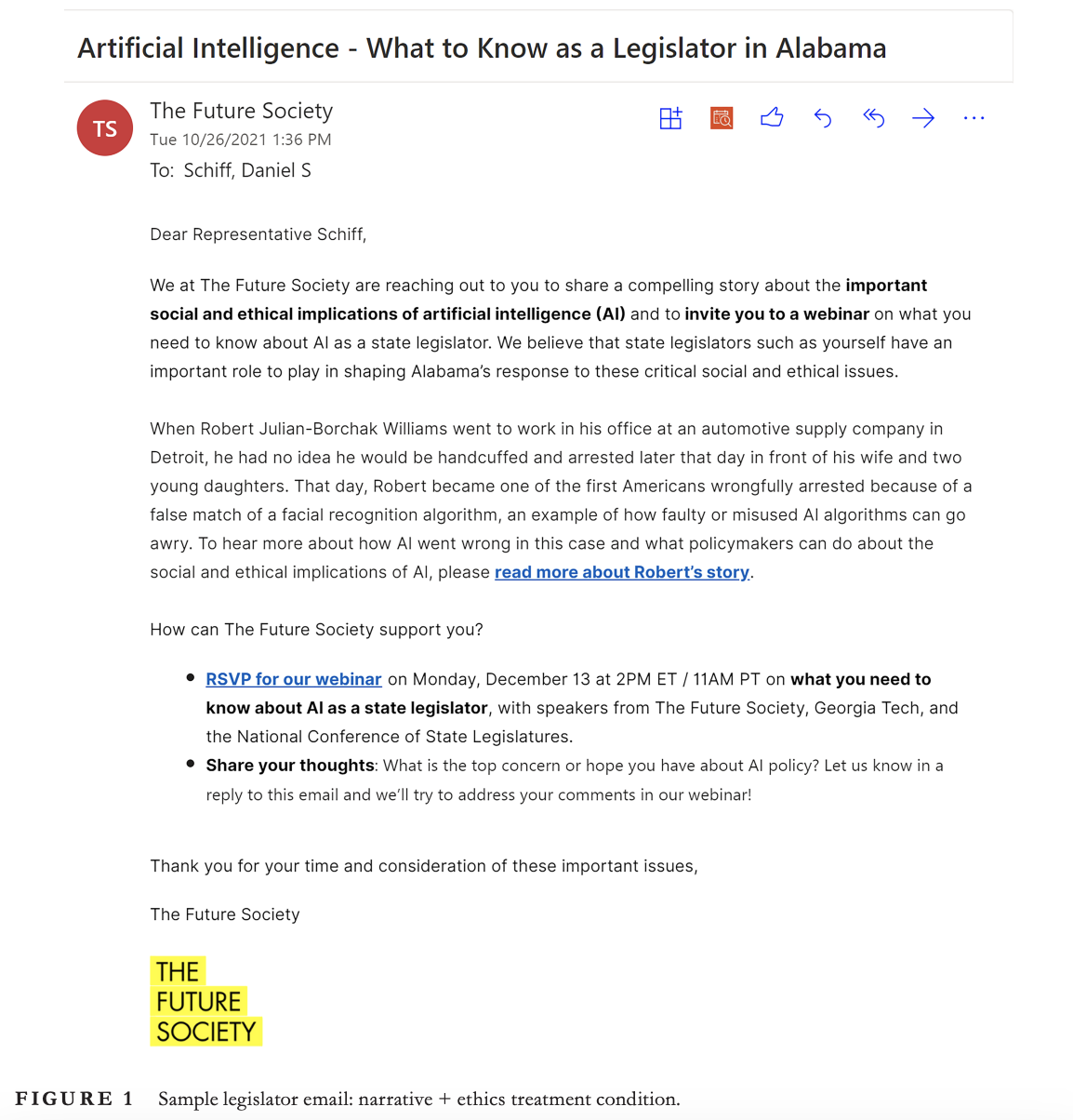
We explore this question in the context of artificial intelligence (AI) policy – an emerging policy domain that is highly technical and multi-faceted, with social, ethical, economic implications. Because the agenda for AI policy is still in the process of development, it presents a ripe case for understanding agenda setting and policy influence efforts. In partnership with a leading AI think tank, The Future Society (TFS), we conducted a field experiment on state legislators across the United States. Emails about AI policy were sent to 7,355 legislative offices. Legislators were randomly assigned to receive an email containing either a narrative strategy, an expertise strategy, or generic, neutral information. We also considered two ways of issue framing: ethical and economic/competition (see Figure 1). 

Legislators were presented with either a fact sheet or story, and invited to register for and attend a webinar about AI for state legislators, which we hosted in December 2021. For example, legislators (or their staffers) might read an email message about an individual falsely arrested due to facial recognition, or between a geopolitical contest between the US and China.

We measured link clicks and webinar registration and attendance as proxies for policymaker engagement. Using these data on engagement with the emails, we tested the following hypotheses:

  • Policy Entrepreneur Effectiveness Hypothesis: The provision of narratives or expertise by policy entrepreneurs will increase policymaker attention to and engagement with the policy issue at hand.
  • Dominance of Narratives Hypothesis: The provision of narratives will induce greater policymaker engagement than the provision of expertise.
  • Dominance of Expertise Hypothesis: The provision of expertise will induce greater policymaker engagement than the provision of narratives.
  • Strategies by Issue Framing Hypothesis: Policymakers will respond with greater engagement to narratives when they are provided issue frames emphasizing the ethical and social dimensions of AI as compared to issue frames emphasizing the economic and technological competitiveness dimensions of AI.
  • Prior Experience Hypothesis: Compared to legislators in states with greater prior experience in AI policymaking, legislators in states with less experience with AI will respond with greater engagement to the expertise treatment.

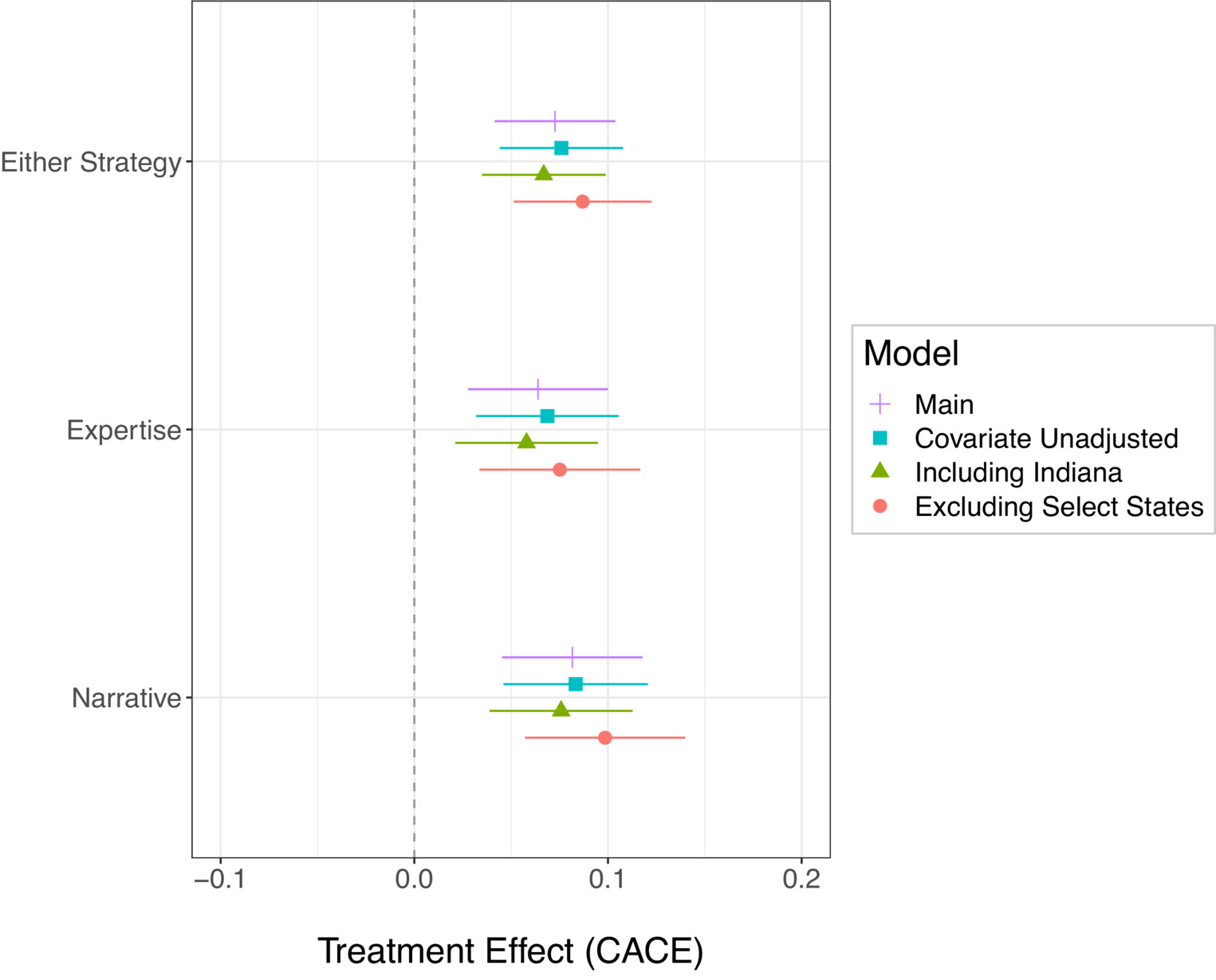
Consistent with the Policy Entrepreneur Effectiveness Hypothesis, we found that narrative strategies and expert information increased engagement with the emails (see Figure 3). Interestingly, comparing the narrative and expertise treatments, we found no statistically significant differences in their effects on engagement, suggesting that narratives are as effective as expert information even for this complex policy domain. 

Figure 3. Both expert information and narratives engaged state legislators as compared to a more generic ‘control’ message, with increased engagement of 30 or more percentage points.

Contrary to our expectations, framing the issue to emphasize ethical or economic dimensions of AI also did not affect engagement, suggesting that the use of strategies like narratives can be effective even when AI policy is framed in very different ways. We had hypothesized that narratives might be especially effective when an ethics-focused policy frame of AI is promoted, but it appears narratives are just as effective when geopolitical and strategic dimensions of AI policy are emphasized. 

Finally, legislators with no prior experience with AI policy were more likely to engage with the emails than legislators who had considered or passed AI policy in the past, and state legislatures with higher capacity (e.g., more staff, longer sessions) were far more likely to the email messages, an important note for those seeking to reach out to policymakers..

Our findings show that narratives can influence policymakers as much as expertise, even in complicated policy domains like AI. It is worth noting that our data was collected in 2021 before the introduction of large language models (LLMs), like OpenAI’s ChatGPT, which gained unprecedented public attention. This development has surely influenced the salience of AI policy. We suggest that future research should consider this development. Nevertheless, our work makes important contributions by extending the NPF to new contexts and investigating narratives using field experiments, a novel research approach in the field.

You can read the original article in Policy Studies Journal at

Schiff, Daniel S. and Kaylyn Jackson Schiff. 2023. “ Narratives and Expert Information in Agenda-setting: Experimental Evidence on State Legislator Engagement With Artificial Intelligence Policy.” Policy Studies Journal 51(4): 817–842. https://doi.org/10.1111/psj.12511.

About the Authors

Dr. Daniel Schiff is an Assistant Professor of Technology Policy at Purdue University’s Department of Political Science and the Co-Director of GRAIL, the Governance and Responsible AI Lab. He studies the formal and informal governance of AI through policy and industry, as well as AI’s social and ethical implications in domains like education, manufacturing, finance, and criminal justice.

Follow him on X/Twitter: @Dan_Schiff (@purduepolsci and @Purdue)

Kaylyn Jackson Schiff is an Assistant Professor in the Department of Political Science at Purdue University and Co-Director of the Governance and Responsible AI Lab (GRAIL). Her research addresses the impacts of emerging technologies on government and society. She studies how technological developments are changing citizen-government contact, and she explores public opinion on artificial intelligence in government.

Follow her on X/Twitter: @kaylynjackson

The Role of Policy Narrators During Crisis: A Micro-Level Analysis of the Sourcing, Synthesizing, and Sharing of Policy Narratives in Rural Texas

by Mark C. Hand, Megan Morris, & Varun Rai

Policy researchers have done extensive research to understand the use of narratives in the policy process. We see that policymakers use narratives to set policy agendas, to emphasize issues, to suggest solutions, and much more. But how do policymakers respond to crisis?

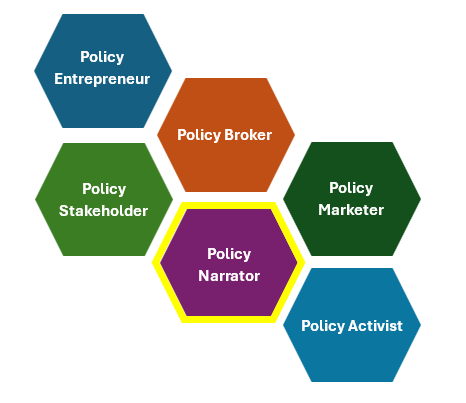
Across numerous theories of the modern policy process, scholars have highlighted the importance of policy actors, or individuals that drive policy change. Scholars have variably defined these actors as policy entrepreneurs, policy stakeholders, policy brokers, and policy activists, with the distinctions across roles often blurry. Seeking a term that can span theories, some scholars have suggested the concept of the policy entrepreneur. While we share the goal of bridging theory, we argue that the fuzziness of this term limits our ability to detangle the diverse functions that policy actors serve.

We suggest a different method: What if we conceptualized a range of policy actors, each who serve distinct roles within each framework?

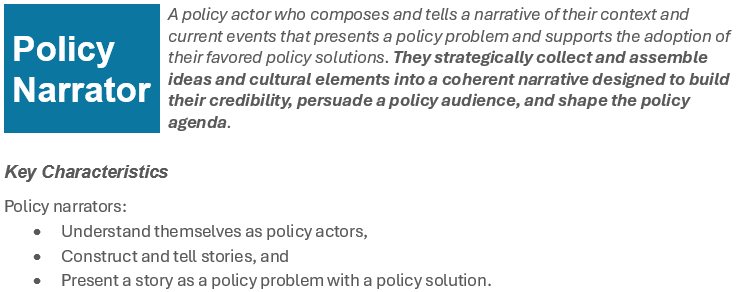
In our study, we propose a policy actor who can sit at the center of the Narrative Policy Framework (NPF) specifically: the policy narrator. This actor, we argue, plays the unique role of composing narratives that weave political, social, and economic contexts and current events to present a distinct policy problem and call for a particular policy solution. 

To further conceptualize this actor’s role in the policy creation process, we use comparative case studies of seven oil-producing counties in one region of rural Texas that experienced two distinct crises in 2020: falling oil prices and mass rig closures following the spread of COVID-19.

Building on previous NPF work – as well as from narratology, entrepreneurship scholarship, and diffusion theory – we test four sets of propositions about how policy narrators source, synthesize, and share their policy narratives during times of crises. 

While we make multiple findings on narrative strategies (including surrounding the effectiveness of the devil-angel shift, narrative congruence, and the use of characters), we believe that our most important contribution is defining and situating a specific policy actor within the NPF. 

Our results support the idea that policy narrators create narratives with distinct, identifiable characteristics that can conceptually separate them from other policy actors. We argue that if we continue this honing of the characteristics, function, and strategies of actors across other policy process theories, we can start to build a common language that connects our understandings of how the policy process operates. 

You can read the original article in Policy Studies Journal at

Hand, M. C., Morris, M., and Rai, V.. 2023. “The role of policy narrators during crisis: A micro-level analysis of the sourcing, synthesizing, and sharing of policy narratives in rural Texas.” Policy Studies Journal, 51, 843–868. https://doi.org/10.1111/psj.12501

About the Authors

Mark C. Hand is an Assistant Professor in the Political Science department at the University of Texas at Arlington, where he researches employee ownership and workplace democracy, campaigns and elections, and theories of the policymaking process. 


Megan Morris is a Policy Manager at the Abdul Latif Jameel Poverty Action Lab (J-PAL) at MIT. Megan manages the Gender sector and works on issues related to gender equity and women’s and girl’s agency. 


Dr. Varun Rai is the Walt and Elspeth Rostow Professor in the LBJ School of Public Affairs at the University of Texas at Austin, with a joint appointment in Mechanical Engineering. His interdisciplinary research, delving with issues at the interface of energy systems, complex systems, decision science, and public policy, develops policy solutions for a sustainable and resilient energy system. In 2016 he was awarded the David N. Kershaw Award and Prize. He received his Ph.D. and MS in Mechanical Engineering from Stanford University and a bachelor’s degree in Mechanical Engineering from the Indian Institute of Technology (IIT) Kharagpur.