
In 2017, Amazon launched a high-profile competition to choose a location for its second headquarters (HQ2). More than 230 U.S. cities submitted bids, many offering huge incentive packages to lure the tech giant. While researchers have long studied why governments offer these economic development deals to corporations, one question remains: Does making these bids public change how people feel about them? This study uses the Amazon HQ2 contest to explore how transparency and/or secrecy shapes public sentiment and political discourse. This case study applies the Political Market Framework (PMF) to better understand exchanges between policy demanders (e.g., Amazon) and policy suppliers (e.g., local governments).
Hypotheses
The authors test four hypotheses:
- Expressions of sentiment in locations with private or redacted bids, rather than public bids, will be more positive than those associated with public bids.
- Business stakeholders will express more positive sentiment and be less influenced by transparency.
- Government officials will express more positive sentiment and be less influenced by transparency.
- Public expressions of sentiment will be more positive when bids are private or redacted, relative to public bids.
Methodology
The authors analyzed nearly 40,000 tweets about HQ2 from 2017 to 2021, which were grouped by actor type (i.e., public, media, politicians, and pro-development stakeholders) and linked to bid transparency status (i.e., whether the local bid was public, redacted, or private). Using a RoBERTa model, the authors determined the positivity and negativity of each Tweet. Additionally, they used multivariate regression modeling to determine whether the transparency of the bid and the type of Twitter user influenced the expression of sentiment in the Tweet.
Key Findings
Less Transparency, More Optimism
Table 1 shows that Tweets from locations with private or redacted bids were significantly more positive than those from places that published full details. When billion-dollar tax subsidies are hidden, the authors explain, people tend to underestimate the costs and view the bid more optimistically–a phenomenon known as “fiscal illusion.” This finding challenges the idea that transparency always builds trust. In this case, openness and honesty about the costs and benefits provided the sunshine to accurately evaluate the true cost of the bids which was met with public backlash, in support of their hypothesis 1.
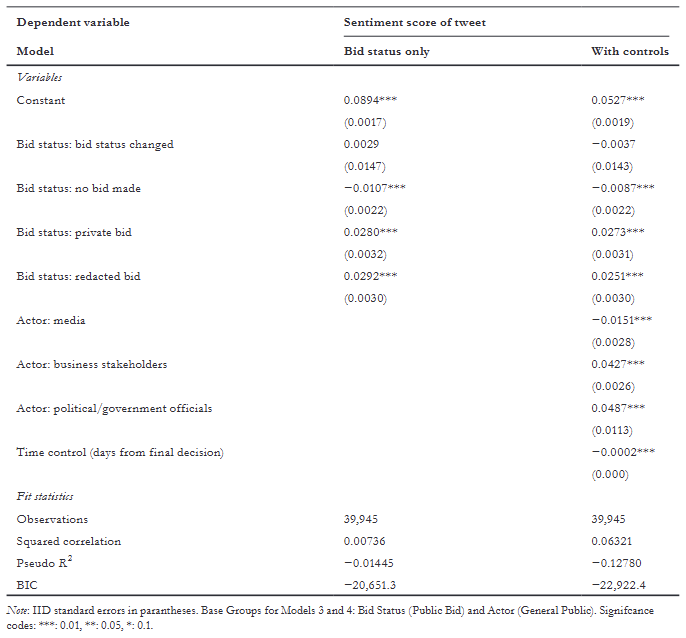
Table 1. Bid availability by sentiment.
Business Stays Positive, No Matter What
Figure 1 reveals that business stakeholders were consistently upbeat, regardless of bid transparency status. Unlike the general public, the authors point out, pro-development actors benefit directly from these types of incentive deals, so transparency does not dampen their enthusiasm. This finding highlights a key asymmetry: while public sentiment turns negative when costs are revealed, business voices remain supportive and influential. Hypothesis 2 is thus supported.
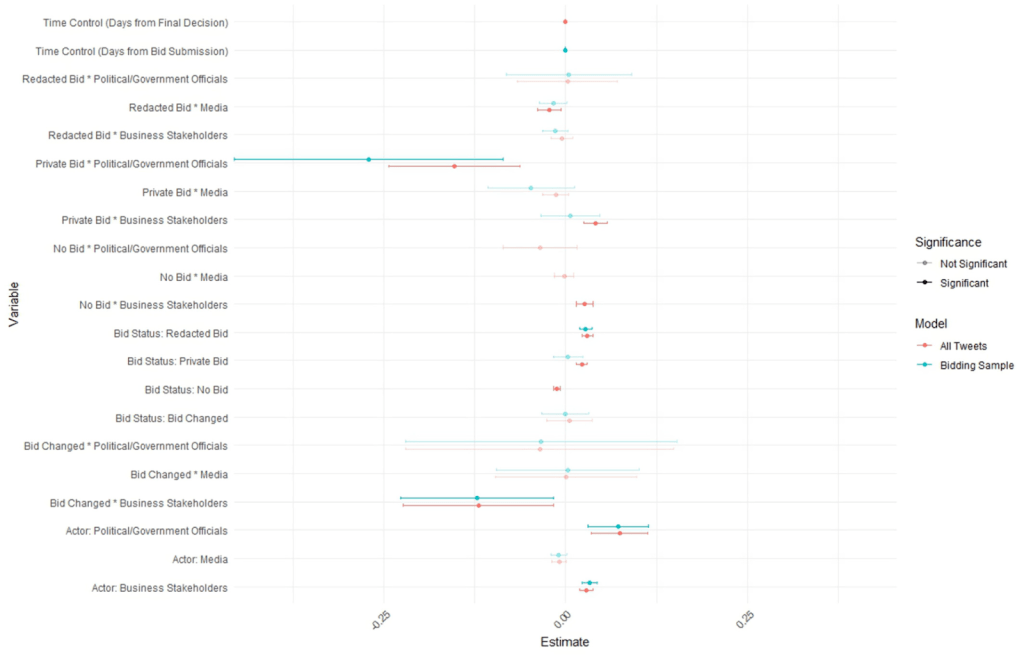
Figure 1. Bid transparency by actor on sentiment.
Why It Matters
This study shows that transparency in economic development deals can have unintended consequences. Instead of building trust, the authors explain, revealing the full price tag of economic development bids often sparks criticism. This finding raises tough questions for policymakers considering how to balance openness with the risk of public backlash. They take care to note that this is not a reason policymakers should avoid providing transparency, but they should carefully consider the full costs of these deals before promoting them. The authors call on researchers to look at other high-profile incentive deals and explore how transparency interacts with partisan framing and media coverage.
Read the original article in Policy Studies Journal:
Stokan, Eric, Ian Anson and Nathan M. Jensen. 2025. “When Sunshine Gets You Down: The Role of Transparency on Public Sentiment Toward the Amazon HQ2 Competition.” Policy Studies Journal 53(2): 499–523. https://doi.org/10.1111/psj.70016.
About the Article’s Authors

Eric Stokan is an Associate Professor in the Department of Political Science and Affiliate Faculty in the School of Public Policy at the University of Maryland Baltimore County (UMBC). He is the Director of the Center for Social Science Scholarship at UMBC and Co-Director of the Metropolitan Governance and Management Transitions Lab (MGMT) at the Paul H. O’Neil School of Public and Environmental Affairs at Indiana University Bloomington and is faculty affiliate to the Center for Urban Studies at Wayne State University. He serves on the editorial boards for the Urban Affairs Review and State and Local Government Review. His research examines how local governments balance environmental sustainability, economic growth, and community development. He also evaluates the social equity implications of these decisions.

Ian G. Anson is an Associate Professor in the Department of Political Science at UMBC. Dr. Anson arrived at UMBC in 2015 after matriculating from Indiana University in Bloomington, Indiana. He holds a Ph.D. in political science and a M.S. in applied statistics. Dr. Anson’s primary scholarly interests lie at the intersection of the fields of public opinion, political communication, and political behavior. His work often focuses on partisan biases, motivated reasoning, and factual misperceptions in American public opinion. Dr. Anson also contributes to the scholarship of teaching and learning (SoTL). His recent book, entitled Following the Ticker: The Political Origins and Consequences of Americans’ Stock Market Perceptions (2023, SUNY Press), examines how public opinion and political behavior have been reshaped since the 1980s by media attention to the stock market.

Nathan M. Jensen (2002, Yale Ph.D.) is a Professor in the Department of Government at the University of Texas-Austin. He only speaks in the third person for the purposes of bios. He was previously an associate professor in the Department of International Business at George Washington University (2014–2016) and associate professor in the Political Science Department at Washington University in St. Louis (2002–2014).
 Policy Studies Journal Blog