

by Gregory Porumbescu, Stephanie Walsh, & Andrea Hetling
This study examines how lowering learning costs in means-tested benefit programs, such as the Supplemental Nutrition Assistance Program (SNAP), influences public support and perceptions of beneficiary deservingness. Drawing on educational psychology research (cognitive load theory) and policy feedback theory, we investigate how the structure and clarity of information about SNAP’s eligibility and application process influence learning costs, public support, and attitudes. Through a pre-registered dose-response survey experiment, our findings show that improving the clarity of SNAP information reduces learning barriers, increasing support and positive perceptions of beneficiaries. This study is guided by two testable hypotheses:
- Reducing learning costs improves comprehension drawing on educational psychology cognitive load theory.
- Improved comprehension increases public support based on policy feedback theory.
To test these hypotheses, we performed a dose-response survey experiment involving 1,677 New Jersey residents. Participants were assigned randomly to one of four groups: a control group that was given no information, and three treatment groups that were given increasingly clearer and more structured information on SNAP. The treatments were:
Flyer: A low-structuring treatment with minimal structuring of content.
Screener: A tool that breaks the content into bite-sized, manageable chunks, mimicking state-level eligibility screens.
Video: A how-to tutorial walking participants through the eligibility process.
After being exposed to the treatment, each participant answered a series of questions related to SNAP, with the number of questions they answered correctly comprising the dependent variable, their SNAP comprehension score. To analyze the data, we employed a one-way analysis of variance (ANOVA) to evaluate whether differences exist across the control and three treatment groups. We utilized planned contrasts to determine if the means differed significantly across each treatment group. To analyze the relationship between comprehension and program support measures, we used ordinary least squares regressions. The mediation framework improves upon traditional methods by leveraging the potential outcomes framework. By modeling intermediate pathways explicitly, this method offers improved estimates of indirect effects compared to the associations produced by standard mediation techniques.

Figure 2. Distribution of SNAP comprehension score by treatment group.
As shown in figure 2, providing structured, digestible information significantly enhances study participants’ knowledge. The video treatment group, which received the clearest presentation, had the highest comprehension levels, followed by the screener group. The flyer treatment group, with the least structured data, had the lowest comprehension. In addition, differences by participant racial identity emerged, as Black non-Hispanic participants show a stronger inverse relationship between SNAP understanding and perceived deservingness compared to other groups. These findings underscore the importance of comprehension in shaping attitudes toward SNAP policies.
Findings also revealed significant indirect effects on SNAP approval, perceived deservingness, and support for increased funding. Higher comprehension connects reduced learning costs to greater support. This indicates that simplifying information delivery about complex benefit programs can enhance public approval and engagement. These results align with policy feedback theory, highlighting the importance of accessible information in shaping support for means-tested policies such as SNAP.
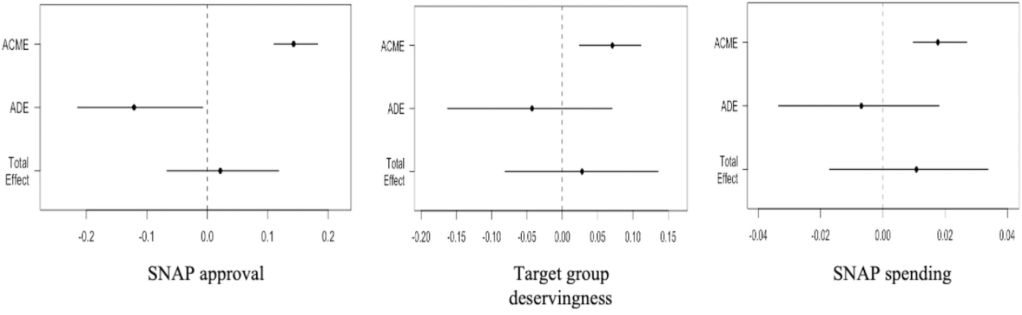
Figure 3. Indirect effects of content structure on different aspects of SNAP support.
Empirically, the findings show that reducing learning costs not only improves knowledge but also increases support for programs like SNAP, improves positive perceptions of program beneficiaries, and draws support for program funding. These effects could carry over to other complex safety net programs like Temporary Assistance Needy Families (TANF) and Medicaid, with policy communication implications extending beyond the reduction of learning cost.
You can read the original article in Policy Studies Journal at
Porumbescu, Gregory, Stephanie Walsh and Andrea Hetling. 2025. “ Can Reducing Learning Costs Improve Public Support For Means-tested Benefit Programs?.” Policy Studies Journal 53(1): 135–157. https://doi.org/10.1111/psj.12578.
About the Authors

Gregory Porumbescu (PhD, Seoul National University) is an associate professor in the Department of Public Administration and Policy at the University of Georgia‘s School of Public and International Affairs (SPIA). His research centers on understanding the implications of technology for government transparency and accountability. Dr. Porumbescu‘s work has been published in journals such as the Journal of Public Administration Research and Theory, Public Administration Review, Governance, and Social Science & Medicine. Prior to joining SPIA, Dr. Porumbescu served as an associate professor at Rutgers University–Newark. There, he was a co-founding principal investigator for the New Jersey State Policy Lab, an initiative dedicated to enhancing evidence based policy making in state governments. During his time at Rutgers, he was also appointed to serve on the AI, Equity, and Literacy Working Group, contributing to Governor Phil Murphy‘s New Jersey AI task force. Dr. Porumbescu‘s research has been supported by organizations such as the National Science Foundation, Korean Research Foundation, and the New Jersey Office of the Secretary of Higher Education.

Stephanie Walsh is Assistant Director of the Heldrich Center. She earned her doctorate in planning and public policy at Rutgers University. She also holds a Master‘s degree in public policy. Stephanie also serves as the Director of the New Jersey Statewide Data System, overseeing the governance, research agenda, and publications that use the linked longitudinal data. Her research interests focus on how data can inform public programs and policies to better support service delivery and improve individual outcomes.

Andrea Hetling is a Professor at the Edward J. Bloustein School of Planning and Public Policy at Rutgers University. Dr. Hetling‘s research interests focus on how public programs and policies can support economic well-being and financial stability among vulnerable populations, including families living in poverty and survivors of intimate partner violence. In 2019, Andrea was selected as one of only five Family Self-Sufficiency and Stability Research Network (FSSRN) Scholars and awarded a five-year grant by the US Department of Health & Human Services, Administration for Children and Families. Before getting her Ph.D., Andrea worked as a program administrator at a domestic violence agency, focusing on advocacy and development issues. As a strong believer in the public impact of applied policy research, Andrea regularly connects her research projects with her teaching and mentoring and to her service to the greater community.
 Policy Studies Journal Blog