Rapid Response and Uncertain Agendas: Senators’ Response to Dobbs

by Corinne Connor & Annelise Russell

How do elected officials signal what matters to them when agenda-setting isn’t just about picking issues, but also deciding how to respond? In our recent paper, we dig into this question by looking at how U.S. senators reacted to the Supreme Court’s 2022 Dobbs v. Jackson Women’s Health Organization decision and the earlier draft opinion leak.

Twitter (or X, if you must) remains a go-to platform for today’s legislators—a direct line to advocates, the media, and political elites. Unlike traditional media, it lets lawmakers respond instantly and unfiltered, making it the perfect stage for showing where they stand. We explored how senators used Twitter during two moments: the shock of the draft opinion leak and the expected court ruling. By examining their “rhetorical agendas”— the issues they highlight and how they frame them online — we uncovered insights into how they communicate their priorities in real time

We tested the following hypotheses:

Time Hypothesis (a): More ideologically extreme senators will be more likely to react more quickly to theleaked court opinion on Twitter.

Time Hypothesis (b): Democratic senators will be more likely to react more quickly to the leaked court opinion on Twitter.

Frame Hypothesis (a): The most ideologically extreme senators will be more likely to frame the Dobbs leak and decision in terms of pro-life or pro-choice alternatives.

Frame Hypothesis (b): Senators with greater electoral security will be more likely to adopt pro-choice or pro-life responses to the leak and/or decision.

Image Description

Using 5,163 tweets from senators’ official Twitter accounts from the week surrounding both events, our analysis revealed clear distinctions in senators’ reactions. We found strong support for the Time Hypotheses regarding the leak. Ideologically extreme members were quicker to respond to the Dobbs leak compared to their more moderate peers. Democrats, as anticipated, were generally more prompt in addressing the leak, reflecting their platform’s commitment to reproductive rights. Interestingly, response timing for the court’s final decision did not follow the same pattern, suggesting that anticipation allowed for more calculated, uniform engagement across ideological lines.

Image Description

The results of our analysis, on the other hand, did not support our Frame Hypotheses. We found that partisanship and extremity of partisanship were significant predictors of whether a senator would adopt a “pro-life” or “pro-choice” position relative to the other issue frames. However, electoral vulnerability and ideological extremity did not seem to be significant predictors of issue framing—with the exception that ideological extremity predicted pro-life/pro-choice frames).

Image Description

Our study aims to understand how lawmakers’ attention and agenda-setting behavior as a response to highly salient events. During the Dobbs leak, uncertainty prompted quicker, more polarized responses. Conversely, the anticipated ruling enabled senators to prepare and standardize their communications, highlighting the difference between reactive and proactive agenda setting. Rapid-response platforms—like Twitter—compel lawmakers to not only choose whether to engage but how quickly and with what narrative. 

This study opens avenues for exploring digital responses to other unexpected events, such as acts of political violence or security crises, and how they compare to anticipated policy announcements. Additionally, further research could investigate whether similar patterns hold in the U.S. House or within other political systems that also use social media for agenda setting. Understanding these dynamics could deepen our grasp of modern policymaking and communication strategies in a digital landscape.

You can read the original article in Policy Studies Journal at

Connor, Corinne and Annelise Russell. 2024. “ Rapid Response and Uncertain Agendas: Senators’ Response to Dobbs.” Policy Studies Journal 52(4): 751–775. https://doi.org/10.1111/psj.12553.

About the Authors

Corinne Connor is a program analyst with The Heinz Endowments.


Annelise Russell is an associate professor at the University of Kentucky.


The Public-Facing Policy Agenda of State Legislatures: The Communication of Public Policy via Twitter

by David A.M. Peterson, Wallapak Tavanapong, Lei Qi, Adisak Sukul, & Mohammed Khaleel

The Policy Agenda Project (PAP) has been an incredible resource for scholars of public policy. By coding a variety of data on national institutions, the media, and public opinion, the PAP has allowed scholars to test foundational questions about the policymaking process, and the Comparative Agendas Project (CAP) has extended this approach to 22 democracies, allowing for cross-national comparisons. However, to date, little work has investigated the policy agendas of subnational units. In our article, we utilize agenda-setting research methods to analyze what we call the public-facing agendas of state legislatures across the United States. This is not the actual agenda of what the legislatures are doing, but what they legislators chose to communicate to the public.  

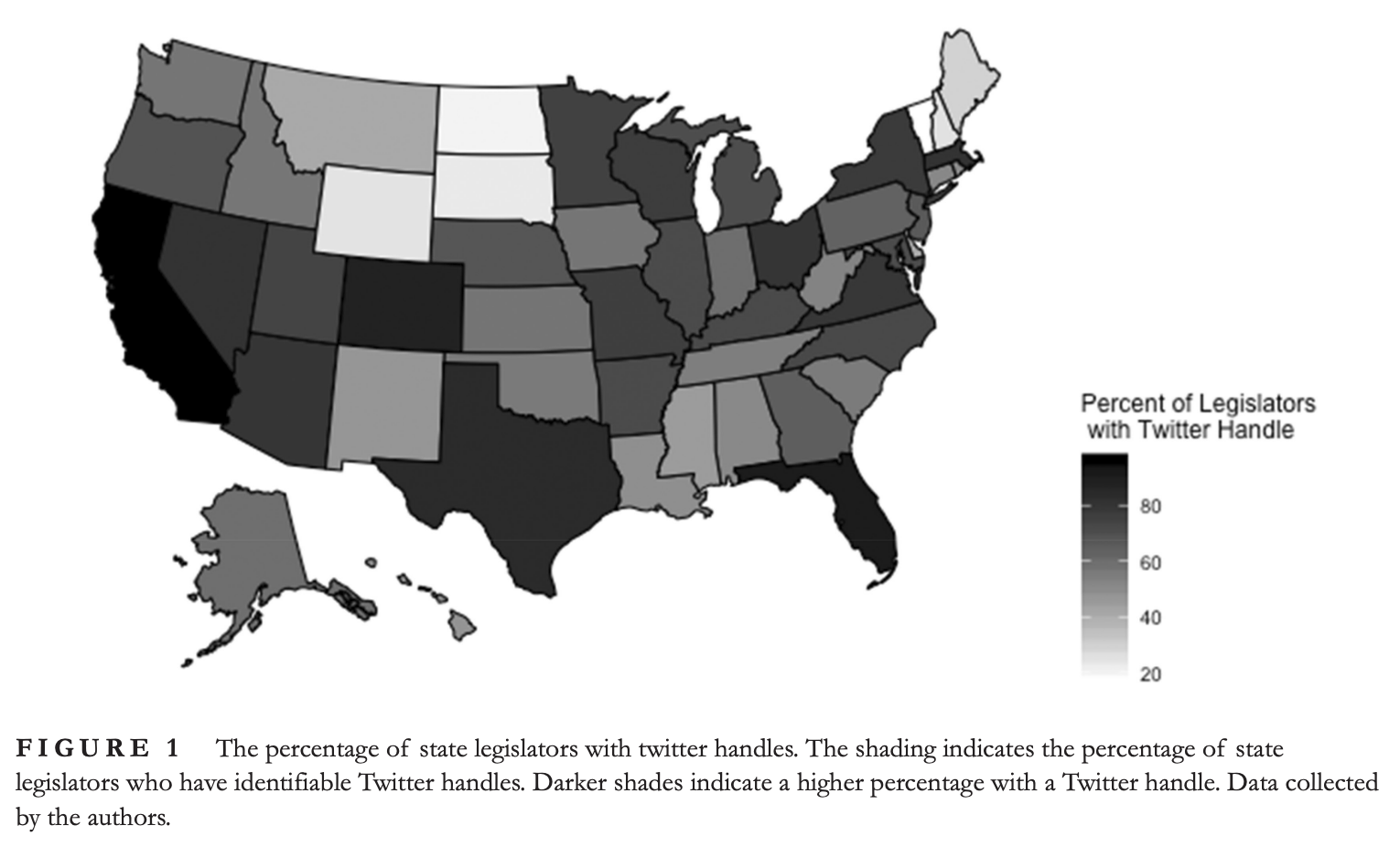
For our analysis, we looked at the tweets of state legislators during the year 2017. We chose to collect our data this way because tweets can help measure the public-facing policy agendas of legislatures when considered in aggregate, and because of its prominent use among state legislators (see Figure 1).

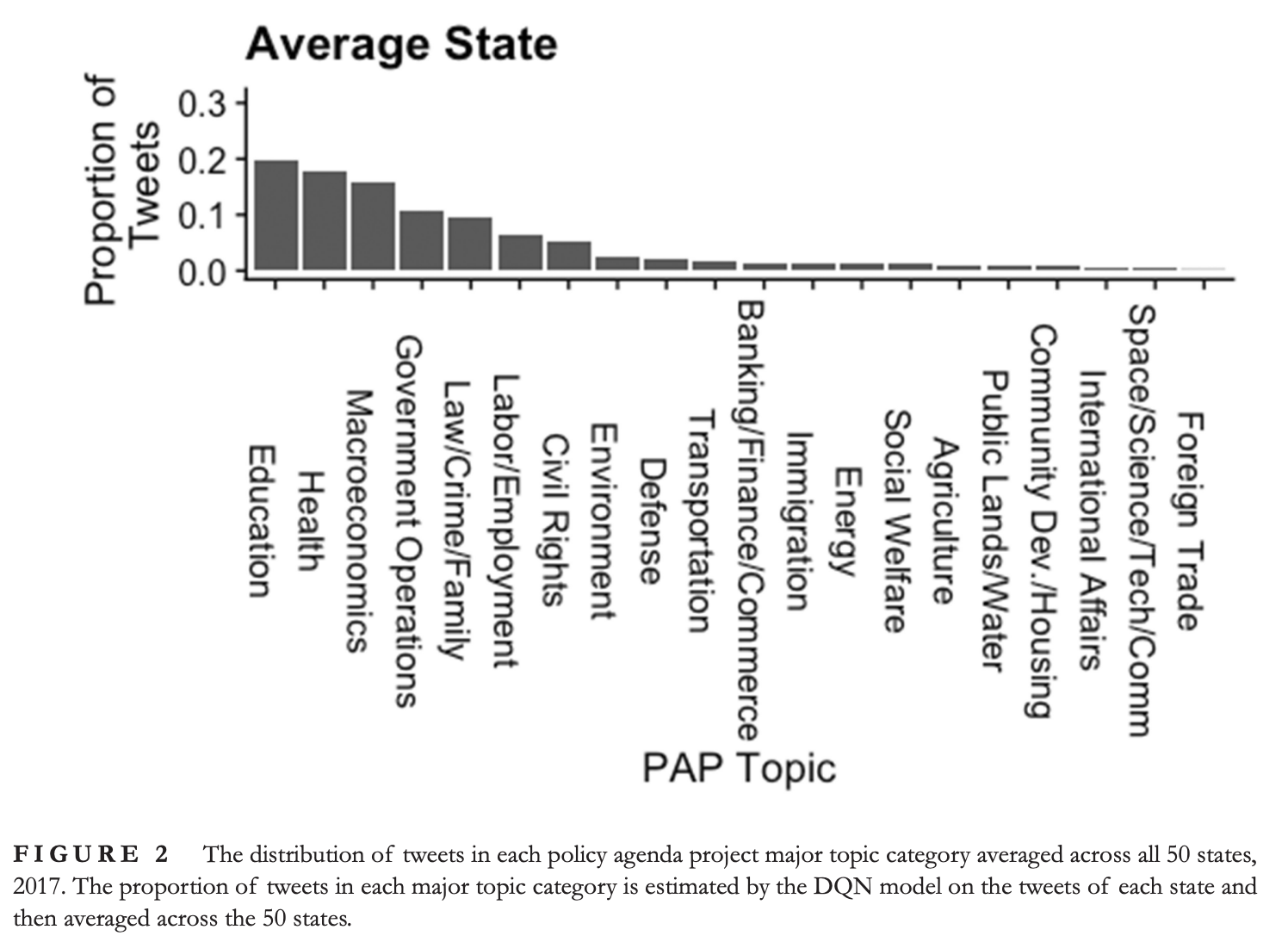
We used machine learning tools that combed through Twitter and calculated the proportion of state legislators’ tweets that fell within certain policy topic areas (as determined by the PAP). Unsurprisingly, we found that the top three policy topics among state legislatures were education, health, and macroeconomics (see Figure 2).

We also investigated how and why individual state legislatures deviated from one another. We theorize that state policy agenda heterogeneity could be related to three factors: institutional capacity, politics, and population pressures. Institutional capacity refers to the level of professionalism and innovativeness of the state legislature. The politics of a state legislature measure the partisan makeup of the body and the constituency. Population pressures can be things like the wealth of a state, racial diversity, or the size of the population.

Our results showed that there was little variation in policy agendas among states, especially for the top three policy topics (education, health, and macroeconomics). When variation did occur, it was correlated with institutional and political differences. The degree of professionalism of the legislature was the strongest predictor of how much legislatures paid attention to topics like macroeconomics, agriculture, energy, transportation, social welfare, housing, and public lands. The party control of a legislature also predicts attention for several categories. 

Our work makes important steps toward a stronger understanding of state-level policymaking. It also demonstrates that PAP research can be extended to state governments. We hope that we have laid the groundwork for future research to investigate state policy agendas in different years and national environments. 

You can read the original article in Policy Studies Journal at

Peterson, David A. M., Tavanapong, Wallapak, Qi, Lei, Sukul, Adisak, and Khaleel, Mohammed. 2023. The public-facing policy agenda of state legislatures: The communication of public policy via twitter. Policy Studies Journal 51: 551–571. https://doi.org/10.1111/psj.12485

About the Authors

David A. M. Peterson is the Lucken Professor of Political Science at Iowa State University. 


Wallapak Tavanapong is a Professor of Computer Science and Director of Computational Media Lab at Iowa State University, USA. She is also a co-founder and a Chief Technology Officer of EndoMetric Corporation which offers cutting-edge computer-assisted technology for improving patient care for endoscopy. Prof. Tavanapong received a BS degree in Computer Science from Thammasat University, Thailand, in 1992 and an MS and a Ph.D. in Computer Science from the University of Central Florida in 1995 and 1999, respectively.

Lei Qi received his Ph.D. in Computer Science from Iowa State University.


Adisak Sukul is an Associate Teaching Professor at Department of Computer Science, Iowa State University, specializing in data science and machine learning with a strong focus on AI. As a Google Cloud Faculty Expert, he integrates cutting-edge cloud technologies into academic settings, promoting practical, impactful education. His expertise in big data analytics, online learning, and applied machine learning enables him to develop and offer a range of workshops and bootcamps in Data Science, ML, and AI. Adisak’s commitment to blending academic knowledge with industry skills underpins his innovative approach to teaching and technology application.

Mo Khaleel holds a Ph.D. degree in computer science from Iowa State University, where his research has focused on explainable AI and understanding confusion in deep neural networks. With 16 published papers in reputable journals and conferences, Mo has established himself as a pioneer in the field. Currently serving as a Senior Machine Learning Engineer at MathWorks, Mo leads a team of 5 software engineers and is responsible for overseeing the AI-Assisted coding feature. With previous experience at Meta and Kingland Systems, Mo brings a wealth of industry knowledge to his current role, driving innovation and advancing the frontier of machine learning and natural language processing technologies.