The Public-Facing Policy Agenda of State Legislatures: The Communication of Public Policy via Twitter

by David A.M. Peterson, Wallapak Tavanapong, Lei Qi, Adisak Sukul, & Mohammed Khaleel

The Policy Agenda Project (PAP) has been an incredible resource for scholars of public policy. By coding a variety of data on national institutions, the media, and public opinion, the PAP has allowed scholars to test foundational questions about the policymaking process, and the Comparative Agendas Project (CAP) has extended this approach to 22 democracies, allowing for cross-national comparisons. However, to date, little work has investigated the policy agendas of subnational units. In our article, we utilize agenda-setting research methods to analyze what we call the public-facing agendas of state legislatures across the United States. This is not the actual agenda of what the legislatures are doing, but what they legislators chose to communicate to the public.  

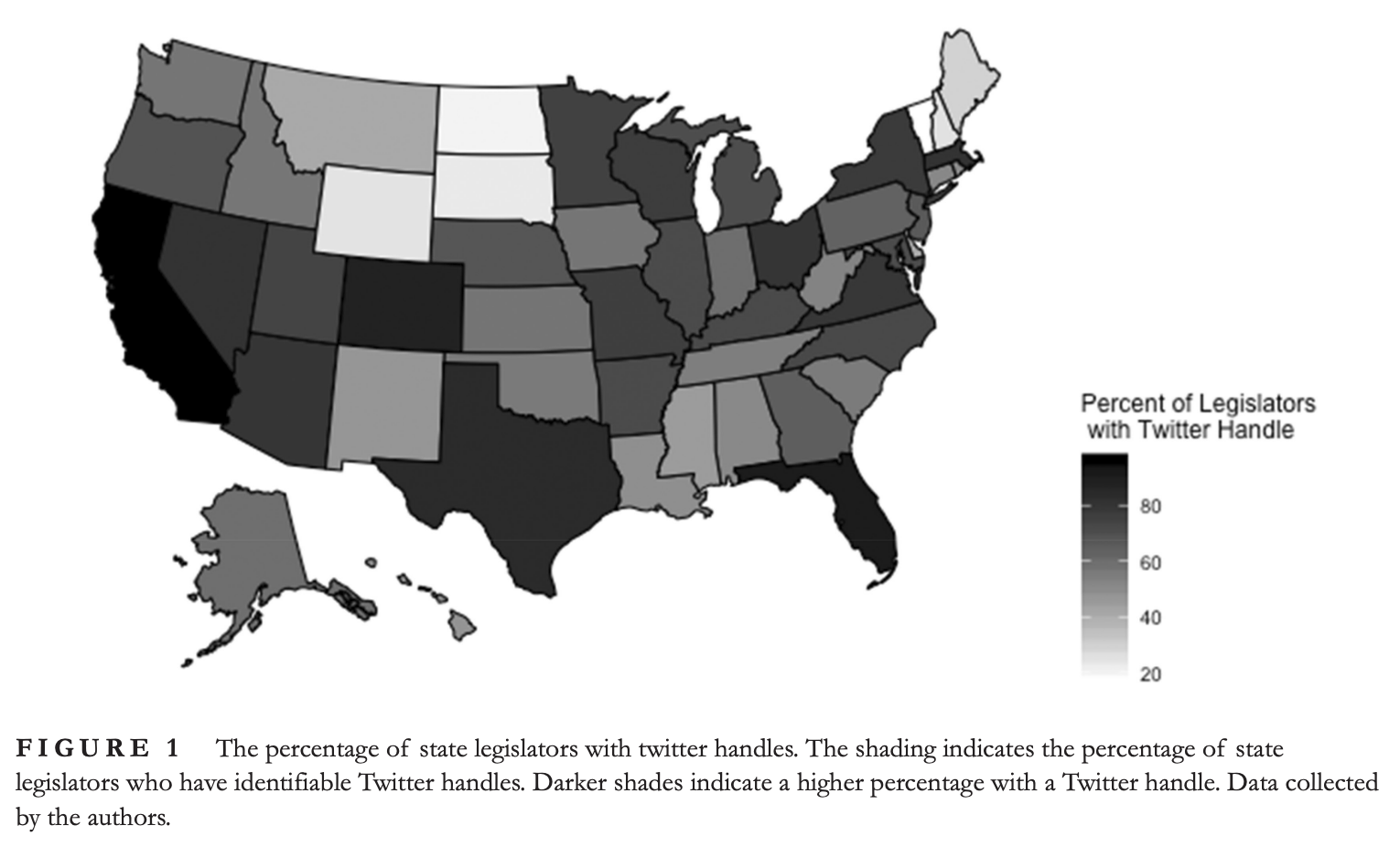
For our analysis, we looked at the tweets of state legislators during the year 2017. We chose to collect our data this way because tweets can help measure the public-facing policy agendas of legislatures when considered in aggregate, and because of its prominent use among state legislators (see Figure 1).
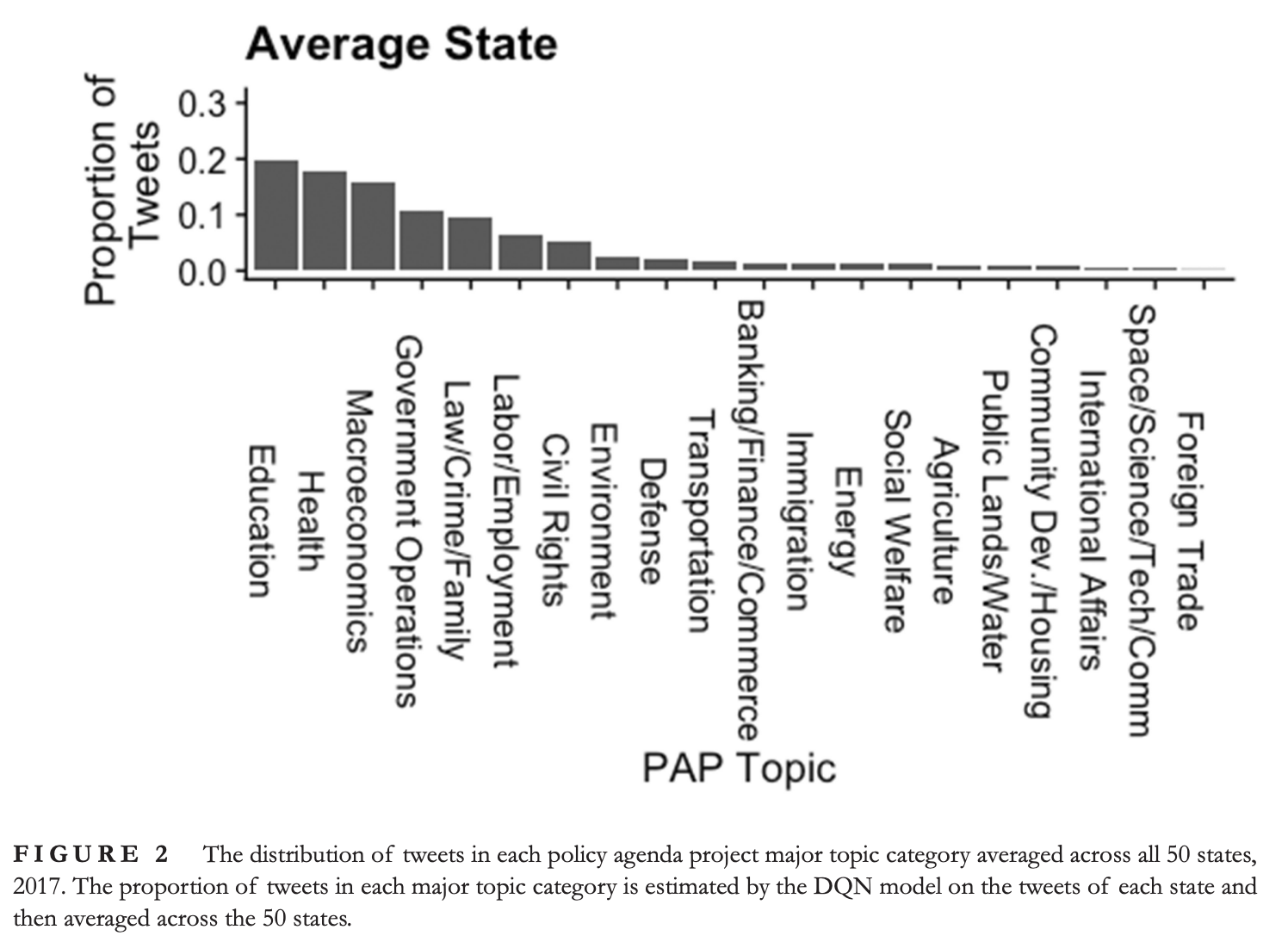
We used machine learning tools that combed through Twitter and calculated the proportion of state legislators’ tweets that fell within certain policy topic areas (as determined by the PAP). Unsurprisingly, we found that the top three policy topics among state legislatures were education, health, and macroeconomics (see Figure 2).
We also investigated how and why individual state legislatures deviated from one another. We theorize that state policy agenda heterogeneity could be related to three factors: institutional capacity, politics, and population pressures. Institutional capacity refers to the level of professionalism and innovativeness of the state legislature. The politics of a state legislature measure the partisan makeup of the body and the constituency. Population pressures can be things like the wealth of a state, racial diversity, or the size of the population.

Our results showed that there was little variation in policy agendas among states, especially for the top three policy topics (education, health, and macroeconomics). When variation did occur, it was correlated with institutional and political differences. The degree of professionalism of the legislature was the strongest predictor of how much legislatures paid attention to topics like macroeconomics, agriculture, energy, transportation, social welfare, housing, and public lands. The party control of a legislature also predicts attention for several categories. 

Our work makes important steps toward a stronger understanding of state-level policymaking. It also demonstrates that PAP research can be extended to state governments. We hope that we have laid the groundwork for future research to investigate state policy agendas in different years and national environments. 

You can read the original article in Policy Studies Journal at

Peterson, David A. M., Tavanapong, Wallapak, Qi, Lei, Sukul, Adisak, and Khaleel, Mohammed. 2023. The public-facing policy agenda of state legislatures: The communication of public policy via twitter. Policy Studies Journal 51: 551–571. https://doi.org/10.1111/psj.12485

About the Authors

David A. M. Peterson is the Lucken Professor of Political Science at Iowa State University. 



Wallapak Tavanapong is a Professor of Computer Science and Director of Computational Media Lab at Iowa State University, USA. She is also a co-founder and a Chief Technology Officer of EndoMetric Corporation which offers cutting-edge computer-assisted technology for improving patient care for endoscopy. Prof. Tavanapong received a BS degree in Computer Science from Thammasat University, Thailand, in 1992 and an MS and a Ph.D. in Computer Science from the University of Central Florida in 1995 and 1999, respectively.

Lei Qi received his Ph.D. in Computer Science from Iowa State University.


Adisak Sukul is an Associate Teaching Professor at Department of Computer Science, Iowa State University, specializing in data science and machine learning with a strong focus on AI. As a Google Cloud Faculty Expert, he integrates cutting-edge cloud technologies into academic settings, promoting practical, impactful education. His expertise in big data analytics, online learning, and applied machine learning enables him to develop and offer a range of workshops and bootcamps in Data Science, ML, and AI. Adisak’s commitment to blending academic knowledge with industry skills underpins his innovative approach to teaching and technology application.

Mo Khaleel holds a Ph.D. degree in computer science from Iowa State University, where his research has focused on explainable AI and understanding confusion in deep neural networks. With 16 published papers in reputable journals and conferences, Mo has established himself as a pioneer in the field. Currently serving as a Senior Machine Learning Engineer at MathWorks, Mo leads a team of 5 software engineers and is responsible for overseeing the AI-Assisted coding feature. With previous experience at Meta and Kingland Systems, Mo brings a wealth of industry knowledge to his current role, driving innovation and advancing the frontier of machine learning and natural language processing technologies.

The Policy Studies Journal (PSJ) invites submissions for a Special Issue focusing on Policy Advisory Systems

Policy advice remains a core activity in established theories of the policy process and key policymaking activity within and outside of governments. Policy scholars have increasingly adopted a systems view, researching policy advisory systems (PAS) – the assemblage of formal and informal advisory units and practices both inside and outside of government that exist at a given time and with which governments and other actors engage for policy formulation and implementation purposes (Craft & Halligan, 2020).

PAS are important arenas for policymaking where various types of policy advice, including expertise, political advice, technical advice, are sifted and sorted. They reflect the diverse array of policy advisers including public servants, think tanks, consultants, and political advisers, who are engaged in policy-relevant advisory activity within and around governments. The PAS concept recognizes important distinctions that often characterize the structure, components, outputs, and dynamics of these systems across a range of policy activities.

This special issue invites papers that engage with big questions that have emerged from a vibrant research programme on PAS and seek to better integrate mainstream policy process theories into the study of PAS. These include papers that:

●      Examine how systems of policy advice are configured and operate in different countries or policy domains.

●      Focus on how and why these systems of policy advice change and evolve.

●      Adopt policy process theories or explore the intersection and relevance of policy process theory to the PAS.

●      Theorize or empirically study how policy influence is gained, exercised, or lost in PAS.

●      Explore what constitutes effective and well-functioning systems of policy advice.

●      Investigate PAS and specific policymaking activities (e.g., agenda setting, formulation, implementation, evaluation, stakeholder relations, etc.).

●      Offer critical analysis of key theoretical, methodological, or empirical aspects of policy advising or PAS.

** The deadline for submitting a manuscript for the Special Issue is August 15, 2024 **

Potential contributors to the Special Issue may participate in a “Peer Paper Exchange” in the Spring of 2024 through which authors can obtain informal feedback from peers who also plan to submit a paper for the Special Issue and opt to participate in the Exchange. Each paper will be reviewed by 1-2 peers who will provide informal written feedback. Participation in the Exchange is intended to support the development of papers but has no bearing on the peer review process that will be undertaken by PSJ once papers are submitted to the Journal; that review process is formal and entirely independent of the “Peer Paper Exchange.”

To participate in the “Peer Paper Exchange,” please submit a one-page abstract that explains your research question, contribution of your paper to scholarship on PAS, and the data and methodological approaches you plan to use to answer your research question, along with the paper title and author information. This is due by April 25th. Notifications of acceptance to participate in the “Peer Paper Exchange” will be made by May 9th. 

Authors participating in the Exchange must share their draft papers with fellow Exchange participants by July 4th. Comments from the Exchange peer review will be returned to authors by July 25th. 

To apply for the “Peer Paper Exchange,” please visit: https://uark.qualtrics.com/jfe/form/SV_01AlQKG8cGMkKqO

If you have any questions about the submission process or the “Peer Paper Exchange,” please contact Dr. Holly Peterson (PSJ Associate Editor) at policystudiesjournal@gmail.com.

Explore the Art of the Research Process with Art of Science

While aspiring scholars, junior faculty, and even veteran academics have access to the latest theoretical and methodological advances through journals such as the Policy Studies Journal, the creativity, ingenuity, and art associated with breakthrough work is often less accessible. Art of Science (AoS) aims to fill this gap by interviewing scholars with recent publications in the Policy Studies Journal, exploring the research process sitting behind the article. AoS is meant to break down the mystique of research for early career researchers. By focusing on the process from idea to publication rather than on the publication itself, AoS aims to be a resource where scholars can receive honest advice and a place where failures and the problems solving associated with them are discussed as much as the successes that became the publication itself. 

Art of Science is hosted by Graham Ambrose. Episodes of AoS release quarterly, in conjunction with new issues of the Policy Studies Journal. You can watch all the author conversations on the Art of Science YouTube channel or listen to the audio on all major podcasting platforms. You can also read full transcripts of each episode on the Art of Science Substack.

Art of Science is a co-production of the Policy Studies Journal and the Center for Policy Design and Governance at Syracuse University.

Check out the latest episode of Art of Science, where Dr. Mallory SoRelle from Duke University and Dr. Delphia Shanks from Hendrix College joined Graham for a conversation about their paper “The policy acknowledgement gap: Explaining (mis)perceptions of government social program use.”

You can listen to the conversation on Apple, Spotify, Google, and wherever else you get your podcasts. A full transcript of the conversation is also available here.

You can also follow Art of Science on X/Twitter @ArtOfSciencePod.

The Role of Policy Narrators During Crisis: A Micro-Level Analysis of the Sourcing, Synthesizing, and Sharing of Policy Narratives in Rural Texas

by Mark C. Hand, Megan Morris, & Varun Rai

Policy researchers have done extensive research to understand the use of narratives in the policy process. We see that policymakers use narratives to set policy agendas, to emphasize issues, to suggest solutions, and much more. But how do policymakers respond to crisis?

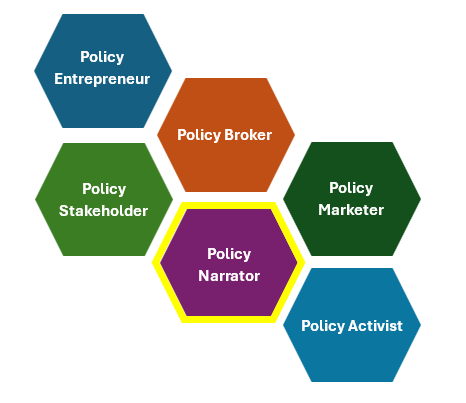
Across numerous theories of the modern policy process, scholars have highlighted the importance of policy actors, or individuals that drive policy change. Scholars have variably defined these actors as policy entrepreneurs, policy stakeholders, policy brokers, and policy activists, with the distinctions across roles often blurry. Seeking a term that can span theories, some scholars have suggested the concept of the policy entrepreneur. While we share the goal of bridging theory, we argue that the fuzziness of this term limits our ability to detangle the diverse functions that policy actors serve.

We suggest a different method: What if we conceptualized a range of policy actors, each who serve distinct roles within each framework?

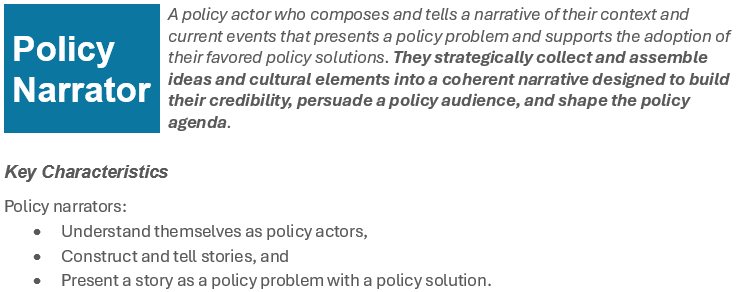
In our study, we propose a policy actor who can sit at the center of the Narrative Policy Framework (NPF) specifically: the policy narrator. This actor, we argue, plays the unique role of composing narratives that weave political, social, and economic contexts and current events to present a distinct policy problem and call for a particular policy solution. 

To further conceptualize this actor’s role in the policy creation process, we use comparative case studies of seven oil-producing counties in one region of rural Texas that experienced two distinct crises in 2020: falling oil prices and mass rig closures following the spread of COVID-19.

Building on previous NPF work – as well as from narratology, entrepreneurship scholarship, and diffusion theory – we test four sets of propositions about how policy narrators source, synthesize, and share their policy narratives during times of crises. 

While we make multiple findings on narrative strategies (including surrounding the effectiveness of the devil-angel shift, narrative congruence, and the use of characters), we believe that our most important contribution is defining and situating a specific policy actor within the NPF. 

Our results support the idea that policy narrators create narratives with distinct, identifiable characteristics that can conceptually separate them from other policy actors. We argue that if we continue this honing of the characteristics, function, and strategies of actors across other policy process theories, we can start to build a common language that connects our understandings of how the policy process operates. 

You can read the original article in Policy Studies Journal at

Hand, M. C., Morris, M., and Rai, V.. 2023. “The role of policy narrators during crisis: A micro-level analysis of the sourcing, synthesizing, and sharing of policy narratives in rural Texas.” Policy Studies Journal, 51, 843–868. https://doi.org/10.1111/psj.12501

About the Authors

Mark C. Hand is an Assistant Professor in the Political Science department at the University of Texas at Arlington, where he researches employee ownership and workplace democracy, campaigns and elections, and theories of the policymaking process. 


Megan Morris is a Policy Manager at the Abdul Latif Jameel Poverty Action Lab (J-PAL) at MIT. Megan manages the Gender sector and works on issues related to gender equity and women’s and girl’s agency. 


Dr. Varun Rai is the Walt and Elspeth Rostow Professor in the LBJ School of Public Affairs at the University of Texas at Austin, with a joint appointment in Mechanical Engineering. His interdisciplinary research, delving with issues at the interface of energy systems, complex systems, decision science, and public policy, develops policy solutions for a sustainable and resilient energy system. In 2016 he was awarded the David N. Kershaw Award and Prize. He received his Ph.D. and MS in Mechanical Engineering from Stanford University and a bachelor’s degree in Mechanical Engineering from the Indian Institute of Technology (IIT) Kharagpur.

Coupling the Streams by Connecting Claims: Discourse Networks Show How a German Labor Market Policy Hits the Agenda in the Early Phase of the Covid‑19 Pandemic

by Malte Möck, Colette S. Vogeler, Nils C. Bandelow, & Johanna Hornung

The early textbook approach of the policy process pictures policy-makers as capable of crafting policies as solutions for existing societal problems. The multiple streams perspective pioneered by John Kingdon in the 1980s suggests that reality is far more chaotic. Too much happens simultaneously. Policies are developed, adapted and combined. Problems emerge, change and are replaced by more important ones. Policy-makers in governments come and go and are by no means capable of addressing all relevant problems in a timely and orderly manner. There are simply too many issues, while the attention of decision-makers is limited. Against this background, some actors are able to promote a policy in a way that makes it look like the perfect solution to a problem. Such actors are called policy entrepreneurs, and the purposeful sense-making of an ambiguous reality is known as coupling problems, solutions, and politics. The mechanisms of coupling, however, are understudied.

The Multiple Streams Framework distinguishes between the ever-changing but initially unconnected problems, policies and politics. In any policy area, the streams can pose more or less advantageous conditions; for example, the current government could be supporting or opposing the policy. If the streams are generally favorable and an opportunity presents itself, entrepreneurs can seize such a policy window to couple the streams. In our article, we investigate a case that presents such a constellation. In summer 2020, the Work Safety Control Act made it to the German federal government’s agenda. This policy addresses poor working conditions in the meat-processing industry by banning service contracts and temporary work, creating standards regarding the recording of working time and accommodation of workers, and introducing provisions on monitoring compliance.

We argue that the Multiple Streams Framework explains agenda setting in this case rather well. The policy proposals had been around for a while in the policy community and in the context of self-commitments by the industry. Also, the political context was favorable as the Social Democrats calling for such changes were a part of the governing coalition and in charge of the respective ministry. Finally, outbreaks of Covid‑19 in German abattoirs in spring 2020 created a policy window in the problem stream. In this early phase of the pandemic, Covid‑19 dominated every agenda and infection hubs were easily linked to insufficient working conditions in the abattoirs.

But how exactly were streams coupled while the policy window was open? To answer this question, we provide a methodology to zoom in on the coupling by entrepreneurs. We build on previous work conceptualizing coupling as making an argument or claim about elements from the streams as representations of reality and as taking place not only across all three streams, but also partially by for example linking problem and solution (cf. post in PSJ Blog below on 4 Oct 2023). Studying discourses as bipartite networks, in which actors make statements about issues, allows researchers to represent elements from a discourse as linked by actors making similar claims about them. We suggest combining these approaches as relational coupling as illustrated below.

Relational coupling enables us to study the German public debate on Covid‑19 infections and working conditions in abattoirs. In this way, it is possible to investigate how policy entrepreneurs coupled the streams in order to push the Work Safety Control Act to the government’s agenda. Our discourse network analysis shows two phases of agenda setting. In the first phase in May and early June 2020, entrepreneurs mainly engaged in presenting and linking problems. They connected issues like Covid‑19 outbreaks in the meat-processing industry, insufficient health protection and working conditions and the subcontractor system. Coupling across streams is observed rarely, for example in attributing responsibility to the companies and the German states (political stream) or in pointing to the need of improved controls (policy stream).

This is different for the second investigation period in late June and July 2020, in which more discursive elements were addressed and connected more densely also across streams. One cluster of couplings builds on crisis management considerations regarding a specific Covid‑19 outbreak in an abattoir. The respective company was held responsible (political stream) and regional lockdowns were suggested (policy stream). Building on this cluster, however, the previously framed general problems were interlinked along with the policy proposals of the Work Safety Control Act, which was considered by the German cabinet at the end of July 2020. This shows that relational coupling contributes to understanding the mechanisms of coupling the streams and facilitates investigating the crucial process of how policy entrepreneurs can make use of an opportunity to push their policy to the agenda.

You can read the original article in Policy Studies Journal at

Möck, Malte, Vogeler, Colette S., Bandelow, Nils C., and Hornung, Johanna. 2023. “Relational Coupling of Multiple Streams: The Case of COVID-19 Infections in German Abattoirs.” Policy Studies Journal, 51: 351-374. https://doi.org/10.1111/psj.12459

About the Authors

Malte Möck is a postdoctoral researcher at the Agricultural and Food Policy Group at Humboldt-Universität zu Berlin, Germany. His research addresses agricultural policy, socio-technical change and urban-rural relations, especially in inter- and transdisciplinary contexts.

Colette S. Vogeler is professor of Comparative Public Administration and Policy Analysis at the University of Speyer, Germany. Her research focuses on public policymaking in the areas of environmental, agricultural and animal welfare policy.

Nils C. Bandelow is a professor of political science and head of the Institute of Comparative Politics and Public Policy (CoPPP), Technische Universität Braunschweig, Germany. His research focuses on actor-centered approaches to the policy process, which he applies to health and infrastructure policy in inter- and transdisciplinary cooperations.

Johanna Hornung is a postdoctoral researcher at the KPM Center for Public Management, University of Bern, Switzerland. Her research focuses on the integration of (social) psychological perspectives into public policy theories, which she applies to health and environmental policy and in interdisciplinary cooperations.

How Street-Level Dilemmas and Politics Shape Divergence: The Accountability Regimes Framework

by Eva Thomann, James Maxia, & Jörn Ege

Conventional thought holds that policies are passed down from policymakers to street-level bureaucrats (i.e., police officers, public school teachers, social workers, etc.) who implement these policies as instructed. However, both anecdotal and empirical data reveal that these street-level bureaucrats can diverge from the formal rules of policies at their discretion. This policy divergence suggests that street-level bureaucrats can become informal policymakers because of their pivotal role in policy implementation. In our paper, we investigate this policy divergence and explore how informal accountability relations influence street-level bureaucrats.

Using the Accountability Regime Framework (ARF), we identify four mechanisms, which can influence the behavior of street-level bureaucrats: political-administrative, professional, participatory/societal, and market. We also suggest the inclusion of a new accountability regime in the ARF: political-ideological. These five accountability relations aim to describe the pressures street-level bureaucrats experience from the formal rules of policies, the norms of their professions, their role in society, their role as economic actors, and their political/ideological beliefs, respectively.

When two or more of these accountability relations create competing demands on a street-level bureaucrat, we call this an accountability dilemma. We argue that actors who experience accountability dilemmas are more likely to diverge from the formal rules of a policy. We also expect divergence to be more likely among actors who prioritize accountability relations inconsistent with the formal rules. We offer the following hypotheses:

Hypothesis 1a: Street-level bureaucrats with political attitudes that contradict with the policy (ideological distance) are likely to articulate a rule-political dilemma.

Hypothesis 1b: Street-level bureaucrats with political attitudes that contradict with the policy are likely to articulate a rule-political dilemma, but only if they also strongly refer to political-ideological pressure.

Hypothesis 2: Stronger reference to an accountability pressure other than rule pressure makes it more likely that the street-level bureaucrat experiences a dilemma of rule pressure with the respective action prescriptions.

Hypothesis 3: The stronger or more numerous the dilemmas expressed by the street-level bureaucrat, the more likely they are to diverge from the policy.

To test our hypotheses, we analyze a case of the UK’s “Prevent Duty” counterterrorism policy. This policy instructs university lecturers to identify and report students they suspect are becoming radicalized. The ambiguity of Prevent Duty’s instructions, its political saliency, and the high degree of discretion that university lecturers enjoy suggest that this case will be useful for our purposes. 

For our analysis, we surveyed social science lecturers in British universities. The survey included measured feelings of accountability and the likelihood of compliance with Prevent Duty. We also conducted qualitative follow-up interviews with lecturers who had experience implementing Prevent Duty. 

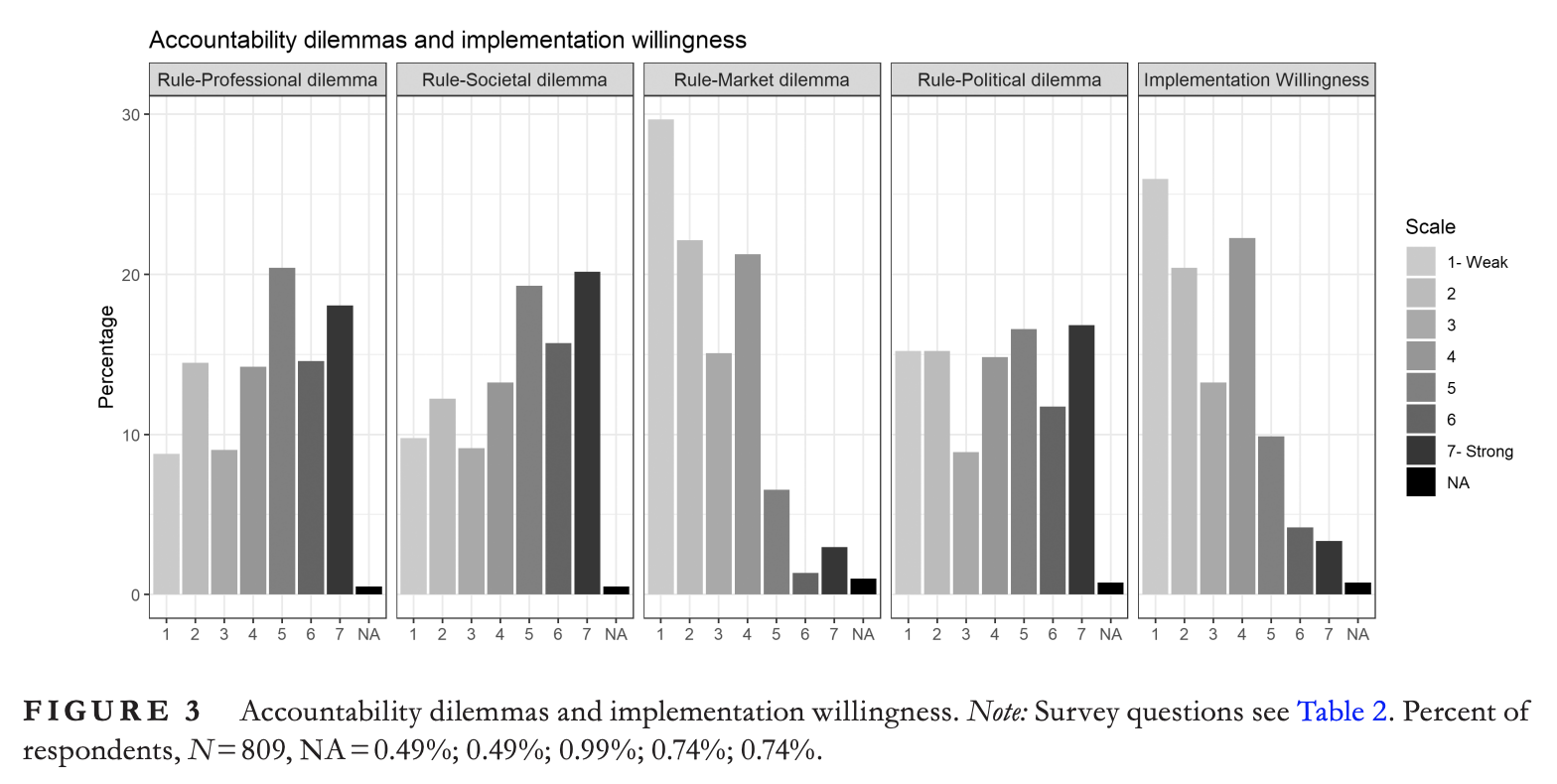
In line with H1a, we found that lecturers whose political views contrasted with Prevent Duty were more likely to identify a perceived rule-political dilemma. However, contrary to H1b, the importance one placed on political-ideological accountability did not seem to affect the likelihood of perceiving a rule-political dilemma. In other words, contrasting political beliefs seemed to interfere with the implementation of Prevent Day even among lecturers who separated their work from their political beliefs. 

We also found that the higher priority lecturers placed on an accountability regime, the more likely they were to experience an accountability dilemma, except for market accountability. Perhaps most importantly, we found that stronger accountability dilemmas were associated with higher levels of policy divergence. 

Our findings extend the ARF to include a new accountability regime, political-ideological, which we believe to be an important addition to understanding street-level bureaucrats as “political animals.” We also successfully show that informal accountability relations play an important role in policy implementation. 

You can read the original article in Policy Studies Journal at

Thomann, Eva, James Maxia and Jörn Ege. 2023. “How street-level dilemmas and politics shape divergence: The accountability regimes framework.” Policy Studies Journal 51 (4): 793–816. https://doi.org/10.1111/psj.12504.

About the Authors

Eva Thomann is a full professor of Public Administration at the Department of Politics and Public Administration at the University of Konstanz. She holds a master’s degree in Political Science from the University of Zurich and a Ph.D. in Public Administration from the University of Bern. She specializes in Public Policy and Public Administration; her research focuses on the patterns, reasons, and consequences of how policies are put into practice.

James Maxia is working in the private sector in London, UK. He graduated from the University of Oxford with an MPhil in Comparative Government after completing his undergraduate studies at the University of Exeter. He is interested in studying voting behavior, political violence, and public policy implementation.

Jörn Ege is a permanent lecturer in “Local & Regional Governance” at the ZHAW School of Management and Law in Winterthur, Switzerland. He studies administrative arrangements and their consequences for the governance of societal problems in international(ized), regional, and local contexts.

Find him online:
Website: https://www.zhaw.ch/en/about-us/person/egej/
X: https://twitter.com/EgeJorn
LinkedIn: https://www.linkedin.com/in/jorn-ege/

Farmed Out: Agricultural Lobbying in a Polarized Congress  

by Clare Brock

Food and Agriculture policy has often been referred to as one of the last bastions of bipartisanship. Policymakers in the space claim that policymaking in this area has historically been special and uniquely cooperative. And yet, recent fights over the Farm Bill and other food and nutrition policy have made clear that food policymaking is no more exempt from bitter partisan battles than any other policy area.

Farmed Out: Agricultural Lobbying in a Polarized Congress considers the relationship between partisan polarization, lobbying, and policy dynamics. The evidence presented in the book shows that partisan polarization has a dual impact on lobbying in that space. On the one hand, partisan polarization has increasingly frustrated lobbyists who hope to see lawmakers move forward on policy change in a timely fashion; one lobbyist explained, “I find the issues that should have been a lighter lift have become a Herculean lift” (Brock 2023, 111). The consequence is that, as the legislative pace slows, lobbyists must persistently work on the same issues over a longer time horizon, exacerbating the already large advantage to business and well-organized and funded interests. This trend is particularly visible among business interests, whose behavior, characteristics, and resources we have a clearer picture of compared to other types of interest groups.

Figure 7.1. Relationship between lobbying reports and firm revenue, by year.

Figure 7.1 (Brock 2023, 113) illustrates the increasingly exaggerated relationship between lobbying reports and resources over time, particularly among business interests. It is clear that access to resource allows firms to engage in politics more aggressively than their less well-resourced counterparts.

Advocacy groups are adapting and finding new (and old) ways to overcome legislative sluggishness, however. Reliance on coalitions and cross-cutting partnerships, also known as “unlikely bedfellows” or “boot-leggers and Baptist” partnerships, are particularly desirable coalitional strategies as they provide “air cover” to politicians and create new pathways to cooperation in a Congress with increasingly slim majorities and challenging dynamics (Brock 2023, 126).

Farmed Out explores both the practical and normative consequences of partisan polarization on lobbying, and specifically, the consequences of these dynamics on policymaking in the food and agricultural subsystem. “Legislators spend more time fighting, flying home, and rallying their bases, and less time on policymaking. Congress has lost expertise and has outsourced brainpower to lobbyists. As lobbying increasingly becomes more skewed toward the ultra-wealthy interest groups and corporations, we risk moving the food system even further from the ideal points of the public” (Brock 2023, 140). In short, partisan polarization has consequences not only for our politics, but also for our diets.

You can find the full book at

Brock, Clare R., Farmed Out: Agricultural Lobbying in a Polarized Congress (New York, 2024; online edn, Oxford Academic, 23 Nov. 2023), https://doi.org/10.1093/oso/9780197683798.001.0001

About the Author

Clare Brock is an Assistant Professor of Political Science at Colorado State University. Her research interests include public policy process, interest groups and advocacy, food politics, and the impact of polarization on policymaking.