Coupling the Streams by Connecting Claims: Discourse Networks Show How a German Labor Market Policy Hits the Agenda in the Early Phase of the Covid‑19 Pandemic

by Malte Möck, Colette S. Vogeler, Nils C. Bandelow, & Johanna Hornung

The early textbook approach of the policy process pictures policy-makers as capable of crafting policies as solutions for existing societal problems. The multiple streams perspective pioneered by John Kingdon in the 1980s suggests that reality is far more chaotic. Too much happens simultaneously. Policies are developed, adapted and combined. Problems emerge, change and are replaced by more important ones. Policy-makers in governments come and go and are by no means capable of addressing all relevant problems in a timely and orderly manner. There are simply too many issues, while the attention of decision-makers is limited. Against this background, some actors are able to promote a policy in a way that makes it look like the perfect solution to a problem. Such actors are called policy entrepreneurs, and the purposeful sense-making of an ambiguous reality is known as coupling problems, solutions, and politics. The mechanisms of coupling, however, are understudied.

The Multiple Streams Framework distinguishes between the ever-changing but initially unconnected problems, policies and politics. In any policy area, the streams can pose more or less advantageous conditions; for example, the current government could be supporting or opposing the policy. If the streams are generally favorable and an opportunity presents itself, entrepreneurs can seize such a policy window to couple the streams. In our article, we investigate a case that presents such a constellation. In summer 2020, the Work Safety Control Act made it to the German federal government’s agenda. This policy addresses poor working conditions in the meat-processing industry by banning service contracts and temporary work, creating standards regarding the recording of working time and accommodation of workers, and introducing provisions on monitoring compliance.

We argue that the Multiple Streams Framework explains agenda setting in this case rather well. The policy proposals had been around for a while in the policy community and in the context of self-commitments by the industry. Also, the political context was favorable as the Social Democrats calling for such changes were a part of the governing coalition and in charge of the respective ministry. Finally, outbreaks of Covid‑19 in German abattoirs in spring 2020 created a policy window in the problem stream. In this early phase of the pandemic, Covid‑19 dominated every agenda and infection hubs were easily linked to insufficient working conditions in the abattoirs.

But how exactly were streams coupled while the policy window was open? To answer this question, we provide a methodology to zoom in on the coupling by entrepreneurs. We build on previous work conceptualizing coupling as making an argument or claim about elements from the streams as representations of reality and as taking place not only across all three streams, but also partially by for example linking problem and solution (cf. post in PSJ Blog below on 4 Oct 2023). Studying discourses as bipartite networks, in which actors make statements about issues, allows researchers to represent elements from a discourse as linked by actors making similar claims about them. We suggest combining these approaches as relational coupling as illustrated below.

Relational coupling enables us to study the German public debate on Covid‑19 infections and working conditions in abattoirs. In this way, it is possible to investigate how policy entrepreneurs coupled the streams in order to push the Work Safety Control Act to the government’s agenda. Our discourse network analysis shows two phases of agenda setting. In the first phase in May and early June 2020, entrepreneurs mainly engaged in presenting and linking problems. They connected issues like Covid‑19 outbreaks in the meat-processing industry, insufficient health protection and working conditions and the subcontractor system. Coupling across streams is observed rarely, for example in attributing responsibility to the companies and the German states (political stream) or in pointing to the need of improved controls (policy stream).

This is different for the second investigation period in late June and July 2020, in which more discursive elements were addressed and connected more densely also across streams. One cluster of couplings builds on crisis management considerations regarding a specific Covid‑19 outbreak in an abattoir. The respective company was held responsible (political stream) and regional lockdowns were suggested (policy stream). Building on this cluster, however, the previously framed general problems were interlinked along with the policy proposals of the Work Safety Control Act, which was considered by the German cabinet at the end of July 2020. This shows that relational coupling contributes to understanding the mechanisms of coupling the streams and facilitates investigating the crucial process of how policy entrepreneurs can make use of an opportunity to push their policy to the agenda.

You can read the original article in Policy Studies Journal at

Möck, Malte, Vogeler, Colette S., Bandelow, Nils C., and Hornung, Johanna. 2023. “Relational Coupling of Multiple Streams: The Case of COVID-19 Infections in German Abattoirs.” Policy Studies Journal, 51: 351-374. https://doi.org/10.1111/psj.12459

About the Authors

Malte Möck is a postdoctoral researcher at the Agricultural and Food Policy Group at Humboldt-Universität zu Berlin, Germany. His research addresses agricultural policy, socio-technical change and urban-rural relations, especially in inter- and transdisciplinary contexts.

Colette S. Vogeler is professor of Comparative Public Administration and Policy Analysis at the University of Speyer, Germany. Her research focuses on public policymaking in the areas of environmental, agricultural and animal welfare policy.

Nils C. Bandelow is a professor of political science and head of the Institute of Comparative Politics and Public Policy (CoPPP), Technische Universität Braunschweig, Germany. His research focuses on actor-centered approaches to the policy process, which he applies to health and infrastructure policy in inter- and transdisciplinary cooperations.

Johanna Hornung is a postdoctoral researcher at the KPM Center for Public Management, University of Bern, Switzerland. Her research focuses on the integration of (social) psychological perspectives into public policy theories, which she applies to health and environmental policy and in interdisciplinary cooperations.
How Street-Level Dilemmas and Politics Shape Divergence: The Accountability Regimes Framework

by Eva Thomann, James Maxia, & Jörn Ege

Conventional thought holds that policies are passed down from policymakers to street-level bureaucrats (i.e., police officers, public school teachers, social workers, etc.) who implement these policies as instructed. However, both anecdotal and empirical data reveal that these street-level bureaucrats can diverge from the formal rules of policies at their discretion. This policy divergence suggests that street-level bureaucrats can become informal policymakers because of their pivotal role in policy implementation. In our paper, we investigate this policy divergence and explore how informal accountability relations influence street-level bureaucrats.

Using the Accountability Regime Framework (ARF), we identify four mechanisms, which can influence the behavior of street-level bureaucrats: political-administrative, professional, participatory/societal, and market. We also suggest the inclusion of a new accountability regime in the ARF: political-ideological. These five accountability relations aim to describe the pressures street-level bureaucrats experience from the formal rules of policies, the norms of their professions, their role in society, their role as economic actors, and their political/ideological beliefs, respectively.

When two or more of these accountability relations create competing demands on a street-level bureaucrat, we call this an accountability dilemma. We argue that actors who experience accountability dilemmas are more likely to diverge from the formal rules of a policy. We also expect divergence to be more likely among actors who prioritize accountability relations inconsistent with the formal rules. We offer the following hypotheses:

Hypothesis 1a: Street-level bureaucrats with political attitudes that contradict with the policy (ideological distance) are likely to articulate a rule-political dilemma.

Hypothesis 1b: Street-level bureaucrats with political attitudes that contradict with the policy are likely to articulate a rule-political dilemma, but only if they also strongly refer to political-ideological pressure.

Hypothesis 2: Stronger reference to an accountability pressure other than rule pressure makes it more likely that the street-level bureaucrat experiences a dilemma of rule pressure with the respective action prescriptions.

Hypothesis 3: The stronger or more numerous the dilemmas expressed by the street-level bureaucrat, the more likely they are to diverge from the policy.

To test our hypotheses, we analyze a case of the UK’s “Prevent Duty” counterterrorism policy. This policy instructs university lecturers to identify and report students they suspect are becoming radicalized. The ambiguity of Prevent Duty’s instructions, its political saliency, and the high degree of discretion that university lecturers enjoy suggest that this case will be useful for our purposes. 

For our analysis, we surveyed social science lecturers in British universities. The survey included measured feelings of accountability and the likelihood of compliance with Prevent Duty. We also conducted qualitative follow-up interviews with lecturers who had experience implementing Prevent Duty. 

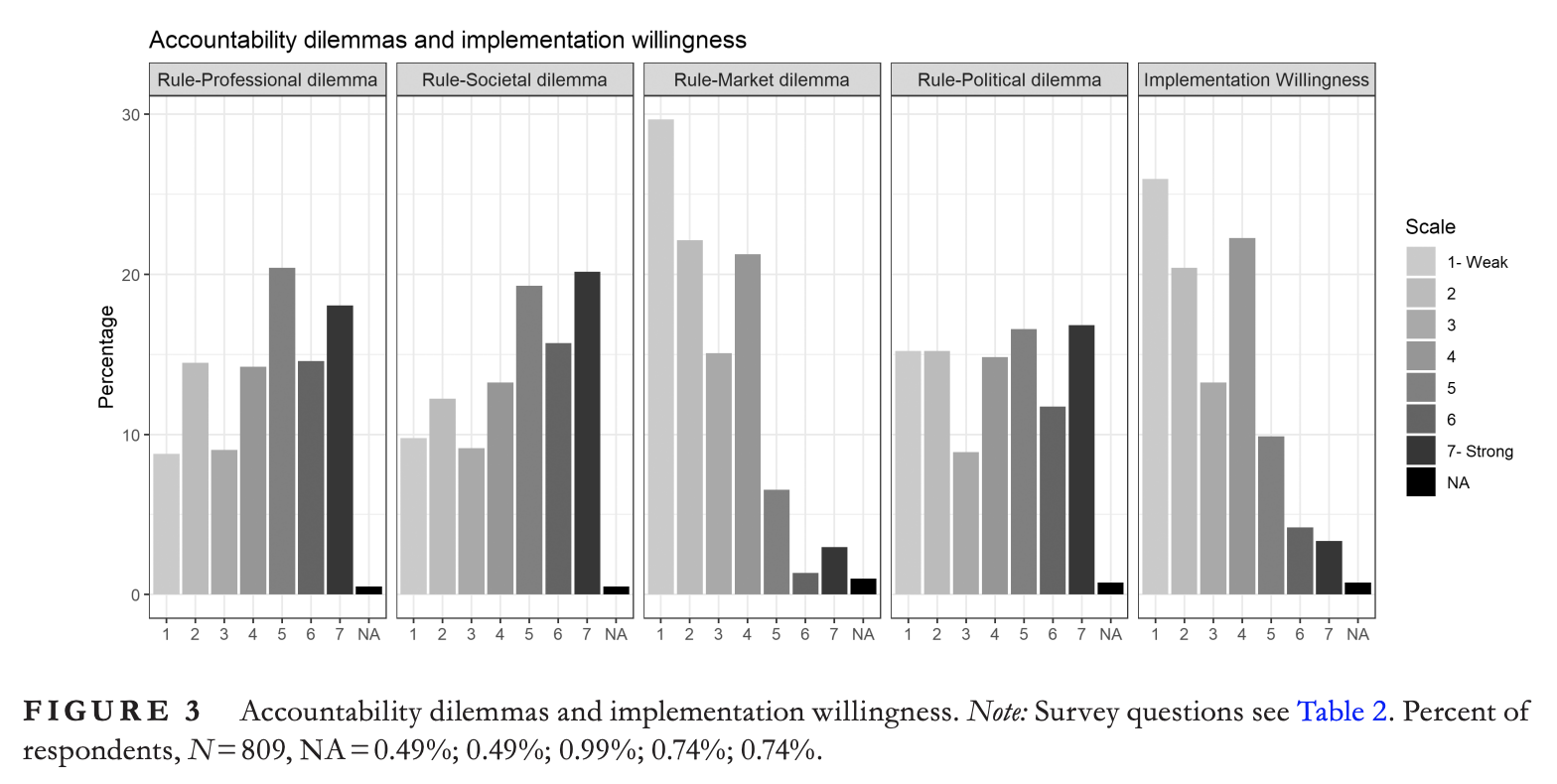
In line with H1a, we found that lecturers whose political views contrasted with Prevent Duty were more likely to identify a perceived rule-political dilemma. However, contrary to H1b, the importance one placed on political-ideological accountability did not seem to affect the likelihood of perceiving a rule-political dilemma. In other words, contrasting political beliefs seemed to interfere with the implementation of Prevent Day even among lecturers who separated their work from their political beliefs. 

We also found that the higher priority lecturers placed on an accountability regime, the more likely they were to experience an accountability dilemma, except for market accountability. Perhaps most importantly, we found that stronger accountability dilemmas were associated with higher levels of policy divergence. 

Our findings extend the ARF to include a new accountability regime, political-ideological, which we believe to be an important addition to understanding street-level bureaucrats as “political animals.” We also successfully show that informal accountability relations play an important role in policy implementation. 

You can read the original article in Policy Studies Journal at

Thomann, Eva, James Maxia and Jörn Ege. 2023. “How street-level dilemmas and politics shape divergence: The accountability regimes framework.” Policy Studies Journal 51 (4): 793–816. https://doi.org/10.1111/psj.12504.

About the Authors

Eva Thomann is a full professor of Public Administration at the Department of Politics and Public Administration at the University of Konstanz. She holds a master’s degree in Political Science from the University of Zurich and a Ph.D. in Public Administration from the University of Bern. She specializes in Public Policy and Public Administration; her research focuses on the patterns, reasons, and consequences of how policies are put into practice.

James Maxia is working in the private sector in London, UK. He graduated from the University of Oxford with an MPhil in Comparative Government after completing his undergraduate studies at the University of Exeter. He is interested in studying voting behavior, political violence, and public policy implementation.

Jörn Ege is a permanent lecturer in “Local & Regional Governance” at the ZHAW School of Management and Law in Winterthur, Switzerland. He studies administrative arrangements and their consequences for the governance of societal problems in international(ized), regional, and local contexts.

Find him online:
Website: https://www.zhaw.ch/en/about-us/person/egej/
X: https://twitter.com/EgeJorn
LinkedIn: https://www.linkedin.com/in/jorn-ege/

Farmed Out: Agricultural Lobbying in a Polarized Congress  

by Clare Brock

Food and Agriculture policy has often been referred to as one of the last bastions of bipartisanship. Policymakers in the space claim that policymaking in this area has historically been special and uniquely cooperative. And yet, recent fights over the Farm Bill and other food and nutrition policy have made clear that food policymaking is no more exempt from bitter partisan battles than any other policy area.

Farmed Out: Agricultural Lobbying in a Polarized Congress considers the relationship between partisan polarization, lobbying, and policy dynamics. The evidence presented in the book shows that partisan polarization has a dual impact on lobbying in that space. On the one hand, partisan polarization has increasingly frustrated lobbyists who hope to see lawmakers move forward on policy change in a timely fashion; one lobbyist explained, “I find the issues that should have been a lighter lift have become a Herculean lift” (Brock 2023, 111). The consequence is that, as the legislative pace slows, lobbyists must persistently work on the same issues over a longer time horizon, exacerbating the already large advantage to business and well-organized and funded interests. This trend is particularly visible among business interests, whose behavior, characteristics, and resources we have a clearer picture of compared to other types of interest groups.

Figure 7.1. Relationship between lobbying reports and firm revenue, by year.

Figure 7.1 (Brock 2023, 113) illustrates the increasingly exaggerated relationship between lobbying reports and resources over time, particularly among business interests. It is clear that access to resource allows firms to engage in politics more aggressively than their less well-resourced counterparts.

Advocacy groups are adapting and finding new (and old) ways to overcome legislative sluggishness, however. Reliance on coalitions and cross-cutting partnerships, also known as “unlikely bedfellows” or “boot-leggers and Baptist” partnerships, are particularly desirable coalitional strategies as they provide “air cover” to politicians and create new pathways to cooperation in a Congress with increasingly slim majorities and challenging dynamics (Brock 2023, 126).

Farmed Out explores both the practical and normative consequences of partisan polarization on lobbying, and specifically, the consequences of these dynamics on policymaking in the food and agricultural subsystem. “Legislators spend more time fighting, flying home, and rallying their bases, and less time on policymaking. Congress has lost expertise and has outsourced brainpower to lobbyists. As lobbying increasingly becomes more skewed toward the ultra-wealthy interest groups and corporations, we risk moving the food system even further from the ideal points of the public” (Brock 2023, 140). In short, partisan polarization has consequences not only for our politics, but also for our diets.

You can find the full book at

Brock, Clare R., Farmed Out: Agricultural Lobbying in a Polarized Congress (New York, 2024; online edn, Oxford Academic, 23 Nov. 2023), https://doi.org/10.1093/oso/9780197683798.001.0001

About the Author

Clare Brock is an Assistant Professor of Political Science at Colorado State University. Her research interests include public policy process, interest groups and advocacy, food politics, and the impact of polarization on policymaking.


A Grammar of Institutions for Complex Legal Topics: Resolving Statutory Multiplicity and Scaling up to Jurisdiction-Level Legal Institutions

by Anthony J. DeMattee

Laws constrain who can vote, what we may consume, what we can choose to do with our bodies, and many other aspects of our daily lives. Understanding a law’s impact on society is oftentimes challenging. A key reason for this is statutory multiplicity: legal domains are frequently governed by numerous laws whose provisions overlap and sometimes contradict each other. Capturing and resolving statutory multiplicity, then, is vital to understanding how laws are interpreted and applied to specific circumstances.

In my paper, I present a method for addressing statutory multiplicity that uses the Institutional Grammar. Originally developed by Sue Crawford and Elinor Ostrom in 1995, Institutional Grammar is a tool for turning provisions found in legal texts (e.g., laws, regulations) into institutional statements – directives about what an actor may, must, or must not do. Those institutional statements can then be broken down into a set of components to capture information about the institution being studied. Crawford and Ostrom’s Grammar had five such components: the Attribute (the actor in the institutional statement), the Deontic (which identifies if an action is required or optional), the Aim (the action in question), the Conditions (the circumstances under which the statement applies), and the Or else (the consequences if the statement is not followed). 

Figure 1. Section 15 of Kenya’s Societies Act of 1968. 

If we conceptualize laws as bundles of legal rules, we can interpret a legal institution that governs a specific domain as a bundle of rules found across multiple laws. We can then use the Institutional Grammar to both describe the features of that legal institution and also detail how the legal institution changes over time. In essence, my method involves “scaling up” from legal provisions to laws, and, ultimately, jurisdiction-level legal institutions.

The method that I outline in my paper has three steps. First, I code laws using IG-based coding protocol items. I do this by taking provisions found in legal texts, reworking them into the institutional statements, and coding all laws using Institutional Grammar (see Figure 1 for an example of this). I assign each statement a numerical value based on whether the rule being coded is permissive/democratic or restrictive/undemocratic. Permissive rules are given a [+1], while restrictive rules receive a [-1]. After coding all laws in the legal corpus, the second step averages coded values for each coding protocol item. This calculates a jurisdiction value for each item in the coding protocol and equals the average value of a particular coding protocol item across relevant laws active in the jurisdiction. The final step estimates values for the jurisdiction-level legal institution. To do so,  I aggregate all values calculated in step two. Aggregation can be done either by simple summation or factor analysis. Each method has its benefits and drawbacks. Simple summation is the more straightforward of the two, though this can come at the expense of a loss of nuance since under simple summation rules with a positive and negative valence would cancel each other out. Factor analysis, on the other hand, allows you to weigh provisions and thus get a more accurate calculation, but is consequently more complicated than simple summation.

I applied this method to laws regulating civil society organizations (CSOs) in Kenya. Throughout its independence, as few as 1 to as many as 13 laws simultaneously affect Kenyan CSOs. I applied both simple summation and factor analysis to calculate the values for the jurisdiction-level legal institutions. Figure 3 compares the results for both techniques at four important moments in Kenya’s post-colonial history, with net permissiveness (dashed line) representing simple summation and latent permissiveness (solid line) representing factor analysis. The latent permissiveness measurement suggests that the permissiveness of Kenyan CSO laws increased significantly in the years immediately following independence and remained relatively steady thereafter, while net permissiveness registered a significant uptick in permissiveness in the 1990s.

Figure 3. Comparing techniques measuring Kenya’s legal institutions. 

Legal institutions have become increasingly complex, defined by numerous laws that intersect with one another. Statutory multiplicity is fertile ground for abuse. For instance, antidemocratic regimes may exploit complexity to engage in “restriction by addition,” where restrictive and undemocratic rules are added to the institution, or “restriction through subtraction,” where an institution is made more restrictive by removing permissive rules. My paper presents an approach that leverages the Institutional Grammar to better account for the many legal rules that comprise a jurisdiction’s legal institution. This method is amenable to any legal topic and is especially appropriate when multiple statutes simultaneously comprise the legal institution in a single jurisdiction.

You can read the original article in Policy Studies Journal at

DeMattee, A.J. 2023. “A grammar of institutions for complex legal topics: Resolving statutory multiplicity and scaling up to jurisdiction-level legal institutions”. Policy Studies Journal 51: 529–550. Available from: https://doi.org/10.1111/psj.12488

About the Author

Anthony DeMattee is a data scientist in the Democracy Program at The Carter Center, where he develops standards and best practices for election technologies and campaign finance, media literacy, social media analyses, and studies legal institutions regulating speech, corruption, data privacy and protection, and elections. He also supports the Center’s special initiatives by creating research designs that integrate many data types for valid and reliable measurement and credible causal inference. DeMattee completed his joint Ph.D. in public policy from Indiana University, specializing in comparative politics, public policy, and public administration. DeMattee was an Ostrom Fellow during this time and remains affiliated with the Ostrom Workshop in Political Theory & Policy Analysis. After graduation, he spent two years at Emory University as a National Science Foundation Postdoctoral Research Fellow for Fundamental Research; DeMattee joined The Carter Center in 2022.

Developing a Comprehensive Policy Conference List

Academic conferences are hubs for the latest and most promising research in our field. They provide the opportunity to receive invaluable feedback, to connect with other scholars, and to gain inspiration for future research endeavors. 

However, many of us attend the same conferences every year. Like clockwork, we mark our calendars for the submission deadlines and participation dates for these select few and begin planning from there. It’s true that we have limited resources and time that can be stretched across multiple conferences every year, but there is also another reason we tend to stay the course: keeping up with the full range of conferences within our field can be a daunting task.  

As an editorial team, we asked ourselves: 

  • What annual conference opportunities are out there? And which of these would we as researchers be interested in presenting our own work?
  • Further, as a journal focused on international policy theory development, what are promising conferences located outside the Western hemisphere?

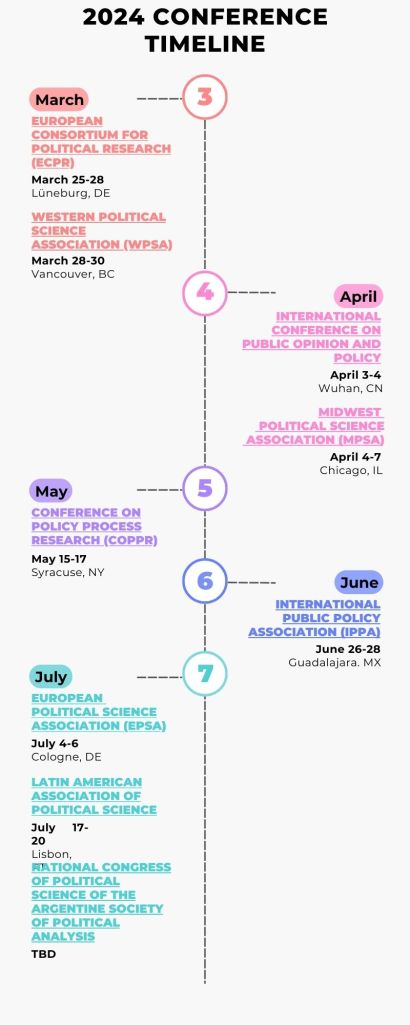
Below we have compiled what we believe to be a comprehensive timeline of public policy and political science conferences happening between March and December 2024. We encourage policy scholars to follow the clickable links for each conference to learn more about its history and foci as well as to access its most up-to-date participation deadlines. 

After reviewing this list, we also ask you: are there international conferences we’ve missed? And what other resources could we provide to make conference information more accessible?

Advocacy Coalitions, Beliefs, and Learning: An Analysis of Stability, Change, and Reinforcement

by Christopher Weible, Kristin L. Oloffson, & Tanya Heikkila 

The Advocacy Coalition Framework (ACF) is one of the primary approaches for studying advocacy coalitions, belief systems, and policy learning. While hundreds of empirical studies have confirmed the framework’s major expectations, research is limited by a lack of longitudinal studies, comparisons between panel and non-panel data, and multiple measures of policy-oriented learning in the same study. To fill these gaps, we examine the characteristics of advocacy coalitions in the ever-evolving landscape of energy policy. Three questions guide the exploration: 

  1. What defines the characteristics of advocacy coalitions in the setting of shale oil and gas development, and to what extent do these coalitions exhibit stability over time? 
  2. To what degree do members within advocacy coalitions undergo changes in their beliefs, and how does this impact their sustained alignment within the same coalition? 
  3. What are the prevalent trends regarding advocacy coalition members self-reporting belief changes or expressing a willingness to shift their positions?

In 2013, 2015, and 2017, we conducted surveys of policy actors involved in shale oil and gas extraction in Colorado. The survey participants comprised individuals actively involved or knowledgeable about the pertinent policy issues, including industry stakeholders, government officials, non-profit and community group representatives, consultants, academics, and reporters. Respondents were identified through a purposive sampling approach, utilizing evidence from media reports, online sources, public hearings, testimonies, and recommendations. The survey included measures of policy core beliefs, such as positions on oil and gas development, problem perceptions, coordination, and interactions with other policy actors. 

To analyze the data, we used K-Means Clustering, a method that identifies distinct groups within a dataset. The K-Means Clustering method categorized respondents into two coalitions based on minimizing distances within each cluster.

As illustrated in Figure 2, while beliefs remained relatively constant, specific indicators signaled some movement, reflecting shifts in the policy subsystem’s circumstances. For instance, concerns over public nuisances rose during a period of increased drilling activity, only to subside when drilling declined due to falling oil prices. The coalitional characteristics remained relatively stable across the three time periods, confirming patterns typical for environmental policy issues.

Figure 2. Frequency of belief change for respondents by panels

This analytical approach provides valuable insights into the dynamics of advocacy coalitions, shedding light on their composition and stability over time in the context of shale oil and gas development policy. One key contribution lies in the identification and characterization of two distinct advocacy coalitions, namely the anti-oil and gas coalition primarily comprising environmental and citizen group representatives, and the pro-oil and gas coalition dominated by industry stakeholders. The stability of these coalitions over the five-year period underscores the enduring nature of these groupings. The research also delves into the nuanced realm of belief change and policy learning among coalition members. The findings provide crucial insights into the tendencies of coalition members to either reinforce their existing beliefs or undergo shifts in response to evolving circumstances, contributing to the broader discourse on policy learning. 

You can read the original article in Policy Studies Journal at

Weible, C. M., Olofsson, K. L. and Heikkila, T. 2023. “Advocacy coalitions, beliefs, and learning: An analysis of stability, change, and reinforcement.” Policy Studies Journal 51: 209–229. https://doi.org/10.1111/psj.12458

About the Authors

Chris Weible is a professor at the University of Colorado Denver School of Public Affairs. His research and teaching center on policy process theories and methods, democracy, and environmental policy. He is the Co-Founder and Co-Director of the Center for Policy and Democracy (CPD) and Co-Editor of Policy & Politics. He teaches courses in environmental politics, public policy and democracy, policy analysis, and research methods and design. Recent and current research includes studying policy conflicts in energy issues (e.g., siting energy infrastructure and oil and gas development), the role of emotions in public discourse, the institutional configurations of public policies, politics involving marginalized communities, and patterns and explanations of advocacy coalitions, learning, and policy change. He has published over a hundred articles and book chapters and has been awarded millions of dollars in external funding. His edited volumes include “Theories of the Policy Process,” “Methods of the Policy Process,” and “Policy Debates in Hydraulic Fracturing.” He regularly engages and enjoys collaborating with students and communities in research projects. Professor Weible earned his Ph.D. in Ecology from the University of California Davis and a Master of Public Administration and a Bachelor of Science in Mathematics and Statistics from the University of Washington. He has an Honorary Doctor of Philosophy and a Visiting Professor position at Luleå University of Technology (LTU), Sweden. Before coming to CU Denver, Professor Weible was an Assistant Professor at the Georgia Institute of Technology. He is a returned Peace Corps Volunteer.

Dr. Kristin L. Olofsson’s research focuses on public policy, institutional design, and stakeholder participation. She specializes in policy process scholarship through the lens of environmental and energy justice to focus on the dynamics of policy coalitions and networks of policy actors. Dr. Olofsson explores differentiation in institutional settings to better understand how the people involved in the policy process shape policy outcomes. Her research questions how decisions are made in contentious politics, using both quantitative and qualitative methods.

Professor Tanya Heikkila’s research and teaching focus on policy processes and environmental governance. She is particularly interested in how conflict and collaboration arise in policy processes, and what types of institutions support collaboration, learning, and conflict resolution. Some of her recent research has explored these issues in the context of interstate watersheds, large-scale ecosystem restoration programs, and unconventional oil and gas development. Prof. Heikkila has published numerous articles and books on these topics and has participated in several interdisciplinary research and education projects. She enjoys collaborating with faculty and students, especially through the Center for Policy and Democracy (CPD) at CU Denver, which she co-directs. She also serves as a member of the Delta Independent Science Board for the state of California. Prior to coming to CU Denver, Prof. Heikkila was a post-doctoral fellow at Indiana University’s Workshop in Political Theory and Policy Analysis and an Assistant Professor at Columbia University’s School of International and Public Affairs. A native of Oregon, she received her BA from the University of Oregon and then learned to appreciate desert life while completing her MPA and PhD at the University of Arizona.

How to Write a Good Review

Whether you’re a graduate student or a full professor, or somewhere in between, participating in the peer review process by serving as a manuscript reviewer provides an essential service to the wider scholarly community. It’s an opportunity to use your expertise to help fellow researchers strengthen their contribution to their field.

But in addition to agreeing to review a manuscript, it’s also important to provide a review that will both help the authors revise their manuscript and help the editors decide its fate. We asked members of the PSJ editorial team for their advice on crafting a strong review.

  1. Follow the Golden Rule. Treat other scholars like you want to be treated. There are real people behind the manuscript you’re evaluating: be constructive, not destructive. Write a review such that you wouldn’t be embarrassed or ashamed if your name was publicly attached to it.

  2. Triage your critiques. It can be helpful for reviewers to categorize their critiques as major versus minor, so that the editors and authors get a sense of the weight to assign to the critique.

  3. Point the authors in the right direction. If you recommend literature that the authors should discuss, provide enough detail for the authors to find the citations you suggest. Relatedly, be specific about the scholarship with which you want the authors to engage. Something like “needs to have a strong literature review” is not helpful.

  4. Engage the authors on their terms. Evaluate the paper that was submitted, not the paper that you wish was submitted. Admittedly, this is a blurry line. But if heeding your advice would require a near-total overhaul, you’ve probably gone too far. In that situation, you may want to recommend that the journal reject the manuscript.

  5. Give the editors comments too. If you have overall thoughts or concerns or praise related to a manuscript, particularly as it relates to the broader literature or discipline or state-of-the-art of a method, don’t hesitate to take advantage of the option to provide separate comments to the editors (which are blinded to the authors). This is where you can raise issues that you can’t necessarily expect authors to address because they may be too fundamental.

  6. Keep an eye on the big picture. Think about how a paper adds to the broader literature or scholarship and discuss this in your review. This may not be essential for the authors, who already ought to know how they contribute, but it can be very helpful to the editors who make final decisions about a manuscript.

  7. Say something positive. If a manuscript is sent out for peer review, it’s because the editors see potential in it. Accordingly, even if you feel that the manuscript isn’t the best fit for the journal, or you identify crucial flaws or oversights, odds are that the manuscript still has some redeeming qualities. Make sure to highlight these even as you lay out your concerns.

Building Blocks of Polycentric Governance

by Tiffany H. Morrison, Örjan Bodin, Graeme S. Cumming, Mark Lubell, Ralf Seppelt, Tim Seppelt, & Christopher M. Weible

Many governance systems are plagued by coordination problems. Polycentricity is often presented as key to resolving such problems.  Polycentric systems are characterized by a decentralized and self-organized style of governance, where actors operating across diverse venues work together to make decisions through collective action. But despite their pervasiveness, as well as numerous studies that have looked into different polycentric governance arrangements, we still don’t have tools for studying how coordination within a polycentric governance system changes over time, and how those changes impact the success or failure of that system.

Our paper, “Building blocks of polycentric governance,” introduces a “building blocks” model for understanding polycentric governance. It treats polycentric governance as a network of decision-making venues, governance actors, and policy issues that are linked to one another. Our model focuses on three permutations of those linkages: venue-to-actor, venue-to-issue, and venue-to-actor-to-issue. If a polycentric governance system has certain permutations of venues, actors, and issues that appear regularly, we refer to those as building blocks. Those building blocks can then be used to study how coordination in that system evolves over time. Figure 1 shows different kinds of building blocks that can emerge in a polycentric system.

Figure 1. Proposed typology of building blocks of polycentricity

We applied our model to study the polycentric system that governs the Great Barrier Reef. We chose the Great Barrier Reef because of its longevity (it dates to the 1970s), the wealth of publicly available quantitative and qualitative data, the presence of prior studies, and its status as an innovator in polycentric governance. We mapped out the network for three years: 1980, 2005, and 2015. Figure 2 shows the results.

Figure 2. 3-Mode network models of the polycentric Great Barrier Reef regime

Our network analysis yielded several findings. First, between 1980 and 2015, coordination among actors participating in the same venue increased. Across that same period, there was also greater coordination between venues and issues, meaning that venues became increasingly specialized in the specific governance issues that they tackled. That said, venues were more crucial in coordinating actors than issues. This suggests that it’s easier for venues to bring actors together than to evolve to take on new issues. Finally, the governance system became more polycentric over time, as new policy issues resulted in new actors joining the system and new venues were created to address those issues. However, those newcomers have been at a disconnect from the other actors, issues, and venues in the system, operating independently rather than embedding themselves within pre-existing relationships.

By capturing the linkages among actors, venues, and issues and showing how they change over time, our building blocks model reveals the key role that venues play in facilitating – and hindering – coordination within a polycentric governance system. On the one hand, venues can help bring diverse governance actors together and facilitate specialization on specific policy issues. At the same time, the introduction of new venues can cause the governance system to fragment: actors who participate in new venues may not necessarily work with actors in other venues, or new venues will focus on a specific policy issue (or set of issues) without considering its relationship to other issues.

The Great Barrier Reef governance system is small and has changed slowly over time. Additionally, in the interest of presenting an application of our model that was easy to digest, we focused narrowly on actors, venues, and issues. We welcome studies that apply our building blocks model to larger and more dynamic polycentric governance systems. There are, of course, many more variables present in any polycentric governance system, and we would love to see future studies that incorporate that complexity into applications of our model. Benefits of extending our building blocks approach therefore include: (1) understanding how structure and agency influence environmental efforts (for example, if a new ‘polycentric’ governance system is only partially successful, are its failures due to structural inadequacies?); (2) detection of threshold effects and feedbacks (for example, does a system need to be strongly polycentric in order for a particular social process to occur?); and (3) more direct comparison between different case studies, facilitating practical insights for policymakers and other stakeholders interested in improving the performance of a specific environmental governance system.

You can read the original article in Policy Studies Journal at

Morrison, Tiffany H., Örjan Bodin, Graeme S. Cumming, Mark Lubell, Ralf Seppelt, Tim Seppelt, and Christopher M. Weible. 2023. Building blocks of polycentric governance. Policy Studies Journal 51: 475–499. https://doi.org/10.1111/psj.12492

About the Authors

Tiffany Morrison holds professorial appointments in the School of Geography, Earth & Atmospheric Sciences at Melbourne University, the Environmental Policy Group at Wageningen University & Research, and the College of Science & Engineering at James Cook University. Her expertise is in the governance of environmental change, policy responses to warming ecosystems, and governance of new interventions in warming ecosystems. She has twenty years of experience conducting innovative interdisciplinary research spanning human geography, political science, climate science, and ecology.

Örjan Bodin is a researcher at the Stockholm Resilience Centre at Stockholm University, Sweden. He employs a cross-disciplinary approach, integrating methods from various scientific disciplines to study social-ecological systems. He is particularly interested in using network analysis to study various aspects of ecosystems governance.

Graeme S. Cumming is an academic and researcher with a background in Zoology and Entomology. He is currently a Professor and Premier’s Science Fellow at the University of Western Australia. Graeme has a wide range of interests, centering around understanding spatial aspects of ecology and the relevance of broad-scale pattern-process dynamics for ecosystem (and social-ecological system) function and resilience. He is also interested in the applications of landscape ecology and complexity theory to conservation and the sustainable management of natural resources.

Mark Lubell is Professor in the Department of Environmental Science and Policy at the University of California, Davis and the Director of its Center for Environmental Policy and Behavior. Lubell studies cooperation problems and decision making in environmental, agricultural, and public policy. His research topics include water management, sustainable agriculture, adaptive decision-making, climate change policy, local government policy, transportation behavior, plant disease management, invasive species, and policy/social network analysis.

Ralf Seppelt is a professor for landscape ecology and Resource Economics at Martin-Luther University Halle-Wittenberg, where he lectures course on Environmental Modelling. He is head of the department for Computational Landscape Ecology. His major research focus is land resources management based on integrated simulation and modelling systems. He thus is interested in the interactions and interrelationship of anthropheric and biospheric processes. 

Tim Seppelt is a fourth-year PhD student at RWTH Aachen University. He is interested in graphs and more specifically in theoretical and algorithmic notions concerning the similarity of two graphs. A central theme of his PhD is homomorphism indistinguishability, which describes the similarity of graphs in terms of numbers of homomorphisms.

Christopher M. Weible is a Professor in the School of Public Affairs at the University of Colorado Denver. His research focuses on policy process theories, contentious politics, and environmental policy. He is the Editor of Theories of the Policy Process (Routledge, 2023), Co-Editor of Methods of the Policy Process (with Samuel Workman, Routledge, 2022), Co-Editor of Policy & Politics, and Co-Director of the Center for Policy and Democracy.

Policy Feedback via Economic Behavior: A Model and Experimental Analysis of Consumption Behavior

by Gregory S. Schober

Policy feedback scholars have done extensive work to understand how public policies affect mass behavior (the feed) and subsequent policy outcomes (the back). Thus far, this literature has focused mainly on political behavior feeds. However, the impact of these policies extends beyond the realm of politics, influencing the economic behavior of individuals and, in turn, shaping future policy outcomes.

In my paper, I develop a policy feedback model of consumption behavior in mass publics. Illustrated in Figure 1, the model shows how policies influence consumption capacity and preferences, which in turn affect future policy decisions. For example, social assistance policies transfer resources to beneficiaries, thus altering their spending decisions and influencing government policy responses (see path A-C-F-H).

I use this theory to investigate how targeted cash assistance policies (TCAPs) influence not just the immediate consumption patterns but also the subsequent policies. To do this, I analyzed the effects of Progresa—a Mexican TCAP that aimed to reduce poverty—by utilizing data collected during a randomized field experiment. I performed downstream analysis on the data to estimate the effects of Progresa.

In the short term, Progresa positively influenced private consumption of basic utilities. When households received the cash transfers, they used them to purchase private access to drainage (via septic tanks). However, in the medium term, a startling shift occurred. In communities where Progresa was implemented and private access to drainage increased, the government began making less of an effort to maintain the public water system.

My work offers key insights into the complex relationship between short-term consumption changes and (unintended) medium-term policy outcomes. It emphasizes that while consumption effects did occur swiftly, leading to increased private access to drainage, the subsequent impact on government policy ultimately led to reductions in basic utility access.

An intriguing question arises when considering the medium-term results: are targeted cash assistance policies—which generally are administered at the national level—letting local governments off the hook in terms of basic utility provision? When program beneficiaries use cash transfers to invest in private access to basic utilities, they in turn may be disincentivizing local governments from investing in public utility systems.

The implications of this study reverberate across various domains of policy feedback research. It highlights the need to broaden the scope of policy feedback analysis beyond political spheres to include economic mechanisms. These findings prompt further exploration into how economic feeds could influence future political behavior and policy outcomes.

In conclusion, this research breaks new ground by unraveling the ripple effects of social assistance policies, shedding light on how they influence consumption patterns and government policies regarding basic utilities. Understanding these intricate dynamics between policy, consumption behavior, and subsequent governance decisions is crucial for designing effective, holistic policies that address poverty while ensuring sustained access to essential services for vulnerable populations.

You can read the original article in Policy Studies Journal at

Schober, Gregory S. 2023. “Policy feedback via economic behavior: A model and experimental analysis of consumption behavior.” Policy Studies Journal 51: 607–627. https://doi.org/10.1111/psj.12474.

About the Author

Gregory S. Schober is an Assistant Professor in the Rehabilitation Sciences Program at The University of Texas at El Paso. His research examines social policy, political and economic behavior, and health in developing countries and the United States.


Mitigating conflict with collaboration: Reaching negotiated agreement amidst belief divergence in environmental governance

by Elizabeth A. Koebele & Deserai Anderson Crow

Conflict is a natural part of democratic processes. However, understanding what drives conflict – and how it can be mitigated to a level where negotiation can occur – is essential for fostering productive policy making.

The Advocacy Coalition Framework (ACF) argues that policy conflict is fundamentally driven by belief divergence among coalitions, or groups of policy actors who share beliefs about a policy subsystem and coordinate to achieve their goals. It makes sense, then, that bringing coalitions’ beliefs closer together may also reduce conflict. However, the ACF warns that beliefs are hard to change, especially in high-conflict settings where actors are prone to biased assimilation of information, the devil-shift, and other tendencies that exacerbate conflict.

Collaborative governance is touted as a way to reduce policy conflict under such circumstances by encouraging diverse policy actors to engage in sustained, consensus-oriented deliberation around a shared problem. While collaborative governance may foster some level of belief convergence through information sharing and collective learning, it may also encourage opposing coalitions to negotiate through other mechanisms. For example, as they participate in a collaborative process, coalitions may come to better understand one another’s needs over time, build trust and mutual respect, and support collaborative institutions they perceive to be fair, even as they maintain unique beliefs.

To better understand the relationship between beliefs, conflict, and negotiation, we empirically analyze how two adversarial coalitions’ beliefs changed as they participated in a collaborative water governance process in Colorado, U.S., over the course of a decade. While the collaborative process ended in negotiated agreement, our analyses of longitudinal survey and interview data show that the coalitions’ beliefs actually diverged more at the end of the process than they did at the start – a finding contrary to what we would expect if negotiation was driven primarily by belief convergence.

We then identify several other aspects of the collaborative process and broader policy context that facilitated negotiation among the coalitions. Most importantly, societal value shifts, process norms that institutionalized actor roles and encouraged “multi-purpose” solutions, and the development of respect and social capital among actors appear to have promoted successful negotiation amidst belief divergence. We also found that the trend toward greater belief divergence was primarily attributed to one coalition strengthening their own unique beliefs over time while the other coalition’s beliefs remained fairly stable throughout the process.

Our results demonstrate that while belief divergence was likely a driver of conflict in this policy process, collaborative governance helped adversarial policy actors identify places where they could agree on, or at least consent to, common solutions over time. These findings have important implications for how collaborative processes can be designed to mitigate conflict among opposing coalitions and encourage future research on who changes their beliefs, how, and why while participating in a collaborative process. Scholars should also examine how collaborative governance affects different policy beliefs in different ways, which can help support the development of a more robust typology of beliefs in the ACF literature.

You can read the original article in Policy Studies Journal at

Koebele, Elizabeth A., and Deserai A., Crow. 2023. “ Mitigating conflict with collaboration: Reaching negotiated agreement amidst belief divergence in environmental governance.” Policy Studies Journal, 51, 439–458. https://doi.org/10.1111/psj.12496.

About the Authors

Elizabeth A. Koebele, Ph.D., is an Associate Professor of Political Science and Associate Director of the Graduate Program of Hydrologic Sciences at the University of Nevada, Reno. She holds a Ph.D. and M.S. in Environmental Studies from the University of Colorado-Boulder, and B.A.s in English and Education from Arizona State University. Dr. Koebele researches and teaches about water policy and management in the western United States, with a focus on understanding the impacts of collaborative policy-making processes on governance and environmental outcomes in the Colorado River Basin. She also co-edits the scholarly journal Policy & Politics.

Dr. Deserai Anderson Crow is a Professor in the School of Public Affairs at the University of Colorado Denver. Her work focuses on environmental policy as well as crisis and disaster recovery, risk mitigation in local communities, and stakeholder involvement in decision-making processes. She earned her PhD from Duke University, and her B.S. and MPA from the University of Colorado.